---
title: Themis
author: Liana Miate
source: https://www.worldhistory.org/Themis/
format: machine-readable-alternate
license: Creative Commons Attribution-NonCommercial-ShareAlike (https://creativecommons.org/licenses/by-nc-sa/4.0/)
updated: 2023-02-07
---
# Themis
_Authored by [Liana Miate](https://www.worldhistory.org/user/lianamiate/)_
Themis is the personification and goddess of divine [law](https://www.worldhistory.org/disambiguation/law/), will, and justice in [Greek mythology](https://www.worldhistory.org/Greek_Mythology/). She was held in high esteem by the Olympians, often sitting by [Zeus](https://www.worldhistory.org/zeus/)' throne and giving him wise counsel. Themis held the place of Oracle at [Delphi](https://www.worldhistory.org/delphi/) before passing on her prophetic powers to [Apollo](https://www.worldhistory.org/apollo/). Common epithets of Themis include [Gaia](https://www.worldhistory.org/Gaia/) Themis ('Earth' and 'Right').
Themis was the daughter of [Uranus](https://www.worldhistory.org/Uranus/) (Heaven) and Gaia (Earth) and the second wife of Zeus. She is often depicted with the sword of justice and scales, symbolising the law and judgement she gives.
### Birth & Family
In [Hesiod](https://www.worldhistory.org/hesiod/)'s (c. 700 BCE) *[Theogony](https://www.worldhistory.org/Theogony/)*, Themis is the daughter of Gaia (Earth) and Uranus (Heaven). She is the sister of [Oceanus](https://www.worldhistory.org/Oceanus/), [Rhea](https://www.worldhistory.org/Rhea/), and [Cronus](https://www.worldhistory.org/Cronus/).
> And then she lay with Heaven, and bore
> Deep-whirling Oceanus and Koios; then
> Kreius, Iapetos, Hyperion,
> Theia, Rhea, Themis, Mnemosyne,
> Lovely Tethys, and Phoebe, golden-crowned.
> (*Theogony*, 136-140)
Themis became Zeus' second wife (although some sources say she was his first). Her children with Zeus represented the visible order of the world. They included the [Horae](https://www.worldhistory.org/Horae/) (the [Seasons](https://www.worldhistory.org/Horae/)), Eirene (Peace), Dike (Justice) and the three [Fates](https://www.worldhistory.org/Fates/) (Clotho, Lachesis, and Atropos). In some sources, such as [Aeschylus](https://www.worldhistory.org/Aeschylus/)' (c. 525 to c. 456 BCE) tragedy *[Prometheus Bound](https://www.worldhistory.org/Prometheus_Bound/)*, Themis is listed as being [Prometheus](https://www.worldhistory.org/Prometheus/)' mother, although he is more commonly known as being the son of Iapetus and Clymene or Asia.
### Appearance
Ancient artists depicted Themis as a mature woman with large eyes and a flowing garment tied at the shoulder. In [Greek](https://www.worldhistory.org/disambiguation/greek/) art, she is often found to be holding the sword of justice and a chain in her right hand, and the scales in her left hand which symbolise the causes that she judged. Her eyes are sometimes covered to show her impartiality to each individual being judged.
### Goddess of Divine Law, Will, & Justice
As the goddess of divine law, will, and justice, Themis oversaw all the laws that governed both mortals and [immortals](https://www.worldhistory.org/disambiguation/immortals/), often at assemblies that were held by kings who would overhear petitions and make judgements. These laws would often be impervious to any outside or human influences.
[  Themis Ricardo André Frantz (CC BY-SA) ](https://www.worldhistory.org/image/6247/themis/ "Themis")Themis' trustworthy and fair nature meant that the Olympians, including Zeus, trusted her judgment. According to the *Homeric Hymns*, she often sat next to his throne and gave him judgement and advice, listening to his wisdom in return. Themis also presided over the feasts of the Olympian gods and was sometimes viewed as the goddess of the rites of hospitality.
> From the peak of rugged ridged Olympus
> Zeus commanded Themis to call the gods to council.
> Themis made her rounds, ranging far and wide
> and summoned all to march to Father's halls.
> ([Homer](https://www.worldhistory.org/homer/), *[Iliad](https://www.worldhistory.org/iliad/)*, 20.7-9)
During the Titanomachy, Themis came down to earth during the golden age and taught humans the practice of moderation and good behaviour. However, humanity soon forgot her lessons and began acting in sinful and disgraceful ways. So Themis returned to Mount Olympus.
### Themis' Prophecies
As a great goddess, Themis had prophetic powers, which she used to aid both mortals and immortals. Her most famous prophecy was the one relating to the son of the Nereid [Thetis](https://www.worldhistory.org/Thetis/). Zeus had intended to marry Thetis until Themis informed him that any son of Thetis would be far greater than his father. Unsurprisingly, Zeus did not want anyone challenging his power, least of all his own son. So he gave up his pursuit of Thetis and instead arranged for her to marry the mortal King Peleus of Phthia. Themis was correct; from this marriage came the great Greek hero [Achilles](https://www.worldhistory.org/achilles/), whose legendary feats are still spoken about to this day.
In the [Greek tragedy](https://www.worldhistory.org/Greek_Tragedy/) *Prometheus Bound*, Themis made several prophecies which are relayed by Prometheus, her son. The first one has to do with the fall of the Titans. During the Titanomachy, Prometheus told the Titans that they could not overthrow the children of Cronus with strength and brute force alone. According to Themis, the ones who were wise and used their wiles would be the ones to rule. The Titans did not heed this advice, and Themis and Prometheus joined the side of Zeus and the other children of Cronus, who defeated the Titans. Themis also foretold that Prometheus will be rescued from his repetitive punishment by a famous archer (Heracles).
[  Modern Statue of Themis Scotted400 (Public Domain) ](https://www.worldhistory.org/image/16994/modern-statue-of-themis/ "Modern Statue of Themis")In [Ovid](https://www.worldhistory.org/ovid/)'s (43 BCE to 17 CE) *Metamorphoses*, Zeus sent a great flood to earth. Deucalion, a king of [Thessaly](https://www.worldhistory.org/disambiguation/Thessaly/) and son of Prometheus (according to some traditions), and his wife Pyrrha were the only survivors. They reached Mount Parnassus, where they honoured Themis. A distraught Deucalion mourned the loss of human life, and they decided to pray to Themis near her shrine on the river Cephisus. They prostrated themselves and kissed the cold ground, invoking gentle Themis to restore the world to its original form. Themis was moved by their pleas and instructed them to leave the sanctuary, cover their heads and undo their clothes. Much to their shock, she then instructed them to cast their mothers' bones behind them. Deucalion suggested that no oracle would order them to do something so disrespectful and theorised that she meant Mother Earth. They followed Themis' instructions, throwing stones behind their back. The rocks began to soften and assumed the shape of men and [women](https://www.worldhistory.org/disambiguation/women/), and so Themis helped restore the world after the great flood.
In Book 4 of *Metamorphoses*, the [Titan](https://www.worldhistory.org/Titan/) [Atlas](https://www.worldhistory.org/Atlas/) recalled when Themis told him an ancient prophecy at Delphi. She warned him that his tree would one day be robbed of its golden apples by a son of Zeus. Atlas took her warning seriously, built a high [wall](https://www.worldhistory.org/wall/) around his orchard and set a fearsome dragon to guard it. And so, when the Greek hero [Perseus](https://www.worldhistory.org/Perseus/) turned up at his home, Atlas was wary and reluctant to offer him hospitality, with the prophecy of Themis always present in his mind. In anger, Perseus pulled out the head of [Medusa](https://www.worldhistory.org/Medusa/) and turned Atlas into a stony mountain range.
Another prophecy that is featured in *Metamorphoses* is one regarding Iolaus and the sons of Callirhoe. [Hebe](https://www.worldhistory.org/Hebe/), the goddess of youth, had made Iolaus, the nephew of Heracles, young again. Upon seeing his youth restored, Hebe swore she would never again bestow her gift upon anyone else. Themis argued with her and told her that [Thebes](https://www.worldhistory.org/disambiguation/Thebes/) was going through a civil [war](https://www.worldhistory.org/disambiguation/War/) with brothers killing each other and sons killing mothers to avenge their mothers.
Alcmaeon, leader of the Argives, had married Callirhoe, daughter of the river [god](https://www.worldhistory.org/God/) Achelous. His new wife was obsessed with obtaining the cursed necklace of Harmonia, the goddess of harmony. Unfortunately, Alcmaeon was murdered during his quest to retrieve the necklace. In her grief, Callirhoe begged Zeus to take Iolaus' years and add them to her sons' ages, so they would be old enough to avenge their father. Zeus, who was Callirhoe's lover, agreed to this, and so from then on, children would be turned into adult men with the help of Hebe and Zeus. After Themis had told the gods of this prophecy, they were unhappy and wondered why this gift could not be granted to others – each of them having someone in mind.
### Themis, Delphi & Apollo
The Delphic Oracle was by far the most popular of the ancient Greek oracle sites. Although Apollo is most commonly associated with Delphi, its long history began before Apollo's birth. A widely accepted fact in Greek [mythology](https://www.worldhistory.org/mythology/) is that other deities, such as Gaia and her daughter Themis were reading oracles before Apollo went to Delphi.
[  Aegeus Consults the Oracle at Delphi Bibi Saint-Pol (Public Domain) ](https://www.worldhistory.org/image/3791/aegeus-consults-the-oracle-at-delphi/ "Aegeus Consults the Oracle at Delphi")According to Aeschylus, Delphi was passed down in succession – Gaia passed it on to her daughter Themis who then passed it on to her sister, the Titaness Phoebe, who handed it over to Apollo. [Pausanias](https://www.worldhistory.org/disambiguation/Pausanias/) (c. 115 to c. 180 CE) says that [Poseidon](https://www.worldhistory.org/poseidon/) and Gaia both shared the oracle before Gaia passed it on to Themis, and Themis passed it on to Apollo. The *Homeric Hymn to Apollo* mentions that Themis was present at Apollo's birth, along with the other great goddesses. Instead of being suckled, Themis fed Apollo nectar and ambrosia. As soon as he consumed these heavenly foods, Apollo was given the gift of the oracle.
### Themis & the [Trojan War](https://www.worldhistory.org/Trojan_War/)
The lost epic poem *Kypria* mentions that Themis and Zeus planned the Trojan War. Themis was the first one who brought up the idea of a great war to Zeus in order to punish humankind's sinful behaviour and reduce the earth's population. She further set her plan into motion with her prophecy that ultimately caused Thetis to marry King Peleus instead of Zeus or Poseidon. [Eris](https://www.worldhistory.org/Eris/)' appearance at the wedding and her Golden Apple of Discord with its inscription "to the fairest one" set up the events that would ultimately lead directly to the greatest war of all time, just as Themis intended.
[ 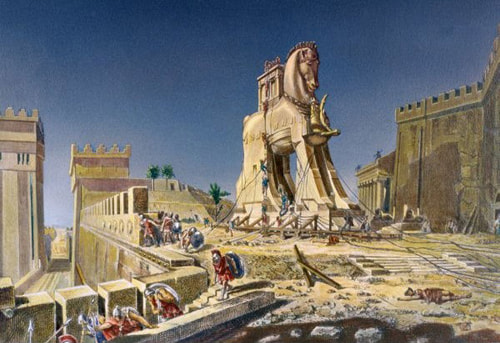 The Trojan Horse Tetraktyas (CC BY-SA) ](https://www.worldhistory.org/image/1215/the-trojan-horse/ "The Trojan Horse")###
Worship
In the *Orphic Hymn to Themis*, she is referred to as the "prophetess of the gods" and the first to show humankind the holy oracle.
> Amid reverence and honour
> you shine in the night,
> for you were first
> to teach men holy worship.
> (*Hymn to Themis*, 79.7-8).
Evidence shows that people across ancient [Greece](https://www.worldhistory.org/greece/) worshipped Themis. According to Pausanias in his *Description of Greece*, Themis had a shrine dedicated to her in Attica. In [Corinth](https://www.worldhistory.org/corinth/), a sanctuary dedicated to [Aphrodite](https://www.worldhistory.org/Aphrodite/) and Themis was located inside a grove. In Boeotia, near the Neistan Gates, there was a sanctuary of Themis with a white stone statue next to it. In [Olympia](https://www.worldhistory.org/Olympia/), there was an altar of Themis. At Rhamnus, she was worshipped alongside Nemesis, the goddess of revenge.
#### Editorial Review
This human-authored definition has been reviewed by our editorial team before publication to ensure accuracy, reliability and adherence to academic standards in accordance with our [editorial policy](https://www.worldhistory.org/static/editorial-policy/).
## Bibliography
- [Athanassakis, Apostolos N. & Wolkow, Benjamin M. *The Orphic Hymns.* Johns Hopkins University Press, 2013.](https://www.worldhistory.org/books/1421408821/)
- [E. M. Berens & Ulf Bjorklund & Dreamscape Media. *The Myths and Legends of Ancient Greece and Rome.* Dreamscape Media, 2022.](https://www.worldhistory.org/books/B0B8KZD2Z9/)
- [Fontenrose, Joseph. *The Delphic Oracle.* University of California Press, 2021.](https://www.worldhistory.org/books/0520370295/)
- [Graves, Robert. *The Greek Myths\[May 15, 2018\] Graves, Robert.* Viking, 2018.](https://www.worldhistory.org/books/0241982359/)
- [Harrison, Jane Ellen. *Epilegomena to the Study of Greek Religion, and Themis, A Study of the Social..* University Books, 1966.](https://www.worldhistory.org/books/B0007DSHVO/)
- [Hesiod & Theognis & Wender, Dorothea & Wender, Dorothea. *Hesiod and Theognis .* Penguin Classics, 1976.](https://www.worldhistory.org/books/0140442839/)
- [Homer & Richardson, Nicholas & Cashford, Jules & Richardson, Nicholas. *Homeric Hymns .* Penguin Classics, 2003.](https://www.worldhistory.org/books/0140437827/)
- [Homer & Robert Fagles & Bernard Knox. *The Iliad.* Penguin Classics, 1998.](https://www.worldhistory.org/books/0140275363/)
- [Murray A. S. (Alexander Stuart) -. *Manual of mythology. Greek and Roman Norse and Old German Hindoo and Egyptian..* Generic, 2023.](https://www.worldhistory.org/books/B0BS6H6LJD/)
- [Ovid & Raeburn, David & Feeney, Denis. *Metamorphoses .* Penguin Classics, 2004.](https://www.worldhistory.org/books/014044789X/)
- [Pausanias & Peter Levi. *Guide to Greece, Vol. 1.* Penguin Classics, 1984.](https://www.worldhistory.org/books/0140442251/)
- [Powell, Barry B. *Classical Myth.* Pearson, 1970.](https://www.worldhistory.org/books/0132461854/)
- [Smith, Amy C. *Polis and Personification in Classical Athenian Art .* Brill, 2011.](https://www.worldhistory.org/books/9004194177/)
- [Smith, William & Anthon, Charles. *A New Classical Dictionary Of Greek And Roman Biography, Mythology And Geography..* Kessinger Publishing, LLC, 2010.](https://www.worldhistory.org/books/1163441465/)
- [Sophocles & Aeschylus & Euripides & Lefkowitz, Mary & Romm, James. *The Greek Plays.* Modern Library, 2017.](https://www.worldhistory.org/books/0812983092/)
## About the Author
Liana is the Social Media Editor for Ancient History Encyclopedia. She holds a Bachelor of Arts Degree with a major in ancient Greece, Rome & Late Antiquity. She is particularly passionate about Rome and Greece, and anything to do with mythology or wo
- [Linkedin Profile](https://www.linkedin.com/in/lian)
## Questions & Answers
### What is Themis goddess of?
Themis is the goddess of divine law, will, and justice.
### Who is Themis to Zeus?
Themis is Zeus' second wife, and she also gave him wise counsel.
### Was Themis a prophetess?
Before Apollo, Themis was an oracle at Delphi. She foretold many prophecies.
## Cite This Work
### APA
Miate, L. (2023, February 07). Themis. *World History Encyclopedia*.
### Chicago
Miate, Liana. "Themis." *World History Encyclopedia*, February 07, 2023. .
### MLA
Miate, Liana. "Themis." *World History Encyclopedia*, 07 Feb 2023, .
## License & Copyright
Submitted by [Liana Miate](https://www.worldhistory.org/user/lianamiate/ "User Page: Liana Miate"), published on 07 February 2023. The copyright holder has published this content under the following license: [Creative Commons Attribution-NonCommercial-ShareAlike](https://creativecommons.org/licenses/by-nc-sa/4.0/deed.en). This license lets others remix, tweak, and build upon this content non-commercially, as long as they credit the author and license their new creations under the identical terms. When republishing on the web a hyperlink back to the original content source URL must be included. Please note that content linked from this page may have different licensing terms.