---
title: Thanatos
author: Liana Miate
source: https://www.worldhistory.org/Thanatos/
format: machine-readable-alternate
license: Creative Commons Attribution-NonCommercial-ShareAlike (https://creativecommons.org/licenses/by-nc-sa/4.0/)
updated: 1970-01-01
---
# Thanatos
_Authored by [Liana Miate](https://www.worldhistory.org/user/lianamiate/)_
Thanatos is the personification of [Death](https://www.worldhistory.org/disambiguation/Death/) in [Greek mythology](https://www.worldhistory.org/Greek_Mythology/). He is the son of [Nyx](https://www.worldhistory.org/Nyx/) (Night) and the twin brother of Hypnos (Sleep). Some sources also name Erebus (Darkness) as his father. As the personification of Death, Thanatos works under [Hades](https://www.worldhistory.org/Hades/)' command and carries humans off to the Underworld once the time allotted to them by the [Fates](https://www.worldhistory.org/Fates/) has expired.
In [Greek literature](https://www.worldhistory.org/Greek_Literature/), Thanatos appears in the *[Iliad](https://www.worldhistory.org/iliad/)* by [Homer](https://www.worldhistory.org/homer/) (c. 750 BCE) and the play *[Alcestis](https://www.worldhistory.org/Alcestis/)* by [Euripides](https://www.worldhistory.org/Euripides/) (c. 484-407 BCE); he is also featured prominently in the myth of [Sisyphus](https://www.worldhistory.org/sisyphus/).
### Depictions of Thanatos
Thanatos is depicted in a number of different ways; during the late 6th and early 5th century BCE, Thanatos and Hypnos are portrayed in Attic vase scenes as carrying off dead [Greek](https://www.worldhistory.org/disambiguation/greek/) heroes like [Sarpedon](https://www.worldhistory.org/Sarpedon/) and Memnon. On white Athenian lekythio, he is often depicted as an older man beside a youthful Hypnos – an effective way of showing that Death was nothing but a prolonged sleep and an older brother to Hypnos.
Thanatos is portrayed as a figure who can not be escaped from. After the 4th century BCE, the Greeks regarded death as a part of life, the natural end of living. This changing mindset resulted in the depiction of Thanatos being shifted from an older man, intent on carrying souls of the departed to the Underworld, to a youthful figure who is less terrible. Greek vase paintings and funeral steles began to portray him as being a kindly and resolute escort, and his image is one of peace and rest. He is often painted as a large, winged figure wearing [battle](https://www.worldhistory.org/disambiguation/battle/) gear and with piercing eyes.
In written texts, Death is described as a dark cloud, veil or mist that floats around the head of the soon-to-be deceased individual, ready to accept them. The colour of the fog is black (the colour of pain and sorrow or the colour of the night and sea), and porphyry, a rarer colour that is mentioned in the *Iliad* as being the colour of the sea rising or of the flowers [Andromache](https://www.worldhistory.org/Andromache/) wove for Hector's [gold](https://www.worldhistory.org/gold/) [tomb](https://www.worldhistory.org/tomb/). Consequently, Thanatos is rarely seen as a real figure in epic poetry; instead, he is viewed as a physical veil, a cloud between a man and light.
### Thanatos & the Creation of the Gods
As mentioned by [Hesiod](https://www.worldhistory.org/hesiod/) (c. 700 BCE) in his *[Theogony](https://www.worldhistory.org/Theogony/)*, Thanatos was the son of Nyx (Night) and Erebus (Darkness) and the twin brother of Hypnos (Sleep). Thanatos resided in the Underworld along with Hypnos.
> There live the children of dark Night, dread gods,
> Sleep and his brother Death. The shining Sun
> Has never looked upon them with his rays
> Not going up to heaven, nor coming back.
> The one of them is kind to men and goes
> Peacefully over earth and the sea's broad back;
> The other's heart is iron; in his breast
> Is pitiless [bronze](https://www.worldhistory.org/disambiguation/bronze/): if he should touch a man,
> That man is his. And even to the gods
> Who are immortal, Death is an enemy.
> (*Theogony,* 658-267)
### [ 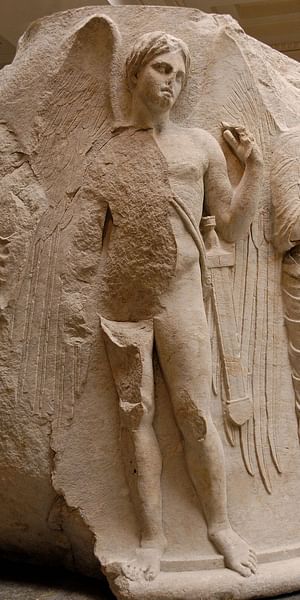 Winged Youth with a Sword (Probably Thanatos) Marie-Lan Nguyen (CC BY-NC-SA) ](https://www.worldhistory.org/image/15748/winged-youth-with-a-sword-probably-thanatos/ "Winged Youth with a Sword (Probably Thanatos)")
### Thanatos in the *Iliad*
In the *Iliad* by Homer, the elemental form of Thanatos is not presented as dangerous but as a dark colour. Thanatos is mentioned in Book 16 of the *Iliad*. [Zeus](https://www.worldhistory.org/zeus/)' son, King Sarpedon of [Lycia](https://www.worldhistory.org/lycia/), a Trojan ally and hero, is killed by [Patroclus](https://www.worldhistory.org/Patroclus/) during the last year of the [Trojan War](https://www.worldhistory.org/Trojan_War/). A grieving Zeus calls [Apollo](https://www.worldhistory.org/apollo/) to summon Thanatos and Hypnos to take his son's body back to Lycia where he could be given a proper [burial](https://www.worldhistory.org/burial/), as he could not stand to see his body lying amongst the blood and gore of the battleground.
> Then send him on his way with the wind-swift escorts,
> twin brothers Sleep and Death, who with all good speed
> will set him down in the broad green land of Lycia.
> (*Iliad*, 16.784-786)
### Thanatos & Sisyphus
Sisyphus was the first king of Ephyra (also known as [Corinth](https://www.worldhistory.org/corinth/)), who promoted navigation and commerce but who was also deceitful. Most horrible of all, Sisyphus killed guests, a violation of *xenia* (the Greek concept of hospitality), which directly fell under Zeus' domain and naturally angered him.
Sisyphus further enraged Zeus by revealing the whereabouts of [Aegina](https://www.worldhistory.org/Aegina/) (the daughter of the river [god](https://www.worldhistory.org/God/) Asopus and the [nymph](https://www.worldhistory.org/nymph/) Metope), a fact that Zeus was trying to keep hidden from her father, Asopus. A furious Zeus ordered Thanatos to chain Sisyphus in [Tartarus](https://www.worldhistory.org/Tartarus/) as punishment. A sly Sisyphus asked Thanatos how the chains worked, and Thanatos granted him his wish. However, Sisyphus seized his chance and trapped Thanatos in the chains instead.
[  Sisyphus Bibi Saint-Pol (Public Domain) ](https://www.worldhistory.org/image/6158/sisyphus/ "Sisyphus")Since Thanatos was trapped, nobody on earth could die; this especially angered [Ares](https://www.worldhistory.org/Ares/), the god of [war](https://www.worldhistory.org/disambiguation/War/), as his battles had lost their fun since nobody could die, and he decided to intervene. Ares freed Thanatos and then turned Sisyphus over to him. However, Sisyphus once again outsmarted Thanatos, as he had informed his wife not to perform the customary funerary rites. An infuriated Hades sent Sisyphus back to earth to fix things, which of course, Sisyphus did not do. When Sisyphus failed to return to the Underworld, he was dragged back by [Hermes](https://www.worldhistory.org/Hermes/). Zeus, king of the Olympian gods, decided to punish him by making Sisyphus endlessly push a [giant](https://www.worldhistory.org/Giants/) boulder up a hill.
### Thanatos in *Alcestis*
In the play *Alcestis* by Euripides, the Fates have granted King Admetus of Pherae immortality at the request of Apollo, after Admetus had shown Apollo hospitality. However, there was a catch; Admetus had to find someone to take his place once Death came for him. His devoted wife Alcestis decided to take his place, showing her selflessness and love for her husband.
[  Hercules Fighting Death to Save Alcestis Transferred from en.wikipedia to Commons by Ntetos using CommonsHelper (Public Domain) ](https://www.worldhistory.org/image/2842/hercules-fighting-death-to-save-alcestis/ "Hercules Fighting Death to Save Alcestis")At the beginning of the play, we find Alcestis close to death. Thanatos arrives at the [palace](https://www.worldhistory.org/disambiguation/palace/), dressed in black and carrying a sword, to take Alcestis to the Underworld. Instead, he bumps into Apollo, who he accuses of trickery for allowing Admetus to cheat death:
> Why are you here at the door, Phoebus?
> What are you doing hanging about?
> Are you plotting another crime?
> Usurping the rights of the gods below?
> Wasn't it enough that you put a stop
> to Admetus' death by tripping up the Fates
> with your deceitful trick? Are you on guard again,
> with bow in hand, to protect Pelias' child?
> She agreed to die in place of her husband.
> (*Alcestis*, 29-38)
After an angry exchange, Apollo storms off, telling Thanatos that a guest at Admetus' home will wrestle Alcestis away from him (Death). Thanatos ignores him and continues to collect Alcestis.
The guest Apollo mentions is none other than the hero Hercules who has no idea about the death of Alcestis. Not wanting to be inhospitable, Admetus chooses not to say anything to Hercules and orders his servants to do the same. As Hercules gets drunker and drunker, his behaviour irritates the servants, who are finding it hard to refrain from mourning for their mistress. Finally, one snaps and tells Hercules that Alcestis has died. Hercules is shocked and angry that his friend lied to him. He decides to confront Thanatos when the funerary sacrifices are made at Alcestis' tomb and force him to give Alcestis back.
Hercules returns to the palace with a woman covered in a veil and introduces her to Admetus as his new wife. Admetus is adamant that he does not want to disrespect Alcestis by taking a new wife but eventually accepts his friend's offer. He finds out that the woman under the veil is none other than Alcestis, to his surprise and joy. Hercules tells him that he fought Thanatos beside Alcestis' tomb to get her back.
[  Hypnos and Thanatos Bringing the Body of Sarpedon Metropolitan Museum of Art (Copyright) ](https://www.worldhistory.org/image/12687/hypnos-and-thanatos-bringing-the-body-of-sarpedon/ "Hypnos and Thanatos Bringing the Body of Sarpedon")### Worship of Thanatos
Thanatos did not have a cult established in his honour, but there was a [temple](https://www.worldhistory.org/temple/) dedicated to him in [Sparta](https://www.worldhistory.org/sparta/), along with temples dedicated to Gelos (Laughter) and Phobos (Fear), a practice that the Greek writer [Plutarch](https://www.worldhistory.org/plutarch/) (c. 45-50 CE and c. 120-125 CE) thought was odd, as he mentions in his *Life of Cleomenes.*
There is also an Orphic Hymn dedicated to Thanatos. The *Orphic Hymns* were a collection of hymns directed mainly toward the Primordials and minor deities in Greek [mythology](https://www.worldhistory.org/mythology/), which were written around the Late [Hellenistic Period](https://www.worldhistory.org/Hellenistic_Period/) (c. 3rd or 2nd century BCE) or the early [Roman](https://www.worldhistory.org/disambiguation/Roman/) Imperial Age (c. 1st-2nd century CE). The *Orphic Hymns* played a central role in Orphism – a religious sect that followed the teachings of the mythical poet [Orpheus](https://www.worldhistory.org/Orpheus/) and whose supreme deity was [Dionysos](https://www.worldhistory.org/Dionysos/). The hymn to Thanatos (Death) is as follows:
> Hear me, O Death \[Thanatos\], whose [empire](https://www.worldhistory.org/empire/) unconfin'd, extends to mortal tribes of ev'ry kind.
> On thee, the portion of our time depends, whose absence lengthens life, whose presence ends.
> Thy sleep perpetual bursts the vivid folds, by which the soul, attracting body holds:
> Common to all of ev'ry sex and age, for nought escapes thy all-destructive rage;
> Not youth itself thy clemency can gain, vig'rous and strong, by thee untimely slain.
> In thee, the end of nature's works is known, in thee, all judgment is absolv'd alone:
> No suppliant arts thy dreadful rage controul, no vows revoke the purpose of thy soul;
> O blessed pow'r regard my ardent pray'r, and human life to age abundant spare.
> (*Orphic Hymns*, 86)
### In [Medicine](https://www.worldhistory.org/disambiguation/medicine/)
Thanatos' name lives on today in other ways, notably in the field of medicine. Thanatos lends his name to Thanatology (the study of death) and Thanatophobia (an unnatural fear of death) in medicine. A rarely used word for autopsy is also derived from Thanatos: Thanatopsy.
#### Editorial Review
This human-authored definition has been reviewed by our editorial team before publication to ensure accuracy, reliability and adherence to academic standards in accordance with our [editorial policy](https://www.worldhistory.org/static/editorial-policy/).
## Bibliography
- [Athanassakis, Apostolos N. & Wolkow, Benjamin M. *The Orphic Hymns.* Johns Hopkins University Press, 2013.](https://www.worldhistory.org/books/1421408821/)
- [Carrick, Paul J. *Medical Ethics in the Ancient World .* Georgetown University Press, 2001.](https://www.worldhistory.org/books/0878408495/)
- [Fry, Stephen. *Mythos.* Chronicle Books, 2019.](https://www.worldhistory.org/books/1452178917/)
- [Garland, Robert. *The Greek Way of Death.* Cornell University Press, 2001.](https://www.worldhistory.org/books/0801487463/)
- [Hesiod & Theognis & Wender, Dorothea & Wender, Dorothea. *Hesiod and Theognis .* Penguin Classics, 1976.](https://www.worldhistory.org/books/0140442839/)
- [Homer & Robert Fagles & Bernard Knox. *The Iliad.* Penguin Classics, 1998.](https://www.worldhistory.org/books/0140275363/)
- [March, Jenny. *The Penguin Book of Classical Myths.* Penguin Books, 2009.](https://www.worldhistory.org/books/0141020776/)
- [Maxime Collignon. *Manual of Mythology.* Generic, 2022.](https://www.worldhistory.org/books/B07QXCS23L/)
- [Menoni, Burton. *Kings of Greek Mythology.* lulu.com, 2016.](https://www.worldhistory.org/books/1329854276/)
- [Orphic Hymns 41 - 86](https://www.theoi.com/Text/OrphicHymns2.html#86 "Orphic Hymns 41 - 86"), accessed 27 Apr 2022.
- [Plutarch, The Parallel Lives (The Life of Cleomenes)](https://penelope.uchicago.edu/Thayer/E/Roman/Texts/Plutarch/Lives/cleomenes*.html "Plutarch, The Parallel Lives (The Life of Cleomenes)"), accessed 27 Apr 2022.
- [Robert Fortuine. *The Words of Medicine.* Charles C Thomas Pub Ltd, 2001.](https://www.worldhistory.org/books/0398071330/)
- [Sophocles & Aeschylus & Euripides & Lefkowitz, Mary & Romm, James. *The Greek Plays.* Modern Library, 2017.](https://www.worldhistory.org/books/0812983092/)
- [Taft, Michael. *Greek Gods & Goddesses (Gods & Goddesses of Mythology).* Encyclopedia Britannica, 2014.](https://www.worldhistory.org/books/B09LDBCD6V/)
- [Vermeule, Emily. *Aspects of Death in Early Greek Art and Poetry .* University of California Press, 1981.](https://www.worldhistory.org/books/0520044045/)
## About the Author
Liana is the Social Media Editor for Ancient History Encyclopedia. She holds a Bachelor of Arts Degree with a major in ancient Greece, Rome & Late Antiquity. She is particularly passionate about Rome and Greece, and anything to do with mythology or wo
- [Linkedin Profile](https://www.linkedin.com/in/lian)
## External Links
- [How Sisyphus Was Eternally Punished By Zeus In Greek Legend](https://allthatsinteresting.com/sisyphus)
## Cite This Work
### APA
Miate, L. (2022, April 29). Thanatos. *World History Encyclopedia*.
### Chicago
Miate, Liana. "Thanatos." *World History Encyclopedia*, April 29, 2022. .
### MLA
Miate, Liana. "Thanatos." *World History Encyclopedia*, 29 Apr 2022, .
## License & Copyright
Submitted by [Liana Miate](https://www.worldhistory.org/user/lianamiate/ "User Page: Liana Miate"), published on 29 April 2022. The copyright holder has published this content under the following license: [Creative Commons Attribution-NonCommercial-ShareAlike](https://creativecommons.org/licenses/by-nc-sa/4.0/deed.en). This license lets others remix, tweak, and build upon this content non-commercially, as long as they credit the author and license their new creations under the identical terms. When republishing on the web a hyperlink back to the original content source URL must be included. Please note that content linked from this page may have different licensing terms.