---
title: Tenjin
author: Mark Cartwright
source: https://www.worldhistory.org/Tenjin/
format: machine-readable-alternate
license: Creative Commons Attribution-NonCommercial-ShareAlike (https://creativecommons.org/licenses/by-nc-sa/4.0/)
updated: 2025-06-05
---
# Tenjin
_Authored by [Mark Cartwright](https://www.worldhistory.org/user/markzcartwright/)_
Sugawara no Michizane, aka Tenman Tenjin (845-903), was a scholar, poet, and high-level administrator in the Japanese court during the [Heian Period](https://www.worldhistory.org/Heian_Period/). Badly treated and exiled, he would gain a spectacular revenge on his political rivals from beyond the [grave](https://www.worldhistory.org/burial/) when he was deified following a series of disasters thought to be a product of Tenjin's anger. He became the patron [god](https://www.worldhistory.org/God/) of scholarship and education, and a shrine was built in his honour at Kyoto, the then capital.
### Early Career
Sugawara no Michizane was born into a family of modest standing in 845, although his grandfather and father had both been scholars of note. Despite his lack of rank, Michizane rose to an unusually high position in the state administrative apparatus thanks to his uncanny talents. He was said to have written his first poem in Chinese at the tender age of ten. At age 12 Michizane embarked on his career as a bureaucrat at the lowest entry rank of six. At 18 he passed the examination of the Ministry of Ceremonial and became a *monjosho* or Scholar of Letters. In 877 he became a professor of [Chinese literature](https://www.worldhistory.org/Chinese_Literature/).
Gaining experience such as receiving an embassy from the Manchurian state of [Balhae](https://www.worldhistory.org/Balhae/) ([Parhae](https://www.worldhistory.org/Balhae/)), he was offered the position of ambassador to the [Tang](https://www.worldhistory.org/Tang_Dynasty/) court in [China](https://www.worldhistory.org/china/). Michizane refused and recommended that no embassies be sent to China, a policy, in fact, followed for several centuries. Michizane became, instead, one of the Heian Period's 68 provincial governors, his province being Sanuki on Shikoku island where he served from 886 to 891. Returning to his passion for [literature](https://www.worldhistory.org/literature/), the administrator then assisted in the compilation of two works on the history of [Japan](https://www.worldhistory.org/disambiguation/Japan/), which included the *Montoku Jitsuroku* ('Chronicles of the Emperor Montoku'). He also produced collections of his father's and grandfather's works and would go on to produce 12 books of his own work, six on prose and six on poetry.
### Rise to Power
Michizane supplemented his administrative duties by teaching at the court university and eventually came to the attention of Emperor Uda (r. 887-897). Under the ruler's patronage, Michizane was able to rise even higher in the state bureaucracy and reach positions usually closed to one of so lowly a social rank. It is probable that Uda was deliberately trying to weaken the [Fujiwara clan](https://www.worldhistory.org/Fujiwara_Clan/)'s stranglehold on power. In 893 Michizane was appointed a court counsellor, and his position was further strengthened when his daughter became one of the emperor's consorts in 895. Uda retired in favour of his young son Daigo in 897, and Michizane, alongside the [Fujiwara](https://www.worldhistory.org/Fujiwara_Clan/) clan leader Tokihira, was now the most powerful politician in Japan. The wily bureaucrat's ties with the imperial family were made even more binding when another daughter married another son of Uda, Tokiyo, in 898. Then, in 899 CE, Michizane was officially promoted to the junior second rank and made Minister of the Right, a position he twice refused. It was a meteoric rise for one of such low social standing as Michizane.
[ 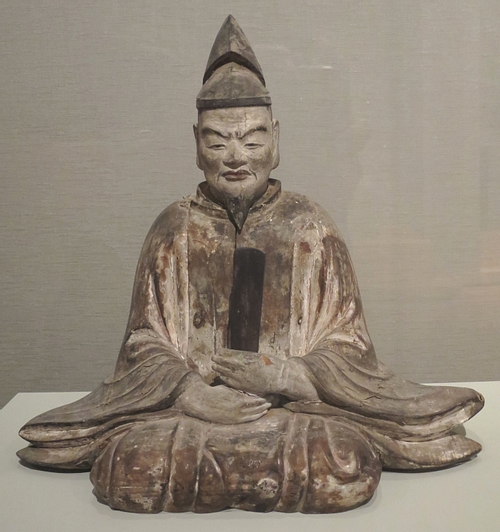 Tenjin Figurine Hiart (Public Domain) ](https://www.worldhistory.org/image/6593/tenjin-figurine/ "Tenjin Figurine")### Betrayal & Fall
Michizane's position was now so high that the only way was down, and enemies, especially from the Fujiwara clan who dominated the majority of high posts within the state apparatus, were all around. They wanted this outsider and those officials he had promoted from the Sugawara clan out of government. A plot was hatched by bribing a man to declare that he had discovered a plan by Michizane to put Tokiyo on the throne. Emperor Daigo swallowed the bait and exiled Michizane to Dazaifu, Kyushu in 901; he also made his brother Tokiyo join a monastery for good measure. Michizane pined away in the countryside, removed from his wife, family, and circle of enlightened friends, and particularly missing his garden and its splendid plum trees. It was during this period that he wrote some of his most famous poems which were later collected into the *Kanke Koshu*. Michizane died in 903 but his story was not finished; the swift wings of revenge would soon be fluttering around the imperial [palace](https://www.worldhistory.org/disambiguation/palace/).
> When the east wind blows,
> Let it send your fragrance,
> Oh plum blossoms.
> Although your master is gone,
> Do not forget the spring.
> *Michizane* (Cali, 131)
### Revenge & Deification
The first stirrings of trouble came when several of the plotters died in the years immediately after Michizane's [death](https://www.worldhistory.org/disambiguation/Death/). Tokihira, Michizane's great rival, died in 909 in mysterious circumstances aged 38; in 923 his nephew, the Crown Prince Yasuakira, died too, aged just 21; and Tokihira's grandson, Crown Prince Yoshiyori, died at age 5 in 925. In the [Shinto religion](https://www.worldhistory.org/collection/43/the-shinto-religion/) it was believed that the dishonoured would not rest easy in their graves, and rumours spread that Michizane's restless spirit was the cause of these unfortunate deaths at court. In an effort to appease the dead diplomat the documents of his charges and his exile were ceremoniously burnt. Michizane was even given back his court rank in the official records. Events would soon prove that these steps were not quite enough.
[ 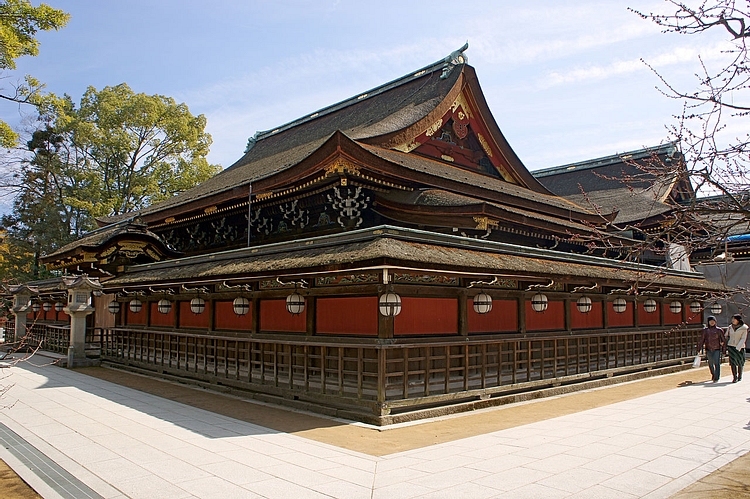 Kitano-tenmangu Shrine, Kyoto 663highland (CC BY-SA) ](https://www.worldhistory.org/image/6594/kitano-tenmangu-shrine-kyoto/ "Kitano-tenmangu Shrine, Kyoto")In 930, the man who had been bribed to accuse Michizane was hit and killed (along with several other officials) by lightning during a spectacular storm which repeatedly struck the imperial palace. Emperor Daigo died in the same year aged only 46. These omens and untimely deaths, and those in the previous decade, along with the wave of devastating fires and a disastrous [plague](https://www.worldhistory.org/disambiguation/plague/) that had hit the capital since Michizane's death meant that people were now convinced that even the gods were angry at his unjust treatment.
Several people told of visions they had experienced where Michizane instructed them to press for the restoration of his reputation and that he be given suitable honours. Amongst these was a [Buddhist](https://www.worldhistory.org/buddhism/) monk, Nichizo Doken, who claimed to have died and visited heaven where he met Michizane and then hell where he encountered a regretful Emperor Daigo. Another witness was a poor woman called Tajihi no Ayako who claimed that Michizane appeared to her calling himself Tenjin and demanding a shrine be built for him at Kitano.
In 947 the remains and literary works of Michizane were enshrined at the Kitano Temmangu shrine at Kyoto which was built in his honour. Michizane's grave, meanwhile, is located at the Dazaifu Tenmangu shrine in northern Kyushu. Then, to complete the process of reconciliation, in 987 Sugawara no Michizane was given the honorary title of Tenjin, making him a god. Thus there are, unusually, two locations where his spirit or *[kami](https://www.worldhistory.org/Kami/)* is thought to reside. He is still worshipped today and is especially associated with literature and scholarship, one of his titles being 'Ancestor of the Way of Letters'. Tenjin is regularly appealed to by students, who offer prayers and leave offerings at his shrines in return for help in their forthcoming exams.
This content was made possible with generous support from the [Great Britain Sasakawa Foundation](http://www.gbsf.org.uk/?utm_source=ancient.eu&utm_medium=link&utm_campaign=ancient.eu).
#### Editorial Review
This human-authored definition has been reviewed by our editorial team before publication to ensure accuracy, reliability and adherence to academic standards in accordance with our [editorial policy](https://www.worldhistory.org/static/editorial-policy/).
## Bibliography
- [Ashkenazi, M. *Handbook of Japanese Mythology.* Oxford University Press, 2008.](https://www.worldhistory.org/books/0195332628/)
- [Beasley, W.G. *The Japanese Experience A Short History of Japan.* University of California, 1999.](https://www.worldhistory.org/books/B000ORKKBI/)
- [Cali, J. *Shinto Shrines.* Latitude 20, 2012.](https://www.worldhistory.org/books/0824837134/)
- [Ebrey, P.B. *Pre-Modern East Asia.* Cengage Learning, 2013.](https://www.worldhistory.org/books/1133606512/)
- [Keene, D. *Seeds in the Heart.* Columbia University Press, 1999.](https://www.worldhistory.org/books/0231114419/)
- [Scott Littleton, C. *Understanding Shinto.* Duncan Baird Publishers, 2002.](https://www.worldhistory.org/books/1903296757/)
- [Whitney Hall, J. *The Cambridge History of Japan, Vol. 2.* Cambridge University Press, 1999.](https://www.worldhistory.org/books/0521223539/)
## About the Author
Mark is WHE’s Publishing Director and has an MA in Political Philosophy (University of York). He is a full-time researcher, writer, historian and editor. Special interests include art, architecture and discovering the ideas that all civilizations share.
## Timeline
- **845 CE - 903 CE**: Life of the deified scholar and court official Sugawara no Michizane, aka [Tenjin](https://www.worldhistory.org/Tenjin/).
- **877 CE**: Sugawara no Michizane ([Tenjin](https://www.worldhistory.org/Tenjin/)) becomes a professor of [Chinese literature](https://www.worldhistory.org/Chinese_Literature/).
- **886 CE - 891 CE**: Sugawara no Michizane ([Tenjin](https://www.worldhistory.org/Tenjin/)) is the regional governor of Sanuki, [Japan](https://www.worldhistory.org/disambiguation/Japan/).
- **893 CE**: Sugawara no Michizane ([Tenjin](https://www.worldhistory.org/Tenjin/)) is appointed a court councillor.
- **899 CE**: Sugawara no Michizane ([Tenjin](https://www.worldhistory.org/Tenjin/)) is made Minister of the Right. The [Fujiwara](https://www.worldhistory.org/Fujiwara_Clan/) leader Tokihira is made Minister of the Left.
- **901 CE**: Sugawara no Michizane ([Tenjin](https://www.worldhistory.org/Tenjin/)) is exiled to Dazaifu, Kyushu.
- **903 CE**: [Death](https://www.worldhistory.org/disambiguation/Death/) in exile of Sugawara no Michizane ([Tenjin](https://www.worldhistory.org/Tenjin/)).
- **947 CE**: The Tenmangu Kitano shrine is founded in honour of Sugawara no Michizane, aka [Tenjin](https://www.worldhistory.org/Tenjin/).
- **987 CE**: Sugawara no Michizane is officially deified and given the title [Tenjin](https://www.worldhistory.org/Tenjin/).
## Cite This Work
### APA
Cartwright, M. (2017, May 08). Tenjin. *World History Encyclopedia*.
### Chicago
Cartwright, Mark. "Tenjin." *World History Encyclopedia*, May 08, 2017. .
### MLA
Cartwright, Mark. "Tenjin." *World History Encyclopedia*, 08 May 2017, .
## License & Copyright
Submitted by [Mark Cartwright](https://www.worldhistory.org/user/markzcartwright/ "User Page: Mark Cartwright"), published on 08 May 2017. The copyright holder has published this content under the following license: [Creative Commons Attribution-NonCommercial-ShareAlike](https://creativecommons.org/licenses/by-nc-sa/4.0/deed.en). This license lets others remix, tweak, and build upon this content non-commercially, as long as they credit the author and license their new creations under the identical terms. When republishing on the web a hyperlink back to the original content source URL must be included. Please note that content linked from this page may have different licensing terms.