---
title: Tegea
author: Mark Cartwright
source: https://www.worldhistory.org/Tegea/
format: machine-readable-alternate
license: Creative Commons Attribution-NonCommercial-ShareAlike (https://creativecommons.org/licenses/by-nc-sa/4.0/)
updated: 1970-01-01
---
# Tegea
_Authored by [Mark Cartwright](https://www.worldhistory.org/user/markzcartwright/)_
Tegea was an ancient [Greek](https://www.worldhistory.org/disambiguation/greek/) [city-state](https://www.worldhistory.org/Polis/) or [polis](https://www.worldhistory.org/Polis/) in the southeast of Arcadia in the [Peloponnese](https://www.worldhistory.org/Peloponnese/). The [city](https://www.worldhistory.org/city/) participated in wider Greek affairs such as the [Persian Wars](https://www.worldhistory.org/Persian_Wars/) of the early 5th century BCE and was a valuable ally of [Sparta](https://www.worldhistory.org/sparta/) during the [Peloponnesian War](https://www.worldhistory.org/Peloponnesian_War/) at the other end of the same century. The city was the site of an important sanctuary to the goddess [Athena](https://www.worldhistory.org/athena/) Alea, which had a large 4th century BCE Doric [temple](https://www.worldhistory.org/temple/).
### Early Settlement
In [mythology](https://www.worldhistory.org/mythology/), the town was founded by Tegeates (son of Lycaon, the king of Arcadia) or Aleus (another legendary Arcadian king). The archaeological record shows that Tegea was first settled in the [Neolithic period](https://www.worldhistory.org/Neolithic/) and was an important [Mycenaean](https://www.worldhistory.org/Mycenaean_Civilization/) site. The latter period has left remains of *tholos* tombs (at Analipsi) and a dike (Lake Takka). [Homer](https://www.worldhistory.org/homer/) lists Tegea in his *[Iliad](https://www.worldhistory.org/iliad/)* as one of the [poleis](https://www.worldhistory.org/Polis/) which supplied ships in the [Trojan War](https://www.worldhistory.org/Trojan_War/). From the [Archaic period](https://www.worldhistory.org/Archaic_Period/), or even earlier, Tegea was an important cult site to the goddess Alea, who had her own athletic games – the Alaiea – and who later became identified with Athena.
### A Spartan Ally
When the Spartans became more ambitious in the Peloponnese in the mid-6th century BCE, Tegea was forced to become their ally. [Herodotus](https://www.worldhistory.org/herodotus/) described Tegea's successful resistance to Spartan expansion in the early 6th century BCE, but the two [cities](https://www.worldhistory.org/city/) did sign a treaty of mutual agreement, which laid the foundation for the [Peloponnesian League](https://www.worldhistory.org/Peloponnesian_League/) (c. 550 BCE - c. 366 BCE). In wider Greek politics Tegea sent hoplites to fight alongside other Greek states in the battles of [Thermopylae](https://www.worldhistory.org/thermopylae/) (480 BCE) and [Plataea](https://www.worldhistory.org/Plataea/) (479 BCE) against the invading Persian army of [Xerxes](https://www.worldhistory.org/Xerxes_I/). After victory at the latter, Herodotus informs us (*Histories*, 9.70) that the Tegeans took the magnificent [bronze](https://www.worldhistory.org/disambiguation/bronze/) horse trough of the Persian general Mardonius and dedicated it in their temple back home.
In the Classical period, Tegea controlled a large territory, some 385 km² separated into nine *demes*, which included land suitable for [agriculture](https://www.worldhistory.org/disambiguation/Agriculture/), grazing, and a marble quarry at Doliana. The town's location was also an advantage, situated as it was on routes leading to [Argos](https://www.worldhistory.org/argos/) and Sparta. Tegea spread to cover 190 ha and also minted its own [coinage](https://www.worldhistory.org/coinage/). Remains of a 5th-century BCE [wall](https://www.worldhistory.org/wall/) show that Tegea was encircled by fortifications which included five gates and several towers. The town itself was laid out in a grid pattern.
There were several attempts by Tegea to break from their powerful neighbour Sparta's grasp, notably a spirited resistance but ultimate defeat at the [battle](https://www.worldhistory.org/disambiguation/battle/) of Dipaea in 470 BCE. Thereafter, Tegea remained a loyal ally of Sparta, including during the Peloponnesian [War](https://www.worldhistory.org/disambiguation/War/) (431 - 404 BCE). However, when Sparta was defeated by [Thebes](https://www.worldhistory.org/disambiguation/Thebes/) at the [Battle of Leuctra](https://www.worldhistory.org/Battle_of_Leuctra/) in 371 BCE, Tegea sought more political freedom of action in the new Greek world. The city formed a federal Arcadian state, the Arcadian League, alongside long-time local rival Mantinea in 370-369 BCE, with its capital at Megalopolis.
[ 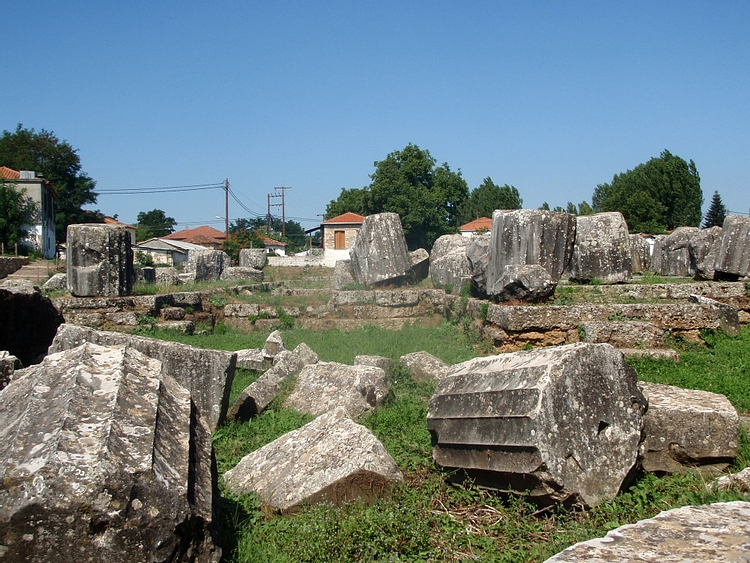 Temple of Athena Alea, Tegea Dan Diffendale (CC BY-NC-SA) ](https://www.worldhistory.org/image/5693/temple-of-athena-alea-tegea/ "Temple of Athena Alea, Tegea")### The Sanctuary of Athena Alea
The sanctuary to Athena Poliatis is mentioned in the writings of the ancient travel writer [Pausanias](https://www.worldhistory.org/disambiguation/Pausanias/), but its remains are yet to be discovered. This sanctuary may have stood on a low hill north of the town proper. There are remains, though, of the sanctuary to Athena Alea. Located outside the city walls the sanctuary was dominated by a 4th-century BCE Doric temple dedicated to the goddess. The sanctuary site shows evidence of cult worship dating back to the 10th century BCE as indicated by the presence of votive offerings. Following the construction of modest wattle-and-daub buildings in the sanctuary's early stages, a first stone temple was built in the 7th century BCE. This structure had 6 x 18 columns but was destroyed by a fire c. 395 BCE.
The replacement 4th-century BCE temple was designed by the famous sculptor and architect Skopas from [Paros](https://www.worldhistory.org/Paros/) (active 370 – 330 BCE). The temple was constructed in marble and presented six columns on each facade and 14 along the long sides. It measured 47 x 22 metres, making it only slightly smaller than the great temple of Zeus at Olympia. The temple was an innovative design with Skopas engaging the interior columns into the *cella* walls and mixing orders by having the bases of the columns in Corinthian order and the top ones Ionic. Inside the temple once stood a large ivory statue of Athena Alea and several less important statues including ones of [Asclepius](https://www.worldhistory.org/Asclepius/) and Hygeia, indicative of the sanctuary's reputation for healing. Some fragments of decorative [sculpture](https://www.worldhistory.org/disambiguation/Sculpture/) survive suggesting the pediments carried scenes from [Greek mythology](https://www.worldhistory.org/Greek_Mythology/), including the battle between [Achilles](https://www.worldhistory.org/achilles/) and Telephos, and the Calydonian boar-hunt led by [Meleager](https://www.worldhistory.org/Meleager/). According to tradition, the temple actually contained the hide of this legendary animal.
[  Persephone, Demeter, & Pluto Marble Plaque, Tegea. Dan Diffendale (CC BY-NC-SA) ](https://www.worldhistory.org/image/5694/persephone-demeter--pluto-marble-plaque-tegea/ "Persephone, Demeter, & Pluto Marble Plaque, Tegea.")### [Hellenistic](https://www.worldhistory.org/Hellenic_World/) & [Roman](https://www.worldhistory.org/disambiguation/Roman/) Periods
The town continued to prosper into the [Hellenistic period](https://www.worldhistory.org/Hellenistic_Period/) as evidenced by the life of one of Tegea's famous residents, the poetess Anyte of Tegea, and the remains of a 2nd-century BCE [theatre](https://www.worldhistory.org/disambiguation/theatre/) excavated at the site. This theatre was itself a replacement of an earlier one and was funded by Antiochus IV Epiphanes in 175 BCE. Parts of the older theatre can be seen today in the foundations of the church of the Panayia while the second theatre had an early Christian church built on its *cavea*.
Tegea, along with many other Greek cities, was controlled by [Rome](https://www.worldhistory.org/Rome/) from 146 BCE. Later in the Roman period Tegea supported [Mark](https://www.worldhistory.org/disambiguation/Mark/) Anthony, but following his defeat at the [Battle of Actium](https://www.worldhistory.org/Battle_of_Actium/) in 31 BCE Tegea's disloyalty to [Augustus](https://www.worldhistory.org/augustus/) resulted in many of the city's prized artworks being removed to Rome. Not enjoying any particular prominence in the centuries thereafter, Tegea suffered destruction at the hands of the invading [Visigoths](https://www.worldhistory.org/visigoth/) in 395 CE. The town did recover somewhat to become the seat of a bishop from the 5th century CE, and remains of churches and a basilica of that period can be seen at the site today, which include several fine mosaics. Eventually, Tegea was abandoned and covered in silt deposits from the Alpheios River (modern Sarantapotamos).
#### Editorial Review
This human-authored definition has been reviewed by our editorial team before publication to ensure accuracy, reliability and adherence to academic standards in accordance with our [editorial policy](https://www.worldhistory.org/static/editorial-policy/).
## Bibliography
- [Ananiadis, D., Litsa Chatzifoti Α. Μolohas. *Ancient Greece - Temples & Sanctuaries.* Toubis Editions, 2016.](https://www.worldhistory.org/books/9605409291/)
- Bagnal, R. *The Encyclopedia of Ancient History.* Wiley-Blackwell, 2012
- [Hornblower, S. *The Oxford Classical Dictionary.* Oxford University Press, 2012.](https://www.worldhistory.org/books/0199545561/)
- [Kinzl, K.H. *A Companion to the Classical Greek World.* Wiley-Blackwell, 2010.](https://www.worldhistory.org/books/1444334123/)
- [Strassler, R.B. *The Landmark Herodotus.* Anchor Books, 2009.](https://www.worldhistory.org/books/1400031141/)
## About the Author
Mark is WHE’s Publishing Director and has an MA in Political Philosophy (University of York). He is a full-time researcher, writer, historian and editor. Special interests include art, architecture and discovering the ideas that all civilizations share.
## Timeline
- **c. 550 BCE - c. 366 BCE**: [Peloponnesian League](https://www.worldhistory.org/Peloponnesian_League/) alliance between [Sparta](https://www.worldhistory.org/sparta/), [Corinth](https://www.worldhistory.org/corinth/), Elis and [Tegea](https://www.worldhistory.org/Tegea/) which establishes Spartan hegemony over the [Peloponnese](https://www.worldhistory.org/Peloponnese/).
- **479 BCE**: [Xerxes](https://www.worldhistory.org/Xerxes_I/)' Persian forces are defeated by [Greek](https://www.worldhistory.org/disambiguation/greek/) forces at [Plataea](https://www.worldhistory.org/Plataea/) effectively ending [Persia](https://www.worldhistory.org/Persia/)'s imperial ambitions in [Greece](https://www.worldhistory.org/greece/).
- **460 BCE - 445 BCE**: First [Peloponnesian War](https://www.worldhistory.org/Peloponnesian_War/).
- **431 BCE - 404 BCE**: The 2nd [Peloponnesian War](https://www.worldhistory.org/Peloponnesian_War/) between [Athens](https://www.worldhistory.org/Athens/) and [Sparta](https://www.worldhistory.org/sparta/) (the [Delian League](https://www.worldhistory.org/Delian_League/) and the [Peloponnesian League](https://www.worldhistory.org/Peloponnesian_League/)) which involved all of [Greece](https://www.worldhistory.org/greece/).
- **371 BCE**: [Thebes](https://www.worldhistory.org/disambiguation/Thebes/), led by [Epaminondas](https://www.worldhistory.org/Epaminondas/), defeats [Sparta](https://www.worldhistory.org/sparta/) in the [Battle of Leuctra](https://www.worldhistory.org/Battle_of_Leuctra/).
## Cite This Work
### APA
Cartwright, M. (2016, September 20). Tegea. *World History Encyclopedia*.
### Chicago
Cartwright, Mark. "Tegea." *World History Encyclopedia*, September 20, 2016. .
### MLA
Cartwright, Mark. "Tegea." *World History Encyclopedia*, 20 Sep 2016, .
## License & Copyright
Submitted by [Mark Cartwright](https://www.worldhistory.org/user/markzcartwright/ "User Page: Mark Cartwright"), published on 20 September 2016. The copyright holder has published this content under the following license: [Creative Commons Attribution-NonCommercial-ShareAlike](https://creativecommons.org/licenses/by-nc-sa/4.0/deed.en). This license lets others remix, tweak, and build upon this content non-commercially, as long as they credit the author and license their new creations under the identical terms. When republishing on the web a hyperlink back to the original content source URL must be included. Please note that content linked from this page may have different licensing terms.