---
title: Taifa
author: Ian Abbey
source: https://www.worldhistory.org/Taifa/
format: machine-readable-alternate
license: Creative Commons Attribution-NonCommercial-ShareAlike (https://creativecommons.org/licenses/by-nc-sa/4.0/)
updated: 1970-01-01
---
# Taifa
_Authored by [Ian Abbey](https://www.worldhistory.org/user/ianabbey/)_
*Taifas* ("factions" or "camps") were small independent Muslim kingdoms and principalities that emerged after the fall of hegemonic Muslim caliphates in al-Andalus – the Muslim-controlled part of the Iberian peninsula – during the High Middle Ages. There were three *taifa* periods between 1031 and the mid-13th century.
### The Three Taifa Periods
The first *taifa* system started after the [Umayyad Caliphate](https://www.worldhistory.org/Umayyad_Dynasty/) of Cordoba fragmented in 1031. The Umayyads' decline began in earnest in 1008 and had been marked with domestic unrest, disputes over hereditary succession, and [Berber](https://www.worldhistory.org/Berbers/) incursions. In the disruption – or *fitna* – that accompanied the [Umayyad](https://www.worldhistory.org/Umayyad_Dynasty/) collapse, warlords and adventurers from throughout al-Andalus staked out their territory. These fiefdoms became *taifas*, and between 30 and 50 were established at this time. The number of *taifas* drastically shrunk in the ensuing scramble. Some were only minor [city](https://www.worldhistory.org/city/)-states that quickly merged into larger polities or were conquered by their neighbors. Eventually the *taifas* coalesced around Zaragoza, Valencia, Toledo, Badajoz, Seville, and Granada. Cordoba, which once boasted a population of 500,000 and had served as the center of Umayyad power and prestige, never regained its former stature.
After Spanish Christians under Alfonso VI, king of Castile and León (r. 1072–1109), conquered the *taifa* of Toledo in 1085, the other *taifas* petitioned Yusuf ibn Tashfin of the Almoravid Dynasty in the Maghreb for military support. The Almoravids arrived and promptly drove the Castilians back. At that point, the would-be rescuers decided to stay as the new masters of Al-Andalus, and they absorbed the *taifas* by 1090.
The Almoravid reign was not to last. The second *taifa* system gradually emerged in 1144 as another Berber dynasty – the Almohads – entered al-Andalus and unseated the Almoravids. This new Berber dynasty conquered most of the *taifas* by 1172. The Almohads dominated al-Andalus for the next 40 years until a decisive Christian victory at Las Navas de Tolosa in 1212 permanently broke Almohad military power and the [caliphate](https://www.worldhistory.org/Islamic_Caliphates/) fragmented once again for the third and final *taifa* period. Except for Granada, most of the remaining *taifas* were absorbed into Castile or Aragon by the mid-13th century.
### [Warfare](https://www.worldhistory.org/warfare/)
Conflict in the Iberian Peninsula closely resembled feudal conflict elsewhere in Christian [Europe](https://www.worldhistory.org/europe/) or in [Japan](https://www.worldhistory.org/disambiguation/Japan/) during the [Sengoku period](https://www.worldhistory.org/Sengoku_Period/). Diplomacy between *taifas* was characterized by mercurial and fluid alliances. [Religion](https://www.worldhistory.org/religion/) was not the greatest indicator of allegiance. These military and political arrangements included similarly fragmented Christian kingdoms as both Christians and Muslims sought to gain economic and strategic advantages over their rivals. Seeking reputation and wealth, mercenaries and adventures sold their services and fought for Muslim and Christian lords. For example, the legendary Rodrigo Diaz, or El Cid, spent more of his career serving Muslims than fellow Christians. The machinations of the rest of Christian Europe also affected what happened in al-Andalus, as the [Second Crusade](https://www.worldhistory.org/Second_Crusade/) (1147-1149) proved. In that campaign, crusaders who did not wish to travel to the Holy Land opted for closer and more convenient targets in al-Andalus.
[ 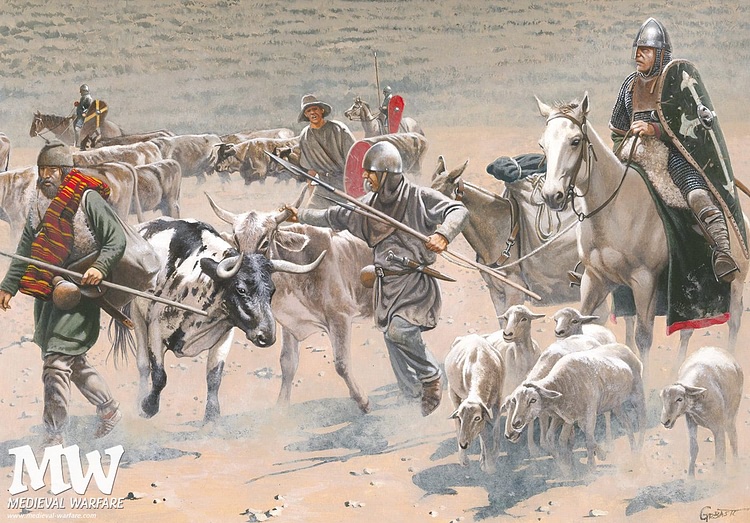 El Cid Plundering the Iberian Countryside Medieval Warfare Magazine / Karwansaray Publishers (Copyright) ](https://www.worldhistory.org/image/13655/el-cid-plundering-the-iberian-countryside/ "El Cid Plundering the Iberian Countryside")### Politics & [Culture](https://www.worldhistory.org/disambiguation/culture/)
At the start of the first *taifa* period, Andalusian Christians and Jews lived under limited discrimination. There was periodic violence against them, but that did not define the relationship between adherents of the competing faiths. As "People of the Book," Christians and Jews enjoyed legal protection and were respected for the most part so that both religious minorities assimilated into Andalusian society. Many Muslim emirs and princes employed Jews in positions of great influence. Although the *taifas* were remarkably tolerant for the time and certainly more accommodating than their successors, there was a great deal of strife as various Christian kingdoms sought to drive wedges between Muslims, exacerbate internal quarrels, and weaken them during the [Reconquista](https://www.worldhistory.org/Reconquista/).
In addition, *taifas* regularly paid *parias*, or tributes in the form of money, commodities, or experts to Christian kingdoms in exchange for military aid. It is difficult to separate *paria* payments from mercenary fees or protection money, as they are somewhat intertwined. Regardless, this was a mutually symbiotic relationship, with culturally dynamic and wealthy but politically weak and unstable *taifas* receiving support from politically formidable but economically lackluster Christian powers. *Paria* payments were absolutely vital for Christian kingdoms to survive, as they needed those funds to advance their own domestic projects and maintain their Christian vassals' loyalty. Initially, *taifas* easily afforded the payments and deducted them from budget surpluses. The payments, however, gradually weakened many *taifas* because the constant warfare meant Christian reinforcements were always needed and increasingly bold Christian armies threatened to attack if they were not paid. The financial drain facilitated the Christian [conquest](https://www.worldhistory.org/warfare/) later. Ironically, the very warriors the *paria* payments were intended to buy off were the same who ended the *taifas*.
*Taifa* rulers patronized the arts and sciences in order to attract poets and scholars from throughout Al-Andalus. It was necessary for Muslim lords to do so because they did not wield much political legitimacy. These leaders were a combination of Arab Umayyad loyalists, [Berbers](https://www.worldhistory.org/Berbers/) from the Maghreb, and warlords. Their claims to rule were tenuous at best. The lords could not justify their rule through shared bloodlines with Umayyad kings and were frequently beset by internal detractors. They could, however, cement their legitimacy through the arts and sciences.
[  Islamic Silk Tapestry Metropolitan Museum of Art (Copyright) ](https://www.worldhistory.org/image/15798/islamic-silk-tapestry/ "Islamic Silk Tapestry")There was a diaspora of scholars after the fall of the Umayyad Caliphate and so many talented individuals sought employment from reputable patrons. As the Reconquista gained momentum, many scholars including Jews fled from recent Christian conquests to *taifas* and worked for courts that would have them. Some leaders even dabbled in poetry themselves in an effort to make themselves and their courts more refined. The larger *taifas* specialized in various disciplines; Seville, Toledo, and Zaragoza focused on poetry, [science](https://www.worldhistory.org/science/), and [philosophy](https://www.worldhistory.org/philosophy/) respectively. The ubiquitous competition between rival taifas, along with the constant migration of itinerant artists from diverse backgrounds, blended local artistic techniques and created a distinct Andalusian style. The specialists' geographic mobility also translated into a great amount of both upward and downward social mobility.
Life under the Almoravids was characterized by increased intolerance and repression, but the *taifas* still retained their cultural dynamism. Remarkably, even the Almoravids were soon quite taken with the *taifas'* learning and culture and began to adopt Andalusian techniques and motifs in their own art, adding a bit of life and verve to their perpetually severe styles. The shared Arab and Islamic cultural advances would continue to influence Spain and, eventually, much of Western Europe as well.
### [Economy](https://www.worldhistory.org/disambiguation/economy/)
Interregional [trade](https://www.worldhistory.org/disambiguation/trade/) was brisk at the start of the first *taifa* period, as the Muslim polities were ideally situated to take advantage of commerce with the Berbers in the Maghreb region of North [Africa](https://www.worldhistory.org/disambiguation/africa/). The Maghreb provided trade hubs for trans-Saharan caravans. As the Almoravid Dynasty took power, it also gave the *taifas* access to the [Ghana Empire](https://www.worldhistory.org/Ghana_Empire/) in West Africa as well as the Upper Niger along with their [gold](https://www.worldhistory.org/gold/), slaves, gum, and ivory exports. By extension, *taifas* gave their Christian partners access to commerce across the breadth of the Islamic and [Silk](https://www.worldhistory.org/Silk/) Roads commercial networks. This arrangement resulted in the *taifas* supplying precious metals, ivory, and silk to the rest of the peninsula. Christian kingdoms, in turn, supplied timber and furs to their Muslim trading partners.
Al-Andalus was much more urbanized than the Christian kingdoms, with some *taifas* urbanizing more than others. They lived in semi-urban societies while their Christian and Almoravid counterparts were heavily rural. Al-Andalus, in fact, was one of the most urbanized regions of the Islamic world and boasted an impressive level of development and educational attainment. It was not a feudal system but, instead, rested on a system that emphasized local and regional markets. Rural hinterlands provided food and raw materials to [cities](https://www.worldhistory.org/city/) that functioned as their primary markets. A skilled workforce maintained a complex irrigation system that allowed the *taifas* to grow luxury crops such as grapes and olives and supply the manufacturing sector. The farmers and [peasants](https://www.worldhistory.org/disambiguation/Peasants/) maintained that productive system by treating it as a science, and they kept it running despite frequent raids by rival Christian and Muslim armies.
[  Great Mosque, Cordoba Timor Espallargas (CC BY-SA) ](https://www.worldhistory.org/image/9185/great-mosque-cordoba/ "Great Mosque, Cordoba")Just as individual taifas specialized in certain fields of knowledge, so to did they specialize in particular industries including sericulture, glassware, and book publishing. The *taifas* were focused on being self-sufficient first but were keen on exporting when practical.
Despite al-Andalus' robust economy, it stagnated as each *taifa's* ruler prioritized their own material well-being, lavish courts, and legitimacy over any plan for long-term sustainability. The amount of gold and [silver](https://www.worldhistory.org/Silver/) specie also declined as increased *paria* payments required more [coin](https://www.worldhistory.org/coinage/). Attempts to make up for the shortfall through taxation met with popular discontent and even rebellion. *Taifa* economies remained strong but increasingly vulnerable, and they were tempting targets for resurgent Christian kingdoms.
The *taifa* periods were short-lived, but they saw a wave of innovation and intellectual curiosity that made al-Andalus a center of innovation and scholarship. The cosmopolitan mixture of Christians, Jews, and Muslims from throughout al-Andalus, the Maghreb, and the [Mediterranean](https://www.worldhistory.org/disambiguation/mediterranean/) made indelible marks on Spanish cuisine, language, and culture that persist until the present day.
#### Editorial Review
This human-authored definition has been reviewed by our editorial team before publication to ensure accuracy, reliability and adherence to academic standards in accordance with our [editorial policy](https://www.worldhistory.org/static/editorial-policy/).
## Bibliography
- [Al-Andalus. 11th Century. Taifa Kingdoms](https://www.spainthenandnow.com/spanish-history/11th-c-al-andalus-taifa-kingdoms "Al-Andalus. 11th Century. Taifa Kingdoms"), accessed 8 May 2022.
- Benaboud, M'hammad. "Economic Trends in Al-Andalus During the Period of the ṬĀ’ifa States (Fifth/Eleventh Century). ." *Islamic Studies*, 30/1/2/1991, pp. 213-240.
- [Catlos, Brian A. *Kingdoms of Faith.* Basic Books, 2018.](https://www.worldhistory.org/books/0465055877/)
- Christys, Ann. "When Iberia Was Shattered: The Era Of the Taifa States." *Medieval Warfare*, 7/6/2018, pp. 8-11.
- Garden, Kenneth. "The riḥla and Self-Reinvention of Abū Bakr Ibn al-ʿArabī." *Journal of the American Oriental Society*, 135/1/2015, pp. 1-17.
- [History of Jews in Spain to 13th Century](https://www.spainthenandnow.com/spanish-history/jews-in-spain-to-13th-century "History of Jews in Spain to 13th Century")
- Konieczny, Peter. "The Conquest of Valencia: ‘The Clear Exposition of the Disastrous Tragedy." *Medieval Warfare*, 7/6/2018, pp. 19-23.
- [Menocal, Maria Rosa. *The Ornament of the World.* Back Bay Books, 2003.](https://www.worldhistory.org/books/0316168718/)
- [The Art of the Almoravid and Almohad Periods (ca. 1062–1269)](http://www.metmuseum.org/toah/hd/almo/hd_almo.htm "The Art of the Almoravid and Almohad Periods (ca. 1062–1269)")
- [Walker, Rose. *Art in Spain and Portugal from the Romans to the Early Middle Ages.* Medieval Institute Publications, 2016, 139-179.](https://www.worldhistory.org/books/1580442188/)
## About the Author
Dr. Ian Abbey is a history professor. He grew up by the sea and has always had an interest in maritime history. He specializes in the history of privateers and pirates, although he also has an interest in historical cooking as well.
## Timeline
- **1031 CE**: The [Umayyad](https://www.worldhistory.org/Umayyad_Dynasty/) Caiphate of Cordoba fragments; the emergence of the [taifa](https://www.worldhistory.org/Taifa/) system.
- **1085 CE**: Alfonso VI, king of Castile and León conquers the [taifa](https://www.worldhistory.org/Taifa/) of Toledo.
- **c. 1090 CE**: The Almoravids take control of al-Andalus.
- **1144 CE**: The second [taifa](https://www.worldhistory.org/Taifa/) system emerges in al-Andalus.
- **1172 CE - 1212 CE**: The Almohads dominate al-Andalus.
- **1212 CE**: Start of the third [taifa](https://www.worldhistory.org/Taifa/) period in al-Andalus.
## Questions & Answers
### What were the taifas?
Taifas ("factions" or "camps") were small independent Muslim kingdoms and principalities in al-Andalus between 1031 and the mid-13th century.
### Where were the taifas located?
The Taifas emerged in al-Andalus, the Muslim-controlled part of the Iberian peninsula.
### How many taifas were there?
It is estimated that between 30 and 50 were established after the fall of the Umayyad Caliphate. However, this number drastically shrunk in the ensuing scramble.
## Cite This Work
### APA
Abbey, I. (2022, May 16). Taifa. *World History Encyclopedia*.
### Chicago
Abbey, Ian. "Taifa." *World History Encyclopedia*, May 16, 2022. .
### MLA
Abbey, Ian. "Taifa." *World History Encyclopedia*, 16 May 2022, .
## License & Copyright
Submitted by [Ian Abbey](https://www.worldhistory.org/user/ianabbey/ "User Page: Ian Abbey"), published on 16 May 2022. The copyright holder has published this content under the following license: [Creative Commons Attribution-NonCommercial-ShareAlike](https://creativecommons.org/licenses/by-nc-sa/4.0/deed.en). This license lets others remix, tweak, and build upon this content non-commercially, as long as they credit the author and license their new creations under the identical terms. When republishing on the web a hyperlink back to the original content source URL must be included. Please note that content linked from this page may have different licensing terms.