---
title: Sumo: Japan's Ancient Form of Wrestling
author: Mark Cartwright
source: https://www.worldhistory.org/Sumo/
format: machine-readable-alternate
license: Creative Commons Attribution-NonCommercial-ShareAlike (https://creativecommons.org/licenses/by-nc-sa/4.0/)
updated: 2025-04-18
---
# Sumo: Japan's Ancient Form of Wrestling
_Authored by [Mark Cartwright](https://www.worldhistory.org/user/markzcartwright/)_
Sumo (Ozumo) is an ancient form of wrestling which has long been the national sport of [Japan](https://www.worldhistory.org/disambiguation/Japan/). Its origins go back to the [Yayoi period](https://www.worldhistory.org/Yayoi_Period/) (c. 300 BCE - c. 300 CE) and it incorporates many elements of the [Shinto religion](https://www.worldhistory.org/collection/43/the-shinto-religion/) in its various rituals and conventions, the combination of which usually last much longer than the actual sporting contest. Still considered a sacred event, the pavilion in which sumo bouts are performed is regarded as a [Shinto](https://www.worldhistory.org/Shinto/) shrine.
### Origins & Development
The origins of sumo are lost in the mists of time but it is thought to have been first practised sometime in the [Yayoi](https://www.worldhistory.org/Yayoi_Period/) period as part of Shinto rituals where *[kami](https://www.worldhistory.org/Kami/)* or spirits were summoned or 'fought.' Traditionally, the very first sumo wrestler was Nomi no Sukune who was ordered by Emperor Suinin (r. 29 BCE - 70 CE) to fight one Taima no Kehaya. Nomi no Sukune won, perhaps unsurprisingly since he was a descendant of Amenohohi, son of the sun goddess [Amaterasu](https://www.worldhistory.org/Amaterasu/).
In the 8th-century CE [Nara period](https://www.worldhistory.org/Nara_Period/) and more certain history, strongman wrestling contests became an important ritual. Sumo fights often involved [samurai](https://www.worldhistory.org/Samurai/) and these bouts were known as *tsuji-zumo* in which there were not many rules, deaths were frequent and the prize was cash. The second type of bout was *kanjin-zumo which were held at shrines to raise money for their upkeep.
The modern form of the sport took shape at the Shinto shrine of Tomioka Hachimangu in Tokyo. Here, from 1684 CE during the [Edo period](https://www.worldhistory.org/Edo_Period/) (1600-1868 CE), regular bouts were organised, notably by the former samurai Ikazuchi Gondayu who created the rules and arena still adhered to today. Sumo wrestlers, often known colloquially as *rikishi*, then became professional sportsmen who toured the country and sumo became the national sport of Japan. Both sumo wrestlers and sumo wrestling continue to be regarded as sacred in Japan today.
### Sumo Shinto Rituals
The explosive physical face-off of a sumo bout is preceded by a lengthy series of rituals and posturing which have origins in ancient warfare and the Shinto [religion](https://www.worldhistory.org/religion/). One such ritual is the wrestler raising one leg and stamping fiercely down on the ground several times. This derives from the [archaic](https://www.worldhistory.org/disambiguation/Archaic/) practice of warriors doing this before [battle](https://www.worldhistory.org/disambiguation/battle/) to frighten the enemy and, known as *shiki*, it was also performed by the goddess Amaterasu when she faced her unruly brother [Susanoo](https://www.worldhistory.org/Susanoo/) in Shinto [mythology](https://www.worldhistory.org/mythology/). Wrestlers also frequently slap their hands together in the pre-fight ritual, another tradition in Shinto when a believer claps to signify the beginning and end of a prayer. Another ritual is for the wrestlers to periodically throw salt across and out from the ring. This is an act of purification, salt long being used for that purpose at Shinto shrines. Finally, the referee (*gyoji*) of a sumo match is a striking sight in his own right as he wears a robe based on those worn in the imperial court of [Japan in medieval times](https://www.worldhistory.org/collection/69/japan-in-medieval-times/) and similar to that of a Shinto priest today.
[ 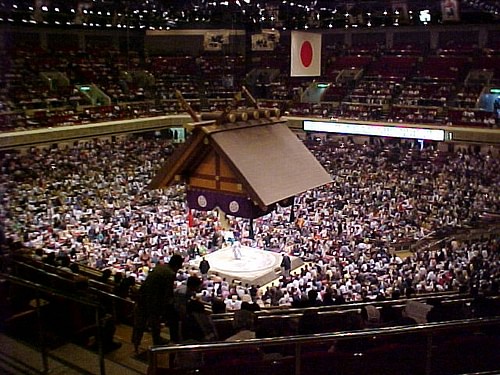 Ryogoku Sumo Hall, Tokyo Brian M. Chapman (CC BY-SA) ](https://www.worldhistory.org/image/6485/ryogoku-sumo-hall-tokyo/ "Ryogoku Sumo Hall, Tokyo")### A Sumo Bout
Two Sumo wrestlers face each other standing within a ring marked out with rope on a raised square platform made of compact clay. The platform measures precisely 5.7 metres (18.7 ft) on each side, and the ring or *dohyo* is a perfect circle with a diameter of 4.57 metres (15 ft). High above the platform is a roof pavilion, and the whole ensemble continues to enjoy the status of a sacred Shinto shrine which it resembles closely.
The winner of the bout must either push his opponent out of the rope ring or force him down to the ground. If any part of a wrestler's body besides his feet touches the clay flooring then he has lost. The wrestlers, with their hair tied in a complicated topknot in imitation of medieval samurai, wear a *mawashi* or large belt which can be grabbed by their opponent to push, wrestle, or lift them across and out of the ring. The task of pushing out an opponent may take only a few seconds in the fastest bouts, but the difficulty lies in the tremendous size of the wrestlers. Many sumo wrestlers generally weigh in at 150 kilos (330 pounds) but some of the [giants](https://www.worldhistory.org/Giants/) of the sport can weigh over 200 kilos (450 pounds).
Some sumo wrestlers are superstars in Japan, especially those who win tournaments and acquire the prestigious title of *yokozuna* or grand champion. Nor is the sport limited to Japanese wrestlers as several *yokozuna* have come from Mongolia and Hawaii. Even the less famous sumo wrestlers are in demand as they are often invited to private homes at the end of winter to rid the house of bad spirits or *oni* in a ceremony known as *setsubun* ('second day, second month'). The sumo wrestler throws beans and repeatedly shouts out the phrase *Oni wa soto, fuku wa uchi* or 'Demons out, good luck in'.
This content was made possible with generous support from the [Great Britain Sasakawa Foundation](http://www.gbsf.org.uk/?utm_source=ancient.eu&utm_medium=link&utm_campaign=ancient.eu).
#### Editorial Review
This human-authored definition has been reviewed by our editorial team before publication to ensure accuracy, reliability and adherence to academic standards in accordance with our [editorial policy](https://www.worldhistory.org/static/editorial-policy/).
## Bibliography
- [Ashkenazi, M. *Handbook of Japanese Mythology.* Oxford University Press, 2008.](https://www.worldhistory.org/books/0195332628/)
- [Cali, J. *Shinto Shrines.* Latitude 20, 2012.](https://www.worldhistory.org/books/0824837134/)
- [Henshall, K. *Historical Dictionary of Japan to 1945.* Scarecrow Press, 2013.](https://www.worldhistory.org/books/0810878712/)
- [Scott Littleton, C. *Understanding Shinto.* Duncan Baird Publishers, 2002.](https://www.worldhistory.org/books/1903296757/)
## About the Author
Mark is WHE’s Publishing Director and has an MA in Political Philosophy (University of York). He is a full-time researcher, writer, historian and editor. Special interests include art, architecture and discovering the ideas that all civilizations share.
## External Links
- [Sumo - Past & Present](https://www.japan-guide.com/e/e2080.html)
## Cite This Work
### APA
Cartwright, M. (2017, April 07). Sumo: Japan's Ancient Form of Wrestling. *World History Encyclopedia*.
### Chicago
Cartwright, Mark. "Sumo: Japan's Ancient Form of Wrestling." *World History Encyclopedia*, April 07, 2017. .
### MLA
Cartwright, Mark. "Sumo: Japan's Ancient Form of Wrestling." *World History Encyclopedia*, 07 Apr 2017, .
## License & Copyright
Submitted by [Mark Cartwright](https://www.worldhistory.org/user/markzcartwright/ "User Page: Mark Cartwright"), published on 07 April 2017. The copyright holder has published this content under the following license: [Creative Commons Attribution-NonCommercial-ShareAlike](https://creativecommons.org/licenses/by-nc-sa/4.0/deed.en). This license lets others remix, tweak, and build upon this content non-commercially, as long as they credit the author and license their new creations under the identical terms. When republishing on the web a hyperlink back to the original content source URL must be included. Please note that content linked from this page may have different licensing terms.