---
title: Sistrum
author: Mark Cartwright
source: https://www.worldhistory.org/Sistrum/
format: machine-readable-alternate
license: Creative Commons Attribution-NonCommercial-ShareAlike (https://creativecommons.org/licenses/by-nc-sa/4.0/)
updated: 1970-01-01
---
# Sistrum
_Authored by [Mark Cartwright](https://www.worldhistory.org/user/markzcartwright/)_
The sistrum (rattle) was a musical percussion instrument first used by the [ancient Egyptians](https://www.worldhistory.org/collection/162/the-ancient-egyptians/), commonly used in ancient [Greek](https://www.worldhistory.org/disambiguation/greek/) musical practices, and often depicted in visual arts such as [sculpture](https://www.worldhistory.org/disambiguation/Sculpture/) and [pottery](https://www.worldhistory.org/pottery/). Made from clay, wood, or [metal](https://www.worldhistory.org/disambiguation/metal/), the instrument provided rhythmical accompaniment to other instruments, particularly in religious rites and festivals. Played by shaking the instrument like a rattle, moveable objects on the horizontal bars or the free movement of the bars themselves against the frame, produced sounds.
Originally from [Egypt](https://www.worldhistory.org/egypt/) and first seen in the [Old Kingdom](https://www.worldhistory.org/disambiguation/Old_Kingdom/), the instrument was closely associated with ritual rites in honour of [Isis](https://www.worldhistory.org/isis/). Indeed, in [Egyptian art](https://www.worldhistory.org/Egyptian_Art/), the goddess and her priestesses are often depicted holding a sistrum. In Egypt the instrument had two forms - an oval hoop or a [temple](https://www.worldhistory.org/temple/) shape. In [Greek culture](https://www.worldhistory.org/disambiguation/Greek_Culture/) the sistrum was shaped like an elongated hoop and used in processions, sacrifices, festivals and funerary contexts. The earliest examples date from [Minoan](https://www.worldhistory.org/disambiguation/Minoan/) [Crete](https://www.worldhistory.org/crete/) (c. 2000-1900 BCE) and are made of clay with two fixed wooden horizontal rods and three clay moveable disks to create sound as they strike the sides of the hoop-shaped frame. However, it is possible that versions in clay were not perhaps intended to be played (their sound production is low) but rather represented the instrument in funerary contexts. Indeed, many sistrums and similar musical instruments have been found in graves, pointing to a belief that [music](https://www.worldhistory.org/disambiguation/Music/) was a part of the after-life. Clay versions of sistrums may also have been used as children's toys.
[ 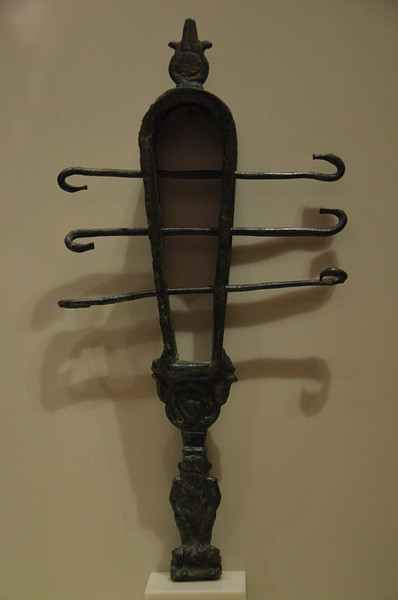 Ancient Egyptian Sistrum Carole Raddato (CC BY-SA) ](https://www.worldhistory.org/image/2476/ancient-egyptian-sistrum/ "Ancient Egyptian Sistrum")There are surviving examples of sistrums in [bronze](https://www.worldhistory.org/disambiguation/bronze/), mostly found in a [burial](https://www.worldhistory.org/burial/) context. An interesting example dates from the second half of the 2nd century BCE, found in Attica. This sistrum has four bronze horizontal bars of decreasing length which slide in and out of the hoop. On the top of the hoop is a modelled dog, there is a modelled bull's head at the base of the handle. and the handle itself is carved to represent a cluster of six auloi in order to resemble a [column](https://www.worldhistory.org/column/) which is topped by a carved capital, joining the handle to the hoop.
In Greek art, dancers in processions are occasionally depicted holding a sistrum. A celebrated example is the Harvester Vase from Hagia Triada on Minoan Crete (1500-1450 BCE) which depicts a sistrum player in a harvest festival procession.
#### Editorial Review
This human-authored definition has been reviewed by our editorial team before publication to ensure accuracy, reliability and adherence to academic standards in accordance with our [editorial policy](https://www.worldhistory.org/static/editorial-policy/).
## Bibliography
- [Kotsanas, K. *THE MUSICAL INSTRUMENTS OF THE ANCIENT GREEKS.* Kostas Kotsanas, 2012.](https://www.worldhistory.org/books/960931614X/)
- Andrikou, E. (et al). *Gifts from the Muses.* Hellenic Ministry of Culture, Athens, 2004
## About the Author
Mark is WHE’s Publishing Director and has an MA in Political Philosophy (University of York). He is a full-time researcher, writer, historian and editor. Special interests include art, architecture and discovering the ideas that all civilizations share.
## Timeline
- **1500 BCE - 1450 BCE**: The 'Harvester Vase' of [Minoan](https://www.worldhistory.org/disambiguation/Minoan/) origin depicts a [sistrum](https://www.worldhistory.org/Sistrum/) player.
## Cite This Work
### APA
Cartwright, M. (2012, September 15). Sistrum. *World History Encyclopedia*.
### Chicago
Cartwright, Mark. "Sistrum." *World History Encyclopedia*, September 15, 2012. .
### MLA
Cartwright, Mark. "Sistrum." *World History Encyclopedia*, 15 Sep 2012, .
## License & Copyright
Submitted by [Mark Cartwright](https://www.worldhistory.org/user/markzcartwright/ "User Page: Mark Cartwright"), published on 15 September 2012. The copyright holder has published this content under the following license: [Creative Commons Attribution-NonCommercial-ShareAlike](https://creativecommons.org/licenses/by-nc-sa/4.0/deed.en). This license lets others remix, tweak, and build upon this content non-commercially, as long as they credit the author and license their new creations under the identical terms. When republishing on the web a hyperlink back to the original content source URL must be included. Please note that content linked from this page may have different licensing terms.