---
title: Silla
author: Mark Cartwright
source: https://www.worldhistory.org/Silla/
format: machine-readable-alternate
license: Creative Commons Attribution-NonCommercial-ShareAlike (https://creativecommons.org/licenses/by-nc-sa/4.0/)
updated: 1970-01-01
---
# Silla
_Authored by [Mark Cartwright](https://www.worldhistory.org/user/markzcartwright/)_
The Silla kingdom ruled south-eastern [Korea](https://www.worldhistory.org/Korea/) during the [Three Kingdoms period](https://www.worldhistory.org/disambiguation/Three_Kingdoms_Period/) from the 1st century BCE to 7th century CE. The capital was Geumseong ([Gyeongju](https://www.worldhistory.org/Gyeongju/)) with a centralised government and hierarchical system of social ranks. The prosperity of Silla is evident in the magnificent [gold](https://www.worldhistory.org/gold/) crowns which are among the most prized art objects of ancient South-East Asia.
The Silla were in constant rivalry with their neighbours the [Baekje](https://www.worldhistory.org/Baekje/) ([Paekche](https://www.worldhistory.org/Baekje/)) and [Goguryeo](https://www.worldhistory.org/Goguryeo/) ([Koguryo](https://www.worldhistory.org/Goguryeo/)) kingdoms, as well as the contemporary [Gaya](https://www.worldhistory.org/Gaya/) ([Kaya](https://www.worldhistory.org/Gaya/)) confederation. An alliance with the [Tang Dynasty](https://www.worldhistory.org/Tang_Dynasty/) of [China](https://www.worldhistory.org/china/) permitted Silla to eventually [conquer](https://www.worldhistory.org/warfare/) the whole of the Korean peninsula in 668 CE, which it then ruled for the next three centuries as the [Unified Silla Kingdom](https://www.worldhistory.org/Unified_Silla_Kingdom/).
### Historical Overview
The traditional founding date of the Silla kingdom (often *Ko-Silla* - 'Old Silla' - to distinguish it from the later unified period) was, according to the 12th-century CE *[Samguk sagi](https://www.worldhistory.org/Samguk_Sagi/)* ('Historical Records of the Three States'), 57 BCE, but this is unlikely to be accurate and modern historians prefer a later date when describing the Silla as a single political entity. The kingdom first developed when Jinhan tribes in south-eastern Korea formed a confederacy. The traditional founder figure is Hyeokgeose (r. 57 BCE – 4 CE) who, once he was born from a magical scarlet egg, founded his fortified capital at Saro, later to become known as Geumseong (modern Gyeongju/Kyongju).
The first leaders carried the title *chachaung*, meaning shaman or priest, suggesting they were selected because of their role as community shamans. The dominant clans in this early period were the Pak, Sok, and Kim. Nulchi (r. 417-458 CE) established a father-to-son inheritance of the crown, replacing the previous rotation system between the clans. During the reign of king Soji (458-500 CE) post stations were established to better link the various fortified [cities](https://www.worldhistory.org/city/) of the group. The capital, Saro, gave the kingdom its first name (also known as Seorabol meaning 'Eastern Land') which was changed to Silla during the reign of king Beopheung (r. 514-540 CE) when a greater degree of centralisation was achieved.
Silla battled constantly over the centuries with the neighbouring kingdoms of Goguryeo, Baekje, and the Gaya confederation, with all four vying for greater control of the Korean peninsula and constantly switching allies. The Silla kingdom did have the advantage of protection from local mountains which isolated it to some degree from the other Korean states. Silla formed an alliance with Goguryeo to rebuff a Japanese-Baekje army in 400 CE, but when Goguryeo became more territorially ambitious in the 5th century, Baekje and Silla formed a long-lasting partnership between 433 and 553 CE.
Silla prospered in the 6th century during the reign of Jijeung (500-514 CE) with greater agricultural yields coming from the introduction of oxen-drawn ploughs and irrigation systems. The kingdom also benefitted from natural resources such as iron and gold. Silla-manufactured goods included silks, leather products, furniture, ceramics, and [metal](https://www.worldhistory.org/disambiguation/metal/) tools and weapons, all of which were supervised by dedicated government departments.
Relations with Baekje turned sour when Silla occupied parts of the lower [Han](https://www.worldhistory.org/Han_Dynasty/) river valley. In 554 CE, at the [battle](https://www.worldhistory.org/disambiguation/battle/) of Gwansan (modern Okcheon), Silla defeated a Baekje army and killed their king Song. This move gave Silla access to the western coast and the Yellow Sea, providing the possibility to forge greater links with China.
[  Three Kingdoms of Korea Map Ashraf Kamel (CC BY-NC-SA) ](https://www.worldhistory.org/image/5790/three-kingdoms-of-korea-map/ "Three Kingdoms of Korea Map")More success came in the south with the Silla attack on the Gaya ruling [city-state](https://www.worldhistory.org/Polis/) Geumgwan Gaya (Bon-Gaya), which fell in 532 CE. By 562 CE Daegaya also fell and the Gaya confederation was wholly absorbed into the Silla kingdom. This still left two dangerous opponents in Goguryeo and Baekje, and they combined effectively to conquer Daeya-dong (modern Hapcheon), also in 562 CE. Silla would require outside help to realise its ambition of controlling all of the peninsula.
Fortunately for the Korean kingdom, China was now ruled by the [Tang](https://www.worldhistory.org/Tang_Dynasty/) Dynasty (618-907 CE) who saw an opportunity to play these troublesome southern kingdoms against each other for their own benefit. Selecting Silla as their ally, things did not at first go well when a joint Silla-Tang army was defeated by a Goguryeo army led by the celebrated general [Yang](https://www.worldhistory.org/Yin_and_Yang/) Manchun in 644 CE. Three more times Tang armies were defeated over the following decade. Then, in a few action-packed years, the whole political map changed dramatically.
A massive joint Tang and Silla army and naval force was formed for one big and decisive push. The Silla army of 50,000 was led by the general [Kim Yu-sin](https://www.worldhistory.org/Kim_Yu-sin/) whilst Tang emperor Gaozong sent a navy of 130,000 men, which sailed up the Geum River. With such an overwhelming force Baekje was caught in a pincer movement, the capital Sabi crushed and the kingdom wholly swept aside in 660 CE. Silla then easily quashed a brief rebel revival in 663 CE; one kingdom down, one to go.
Once again the Tangs were instrumental in Korean affairs when [Pyongyang](https://www.worldhistory.org/Pyongyang/), the Goguryeo capital, was attacked by a Chinese army in 661 and again in 667 CE. The [city](https://www.worldhistory.org/city/), after a one-year siege, eventually fell, and by 668 CE the Goguryeo kingdom was made a Chinese province as was now the old Baekje territory. Silla had no intention of allowing China to keep these gains, though, and while the Tangs were preoccupied with a rising Tibet, the Silla armies battled the Chinese forces remaining in Korea. Battles at Maesosong (675 CE) and Kibolpo (676 CE) brought victory, and finally, Silla was the sole master of Korea.
### Government & Social Classes
As in the other states of the period, below the royal court a central government controlled the kingdom with officials appointed to oversee the six provinces (*pu*). The Silla kings may have had less power than their counterparts in other kingdoms, though, as they shared government with a small council of aristocrats, the *hwabaek*, which decided on even the most important issues of state such as declarations of [war](https://www.worldhistory.org/disambiguation/War/).
[ 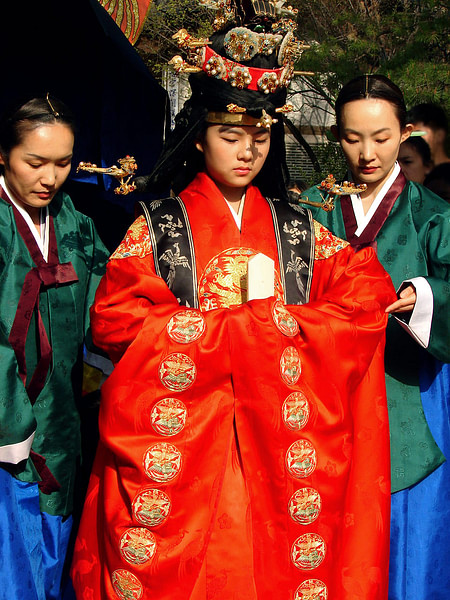 Korean Royal Wedding Re-enactment Steve46814 (CC BY-SA) ](https://www.worldhistory.org/image/5676/korean-royal-wedding-re-enactment/ "Korean Royal Wedding Re-enactment")The Silla kingdom was unusual in that amongst the long line of male sovereigns two Queens ruled – Seondeok (r. 632-647 CE) and Jindeok (r. c. 647-654 CE). The former gained the throne because her father, king Jinpyeong (r. 579-632 CE) had no male heir. Her reign was distinguished by the increased integration of [Buddhism](https://www.worldhistory.org/buddhism/) as the state [religion](https://www.worldhistory.org/religion/). Jindeok followed in her cousin's footsteps and helped Silla dominate the Korean peninsula. There would be a third queen – Jinseong (r. 887-898 CE), who ruled in the Unified Silla Period.
The majority of the king or queen's subjects were farmers who worked their own land but who were also required to provide labour for government projects such as the construction of fortifications and, in time of war, to fight in the Silla army. An aristocracy dominated administrative and religious positions with their wealth coming from [trade](https://www.worldhistory.org/disambiguation/trade/) and landed estates worked by slaves (largely drawn from prisoners of war and criminals). Aristocratic youths were trained in the *[Hwarang](https://www.worldhistory.org/Hwarang/)* or 'Flower Boys' system, which, despite its [Buddhist](https://www.worldhistory.org/buddhism/) teachings, emphasised martial prowess and heroism.
In 520 CE, king Beophung introduced the [bone rank system](https://www.worldhistory.org/Bone_Rank_System/) (*Golpum or Kolpum*). This was a classification of social ranks based on birth, which permitted holders of a certain status to apply for specific levels of jobs within the government administration and determined how much tax they would pay. There were originally three levels: 'sacred bone' (*seonggol*), 'true bone' (*jingol*), and 'head rank' (*tupum*). The latter was the largest and further divided into six levels. The bone rank system was all-pervasive and even dictated such seemingly trivial matters as what types of clothes one could wear, the size of one's house, and the means of transport one was permitted to use. The system was extremely rigid with next to no movement possible between levels, a fact which may have accounted for the social stagnation of the Silla kingdom which eventually contributed to its downfall.
[  Silla Ceramic Warrior ëŒ€í•œë¯¼êµ ì •ë¶€ (CC BY) ](https://www.worldhistory.org/image/5820/silla-ceramic-warrior/ "Silla Ceramic Warrior")### Relations with China
In the 4th century CE, Silla maintained diplomatic relations with China, paying regular tribute to the regional powerhouse. From the 6th century CE Silla rulers adopted the Chinese title *wang* (king) – which replaced the *maripkan* or 'elevation' title of previous Silla kings, the [Chinese writing](https://www.worldhistory.org/Chinese_Writing/) system, [Confucianism](https://www.worldhistory.org/Confucianism/) during the Han period, and Buddhism, which became the official state religion in 535 CE, even if traditional shamanistic practices continued too. When [Taoism](https://www.worldhistory.org/Taoism/) became more popular during the Tang period, so too it became more widespread in the Silla kingdom.
The two states were long-time trading partners with China exporting [silk](https://www.worldhistory.org/Silk/), tea, books, and [silver](https://www.worldhistory.org/Silver/) goods while Silla sent in return gold, horses, ginseng, hides, ornamental manufactured goods such as tables, and slaves. The reigns of [Queen Seondeok](https://www.worldhistory.org/Queen_Seondeok/) and king Taejong Muyol in the mid-7th century CE saw an even closer relationship with Tang China with Tang court customs followed at Kumsong, students sent to China for study, and most significantly of all, massive military aid being sent to help Silla quash their rival kingdoms.
### Silla Art
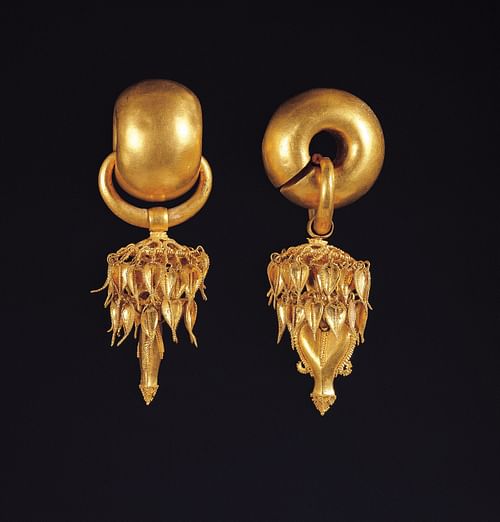
The most celebrated works of Silla craftsmen are, undoubtedly, the gold and gilt-[bronze](https://www.worldhistory.org/disambiguation/bronze/) crowns excavated from several royal tombs, which justify the capital being named Geumseong or 'city of gold'. Made of sheet-gold and decorated with granulation and crescent-shaped pendants of jade (*magatama*), they have tall upright antlers and trees, which indicate a link with shamanism. There are not only crowns, though, but jewellery, belts, shoes, girdles, and cups made of thin sheet-gold, intricately carved, and embellished with gold wiring, granulation, long pendants, and pieces of jade.
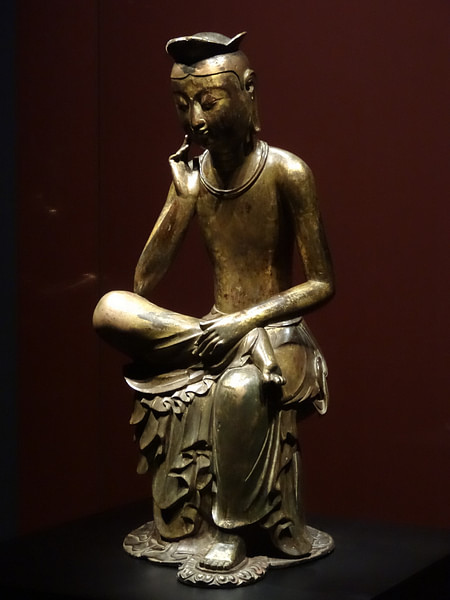
[  Silla Gold Earrings, National Treasure 52 National Museum of Korea (CC BY) ](https://www.worldhistory.org/image/5802/silla-gold-earrings-national-treasure-52/ "Silla Gold Earrings, National Treasure 52")Stone and gilt-bronze sculptures were produced, especially of the [Buddha](https://www.worldhistory.org/Siddhartha_Gautama/), bodhisattvas, and the future Buddha, Maitreya. A gilt-bronze statue of the latter type from c. 600 CE is one of the outstanding pieces of ancient [Korean sculpture](https://www.worldhistory.org/Korean_Sculpture/). The statue presents a contemplative figure with a delicately poised hand, crossed leg and flowing robe; it is currently on display in the National Museum of Korea, Seoul.
[Silla pottery](https://www.worldhistory.org/article/983/silla-pottery/) of the Three Kingdoms period was mostly grey stoneware with incised, applied, and pierced decoration. Two forms predominate: the long-necked jar (*changgyong ho*) and round, lidded cup with a wide foot base known as *kobae (but used for food, not liquids). Other shapes include horned cups, cups with wheels attached, one-handled cups, large bulbous jars, lamps, and bell cups which have small pieces of clay inside a hollow lower section so that they rattle when lifted. [Pottery](https://www.worldhistory.org/pottery/) stands (*kurut pachim*), used to support large bowls, were also made which have intricate pierced designs. Perhaps the most impressive pottery objects are the ewers in the form of armoured horse-riders.
[  Gilt-bronze Silla Maitreya Jeff & Neda Fields (CC BY-NC-ND) ](https://www.worldhistory.org/image/5775/gilt-bronze-silla-maitreya/ "Gilt-bronze Silla Maitreya")### Silla [Architecture](https://www.worldhistory.org/disambiguation/architecture/)
Typical Silla tombs of the Three Kingdoms period are composed of a wooden chamber set in an earth pit which was then covered with a large pile of stones and a mound of earth. To make the [tomb](https://www.worldhistory.org/tomb/) waterproof, layers of clay were applied between the stones. Many tombs contain multiple burials, sometimes as many as ten individuals. The lack of an entrance has meant that many more Silla tombs have survived intact in respect to the other two kingdoms and so provided treasures from golden crowns to jade jewellery. The largest such tomb, actually composed of two mounds and containing a king and queen, is the Hwangnam Taechong tomb. Dating to the 5-7th century CE, the tomb measures 80 x 120 m, and its mounds are 22 and 23 m high.
Notable surviving structures at Gyeongju include the mid-7th century CE [Cheomseongdae](https://www.worldhistory.org/Cheomseongdae/) observatory. Nine metres tall, it acted like a sundial but also has a south-facing window which captures the sun's rays on the interior floor on each equinox. It is the oldest surviving observatory in East Asia.
This content was made possible with generous support from the [British Korean Society](http://www.britishkoreansociety.org.uk/?utm_source=ancient.eu&utm_medium=link&utm_campaign=ancient.eu).
#### Editorial Review
This human-authored definition has been reviewed by our editorial team before publication to ensure accuracy, reliability and adherence to academic standards in accordance with our [editorial policy](https://www.worldhistory.org/static/editorial-policy/).
## Bibliography
- [Jackson, B. *Korean Architecture.* Seoul Selection USA, Inc., 2013.](https://www.worldhistory.org/books/8997639234/)
- [Jinwung Kim. *A History of Korea"Land of the Morning Calm" to States in Conflict.* Indiana University Press, 2012.](https://www.worldhistory.org/books/0253000246/)
- [Ki-baik Lee. *A New History of Korea.* Harvard University Asia Center, 1984.](https://www.worldhistory.org/books/067461576X/)
- Kim, C. *The Arts of Korea.* Thames & Hudson, 1966
- [Kyung Hwang. *A History of Korea.* Palgrave Macmillan, 2010.](https://www.worldhistory.org/books/0230205461/)
- [Portal, J. *Korea: Art & Archaeology.* Thames & Hudson, 2000.](https://www.worldhistory.org/books/0500282021/)
- [Pratt, K. *Korea: A Cultural & Historical Dictionary.* Routledge, 1999.](https://www.worldhistory.org/books/0700704639/)
## About the Author
Mark is WHE’s Publishing Director and has an MA in Political Philosophy (University of York). He is a full-time researcher, writer, historian and editor. Special interests include art, architecture and discovering the ideas that all civilizations share.
## Timeline
- **57 BCE - 4 CE**: Reign of traditional founder of [Korea](https://www.worldhistory.org/Korea/)'s [Silla](https://www.worldhistory.org/Silla/) kingdom Hyeokgeose.
- **57 BCE - 668 CE**: [Three Kingdoms Period in Korea](https://www.worldhistory.org/Three_Kingdoms_Period_in_Korea/) ([Silla](https://www.worldhistory.org/Silla/), [Goguryeo](https://www.worldhistory.org/Goguryeo/), and [Baekje](https://www.worldhistory.org/Baekje/)).
- **57 BCE - 918 CE**: The [Silla](https://www.worldhistory.org/Silla/) Kingdom rules in [Korea](https://www.worldhistory.org/Korea/), first as one of the Three Kingdoms and then alone from 668 CE.
- **417 CE - 458 CE**: Reign of [Silla](https://www.worldhistory.org/Silla/) king Nulji in south-eastern [Korea](https://www.worldhistory.org/Korea/).
- **433 CE - 553 CE**: [Baekje](https://www.worldhistory.org/Baekje/) forms an alliance with the [Silla](https://www.worldhistory.org/Silla/) kingdom in [Korea](https://www.worldhistory.org/Korea/).
- **458 CE - 500 CE**: Reign of [Silla](https://www.worldhistory.org/Silla/) king Soji in south-eastern [Korea](https://www.worldhistory.org/Korea/).
- **500 CE - 514 CE**: Reign of [Silla](https://www.worldhistory.org/Silla/) king Jijeung in south-eastern [Korea](https://www.worldhistory.org/Korea/).
- **514 CE - 540 CE**: Reign of [Silla](https://www.worldhistory.org/Silla/) king Beopheung in south-eastern [Korea](https://www.worldhistory.org/Korea/).
- **520 CE**: [Silla](https://www.worldhistory.org/Silla/) king Beopheung introduces the [bone rank system](https://www.worldhistory.org/Bone_Rank_System/) (Golpum).
- **532 CE**: [Silla](https://www.worldhistory.org/Silla/) captures and destroys the [Gaya](https://www.worldhistory.org/Gaya/) [city](https://www.worldhistory.org/city/) of Bon-Gaya in southern [Korea](https://www.worldhistory.org/Korea/).
- **554 CE**: The [Silla](https://www.worldhistory.org/Silla/) kingdom attacks the [Baekje](https://www.worldhistory.org/Baekje/) kingdom and occupies the lower [Han](https://www.worldhistory.org/Han_Dynasty/) River valley.
- **562 CE**: [Silla](https://www.worldhistory.org/Silla/) conquers the [Gaya](https://www.worldhistory.org/Gaya/) [city](https://www.worldhistory.org/city/) of Daegaya in southern [Korea](https://www.worldhistory.org/Korea/).
- **632 CE - 647 CE**: Reign of [Silla](https://www.worldhistory.org/Silla/) [queen Seondeok](https://www.worldhistory.org/Queen_Seondeok/) in south-eastern [Korea](https://www.worldhistory.org/Korea/).
- **642 CE**: The [Baekje](https://www.worldhistory.org/Baekje/) and [Goguryeo](https://www.worldhistory.org/Goguryeo/) kingdoms join forces against the [Silla](https://www.worldhistory.org/Silla/) and [conquer](https://www.worldhistory.org/warfare/) Taeya-song (modern Hapchon).
- **644 CE**: A [Goguryeo](https://www.worldhistory.org/Goguryeo/) army defeats a combined [Silla](https://www.worldhistory.org/Silla/) and [Tang](https://www.worldhistory.org/Tang_Dynasty/) army.
- **647 CE - 654 CE**: Reign of [Silla](https://www.worldhistory.org/Silla/) queen Jindeok in south-eastern [Korea](https://www.worldhistory.org/Korea/).
- **660 CE**: The [Baekje](https://www.worldhistory.org/Baekje/) kingdom in [Korea](https://www.worldhistory.org/Korea/) falls to a joint [Silla](https://www.worldhistory.org/Silla/) and Chinese [Tang Dynasty](https://www.worldhistory.org/Tang_Dynasty/) army and naval attack.
- **663 CE**: A rebel [Baekje](https://www.worldhistory.org/Baekje/) army is finally crushed by the [Silla](https://www.worldhistory.org/Silla/) in [Korea](https://www.worldhistory.org/Korea/), ending the Baekje kingdom.
- **675 CE**: A [Silla](https://www.worldhistory.org/Silla/) army defeats a [Tang](https://www.worldhistory.org/Tang_Dynasty/) force at the battles of Maesosong.
- **676 CE**: A [Silla](https://www.worldhistory.org/Silla/) army defeats a [Tang](https://www.worldhistory.org/Tang_Dynasty/) force at the [battle](https://www.worldhistory.org/disambiguation/battle/) of Kibolpo, thus gaining control of the whole Korean peninsula.
## External Links
- [List of Rulers of Korea | Lists of Rulers | Heilbrunn Timeline of Art History | The Metropolitan Museum of Art](https://www.metmuseum.org/toah/hd/koru/hd_koru.htm)
## Cite This Work
### APA
Cartwright, M. (2016, October 03). Silla. *World History Encyclopedia*.
### Chicago
Cartwright, Mark. "Silla." *World History Encyclopedia*, October 03, 2016. .
### MLA
Cartwright, Mark. "Silla." *World History Encyclopedia*, 03 Oct 2016, .
## License & Copyright
Submitted by [Mark Cartwright](https://www.worldhistory.org/user/markzcartwright/ "User Page: Mark Cartwright"), published on 03 October 2016. The copyright holder has published this content under the following license: [Creative Commons Attribution-NonCommercial-ShareAlike](https://creativecommons.org/licenses/by-nc-sa/4.0/deed.en). This license lets others remix, tweak, and build upon this content non-commercially, as long as they credit the author and license their new creations under the identical terms. When republishing on the web a hyperlink back to the original content source URL must be included. Please note that content linked from this page may have different licensing terms.