---
title: Shinto
author: Mark Cartwright
source: https://www.worldhistory.org/Shinto/
format: machine-readable-alternate
license: Creative Commons Attribution-NonCommercial-ShareAlike (https://creativecommons.org/licenses/by-nc-sa/4.0/)
updated: 2024-07-22
---
# Shinto
_Authored by [Mark Cartwright](https://www.worldhistory.org/user/markzcartwright/)_
Shinto means 'way of the gods' and it is the oldest [religion](https://www.worldhistory.org/religion/) in [Japan](https://www.worldhistory.org/disambiguation/Japan/). Shinto's key concepts include purity, harmony, family respect, and subordination of the individual before the group. The faith has no founder or prophets and there is no major text which outlines its principal beliefs.
The flexibility in the definition of what Shinto is exactly may be one of the reasons for its longevity. Shinto has become so interwoven with Japanese [culture](https://www.worldhistory.org/disambiguation/culture/) in general that it is almost inseparable as an independent body of thinking. Consequently, Shinto has become part of the Japanese character whether the individual claims a religious affiliation or not.
### Origins of Shinto
Unlike many other religions, Shinto has no recognised founder. The peoples of [ancient Japan](https://www.worldhistory.org/Ancient_Japan/) had long held animistic beliefs, worshipped divine ancestors and communicated with the spirit world via shamans; some elements of these beliefs were incorporated into the first recognised religion practised in Japan, Shinto, which began during the period of the [Yayoi](https://www.worldhistory.org/Yayoi_Period/) culture (c. 300 BCE – 300 CE). For example, certain natural phenomena and geographical features were given an attribution of divinity. Most obvious amongst these are the sun goddess [Amaterasu](https://www.worldhistory.org/Amaterasu/) and the wind [god](https://www.worldhistory.org/God/) [Susanoo](https://www.worldhistory.org/Susanoo/). Rivers and mountains were especially important, none more so than Mt. Fuji, whose name derives from the Ainu name 'Fuchi,' the god of the volcano.
In Shinto gods, spirits, supernatural forces and essences are known as *[kami](https://www.worldhistory.org/Kami/),* and governing nature in all its forms, they are thought to inhabit places of particular natural beauty. In contrast, evil spirits or demons (*oni*) are mostly invisible with some envisioned as [giants](https://www.worldhistory.org/Giants/) with horns and three eyes. Their power is usually only temporary, and they do not represent an inherent evil force. Ghosts are known as *obake* and require certain rituals to send away before they cause harm. Some spirits of dead animals can even possess humans, the worst being the fox, and these individuals must be exorcised by a priest.
### Kojiki & Nihon Shoki
Two chronicles, commissioned by the imperial house (Emperor Temmu), are invaluable sources on Shinto [mythology](https://www.worldhistory.org/mythology/) and beliefs. The *Kojiki* ('Record of Ancient Things') was compiled in 712 CE by the court scholar Ono Yasumaro, who drew on earlier sources, mostly genealogies of powerful clans. Then the *Nihon Shoki* ('Chronicle of Japan' and also known as the *Nihongi*), written by a committee of court scholars, came in 720 CE which sought to redress the bias many clans thought the earlier work had given to the Yamato clan. These works, then, describe the 'Age of the Gods' when the world was created and they ruled before withdrawing to leave humanity to rule itself. They also gave the imperial line a direct descent from the gods – the original purpose of their composition – with the goddess Amaterasu's great-great-grandson Jimmu Tenno being the first [emperor of Japan](https://www.worldhistory.org/Emperor_of_Japan/). Jimmu's traditional rule dates are 660-585 BCE, but he may well be a purely mythical figure. The *Nihon Shoki*, gives us our first textual instance of the word 'Shinto.'
Other important sources on early Shinto beliefs include the *[Manyoshu](https://www.worldhistory.org/Manyoshu/)* or 'Collection of 10,000 Leaves.' Written c. 760 CE, it is an anthology of poems covering all manner of topics not limited to religion. Another source is the many local chronicles, or *Fudoki*, which were commissioned in 713 CE to record local *kami* and associated legends in the various provinces. Finally, there is the *Engishiki*, a collection of 50 books compiled in the 10th century CE, covering the laws, rituals and prayers of Shinto.
[  Izanami & Izanagi Kobayashi Eitaku (Public Domain) ](https://www.worldhistory.org/image/5137/izanami--izanagi/ "Izanami & Izanagi")### Shinto Gods
As with many other ancient religions, the Shinto gods represent important astrological, geographical, and meteorological phenomena which are ever present and considered to affect daily life. These gods or *ujigami*, were associated with specific ancient clans or *uji*. Unusually, the sun and supreme deity is female, Amaterasu. Her brother is Susanoo, the god of the sea and storms. The creator gods are [Izanami and Izanagi](https://www.worldhistory.org/Izanami_and_Izanagi/), who formed the islands of Japan. From Izanagi's left eye was born Amaterasu while from his nose sprang Susanoo. From the god's right eye Tsukuyomi, the moon god was born.
Susanoo and Amaterasu battled with each other following Susanoo's disgraceful behaviour. Amaterasu hid herself in a cave, darkening the world, and the gods could not tempt her out again despite offering fine jewels and a mirror. Finally, an erotic dancer caused such laughter that Amaterasu relented and came out to see the fuss. Susanoo turned over a new leaf, and, slaying an eight-headed dragon monster which was terrifying a farming family, he gave the sword he found in one of the creature's eight tails to Amaterasu in reconciliation. The dispute is taken by historians to represent the victory of the Yamato clan (represented by Amaterasu) over their rivals the Izumo (represented by Susanoo).
Susanoo returned to earth, the 'Reed Plain,' and married a daughter of the family he had saved from the monster Yamato no Orochi. Together they created a new race of gods who ruled the earth. Eventually, Amaterasu became concerned at the power these gods wielded, and so she sent her grandson Honinigi with certain symbols of sovereignty. These were the jewels and mirror the gods used to persuade Amaterasu out of her cave and the sword given to her by Susanoo, known later as Kusanagi. These three objects would become part of the imperial regalia of Japan. Another symbol carried by Honinigi was the magnificent *magatama* jewel which had special fertility powers.
[  Amaterasu Emerging From Exile Utagawa Toyokuni III (Public Domain) ](https://www.worldhistory.org/image/5146/amaterasu-emerging-from-exile/ "Amaterasu Emerging From Exile")Honinigi landed on Mt. Takachio in Kyushu and made a deal with the most powerful of the gods, Okuninushi. For his loyalty to Amaterasu, Okuninushi would have the important role of protector of the future royal family. Later, the god would be regarded as the protector of all Japan.
Other important divine figures include [Inari](https://www.worldhistory.org/Inari/) the rice god *kami*, seen as particularly charitable and important also to merchants, shopkeepers, and artisans. Inari's messenger is the fox, a popular figure in [temple](https://www.worldhistory.org/temple/) art. The '[Seven Lucky Gods](https://www.worldhistory.org/Shichifukujin/)' or [Shichifukujin](https://www.worldhistory.org/Shichifukujin/) are understandably popular, especially Daikokuten and Ebisu who represent wealth. Daikokuten is also considered the god of the kitchen and so is revered by cooks and chefs.
As described below, the Shinto and [Buddhist](https://www.worldhistory.org/buddhism/) faiths became closely intertwined in ancient Japan, and as a consequence, some Buddhist figures, the *bosatsu* or 'enlightened beings,' became popular *kami* with practitioners of Shinto. Three such figures are Amida (ruler of the Pure Land, i.e. heaven), Kannon (protector of children, [women](https://www.worldhistory.org/disambiguation/women/) in childbirth, and dead souls) and Jizo (protector of those in pain and the souls of dead children). Another popular figure who crosses both faiths is [Hachiman](https://www.worldhistory.org/Hachiman/), a warrior god.
[  Shichifukujin Samurai Shiatsu (CC BY-SA) ](https://www.worldhistory.org/image/1336/shichifukujin/ "Shichifukujin")Finally, some mortals were given divine status after their deaths. Perhaps the most famous example is the scholar Sugawara no Michizane, aka [Tenjin](https://www.worldhistory.org/Tenjin/) (845-903 CE), who was badly treated at court and exiled. A wave of devastating fires and [plague](https://www.worldhistory.org/disambiguation/plague/) shortly after his [death](https://www.worldhistory.org/disambiguation/Death/) hit the imperial capital which many took as a sign from the gods of their anger at Tenjin's unjust treatment. The impressive Kitano Tenmangu shrine at Kyoto was built in 947 CE in his honour, and Tenjin became the patron god of scholarship and education.
### Shinto & [Buddhism](https://www.worldhistory.org/buddhism/)
Buddhism had arrived in Japan in the 6th century CE as part of the Sinification process of Japanese culture. Other elements not to be ignored here are the principles of [Taoism](https://www.worldhistory.org/Taoism/) and [Confucianism](https://www.worldhistory.org/Confucianism/) which travelled across the waters just as Buddhist ideas did, especially the Confucian importance given to purity and harmony. These different belief systems were not necessarily in opposition, and both Buddhism and Shinto found enough mutual space to flourish side by side for many centuries in ancient Japan.
By the end of the [Heian period](https://www.worldhistory.org/Heian_Period/) (794-1185 CE), some Shinto *kami* spirits and Buddhist bodhisattvas were formally combined to create a single deity, thus creating *Ryobu Shinto* or 'Double Shinto.' As a result, sometimes images of Buddhist figures were incorporated into Shinto shrines and some Shinto shrines were managed by Buddhist monks. Of the two religions, Shinto was more concerned with life and birth, showed a more open attitude to women, and was much closer to the imperial house. The two religions would not be officially separated until the 19th century CE.
### What are the Key Concepts in Shinto?
The main beliefs or key concepts of Shinto are:
- **Purity** - both physical cleanliness and the avoidance of disruption, and spiritual purity.
- **Physical well-being**.
- **Harmony** (*wa*) exists in all things and must be maintained against imbalance.
- **Procreation and fertility**.
- **Family and ancestral solidarity**.
- **Subordination of the individual to the group**.
- **Reverence of nature**.
- **All things have the potential for both good and bad.**
- **The soul (*tama*) of the dead can influence the living** before it joins with the collective *kami* of its ancestors.
### Shinto Shrines
Shinto shrines, or *jinja*, are the sacred locations of one or more *kami,* and there are some 80,000 in Japan. Certain natural features and mountains may also be considered shrines. Early shrines were merely rock altars on which offerings were presented. Then, buildings were constructed around such altars, often copying the [architecture](https://www.worldhistory.org/disambiguation/architecture/) of thatched rice storehouses. From the [Nara period](https://www.worldhistory.org/Nara_Period/) in the 8th century CE temple design was influenced by [Chinese architecture](https://www.worldhistory.org/Chinese_Architecture/) – upturned gables, and a prodigious use of red paint and decorative elements. Most shrines are built using Hinoki Cypress.
Shrines are easily identified by the presence of a *torii* or sacred gateway. The simplest are merely two upright posts with two longer crossbars and they symbolically separate the sacred space of the shrine from the external world. These gates are often festooned with *gohei*, twin paper or [metal](https://www.worldhistory.org/disambiguation/metal/) strips each ripped in four places and symbolising the *kami*'s presence. A shrine is managed by a head priest (*guji*) and priests (*kannushi*), or, in the case of smaller shrines, by a member of the shrine elders committee, the *sodai*. The local community supports the shrine financially. Finally, private households may have an ancestor shrine or *kamidana which contains the names of the family members who have passed away and honours the ancestral *kami*.
[  Meoto-iwa or the Wedded Rocks Taku (CC BY-NC-ND) ](https://www.worldhistory.org/image/977/meoto-iwa-or-the-wedded-rocks/ "Meoto-iwa or the Wedded Rocks")The typical Shinto shrine complex includes the following common features:
- The *torii* or sacred entrance gate.
- The *honden* or sanctuary which contains an image of the shrine's *kami*.
- The *goshintai* or sacred object inside the *honden* which is invested with the spirit of the *kami*.
- The *sando* or sacred path joining the *torii* and *haiden*.
- The *haiden* or oratory hall for ceremonies and worship.
- The *heiden*, a building for prayers and offerings.
- The *saisenbako*, a box for money offerings.
- The temizuya*, a stone water trough for ritual cleansing.
- The *kaguraden*, a pavilion for ritual dancing and [music](https://www.worldhistory.org/disambiguation/Music/).
- Larger shrines also have a large assembly hall and stalls where charms are sold by *miko* ('shrine virgins').
The most important Shinto shrine is the [Ise Grand Shrine](https://www.worldhistory.org/Ise_Grand_Shrine/) dedicated to Amaterasu with a secondary shrine to the harvest goddess Toyouke. Beginning in the 8th century CE, a tradition arose of rebuilding exactly the shrine of Amaterasu at Ise every 20 years to preserve its vitality. The broken-down material of the old temple is carefully stored and transported to other shrines where it is incorporated into their walls.
[ 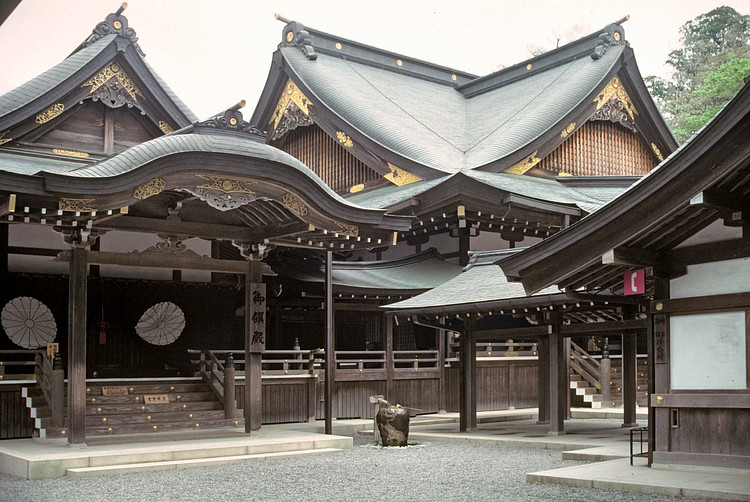 Kaguraden at the Ise Grand Shrine Fg2 (Public Domain) ](https://www.worldhistory.org/image/6468/kaguraden-at-the-ise-grand-shrine/ "Kaguraden at the Ise Grand Shrine")The second most important shrine is that of Okuninushi at Izumo-taisha. These two are the oldest Shinto shrines in Japan. Besides the most famous shrines, every local community had and still has small shrines dedicated to their particular *kami* spirits. Even modern [city](https://www.worldhistory.org/city/) buildings can have a small Shinto shrine on their roof. Some shrines are even portable. Known as *mikoshi*, they can be moved so that ceremonies can be held at places of great natural beauty such as waterfalls.
### Worship & Festivals
The sanctity of shrines means that worshippers must cleanse themselves (*oharai*) before entering them, commonly by washing their hands and mouth with water. Then, when ready to enter, they make a small money offering, ring a small bell or clap their hands twice to alert the *kami* and then bow while saying their prayer. A final clap indicates the end of the prayer. It is also possible to request a priest offer one's prayer. Small offerings might include a bowl of sake (rice wine), rice, and vegetables. As many shrines are in places of natural beauty such as mountains, visiting these shrines is seen as an act of pilgrimage, Mt. Fuji being the most famous example. Believers sometimes wear Omamori, too, which are small embroidered sachets containing prayers to guarantee the person's well-being. As Shinto has no particular view on the afterlife, Shinto cemeteries are rare. Most followers are cremated and interred in Buddhist cemeteries.
The calendar is punctuated by religious festivals to honour particular *kami*. During these events, portable shrines may be taken to sites linked to a *kami,* or there are parades of colourful floats, and worshippers sometimes dress to impersonate certain divine figures. Amongst the most important annual festivals are the three-day *Shogatsu Matsuri* or Japanese New Year festival, the *Obon* Buddhist celebration of the dead returning to the ancestral home which includes many Shinto rituals, and the annual local *matsuri* when a shrine is transported around the local community to purify it and ensure its future well-being.
This content was made possible with generous support from the [Great Britain Sasakawa Foundation](http://www.gbsf.org.uk/?utm_source=ancient.eu&utm_medium=link&utm_campaign=ancient.eu).
#### Editorial Review
This human-authored definition has been reviewed by our editorial team before publication to ensure accuracy, reliability and adherence to academic standards in accordance with our [editorial policy](https://www.worldhistory.org/static/editorial-policy/).
## Bibliography
- [Cali, J. *Shinto Shrines.* Latitude 20, 2012.](https://www.worldhistory.org/books/0824837134/)
- [Henshall, K. *Historical Dictionary of Japan to 1945.* Scarecrow Press, 2013.](https://www.worldhistory.org/books/0810878712/)
- [Scott Littleton, C. *Understanding Shinto.* Duncan Baird Publishers, 2002.](https://www.worldhistory.org/books/1903296757/)
## About the Author
Mark is WHE’s Publishing Director and has an MA in Political Philosophy (University of York). He is a full-time researcher, writer, historian and editor. Special interests include art, architecture and discovering the ideas that all civilizations share.
## Timeline
- **4 BCE**: Traditional founding date of the [Ise Grand Shrine](https://www.worldhistory.org/Ise_Grand_Shrine/) in honour of the [Shinto](https://www.worldhistory.org/Shinto/) goddess [Amaterasu](https://www.worldhistory.org/Amaterasu/).
- **478 CE**: The founding of the Toyouke shrine at the [Shinto](https://www.worldhistory.org/Shinto/) [Ise Grand Shrine](https://www.worldhistory.org/Ise_Grand_Shrine/) in [Japan](https://www.worldhistory.org/disambiguation/Japan/).
- **593 CE**: The traditional foundation date of the [Shinto](https://www.worldhistory.org/Shinto/) [Itsukushima Shrine](https://www.worldhistory.org/Itsukushima_Shrine/).
- **711 CE**: The Fushimi [Inari](https://www.worldhistory.org/Inari/) shrine, dedicated to the [Shinto](https://www.worldhistory.org/Shinto/) rice [god](https://www.worldhistory.org/God/) Inari, is founded near Kyoto.
- **712 CE**: The [Kojiki](https://www.worldhistory.org/Kojiki/) is written, a collection of oral myths forming the basis of the [Shinto religion](https://www.worldhistory.org/collection/43/the-shinto-religion/).
- **713 CE**: The Japanese Fudoki are composed and record local [kami](https://www.worldhistory.org/Kami/) and associated legends.
- **720 CE**: The [Nihon Shoki](https://www.worldhistory.org/Nihon_Shoki/) is written, a collection of oral myths forming the basis of the [Shinto religion](https://www.worldhistory.org/collection/43/the-shinto-religion/).
- **725 CE**: The Usa shrine is founded in northern Kyushu and dedicated to the [Shinto](https://www.worldhistory.org/Shinto/) [god](https://www.worldhistory.org/God/) [Hachiman](https://www.worldhistory.org/Hachiman/).
- **c. 759 CE**: The [Manyoshu](https://www.worldhistory.org/Manyoshu/) or 'Collection of 10,000 Leaves' is written, an important [Shinto](https://www.worldhistory.org/Shinto/) source and classic of Japanese poetry.
- **768 CE**: Official founding date of the [Kasuga Taisha](https://www.worldhistory.org/Kasuga_Taisha/) [Shinto](https://www.worldhistory.org/Shinto/) shrine at [Nara](https://www.worldhistory.org/Nara/), [Japan](https://www.worldhistory.org/disambiguation/Japan/).
- **794 CE**: [Emperor Kammu](https://www.worldhistory.org/Emperor_Kammu/) builds the [Shinto](https://www.worldhistory.org/Shinto/) Herano shrine at [Heiankyo](https://www.worldhistory.org/Heiankyo/) (Kyoto).
- **806 CE**: The [Shinto](https://www.worldhistory.org/Shinto/) shrine of Fujisan Hongu Sengen Taisha is built on [Mount Fuji](https://www.worldhistory.org/Mount_Fuji/).
- **c. 807 CE**: Imibe-no-Hironari writes the Kogoshui, a collection of oral myths forming the basis of the [Shinto religion](https://www.worldhistory.org/collection/43/the-shinto-religion/).
- **811 CE**: The probable historical date for the foundation of the [Shinto](https://www.worldhistory.org/Shinto/) [Itsukushima Shrine](https://www.worldhistory.org/Itsukushima_Shrine/).
- **845 CE - 903 CE**: Life of the deified scholar and court official Sugawara no Michizane, aka [Tenjin](https://www.worldhistory.org/Tenjin/).
- **859 CE**: The Iwashimizu shrine is built and dedicated to the [Shinto](https://www.worldhistory.org/Shinto/) [god](https://www.worldhistory.org/God/) [Hachiman](https://www.worldhistory.org/Hachiman/) in [Heiankyo](https://www.worldhistory.org/Heiankyo/) (Kyoto).
- **937 CE**: The [Shinto](https://www.worldhistory.org/Shinto/) [god](https://www.worldhistory.org/God/) [Hachiman](https://www.worldhistory.org/Hachiman/) is officially recognised as a bodhisattva.
- **947 CE**: The Tenmangu Kitano shrine is founded in honour of Sugawara no Michizane, aka [Tenjin](https://www.worldhistory.org/Tenjin/).
- **987 CE**: Sugawara no Michizane is officially deified and given the title [Tenjin](https://www.worldhistory.org/Tenjin/).
- **1046 CE**: Yorinobu claims [Hachiman](https://www.worldhistory.org/Hachiman/) patron [god](https://www.worldhistory.org/God/) and founder of the [Minamoto clan](https://www.worldhistory.org/Minamoto_Clan/) in [Japan](https://www.worldhistory.org/disambiguation/Japan/).
- **1135 CE**: The Wakamiya Jinja shrine is founded at [Kasuga Taisha](https://www.worldhistory.org/Kasuga_Taisha/), [Nara](https://www.worldhistory.org/Nara/), [Japan](https://www.worldhistory.org/disambiguation/Japan/).
- **1149 CE**: The Dainichiji [temple](https://www.worldhistory.org/temple/) is built near the peak of [Mount Fuji](https://www.worldhistory.org/Mount_Fuji/) by Matsudai Shonin.
- **1168 CE**: Taira no Kiyomori significantly remodels the [Itsukushima Shrine](https://www.worldhistory.org/Itsukushima_Shrine/).
- **1191 CE**: The [Shinto](https://www.worldhistory.org/Shinto/) Tsurugaoka [Hachiman](https://www.worldhistory.org/Hachiman/) Shrine is moved from Yuinogo to [Kamakura](https://www.worldhistory.org/Kamakura/), [Japan](https://www.worldhistory.org/disambiguation/Japan/) by Minamoto no Yoritomo.
## Questions & Answers
### What are the main beliefs of Shinto?
The main beliefs of Shinto are the importance of purity, harmony, respect for nature, family respect, and subordination of the individual before the group. There are many Shinto gods or spirits and these have shrines dedicated to them where people offer food, money and prayers.
### Why is Shinto not considered a religion by some people?
Some people do not consider Shinto a religion because there is no sacred text or founder and because it emphasises general concepts of how to live. Some people regard Shinto as more about ritual than what a person believes.
### How do Shinto and Buddhism coexist?
Shinto and Buddhism coexist in Japan because many people follow both religions since the former emphasises this life and the latter emphasises the next life. Often, sacred sites have both a Buddhist temple and a Shinto shrine. Historically, the two religions have coexisted and many sacred figures have crossed over to appear in the other religion, Hachiman and Amida are examples.
### How does Shinto affect Japanese culture?
Shinto beliefs have become so intertwined with Japanese culture that the two are often difficult to separate. The Japanese have a great respect for nature, family, and ancestors, and they often promote the group above the individual. All of these ideas come from Shinto.
## External Links
- [Shinto | Essay | The Metropolitan Museum of Art | Heilbrunn Timeline of Art History](https://www.metmuseum.org/toah/hd/shin/hd_shin.htm)
- [Shinto Portal - IJCC, Kokugakuin University](https://www2.kokugakuin.ac.jp/e-shinto/)
## Cite This Work
### APA
Cartwright, M. (2017, April 03). Shinto. *World History Encyclopedia*.
### Chicago
Cartwright, Mark. "Shinto." *World History Encyclopedia*, April 03, 2017. .
### MLA
Cartwright, Mark. "Shinto." *World History Encyclopedia*, 03 Apr 2017, .
## License & Copyright
Submitted by [Mark Cartwright](https://www.worldhistory.org/user/markzcartwright/ "User Page: Mark Cartwright"), published on 03 April 2017. The copyright holder has published this content under the following license: [Creative Commons Attribution-NonCommercial-ShareAlike](https://creativecommons.org/licenses/by-nc-sa/4.0/deed.en). This license lets others remix, tweak, and build upon this content non-commercially, as long as they credit the author and license their new creations under the identical terms. When republishing on the web a hyperlink back to the original content source URL must be included. Please note that content linked from this page may have different licensing terms.