---
title: Shengavit
author: James Blake Wiener
source: https://www.worldhistory.org/Shengavit/
format: machine-readable-alternate
license: Creative Commons Attribution-NonCommercial-ShareAlike (https://creativecommons.org/licenses/by-nc-sa/4.0/)
updated: 1970-01-01
---
# Shengavit
_Authored by [James Blake Wiener](https://www.worldhistory.org/user/jbw288/)_
The Shengavit archaeological site is an ancient settlement occupied from c. 3500 - c. 2200 BCE and is located in a southern suburb of what is presently Yerevan, [Armenia](https://www.worldhistory.org/armenia/). The site is nearly 3 hectares (7 acres) in size - it was originally between 10-12 hectares (25-30 acres) - and lies 30 m (98 ft) above the banks of the Hrazdan River. Considered by many archaeologists to be Armenia's most prominent prehistoric and Early [Bronze Age](https://www.worldhistory.org/disambiguation/Bronze_Age/) site, the artifacts found at Shengavit attest to the development of an early agricultural settlement of migrating tribes, whose technology and [culture](https://www.worldhistory.org/disambiguation/culture/) later spread outwards from the Armenian highlands into the Caucasus, [Mesopotamia](https://www.worldhistory.org/Mesopotamia/), and even the [Levant](https://www.worldhistory.org/levant/).
### An Unusual Archaeological Site
Although Shengavit is situated at a fortuitous location for defense and the exploitation of natural resources from the Hrazdan River - including lucrative salt deposits - this prehistoric settlement differed significantly from those of the ancient [Hittites](https://www.worldhistory.org/hittite/), Babylonians, and Egyptians from the fifth to the third millennia BCE. Originally founded in [Neolithic](https://www.worldhistory.org/Neolithic/) times, Shengavit was encompassed by cyclopean-like walls of stones taken from the nearby Hrazdan River and thus has an unusual stratigraphic layout.
[ 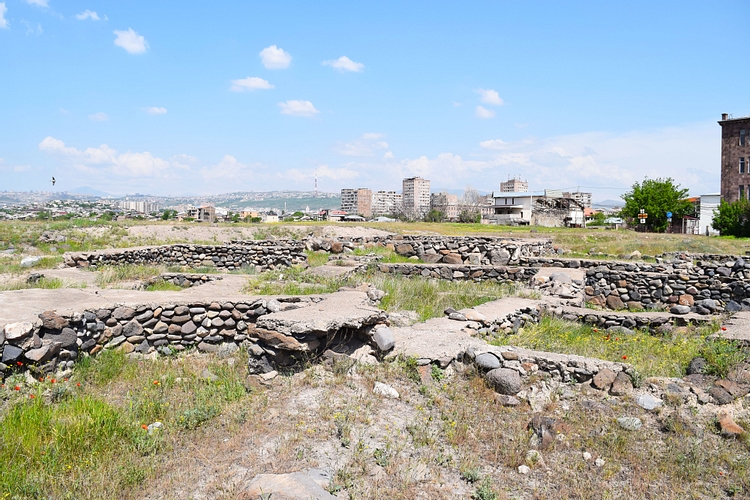 Shengavit Archaeological Site James Blake Wiener (CC BY-NC-SA) ](https://www.worldhistory.org/image/7247/shengavit-archaeological-site/ "Shengavit Archaeological Site")Archaeologists believe that the peoples who inhabited Shengavit lived together in interconnected, rectangular and circular structures made from mud clay and large split stones, which were brought from the Hrazdan River. Located next to these stones are circular hearths made from burnt brick, which served as pillar support to the rectangular structures and other round dwellings. Archaeologists have also uncovered two-story storage pits for grains and cereals in addition to cylindrical, stone-laid entrances, defensive stone walls connected to fortified towers with square layouts, and a mysterious tunnel that runs directly to the Hrazdan River. This peculiar layout is not common in other prehistoric and [Bronze](https://www.worldhistory.org/disambiguation/bronze/) Age settlements in the [Near East](https://www.worldhistory.org/Near_East/). Some archaeologists even posit that Shengavit was further divided into separate districts where groups of people lived according to their occupation or social standing - [copper](https://www.worldhistory.org/copper/) traders, stone workers or farmers lived on one side of the settlement, while merchants lived in other sections.
### Shengavit's People & Material Culture
Shengavit and its culture are increasingly viewed as a society in transition from tribal lifestyle to a sedentary community. (These people and their culture are referred to by academics as “Shengavitian” or “Kura-Araxes.”) Therefore, the advancement of society and cultural development at Shengavit appear to be similar and contemporaneous with other neighboring regions like Mesopotamia and [Anatolia](https://www.worldhistory.org/Asia_Minor/), despite Shengavit's unique structural layout. Material evidence demonstrates that Shengavit's inhabitants traded extensively with peoples located in present-day Iraq, Russia, Iran, and [Turkey](https://www.worldhistory.org/Asia_Minor/), and it is believed that Shengavit had a total population of between 2,000-6,000 people at its height.
[  Stone Tools at Shengavit Settlement James Blake Wiener (CC BY-NC-SA) ](https://www.worldhistory.org/image/7249/stone-tools-at-shengavit-settlement/ "Stone Tools at Shengavit Settlement")Among the most interesting finds at the site are “ornaments” carrying floral, geometric, or animal motifs. Statuettes, spindle heads, daggers, axes, ritual vessels, arrowheads, and tools in varying sizes and shapes have also been uncovered. Most artifacts were created from clay or animal bone. Fine adornments and beads made from precious and semiprecious metals like [gold](https://www.worldhistory.org/gold/), [silver](https://www.worldhistory.org/Silver/), and bronze, stones such as jasper, as well as glass, all imply the development of early social stratification amongst those who resided at Shengavit; moreover, the remains of molds used in the casting of weapons and the wide variance of bronze alloys found in recovered artifacts insinuate an elevated level of metallurgy at Shengavit as well. Exquisite black-varnished, gray, and orange-red earthware and sepulchres have been unearthed beyond Shengavit's enclosure and within a number of dwellings.
The oldest artifacts discovered at Shengavit date to the Neolithic-Chalcolithic period or the “Copper Age.” There are four archaeological or “cultural layers” measuring 4 m (13 f) deep at Shengavit, which are of immense interest to archaeologists: the first and deepest layer dates from the late Neolithic era (c. 3500-c. 3000 BCE); the second layer dates from the early Eneolithic era (c. 3000-c. 2700 BCE); the third layer dates from the middle Eneolithic era (c. 2700-c. 2300 BCE); and finally, the fourth and shallowest layer dates from the late Eneolithic era (c. 2300-c. 2000 BCE.)
[  Prehistoric Mortar from Shengavit James Blake Wiener (CC BY-NC-SA) ](https://www.worldhistory.org/image/7251/prehistoric-mortar-from-shengavit/ "Prehistoric Mortar from Shengavit")### Recent Excavations & Human Impact
Yevgeni Bayburdian and Hovsep Orbelli were the first researchers to work at Shengavit from 1936-1938 CE for the Soviet Committee for the Preservation of Historical Monuments, but their excavations ceased at the end of the Great Purge and World [War](https://www.worldhistory.org/disambiguation/War/) II. (Bayburdian was subsequently arrested, tried, and executed under orders from Joseph Stalin.) Investigations and excavation work led by Sandro Sardarian lasted from 1958 until 1980 CE but stopped just after the beginning of the Soviet-Afghan War (1980-1989 CE). A small museum opened on the site's environs in 1968 CE to [mark](https://www.worldhistory.org/disambiguation/Mark/) the 2750th anniversary of the founding of Yerevan (or ancient [Erebuni](https://www.worldhistory.org/Erebuni/)); that same year, the excavated constructions were partially restored and opened to the public.
Human degradation has taken a heavy toll on Shengavit. After Stalin's [death](https://www.worldhistory.org/disambiguation/Death/) in 1953 CE, the Soviet Union sold a portion of land occupied by Shengavit in order to build a hospital. After Armenia gained its independence in 1991 CE, an additional 40% of the Shengavit preserve was sold illegally and privatized. In recent years, excavation work has once more resumed and was undertaken by Dr. Hakob Simonian in 2000 CE, which continued in 2009, 2010, and 2012 CE with the assistance of Dr. Mitchell Rothman, an archaeologist and professor at Widener University in the United States.
This article was made possible with generous support from the [National Association for Armenian Studies and Research](https://naasr.org/?utm_source=ancient.eu&utm_medium=link&utm_campaign=ancient.eu) and the Knights of Vartan Fund for Armenian Studies.
#### Editorial Review
This human-authored definition has been reviewed by our editorial team before publication to ensure accuracy, reliability and adherence to academic standards in accordance with our [editorial policy](https://www.worldhistory.org/static/editorial-policy/).
## Bibliography
- [Shengavit Settlement (Erebuni Historical & Archaeological Museum-Reserve)](http://www.erebuni.am/index.php?option=com_content&view=article&id=1243&Itemid=111&lang=en "Shengavit Settlement (Erebuni Historical & Archaeological Museum-Reserve)"), accessed 21 Sep 2017.
- [Shengavit: Archaeology, Renovations Progressing](https://armenianweekly.com/2012/07/11/shengavit-archaeology-renovations-progressing/ "Shengavit: Archaeology, Renovations Progressing"), accessed 19 Mar 2020.
- Anonymous. *Erebuni: Historical & Archaeological Culture Preserve.* Prepared by Erebuni Historical & Archaeological Culture Preserve, Yerevan
- Simonyan, H. E. "THE ARCHAEOLOGICAL SITE OF SHENGAVIT: AN ANCIENT TOWN IN THE ARMENIAN HIGHLAND." *FUNDAMENTAL ARMENOLOGY*, No. 1, 2015.
## About the Author
James Blake Wiener has a particular interest in cross-cultural exchange and world history. He is a co-founder of World History Encyclopedia and formerly was its Communications Director.
- [Linkedin Profile](https://www.linkedin.com/in/jameswiener)
## Timeline
- **3500 BCE - 2200 BCE**: Occupation of Shnagavit in ancient [Armenia](https://www.worldhistory.org/armenia/).
## Cite This Work
### APA
Wiener, J. B. (2017, September 25). Shengavit. *World History Encyclopedia*.
### Chicago
Wiener, James Blake. "Shengavit." *World History Encyclopedia*, September 25, 2017. .
### MLA
Wiener, James Blake. "Shengavit." *World History Encyclopedia*, 25 Sep 2017, .
## License & Copyright
Submitted by [James Blake Wiener](https://www.worldhistory.org/user/jbw288/ "User Page: James Blake Wiener"), published on 25 September 2017. The copyright holder has published this content under the following license: [Creative Commons Attribution-NonCommercial-ShareAlike](https://creativecommons.org/licenses/by-nc-sa/4.0/deed.en). This license lets others remix, tweak, and build upon this content non-commercially, as long as they credit the author and license their new creations under the identical terms. When republishing on the web a hyperlink back to the original content source URL must be included. Please note that content linked from this page may have different licensing terms.