---
title: Selinus
author: Mark Cartwright
source: https://www.worldhistory.org/Selinus/
format: machine-readable-alternate
license: Creative Commons Attribution-NonCommercial-ShareAlike (https://creativecommons.org/licenses/by-nc-sa/4.0/)
updated: 1970-01-01
---
# Selinus
_Authored by [Mark Cartwright](https://www.worldhistory.org/user/markzcartwright/)_
Selinus (or Selinous, modern: Selinunte), located on the south-west coast of [Sicily](https://www.worldhistory.org/sicily/), was founded in the mid-7th century BCE by [Greek](https://www.worldhistory.org/disambiguation/greek/) colonists from [Megara](https://www.worldhistory.org/disambiguation/Megara/) Hyblaea on the eastern side of the island. Selinus was the most western Greek colony on Sicily, and it became an important *[polis](https://www.worldhistory.org/Polis/)* or [city-state](https://www.worldhistory.org/Polis/) in the Classical period. The site covered an unusually large and well-planned urban and sacred area, the latter once having at least ten separate temples from the 6th to 5th century BCE. The site also acquired extensive fortifications of which long sections, and especially the North Gate, survive today. The [Temple](https://www.worldhistory.org/temple/) of [Hera](https://www.worldhistory.org/Hera/), Temple C to an unknown deity (perhaps [Apollo](https://www.worldhistory.org/apollo/)), and several other sacred buildings also survive and their spread across the valleys of the site indicates the impressive size and status Selinus once enjoyed in the ancient [Mediterranean](https://www.worldhistory.org/disambiguation/mediterranean/).
### Historical Overview
According to [Thucydides](https://www.worldhistory.org/Thucydides/), in 628 BCE Greek colonists from Megara Hyblaea on the eastern side of Sicily chose the site around the Manuzza hill, as it benefitted from a natural port and was surrounded by fertile plains ideal for [agriculture](https://www.worldhistory.org/disambiguation/Agriculture/), especially wheat and olive production. The town was named after the river Selinos on whose mouth it is situated. The name comes from the Greek word for wild celery (*sélinon*) which grew (and still grows) abundantly in the area.
The site was specifically planned as a megalopolis and so its urban spread is impressive; the residential area on the Manuzza plain, for example, covered at least 20 acres. Planned along two separate grid patterns which joined via a trapezoid [agora](https://www.worldhistory.org/agora/), the [city](https://www.worldhistory.org/city/) was completely re-designed between 580 and 570 BCE. Selinus is, therefore, one of the best examples of ancient town planning, and there is evidence that along the central streets building façades were deliberately made uniform to present a pleasing urban landscape. In 444 BCE, the health of the city was greatly improved when the marshland around the settlement was drained by [Empedocles](https://www.worldhistory.org/Empedocles/), the famed scientist and philosopher from [Agrigento](https://www.worldhistory.org/agrigento/), in order to rid the area of pestilent diseases.
The sacred area with its public buildings was even more impressive with no fewer than ten temples constructed. Other indicators of the city's wealth are the presence of a [theatre](https://www.worldhistory.org/disambiguation/theatre/), the fact that Selinus had its own mint producing coins with symbols of the city, such as the river [god](https://www.worldhistory.org/God/) Selinus and wild celery, and the presence of satellite colonies such as Eraclea Minoa, established in 570 BCE.
As Selinus was the westernmost Greek colony in Sicily, the *polis* was in close proximity to the Phoenician and Elymi peoples. Indeed, Selinus allied itself with [Carthage](https://www.worldhistory.org/carthage/) from 480 BCE and was often at [war](https://www.worldhistory.org/disambiguation/War/) with local rival [Segesta](https://www.worldhistory.org/Segesta/) on the northern coast of the island. Although initially ruled by an oligarchy, Selinus, as with most Sicilian [cities](https://www.worldhistory.org/city/), was governed by tyrants throughout the 5th century BCE. These included Terone, Polienus, [Pythagoras](https://www.worldhistory.org/Pythagoras/), and Eurileonte.
Embroiled in the conflict between Segesta and her ally [Athens](https://www.worldhistory.org/Athens/) against [Syracuse](https://www.worldhistory.org/syracuse/) on the east coast in 415 BCE, Selinus was ultimately sacked by Carthage in 409 BCE. [Hannibal](https://www.worldhistory.org/hannibal/) led the attack, besieging the city for nine days and finally slaughtering some 16,000 of the town's inhabitants. The city was rebuilt by the Syracusan exile Hermocrates, but in the 4th century BCE, back under Carthaginian control, fortifications were added to the [acropolis](https://www.worldhistory.org/Acropolis/) area, and many buildings were also adapted to the worship of [Punic](https://www.worldhistory.org/carthage/) gods such as Tanit and [Baal](https://www.worldhistory.org/baal/) Hammon. By the [first Punic war](https://www.worldhistory.org/First_Punic_War/) with [Rome](https://www.worldhistory.org/Rome/), Carthage forced the residents of Selinus to re-locate to Lilybaeum, and so Selinus was definitively abandoned by 250 BCE.
[  Fortifications, Selinus Mark Cartwright (CC BY-NC-SA) ](https://www.worldhistory.org/image/2611/fortifications-selinus/ "Fortifications, Selinus")### Archaeological Remains
The site of Selinus today presents itself as a sprawling mish-mash of ruined temples and jumbled architectural rubble. The grandeur of the city is still hinted at, though, by the sheer scale of today's evocative physical remains and, indeed, as Guy de Maupassant wrote in 1885 CE, 'These shapeless stones can be interesting only to archaeologists or poetic souls, moved by all these traces of the past' (*Journey to Sicily*). It is not known which deities many of the temples were dedicated to, and so they have been classified using letters.
**Temple A**
Built between 480 and 470 BCE, the temple measured around 40 x 16 metres and had six columns on the façade with 14 along the sides. It was possibly dedicated to [Artemis](https://www.worldhistory.org/artemis/) or Lethe. The interior flooring contains a [mosaic](https://www.worldhistory.org/Mosaic/) depicting the Punic goddess of fertility Tanit.
**Temple B**
Constructed in the 3rd century BCE it measured 8.4 x 4.6 metres. Typical of [Hellenistic](https://www.worldhistory.org/Hellenic_World/) temples, it mixes both Doric and Ionic architectural elements.
**Temple C**
This is the largest and oldest temple on the acropolis (around 64 x 24 metres) and may have been built in honour of Apollo, Artemis, or [Hercules](https://www.worldhistory.org/hercules/). Constructed between 580 and 560 BCE it commands a spectacular view of the sea. The Doric temple had six columns on each façade and 17 along the sides, each 8.62 metres high.
**Temple D**
Built around 540 BCE, this temple measure 56 x 24 metres and had 6 x 13 columns around the exterior, each 7.5 metres high.
[  Interior, Temple of Hera, Selinus Mark Cartwright (CC BY-NC-SA) ](https://www.worldhistory.org/image/2601/interior-temple-of-hera-selinus/ "Interior, Temple of Hera, Selinus")**Temple E**
Dedicated to Hera 480-460 BCE, the Doric style temple measures approximately 70 x 27.5 metres and has six columns on each façade and 15 along the sides, each 10.2 metres high. Unusually, parts of the inner cella survive.
**Temple F**
Possibly dedicated to [Dionysos](https://www.worldhistory.org/Dionysos/) or [Athena](https://www.worldhistory.org/athena/) between 550 and 520 BCE, the Doric temple measured 65.7 x 27.4 metres with a 6 x 14 arrangement of columns, each 9.11 metres high. The surviving metopes from the temple depict scenes from a gigantomachy.
**Temple G**
Probably dedicated to [Zeus](https://www.worldhistory.org/zeus/), this is the largest temple at Selinus and was begun in c. 525 BCE but was never completed. It measured a huge 110 x 50 metres and used tufa quarried from nearby Cusa. The façade had eight columns with 17 along the long sides, each 16.27 metres high. Today it is a mass of tumbled [column](https://www.worldhistory.org/column/) drums and broken blocks with only a single column still standing.
**Temple O**
Dating to 480-470 BCE, the temple measured approximately 40 x 16 metres with 6 x 14 external columns.
**North Gate & Fortifications**
The original 6th century BCE acropolis was fortified, but the walls visible at the site today date to the 5th to 3rd centuries BCE. The fortifications include regular-shaped towers and the impressive three-towered North Gate with its preceding street of shops. Built with fixed catapult emplacements in mind, the fortifications took on an offensive aspect rather than solely defensive with the incorporation of regularly placed exits and even a three-tiered tunnel. The northern-facing [wall](https://www.worldhistory.org/wall/) also has a dry moat and two small arched bridges cross it.
**The Sanctuary of [Demeter](https://www.worldhistory.org/demeter/) Malaphoros**
Built from the 6th century BCE, the sanctuary included several buildings, most important amongst them being the temple of Demeter. All of these structures were enclosed within a boundary wall, measuring approximately 50 x 60 metres. The sacred area also included a field of stelae, sacrificial altars, and a portico. Many votive offerings have been excavated at the site ranging from precious [metal](https://www.worldhistory.org/disambiguation/metal/) artwork to thousands of clay statues of a female deity, probably Demeter.
[ 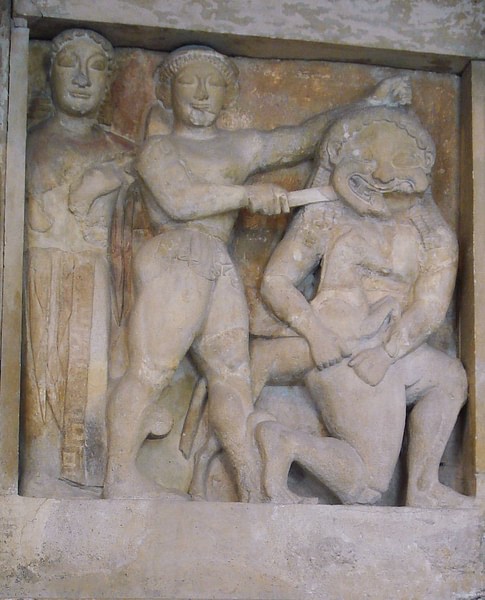 Perseus and Medusa wikipedia user: Amandajm (CC BY-SA) ](https://www.worldhistory.org/image/2610/perseus-and-medusa/ "Perseus and Medusa")### Surviving Art
Aside from the impressive structures at Selinus, the city's legacy is also represented in the splendid temple metopes which now reside in the Archaeological Museum of Palermo. The 6th and 5th century BCE sculptures depict vibrant scenes from [Greek mythology](https://www.worldhistory.org/Greek_Mythology/); often they are male/female confrontations, and amongst these are representations of Zeus and Hera and, most famously, [Perseus](https://www.worldhistory.org/Perseus/) slaying [Medusa](https://www.worldhistory.org/Medusa/) who grasps in her arms [Pegasus](https://www.worldhistory.org/Pegasus/) whilst Athena looks on from the left side. Other metopes show a frontal view of a four-horse [chariot](https://www.worldhistory.org/chariot/) driven by Apollo and Hercules holding the upside-down Cercopes. All are exceptional examples of Greek [Archaic](https://www.worldhistory.org/disambiguation/Archaic/) style [sculpture](https://www.worldhistory.org/disambiguation/Sculpture/). Finally, the 85 cm tall [bronze](https://www.worldhistory.org/disambiguation/bronze/) statue known as the Ephebus of Selinus, now in the town museum of Castelvetrano, is a rare and very fine example of 5th century BCE Greek bronze sculpture.
#### Editorial Review
This human-authored definition has been reviewed by our editorial team before publication to ensure accuracy, reliability and adherence to academic standards in accordance with our [editorial policy](https://www.worldhistory.org/static/editorial-policy/).
## Bibliography
- Bianco, L. *Selinus.* La Medusa Editrice, 2006
- [Boys-Stones, G. et al. *The Oxford Handbook of Hellenic Studies.* Oxford University Press, 2009.](https://www.worldhistory.org/books/0199286140/)
- Casano, F. *Selinus.* Tiziana Casano Editrice, Trapani, 2006
- Dragotta, A.M. *Sicily.* Polygraf, Palermo, 1978
- [Durando, F. *Ancient Greece.* Barnes & Noble Books, 1990.](https://www.worldhistory.org/books/0760762376/)
- [Hornblower, S. *The Oxford Classical Dictionary.* Oxford University Press, 2012.](https://www.worldhistory.org/books/0199545561/)
- [Kinzl, K.H. (ed). *A Companion to the Classical Greek World.* Wiley-Blackwell, 2010.](https://www.worldhistory.org/books/1444334123/)
- [Thucydides. *The Landmark Thucydides.* Free Press, 1998.](https://www.worldhistory.org/books/0684827905/)
## About the Author
Mark is WHE’s Publishing Director and has an MA in Political Philosophy (University of York). He is a full-time researcher, writer, historian and editor. Special interests include art, architecture and discovering the ideas that all civilizations share.
## Timeline
- **c. 630 BCE**: [Selinus](https://www.worldhistory.org/Selinus/) is founded by colonists from [Megara](https://www.worldhistory.org/disambiguation/Megara/) Hyblaea, [Sicily](https://www.worldhistory.org/sicily/).
- **580 BCE - 576 BCE**: [War](https://www.worldhistory.org/disambiguation/War/) between the Sicilian [city](https://www.worldhistory.org/city/)-states of [Segesta](https://www.worldhistory.org/Segesta/) and [Selinus](https://www.worldhistory.org/Selinus/).
- **580 BCE - 560 BCE**: The main [temple](https://www.worldhistory.org/temple/) of the [acropolis](https://www.worldhistory.org/Acropolis/), Temple C, was built at [Selinus](https://www.worldhistory.org/Selinus/).
- **416 BCE**: [War](https://www.worldhistory.org/disambiguation/War/) breaks out again between rival Sicilian [city](https://www.worldhistory.org/city/)-states [Segesta](https://www.worldhistory.org/Segesta/) and [Selinus](https://www.worldhistory.org/Selinus/).
- **250 BCE**: [Selinus](https://www.worldhistory.org/Selinus/) on [Sicily](https://www.worldhistory.org/sicily/) is abandoned.
## Cite This Work
### APA
Cartwright, M. (2014, May 02). Selinus. *World History Encyclopedia*.
### Chicago
Cartwright, Mark. "Selinus." *World History Encyclopedia*, May 02, 2014. .
### MLA
Cartwright, Mark. "Selinus." *World History Encyclopedia*, 02 May 2014, .
## License & Copyright
Submitted by [Mark Cartwright](https://www.worldhistory.org/user/markzcartwright/ "User Page: Mark Cartwright"), published on 02 May 2014. The copyright holder has published this content under the following license: [Creative Commons Attribution-NonCommercial-ShareAlike](https://creativecommons.org/licenses/by-nc-sa/4.0/deed.en). This license lets others remix, tweak, and build upon this content non-commercially, as long as they credit the author and license their new creations under the identical terms. When republishing on the web a hyperlink back to the original content source URL must be included. Please note that content linked from this page may have different licensing terms.