---
title: Selene
author: Liana Miate
source: https://www.worldhistory.org/Selene/
format: machine-readable-alternate
license: Creative Commons Attribution-NonCommercial-ShareAlike (https://creativecommons.org/licenses/by-nc-sa/4.0/)
updated: 2023-02-01
---
# Selene
_Authored by [Liana Miate](https://www.worldhistory.org/user/lianamiate/)_
Selene (also known as Mene) is the personification and goddess of the moon in [Greek mythology](https://www.worldhistory.org/Greek_Mythology/). Every night, she travels across the sky in her [chariot](https://www.worldhistory.org/chariot/), pulling the moon behind her. Selene is the daughter of the Titans Hyperion and Theia. She is commonly associated with the fellow [Greek](https://www.worldhistory.org/disambiguation/greek/) goddesses [Artemis](https://www.worldhistory.org/artemis/) and [Hecate](https://www.worldhistory.org/Hecate/). The [Roman](https://www.worldhistory.org/disambiguation/Roman/) counterpart of Selene is Luna.
### Birth & Family
According to [Hesiod](https://www.worldhistory.org/hesiod/)'s (c. 700 BCE) *[Theogony](https://www.worldhistory.org/Theogony/)*, Selene is the daughter of the Titans Hyperion and Theia and the sister of [Helios](https://www.worldhistory.org/Helios/) (Sun) and [Eos](https://www.worldhistory.org/Eos/) (Dawn). She is also a descendant of [Uranus](https://www.worldhistory.org/Uranus/) (Heavens) and [Gaia](https://www.worldhistory.org/Gaia/) (Earth).
> And Theia, mastered by Hyperion,
> Bore Helios the great, bright Selene,
> And Eos, who shines upon all men on earth
> And on the deathless gods who hold broad heaven.
> (Hesiod, *Theogony*, 371-374)
Selene has two daughters with [Zeus](https://www.worldhistory.org/zeus/); Pandia (who the Athenians honoured every full moon) and Ersa (Herse), the personification of the dew.
### Selene, the Moon Goddess
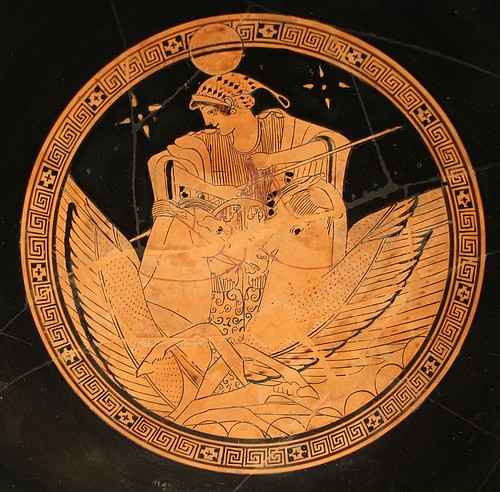
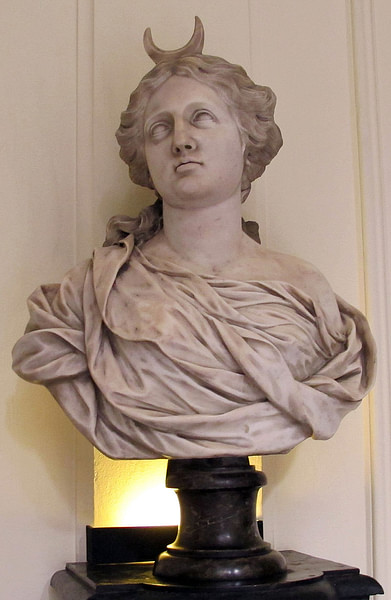
Selene, meaning "the moon", was depicted as a beautiful woman with long wings and a [gold](https://www.worldhistory.org/gold/) crown. Her crown shone a gentle light in the darkness of the night. Selene's moon chariot was pulled across the night sky by a pair of white-silvery horses or sometimes by a pair of oxen. She had a radiance that waxes and wanes with the different phases of the moon.
In the *Orphic Hymn to Selene*, she has horns. In the *Homeric Hymn to Selene,* Selene is described as a kindly and beautiful winged goddess who is crowned with gold and drives her chariot across the night sky as a sign to humans.
> Glistening in heaven
> from her immortal head,
> a radiance encircles earth
> and from her shining light
> great beauty comes.
> The air unlit before
> glows with her golden crown
> and her beams are bright as day.
> (*The Homeric Hymns: Hymn to Selene*, 32.4-7)
The moon was a powerful force in the ancient world. The moon's phases created the schedule of religious festivals celebrated throughout the year and symbolised the cycles of birth and [death](https://www.worldhistory.org/disambiguation/Death/), with the ancient Greeks measuring out time in lunar months. [Women in ancient Greece](https://www.worldhistory.org/article/927/women-in-ancient-greece/) also had a special connection with the moon as it linked to their menstrual cycles, and the shape of a full moon echoed that of heavily pregnant [women](https://www.worldhistory.org/disambiguation/women/).
Some people believed that spirits lived on the moon, while neo-Plaonists believed that purified souls went to the moon after they had died. Another popular belief during the Classical Period was that witches could bring the moon down from the sky, linking Selene to witchcraft, which was further supported by the idea that magical herbs were usually collected and dried by moonlight. Therefore, some Roman and Greek writers associated her with Hecate, the goddess of magic.
[  Vase Painting of Selene and Her Horses Sailko (CC BY) ](https://www.worldhistory.org/image/16918/vase-painting-of-selene-and-her-horses/ "Vase Painting of Selene and Her Horses")###
In Art
Throughout antiquity, Selene is portrayed on vases, reliefs, gems, and coins. In Greek art, Selene was usually depicted with a crescent moon crown and without wings. She was often seen with the moon and alongside her brother Helios flying across the sky – Selene on horseback and Helios in a chariot.
One of the most famous surviving depictions of Selene is the [Greek sculpture](https://www.worldhistory.org/Greek_Sculpture/) by [Phidias](https://www.worldhistory.org/Phidias/) (d. c. 430 BCE) which can be found on the [Parthenon](https://www.worldhistory.org/parthenon/) in [Athens](https://www.worldhistory.org/Athens/). It shows Helios' chariot rising up on the eastern horizon (the sun rising), while on the other side, Selene and her horses are shown sinking over the west, symbolising their connection with the passing of time. Selene can also be found on the [Pergamon](https://www.worldhistory.org/pergamon/) Altar in a scene from the Gigantomachy. In an Attic red-figure kylix krater dating to 430 BCE, Selene is depicted with Helios, who drives a four-horse chariot, and Eos, who is on foot, while Selene is on horseback.
[  Selene Mina Bulic (CC BY-NC-ND) ](https://www.worldhistory.org/image/3616/selene/ "Selene")###
The Gigantomachy & [Typhon](https://www.worldhistory.org/Typhon/)
The only time Selene stopped pulling the moon across the night sky was at the orders of [Hera](https://www.worldhistory.org/Hera/) and Zeus during the [Giants](https://www.worldhistory.org/Giants/)' Revolt (Gigantomachy) against the Olympians. Hera had prophesied that the gods needed the help of a mortal (Heracles) to overthrow the gods. But first, they needed to locate a herb of invulnerability that grew in a secret place, so Hera forbade Selene and Helios to shine for a time. Under the low light of the stars, Zeus searched the earth for the herb and brought it back to heaven.
According to the Greek epic poet Nonnus (5th century CE) in his *Dionysiaca*, the monstrous serpent Typhon attacked Selene during his revolt against the heavens. He launched bulls at her, but she remained undaunted even after he charged at her. Selene struggled with Typhon, locking horns with him and scarring the orb of her bull's horn. Selene's cattle were wary of Typhon's gaping throat. Zeus finally defeated Typhon.
### Selene & Endymion
The best-known story involving Selene is her love affair with the beautiful youth Endymion. As she was flying in her chariot over western [Asia Minor](https://www.worldhistory.org/Asia_Minor/) (modern-day [Turkey](https://www.worldhistory.org/Asia_Minor/)), Selene spotted the shepherd Endymion sleeping on a hill near Mount Latmos. Overcome by his beauty, she waited for the new moon when her chariot would not be seen and flew down to lie with him as he slept.
[ 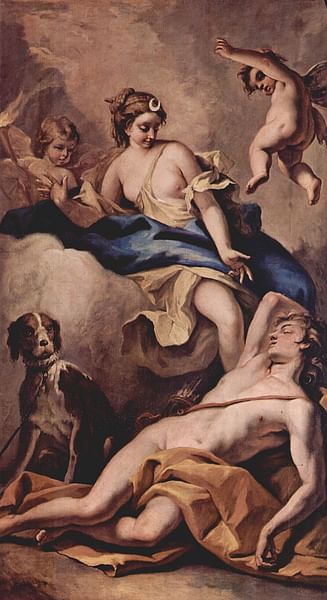 Selene and Endymion Sebastiano Ricci (Public Domain) ](https://www.worldhistory.org/image/16915/selene-and-endymion/ "Selene and Endymion")Selene bore Endymion 50 daughters. According to some sources, Selene begged Zeus to grant Endymion perpetual sleep, so he would not age or die and so she could watch him sleep peacefully each night. Other sources state that Endymion chose it for himself, while some say that it was Selene's punishment from Zeus for being absent from the skies.
### Selene & [Pan](https://www.worldhistory.org/Pan/)
Magic played a part in another one of Selene's relationships. The mischievous [god](https://www.worldhistory.org/God/) Pan disguised himself by covering his short, coarse black goat hair with soft, clean white fleece. Not realising his true identity, Selene climbed onto his back and permitted him to do whatever he wanted to her. Pan's seduction of Selene has ties to the May Eve festival, where the young Queen of the May rode upon her lover's back before taking part in a greenwood marriage ceremony.
### Selene's Revenge
A common theme seen amongst the Greek deities is how quick they are to rise to anger when they are beaten at something or if somebody challenges their powers or talents. This was the case with Ampelos, a youth who [Dionysos](https://www.worldhistory.org/Dionysos/) was enamoured with. Dionysos arranged multiple sporting competitions and was so in love with Ampelos that he let him win each one. Unfortunately, this resulted in Ampelos becoming overconfident.
One day, he foolishly stated that he was better at riding a wild bull than Selene was at riding her horned moon. Selene chose his punishment carefully. She sent down a gadfly that stung the wild bull Ampelos was riding. The crazed bull threw Ampelos from its back and attacked him. Dionysos rushed to Ampelos' side but could not save him. Dionysos transformed Ampelos' mangled body into a winding climbing plant where his blood turned into luscious berries.
[  Bust of Selene Sailko (CC BY-SA) ](https://www.worldhistory.org/image/16920/bust-of-selene/ "Bust of Selene")### Selene & Heracles
Selene was featured briefly in the story of Heracles, where she played a minor part in his being conceived. Zeus had fallen in love with the human Alcmene. To be able to visit her, he needed a long night to ensure that he went unseen. He instructed Hypnos (Sleep) to make all humans so tired that they would not notice that Helios (Sun) did not rise and that Selene moved extra slowly across the night sky, dragging out the night. Then, disguising himself as Alcmene's husband, Amphitryon, he snuck into Alcmene's chambers. Sleeping with both Zeus and her husband, Alcmene became pregnant with twins – Heracles with Zeus and Iphicles with her husband.
Selene is also credited with creating the ferocious Nemean Lion, whom Heracles faced in his first labour. The Nemean Lion was a [giant](https://www.worldhistory.org/Giants/) beast whose fur could not be penetrated by iron, stone or [bronze](https://www.worldhistory.org/disambiguation/bronze/) weapons. Some traditions state that Selene bore the lion with a shudder and dropped it to earth near [Nemea](https://www.worldhistory.org/nemea/) by a two-mouthed cave, where she made the creature prey upon her own people as punishment for an unfulfilled sacrifice.
Other sources say that in answer to Hera's wishes, Selene created the lion from sea foam which was then bound and carried to the Nemean mountains by [Iris](https://www.worldhistory.org/Iris/), the personification of the rainbow, before Heracles faced it.
### Worship & Legacy
In his *Description of [Greece](https://www.worldhistory.org/greece/)*, the Greek geographer [Pausanias](https://www.worldhistory.org/disambiguation/Pausanias/) (c. 115 to c. 180 CE) talks about a stone image of a horned Selene in Elis' [agora](https://www.worldhistory.org/agora/) (open-air marketplace) in southern Greece. According to the work of Pseudo-[Plutarch](https://www.worldhistory.org/plutarch/) in their *De fluviis*, Mount Apesantus used to be named Mount Selenaeus (moon mountain) after Selene.
[ 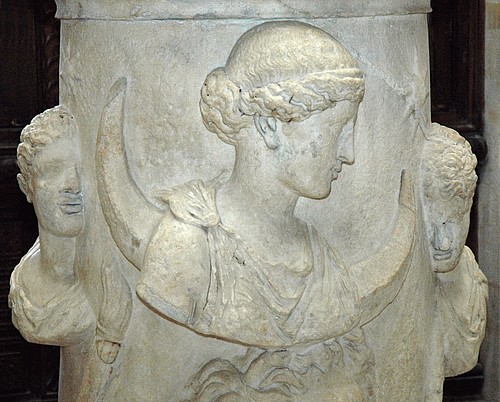 Selene on an Altarpiece Jastrow (Public Domain) ](https://www.worldhistory.org/image/16919/selene-on-an-altarpiece/ "Selene on an Altarpiece")Moon-shaped cakes were made in honour of Selene. According to the Greek historian Philochorus (340-261 BCE), the ancient Attic Tritopatores (a group of worshipped ancestors) were created by the union between the moon and sun, and the Athenians prayed to them. Greek poet [Pindar](https://www.worldhistory.org/Pindar/) (c. 518 to c. 448 BCE) stated that men in love prayed to the sun (Helios), while women in love prayed to the moon (Selene). Evidence of the worship of Selene and Helios could be found in an inscription in Gythium (the [Peloponnese](https://www.worldhistory.org/Peloponnese/)). [Diogenes of Sinope](https://www.worldhistory.org/Diogenes_of_Sinope/) (c. 404-323 BCE) dedicated altars to Selene, [Apollo](https://www.worldhistory.org/apollo/), [Asclepius](https://www.worldhistory.org/Asclepius/), and Hygieia at [Epidaurus](https://www.worldhistory.org/epidaurus/) in the Asclepieion.
In astronomy, the asteroid 580 Selene is named in honour of her. It orbits the Sun between [Mars](https://www.worldhistory.org/Mars/) and [Jupiter](https://www.worldhistory.org/jupiter/). In chemistry, the chemical element selenium was named after Selene in 1818 by the Swedish chemist Jöns [Jacob](https://www.worldhistory.org/Jacob/) Berzelius (1779-1848).
#### Editorial Review
This human-authored definition has been reviewed by our editorial team before publication to ensure accuracy, reliability and adherence to academic standards in accordance with our [editorial policy](https://www.worldhistory.org/static/editorial-policy/).
## Bibliography
- [580 Selene Asteroid Facts](https://www.universeguide.com/asteroid/1225/selene "580 Selene Asteroid Facts"), accessed 20 Jan 2023.
- [Bowman, Laurel & Bulloch, Anthony & Campbell, Andrew & Caviness, Alys & Chew, Kathryn. *Gods and Goddesses of Greece and Rome.* Cavendish Square, 2023.](https://www.worldhistory.org/books/0761479511/)
- Classical Association (Great Britain). *The Classical Review Volume 7.* D. Nutt, 1893
- [Daly, Kathleen N & Rengel, Marian. *Greek and Roman Mythology A to Z.* Chelsea House Publications, 2009.](https://www.worldhistory.org/books/1604134127/)
- [Fry, Stephen & Fry, Stephen. *Mythos.* Chronicle Books, 2019.](https://www.worldhistory.org/books/1452178917/)
- [Graves, Robert. *The Greek Myths\[May 15, 2018\] Graves, Robert.* Viking, 2018.](https://www.worldhistory.org/books/0241982359/)
- [Hesiod & Theognis & Wender, Dorothea & Wender, Dorothea. *Hesiod and Theognis.* Penguin Classics, 1976.](https://www.worldhistory.org/books/0140442839/)
- [Homer & Richardson, Nicholas & Cashford, Jules & Richardson, Nicholas. *Homeric Hymns.* Penguin Classics, 2003.](https://www.worldhistory.org/books/0140437827/)
- [Mackin Roberts, Ellie. *Heroines of Olympus.* Welbeck Publishing, 2020.](https://www.worldhistory.org/books/1787394921/)
- [NONNUS, DIONYSIACA BOOK 1 - Theoi Classical Texts Library](https://www.theoi.com/Text/NonnusDionysiaca1.html "NONNUS, DIONYSIACA BOOK 1 - Theoi Classical Texts Library"), accessed 20 Jan 2023.
- [ní Mheallaigh, Karen. *The Moon in the Greek and Roman Imagination.* Cambridge University Press, 2021.](https://www.worldhistory.org/books/1108716288/)
- [PAUSANIAS, DESCRIPTION OF GREECE 6.19-26 - Theoi Classical Texts Library](https://www.theoi.com/Text/Pausanias6B.html "PAUSANIAS, DESCRIPTION OF GREECE 6.19-26 - Theoi Classical Texts Library"), accessed 20 Jan 2023.
- [Powell, Barry B. *Classical Myth.* Oxford University Press, 2020.](https://www.worldhistory.org/books/0197527981/)
- [Preedy, Victor R. *Selenium.* Royal Society of Chemistry, 2015.](https://www.worldhistory.org/books/1849738912/)
- [Roman, Assistant Professor of Classics Luke & Roman, Monica. *Encyclopedia of Greek and Roman Mythology.* Facts on File, 2010.](https://www.worldhistory.org/books/0816072426/)
- [Vermaseren, M. J. *Corpus Cultus Cybelae Attidisque/2).* Brill Academic Pub, 1982.](https://www.worldhistory.org/books/9004064990/)
## About the Author
Liana is the Social Media Editor for Ancient History Encyclopedia. She holds a Bachelor of Arts Degree with a major in ancient Greece, Rome & Late Antiquity. She is particularly passionate about Rome and Greece, and anything to do with mythology or wo
- [Linkedin Profile](https://www.linkedin.com/in/lian)
## Questions & Answers
### Are Luna and Selene the same person?
Selene is the Greek goddess of the moon, and Luna is her Roman equivalent.
### What is Selene known for?
Selene is known for being the Greek goddess and personification of the moon.
### Was Selene a virgin goddess?
No. Selene had two daughters with Zeus and 50 daughters with Endymion.
### Who is Selene in love with?
Selene was in love with the beautiful shepherd, Endymion.
## Cite This Work
### APA
Miate, L. (2023, January 23). Selene. *World History Encyclopedia*.
### Chicago
Miate, Liana. "Selene." *World History Encyclopedia*, January 23, 2023. .
### MLA
Miate, Liana. "Selene." *World History Encyclopedia*, 23 Jan 2023, .
## License & Copyright
Submitted by [Liana Miate](https://www.worldhistory.org/user/lianamiate/ "User Page: Liana Miate"), published on 23 January 2023. The copyright holder has published this content under the following license: [Creative Commons Attribution-NonCommercial-ShareAlike](https://creativecommons.org/licenses/by-nc-sa/4.0/deed.en). This license lets others remix, tweak, and build upon this content non-commercially, as long as they credit the author and license their new creations under the identical terms. When republishing on the web a hyperlink back to the original content source URL must be included. Please note that content linked from this page may have different licensing terms.