---
title: Scotichronicon
author: Jeffrey King
source: https://www.worldhistory.org/Scotichronicon/
format: machine-readable-alternate
license: Creative Commons Attribution-NonCommercial-ShareAlike (https://creativecommons.org/licenses/by-nc-sa/4.0/)
updated: 1970-01-01
---
# Scotichronicon
_Authored by [Jeffrey King](https://www.worldhistory.org/user/koenig20054u/)_
The *Scotichronicon* is a 15th Century CE legendary chronicle by Walter Bower (c. 1385 – 1449 CE) which recounts the history of [Scotland](https://www.worldhistory.org/disambiguation/Scotland/) and the Scottish people. The *Scotichronicon* begins with the Biblical Creation story and ends with the [death](https://www.worldhistory.org/disambiguation/Death/) of James I in 1437 CE. With the exception of a few quotations, the 14 books of the *Scotichronicon* are written in Medieval Latin.
The beginning chapters of the *Scotichronicon* are widely accepted to be a mythological re-imagining of Scotland's past. Key narrative elements of the *Scotichronicon*, such as the Scottish exile from [Egypt](https://www.worldhistory.org/egypt/) and Goídel Glas' (aka Gathelus) invention of the Gaelic language, are derived from reinterpretations of Biblical narratives and fragments of Gaelic myth.
### Background & composition
The *Scotichronicon* is a continuation of *Chronica Gentis Scotorum* by John of Fordun (c. mid-14th Century CE – 1384 CE), which is the earliest known complete history of the Scots. By the time of his death in 1384, Fordun had completed the first five volumes of his chronicle and recorded history from the [Book of Genesis](https://www.worldhistory.org/Book_of_Genesis/) to the reign of [David I of Scotland](https://www.worldhistory.org/David_I_of_Scotland/) (r. 1124 – 1153 CE), leaving the rest uncompleted. Sir David Stewart of Rosyth commissioned Bower to complete the *Chronica Gentis Scotorum*. Bower based his 14-volume *Scotichronicon* on Fordun's completed work and the materials he had compiled for the rest of his planned chronicles, inserting his own research here and there.
### Scota & Gaelic origins
The *Scotichronicon* begins with the settlement of [Ireland](https://www.worldhistory.org/disambiguation/Ireland/) by the [Egyptian](https://www.worldhistory.org/disambiguation/Egyptian/) princess Scota and her husband Goídel Glas. Earlier traditions identify Goídel Glas as the the son of Scota by the [Scythian](https://www.worldhistory.org/Scythians/) king Nel (aka Neolus). Goídel Glas is credited with creating the Gaelic language out of the most perfect parts of each of the 72 languages created after the Biblical “Confusion of Tongues” which occurred at the Tower of [Babel](https://www.worldhistory.org/babylon/).
According to the *Scotichronicon*, Scota and her followers were exiled from Egypt, and wandered in search of a new homeland for 440 years. The followers of Scota then began calling themselves the Scoti in her honour. This is an inaccurate etymology for the term Scoti which was a [Roman](https://www.worldhistory.org/disambiguation/Roman/) ethnonym for the Gaels. The earliest known usage of the term is from the 3rd Century CE, although its true etymology remains unclear.
The 440-year exile of the Scoti deliberately parallels the 40-year exodus of the Israelites, making a backstory of truly Biblical proportions. After Scota and Goídel Glas establish a kingdom in Ireland, some of the sons of Scota lead an expedition to Scotland where they establish a kingdom named in her honour. Thus, the etymology of Scotland and the Scottish people are neatly tied into this pseudo-Biblical tale.
### Chronicle of the Scottish Kings
As a chronicle of the kings of Scotland, the *Scotichronicon* bridges the gap between history, myth, and propaganda. Through a complex and highly fictitious reckoning of ancient bloodlines and exoduses, the *Scotichronicon* constructs an ancient, Biblical origin for Scotland's nobility. Scotland's rulers are all claimed as descendants of Scota down to the 13th Century CE. The *Scotichronicon* begins its complex genealogy with Fergus I, the first king of Scotland, who was described as a direct descendant of Scota and Goídel Glas. The *Scotichronicon* claims Fergus I emigrated to Scotland from Ireland and began his reign around 330 BCE.
[ 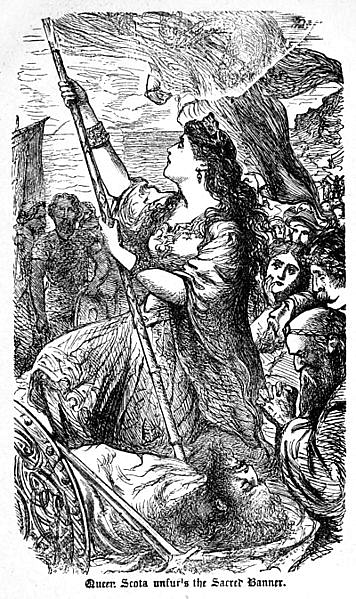 Queen Scota Unfurls the Sacred Banner John Fergus O'Hea (Public Domain) ](https://www.worldhistory.org/image/9796/queen-scota-unfurls-the-sacred-banner/ "Queen Scota Unfurls the Sacred Banner")Just as importantly, the apocryphal legend of Scota makes the claim that the Scots predate the arrival of the [Picts](https://www.worldhistory.org/picts/) and Britons to Scotland, adding to the nationalist themes of the *Scotichronicon*. This view of Scottish history quickly became popular and was accepted more or less uncritically until the 18th Century. Modern historians have disregarded several elements of the *Scotichronicon*'s chronology. A more plausible contender for the title of first king of Scotland is Fergus Mór mac Erc who reigned around the end of the 5th Century CE, but even his historicity is murky.
### The Wars of Independence & the making of Scottish identity
The Wars of Independence (1296–1328 CE and 1332–1357 CE) ended a period of relative friendliness between [England](https://www.worldhistory.org/disambiguation/england/) and Scotland, and plunged both countries into nearly 60 years of [war](https://www.worldhistory.org/disambiguation/War/). This conflict centred around Scotland's claim to independence, and the English claim over the Scottish kingdom. The *Scotichronicon* chronicles these events in its later books, but it is heavily influenced by post-war anti-English sentiments.
The aftermath of the wars left deep scars in both countries, and was a major force behind the creation of Scottish national identity. The earliest histories of Scotland date from the late 13th Century, although these were not as encyclopedic as the *Scotichronicon*. The *Scotichronicon* must be understood as a part of a cultural and literary landscape in which a distinct Scottish national and cultural identity was being formed.
By tracing Scottish heritage back to the mythological Scota, the *Scotichronicon* created a historical narrative for Scottish nationalist sentiments. The *Scotichronicon* puts the limelight on legendary Gaelic figures like Goídel Glas and Fergus Mór mac Erc, although Fordun and Bower's accounts differ from those found in early Medieval Irish chronicles like the 11th Century CE *[Lebor Gabala Erenn](https://www.worldhistory.org/Lebor_Gabala_Erenn/)*.
Bowers and Fordun were also influenced by Geoffrey of Monmouth's 12th Century CE *Historia Regum Brittaniae* (“*History of the Kings of [Britain](https://www.worldhistory.org/disambiguation/Britain/)*”), which constructed a British national identity around the mythological Brutus of [Troy](https://www.worldhistory.org/troy/), legendary progenitor of the Brits. Indeed, the *Scotichronicon*'s version of events was in some ways a reaction to Monmouth's pedigree of British identity, by creating an alternate origin for the Scots. Bowers actually goes so far as to compare his version of events with Monmouth's, declaring his own to be the more accurate account in Book II of the *Scotichronicon*.
### Modern reception
The *Scotichronicon*'s age and background make it an essential source of medieval Scottish history, even if it is an unreliable narrative of ancient history. Both Fordun and Bowers included historical and legendary accounts in their composition, but Bowers is widely considered to be a less competent and reliable historian than his predecessor.
[  King Arthur, English Manuscript timechaser (CC BY-NC-ND) ](https://www.worldhistory.org/image/6649/king-arthur-english-manuscript/ "King Arthur, English Manuscript")The *Scotichronicon* is also notable as a container of early variants of many British legendary traditions. For example, the *Chronica Gentis Scotorum* and *Scotichronicon* contain variants of the [King Arthur](https://www.worldhistory.org/King_Arthur/) legend in which Arthur usurped the throne from his nephew Mordred, the rightful king.
The *Scotichronicon* also contains one of the earliest mentions of Robin Hood, who is described as “a famous cut-throat” from the 12th Century CE, who was celebrated by common folk ballads in Bowers' day. Bowers' insistence that the legend of Robin Hood was only known by the common people has been taken to mean that it was originally an invention of common bards, rather than the aristocracy.
Overall, although it was not as rigorous or as accurate as modern historians might hope, especially with regards to its earliest books, the *Scotichronicon* was an incredibly important piece of early Scottish [literature](https://www.worldhistory.org/literature/).
#### Editorial Review
This human-authored definition has been reviewed by our editorial team before publication to ensure accuracy, reliability and adherence to academic standards in accordance with our [editorial policy](https://www.worldhistory.org/static/editorial-policy/).
## Bibliography
- [Bower, W. *A History Book for Scots.* Birlinn Ltd, 2002.](https://www.worldhistory.org/books/1873644841/)
- [Cowan, E.J. and Richard J. Finlay. *Scottish History.* Edinburgh University Press, 2002.](https://www.worldhistory.org/books/0748614206/)
## About the Author
Dr. Jeffrey King is a writer with a an avid passion for history, travel, foreign languages, and cultural heritage. Jeffrey has a particular interest in Gaelic and Norse history, culture, and languages.
- [X/Twitter Profile](https://twitter.com/MagnaCeltae)
- [Linkedin Profile](https://www.linkedin.com/in/jeff-king-b3905418a/)
## Cite This Work
### APA
King, J. (2019, January 15). Scotichronicon. *World History Encyclopedia*.
### Chicago
King, Jeffrey. "Scotichronicon." *World History Encyclopedia*, January 15, 2019. .
### MLA
King, Jeffrey. "Scotichronicon." *World History Encyclopedia*, 15 Jan 2019, .
## License & Copyright
Submitted by [Jeffrey King](https://www.worldhistory.org/user/koenig20054u/ "User Page: Jeffrey King"), published on 15 January 2019. The copyright holder has published this content under the following license: [Creative Commons Attribution-NonCommercial-ShareAlike](https://creativecommons.org/licenses/by-nc-sa/4.0/deed.en). This license lets others remix, tweak, and build upon this content non-commercially, as long as they credit the author and license their new creations under the identical terms. When republishing on the web a hyperlink back to the original content source URL must be included. Please note that content linked from this page may have different licensing terms.