---
title: Saturnalia: The Jolliest of Roman Festivals
author: Mark Cartwright
source: https://www.worldhistory.org/Saturnalia/
format: machine-readable-alternate
license: Creative Commons Attribution-NonCommercial-ShareAlike (https://creativecommons.org/licenses/by-nc-sa/4.0/)
updated: 2025-04-18
---
# Saturnalia: The Jolliest of Roman Festivals
_Authored by [Mark Cartwright](https://www.worldhistory.org/user/markzcartwright/)_
The Saturnalia was an enduring [Roman](https://www.worldhistory.org/disambiguation/Roman/) festival dedicated to the agricultural [god](https://www.worldhistory.org/God/) [Saturn](https://www.worldhistory.org/Saturn/) which was held between the 17th and 23rd of December each year during the winter solstice. Originating from [archaic](https://www.worldhistory.org/disambiguation/Archaic/) agricultural rituals the Roman festivities came to include a general round of gift-giving, merrymaking, and role-reversals so that it became one of the most popular celebrations in the calendar and certainly the jolliest. The similarities of some of its features and the timing - pushed later into December over time - suggest a strong influence on the Christian celebration of Christmas.
### Saturn
The focus of the Saturnalia and the god who gave his name to the festival was Saturn (or Saturnus), who is something of a mysterious figure in [Roman religion](https://www.worldhistory.org/Roman_Religion/). Depictions of the god in surviving art have him wearing a veil and brandishing either a sickle or a pruning knife suggesting a close relation with [agriculture](https://www.worldhistory.org/disambiguation/Agriculture/) and especially seed-growing or seed-corn. With links to indigenous Italian deities and perhaps, too, a version of the [Greek](https://www.worldhistory.org/disambiguation/greek/) god Kronos, he was regarded as a primordial deity who had taught humanity important agricultural skills. He was thought to have ruled when the world enjoyed a Golden Age of prosperity and happiness, hence the general frivolity of his festival.
### Saturnalia Festival
Despite [Livy](https://www.worldhistory.org/livy/)'s claim that the festival began at the beginning of the 5th century BCE, there is evidence it began much earlier. The Saturnalia enjoyed great longevity for it was famously described in the 5th century CE work of the same name by Macrobius, who selected it as the setting for his dialogue where the protagonists display a certain nostalgia for a time when [Rome](https://www.worldhistory.org/Rome/)'s pagan rituals were more prominent, before the growing influence of [Christianity](https://www.worldhistory.org/christianity/).
Starting off as a one-day holiday the Saturnalia eventually expanded to cover a week by the Late Republic. [Augustus](https://www.worldhistory.org/augustus/) reduced the festivities to a more modest three days, but his successor [Caligula](https://www.worldhistory.org/Caligula/) increased it to five days, and it seems that, in practice, ordinary people celebrated for the full seven days anyway, despite the official decrees.
The Saturnalia was presided over by a king, chosen especially for the occasion, known as the *Saturnalicius* *princeps* or 'leader of the Saturnalia.' Sometimes he is referred to as the 'Lord of Misrule' as he was selected from the lowliest members of a household and given the right to conduct light-hearted mischief. It was a festive period when people gave gifts to one another. Slaves had the freedoms enjoyed by ordinary citizens and were now able to gamble, get drunk in public, and throw aside the cloak of decorum they were meant to present at any other time of the year. More informal clothes (*synthesis*) were worn by citizens instead of the usual toga, and there was a general round of feasts, partying, game playing, and merrymaking for all. These events made it the jolliest Roman festival in the calendar; a fact which led [Catullus](https://www.worldhistory.org/Catullus/) to famously describe it as 'the best of times.'
[ 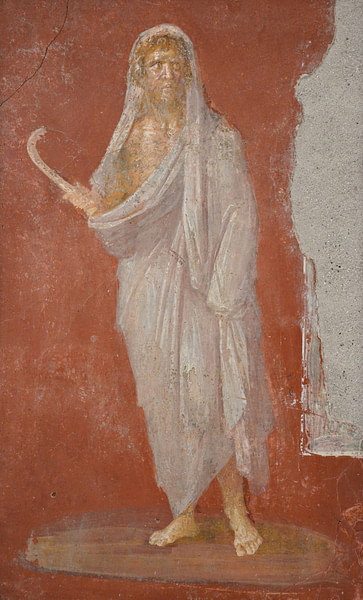 Saturn Carole Raddato (CC BY-SA) ](https://www.worldhistory.org/image/6159/saturn/ "Saturn")One peculiarity of the Saturnalia was not merely the relaxing but reversal of ordinary roles and social conventions, whereby, for example, masters would wear the freed-slave felt hat (*pilleus*) and wait on their slaves (or at least eat together in the same room) who were permitted to do as they wished and even display a touch of insolence. This element of the festival was perhaps a safety valve designed to release the social pressures built up over the year within Roman society's strict social conventions.
The end of the celebrations was marked by the buying and giving of candles, such trifles as jellied figs, and especially the small terracotta figurines or *sigilla* which were on sale in the special market, the *sigillaria*. This fair gave its name to the last day of the festivities, and it was traditional for people to give money to their dependents so that they could buy the cheap goods on offer there.
[  Temple of Saturn, Roman Forum Leo-seta (CC BY) ](https://www.worldhistory.org/image/2182/temple-of-saturn-roman-forum/ "Temple of Saturn, Roman Forum")### [Temple](https://www.worldhistory.org/temple/) of Saturn
The focal point of the Saturnalia festival was the temple dedicated to Saturn in the north-west corner of the Forum of Rome. The first shrine to the god was the Ara Saturni. This was replaced by a temple c. 497 BCE built by the dictator [Titus](https://www.worldhistory.org/disambiguation/Titus/) Tatius. This structure was itself replaced in the 4th century CE by the Temple of Saturn, eight majestic columns of which still stand at the site today. Besides its religious function, during the Republic, the temple also housed the public treasury (*aerarium*), a role it kept, albeit in a more limited function, through the Imperial period.
Within the temple once stood a cult statue of Saturn which became the centre of attention during the Saturnalia when his feet were symbolically freed from the woollen bonds that tied him up for the rest of the year, another manifestation of the role-reversals of the celebrations. This act has led to Saturn being associated with liberation, certainly a prominent feature of the Saturnalia festival, when the stifling Roman social conventions, if only for a week, were thrown to the winter winds.
#### Editorial Review
This human-authored definition has been reviewed by our editorial team before publication to ensure accuracy, reliability and adherence to academic standards in accordance with our [editorial policy](https://www.worldhistory.org/static/editorial-policy/).
## Bibliography
- Bagnal, R.S:. *The Encyclopedia of Ancient History.* Wiley-Blackwell, 2012
- [Barchiesi, A:. *The Oxford Handbook of Roman Studies.* Oxford University Press, 2010.](https://www.worldhistory.org/books/0199211523/)
- [Butterworth, A:. *Pompeii.* St. Martin's Press, 2006.](https://www.worldhistory.org/books/0312355858/)
- [Hornblower, S. *The Oxford Classical Dictionary.* Oxford University Press, 2012.](https://www.worldhistory.org/books/0199545561/)
## About the Author
Mark is WHE’s Publishing Director and has an MA in Political Philosophy (University of York). He is a full-time researcher, writer, historian and editor. Special interests include art, architecture and discovering the ideas that all civilizations share.
## Timeline
- **c. 500 BCE**: Beginning of the [Roman](https://www.worldhistory.org/disambiguation/Roman/) [Saturnalia](https://www.worldhistory.org/Saturnalia/) festival according to [Livy](https://www.worldhistory.org/livy/) (although there is evidence it was a much older tradition).
## External Links
- [What was Saturnalia?](https://www.missedinhistory.com/podcasts/what-was-saturnalia.htm)
## Cite This Work
### APA
Cartwright, M. (2016, December 16). Saturnalia: The Jolliest of Roman Festivals. *World History Encyclopedia*.
### Chicago
Cartwright, Mark. "Saturnalia: The Jolliest of Roman Festivals." *World History Encyclopedia*, December 16, 2016. .
### MLA
Cartwright, Mark. "Saturnalia: The Jolliest of Roman Festivals." *World History Encyclopedia*, 16 Dec 2016, .
## License & Copyright
Submitted by [Mark Cartwright](https://www.worldhistory.org/user/markzcartwright/ "User Page: Mark Cartwright"), published on 16 December 2016. The copyright holder has published this content under the following license: [Creative Commons Attribution-NonCommercial-ShareAlike](https://creativecommons.org/licenses/by-nc-sa/4.0/deed.en). This license lets others remix, tweak, and build upon this content non-commercially, as long as they credit the author and license their new creations under the identical terms. When republishing on the web a hyperlink back to the original content source URL must be included. Please note that content linked from this page may have different licensing terms.