---
title: Sarpedon
author: Willem du Plessis
source: https://www.worldhistory.org/Sarpedon/
format: machine-readable-alternate
license: Creative Commons Attribution-NonCommercial-ShareAlike (https://creativecommons.org/licenses/by-nc-sa/4.0/)
updated: 2023-04-30
---
# Sarpedon
_Authored by [Willem du Plessis](https://www.worldhistory.org/user/wdpzyl/)_
Sarpedon is a figure from ancient [Greek mythology](https://www.worldhistory.org/Greek_Mythology/), a [Lycian](https://www.worldhistory.org/lycia/) prince who was one of the principal heroes during the [Trojan War](https://www.worldhistory.org/Trojan_War/) and fought on the side of [Troy](https://www.worldhistory.org/troy/). According to [Homer](https://www.worldhistory.org/homer/)'s *[Iliad](https://www.worldhistory.org/iliad/)*, he was the son of [Zeus](https://www.worldhistory.org/zeus/) by Laodameia and the cousin of Glaucus of [Lycia](https://www.worldhistory.org/lycia/), the second-in-command of the Lycian forces, although other versions of the myth provide a different genealogy. He was a dominant force in [battle](https://www.worldhistory.org/disambiguation/battle/) and commanded the respect of the Trojan prince Hector and his peers. [Patroclus](https://www.worldhistory.org/Patroclus/), dear companion of the hero [Achilles](https://www.worldhistory.org/achilles/), slew Sarpedon during the Trojan [War](https://www.worldhistory.org/disambiguation/War/), but with Zeus' help, Sarpedon's body was conveyed back to his homeland of Lycia after his [death](https://www.worldhistory.org/disambiguation/Death/), where he was buried with honour.
### Genealogy
In the *Iliad*, the Sarpedon who fights at Troy is the grandson of the hero [Bellerophon](https://www.worldhistory.org/Bellerophon/), the famous slayer of the Chimera and the one who captured the flying horse [Pegasus](https://www.worldhistory.org/Pegasus/). Hailing from [Corinth](https://www.worldhistory.org/corinth/), Bellerophon found himself in the service of King Iobates of Lycia because of the treachery of Stheneboia, the wife of King Proitos of [Tiryns](https://www.worldhistory.org/tiryns/). During his service to Iobates, Bellerophon faced off with the fearsome Chimera, a fire-breathing monster that was a mixture of a lion and goat with a snake for a tail. During another outing, with the help of the goddess [Athena](https://www.worldhistory.org/athena/), Bellerophon was able to tame the flying horse Pegasus, who was born from the severed head of the Gorgon [Medusa](https://www.worldhistory.org/Medusa/) after the hero [Perseus](https://www.worldhistory.org/Perseus/) had killed her.
Bellerophon had three children named Isander, Hippolochos, and the mother of Sarpedon, Laodameia. Both Isander and Hippolochos were vying for the throne of Lycia. To prevent a war of succession, the brothers made a proposition to shoot an arrow through a ring placed upon the breast of a child. When Laodameia offered her son for the exploit, both uncles and his cousin Glaucus withdrew their claim and elevated Sarpedon to the throne of Lycia.
Other versions of the myth describe Sarpedon as the son of Zeus and [Europa](https://www.worldhistory.org/Europa/), and the brother of Minos, the King of [Crete](https://www.worldhistory.org/crete/). In this version, Sarpedon and Minos are both vying for the throne of Crete after the death of their father. As a result of the infighting, Sarpedon is exiled to the Asian mainland, where he establishes himself as the King of Lycia. Another version holds that the Sarpedon who fought at Troy was the grandson of Sarpedon, the brother of Minos.
### The Trojan War
The Trojan War was the result of the abduction of Queen [Helen](https://www.worldhistory.org/disambiguation/Helen/) of [Sparta](https://www.worldhistory.org/sparta/) by the Trojan prince [Paris](https://www.worldhistory.org/disambiguation/paris/). King [Menelaus](https://www.worldhistory.org/Menelaus/), outraged by the audacity of the Trojan visitor on his shores, persuaded his brother, King [Agamemnon](https://www.worldhistory.org/disambiguation/Agamemnon/) of [Mycenae](https://www.worldhistory.org/mycenae/), to gather all his allies and sail to Troy to win back his wife. The [Greek](https://www.worldhistory.org/disambiguation/greek/) fleet that sailed over the [Aegean](https://www.worldhistory.org/aegean/) consisted of more than a thousand ships. The war, which was to last ten years, involved many heroes and even involved the Olympian gods who had vested interests on both sides. The war finally came to an end when the Greeks entered and sacked the [city](https://www.worldhistory.org/city/) with the help of a large wooden horse.
The Lycian forces under Sarpedon were considered the most robust of all the allies of Troy; the 'bulwark of Ilion.' Sarpedon was highly regarded as one of the greatest defenders of Troy, who was much the same as the Trojan heroes Hector and [Aeneas](https://www.worldhistory.org/Aeneas/) regarding fighting prowess. Glaucus, the son of Hippolochos, accompanied Sarpedon to Troy along with his troops from Xanthos. Himself a prominent warrior, Glaucus meets the Greek hero [Diomedes](https://www.worldhistory.org/Diomedes/) on the battlefield, who is leading the Greek forces with the help of the goddess Athena. Glaucus and Diomedes exchange words and upon learning about each other's ancestry, the two warriors decide to not fight each other despite being on opposing sides. Coincidentally both their grandfathers shared a bond of friendship in the past. They continue the tradition of friendship by giving each other their own armour as a gift and part ways as friends. It is during this time that Sarpedon happens upon Tlepolemus, who is the son of none other than the Greek hero Heracles. After trading insults, Tlepolemus is defeated and killed, although he injures Sarpedon in the left thigh.
[  Black-Figure Warrior Scene Mark Cartwright (CC BY-NC-SA) ](https://www.worldhistory.org/image/3381/black-figure-warrior-scene/ "Black-Figure Warrior Scene")Sarpedon commanded so much influence during the war that he criticized Hector during battle. On one occasion, Sarpedon accuses Hector that he is leaving the heavy fighting to the Trojan allies rather than the Trojans themselves. This interaction between the two heroes leads Hector to rally his men and push forward on the Greek position. The “god-like” Sarpedon, along with both his cousin Glaucus and another Trojan ally Asteropaios storm the Greek fortifications helping Hector breach the defences of the Greeks.
Because of a quarrel between King Agamemnon, the leading commander of the Greek forces, and Achilles, the best and bravest of all the Greek warriors, Achilles and his Myrmidons refrained from participating further in the war. The absence of Achilles prompts the Trojans to exploit the situation and attack the Greek encampment until one of the Greek ships is finally set alight. During this time, Patroclus begs Achilles to return to the battlefield and help defend the ships against the approaching Trojans. Achilles yields and gives Patroclus his armour to wear to instil fear into the opposing Trojans. Believing that Achilles is back in the fight defending the ships, Sarpedon meets Patroclus on the battlefield.
Zeus, knowing that fate is at hand and that the death of his son is drawing close, considers saving Sarpedon from death by removing him from the battle. [Hera](https://www.worldhistory.org/Hera/) confronts Zeus and warns him that the other Olympians deities would not look kindly on such an act of divine intervention, as many of them have children of their own on the battlefield. Zeus relents and compromises by guaranteeing to send Sarpedon's body home to Lycia after his death by the hand of Patroclus.
[ 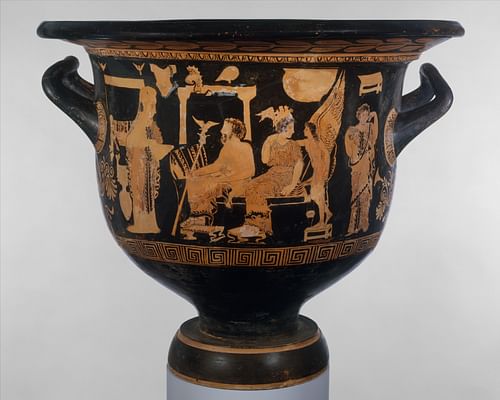 Krater with Europa Pleading for the Life of Sarpedon Metropolitan Museum of Art (Copyright) ](https://www.worldhistory.org/image/12684/krater-with-europa-pleading-for-the-life-of-sarped/ "Krater with Europa Pleading for the Life of Sarpedon")Glaucus, filled with anguish and sorrow over his fallen commander and cousin, reminds Hector of his duty to the Trojan allies. Fierce fighting breaks out around the body of Sarpedon as both sides aim to claim the body of the Lycian commander. Just as Trojans take the armour from his body, [Apollo](https://www.worldhistory.org/apollo/) appears, accompanied by Hypnos and [Thanatos](https://www.worldhistory.org/Thanatos/), to cleanse the body and ease it back to Lycia. Glaucus follows in the steps of Sarpedon by leading the Lycian troops after his death.
### The Cult of Sarpedon
Sarpedon was a well-known figure in [Asia Minor](https://www.worldhistory.org/Asia_Minor/) because of his involvement in the Trojan War and the myth of how he came to settle in Lycia after his exile from Crete. The area of Sarpedon's devotion was on Xanthos where, according to Homer and [Aristotle](https://www.worldhistory.org/aristotle/), he was buried. Later, during the 5th century BCE, a large [temple](https://www.worldhistory.org/temple/) complex was built on Sarpedon's supposed [burial](https://www.worldhistory.org/burial/) site at the [acropolis](https://www.worldhistory.org/Acropolis/) on Xanthos. This complex was known as the Sarpedoneia, where games were held and regular sacrifices were made in honour of the Lycian hero.
### Representations in Art
Various iterations of Sarpedon are found in art, mostly illustrating his death and the subsequent removal of his body from battle by Hypnos and Thanatos. A terracotta bell-krater (a mixing bowl), now in the Metropolitan Museum of Art, shows Europa imploring Zeus for the life of Sarpedon on one side, while the reverse illustrates Europa observing the return of Sarpedon's lifeless body back from Troy. Sarpedon is also represented in an 1874 CE oil canvas painting by Henri Levi. The painting, which is housed at the Musee d'Orsay, illustrates the dramatic conveyance of Sarpedon's body to his father Zeus by Hypnos and Thanatos.
[  Hypnos and Thanatos Bringing the Body of Sarpedon Metropolitan Museum of Art (Copyright) ](https://www.worldhistory.org/image/12687/hypnos-and-thanatos-bringing-the-body-of-sarpedon/ "Hypnos and Thanatos Bringing the Body of Sarpedon")Possibly the most famous iteration of Sarpedon comes in the form of the Sarpedon Krater (see title image) which, until recently, was housed in the New York Metropolitan Museum of Art, after which it was repatriated to the Museum of [Cerveteri](https://www.worldhistory.org/Cerveteri/) in [Italy](https://www.worldhistory.org/italy/). The image embellished on the krater shows Sarpedon after he has fallen by the hand of Patroclus and being transported from the field of battle by Sleep and Death by the command of Zeus. This piece of terracotta art was crafted by Euxitheos and Euphronios, both Athenians, in the 6th century BCE.
Another piece of prominent art regarding Sarpedon is an [Etruscan](https://www.worldhistory.org/Etruscan_Civilization/) [bronze](https://www.worldhistory.org/disambiguation/bronze/) handle of a cista which possibly portrays Sleep and Death carrying the body of Sarpedon from the battlefield. If the bronze handle is not that of Sarpedon, it is widely believed to be that of the Ethiopian king Memnon who was killed by Achilles.
#### Editorial Review
This human-authored definition has been reviewed by our editorial team before publication to ensure accuracy, reliability and adherence to academic standards in accordance with our [editorial policy](https://www.worldhistory.org/static/editorial-policy/).
## Bibliography
- [Archeologia, Franceschini: "Il cratere di Eufronio resta a Cerveteri"](https://roma.repubblica.it/cronaca/2015/11/07/news/franceschini_il_cratere_di_eufronio_resta_a_cerveteri_-126844061/ "Archeologia, Franceschini: "Il cratere di Eufronio resta a Cerveteri""), accessed 8 Sep 2020.
- [Greek Mythology in Art](https://www.greekmythologyinart.com/sarpedon-levy.html "Greek Mythology in Art"), accessed 8 Sep 2020.
- [Hard, Robin. *The Routledge Handbook of Greek Mythology.* Routledge, 2003.](https://www.worldhistory.org/books/0415478901/)
- Marie Delcourt. "Legend Of Sarpedon And The Saga Of The Archer." *The University of Chicago Press*, 1962, Vol. 2, No. 1 (Summer, 1962), pp. 34 - 35.
- [Richmond Lattimore & Homer. *The Iliad of Homer.* University of Chicago Press, 2020.](https://www.worldhistory.org/books/0226470490/)
- [Smith, William. *A New Classical Dictionary of Greek and Roman Biography, Mythology and Geography.* Forgotten Books, 2018.](https://www.worldhistory.org/books/0282145419/)
- [Spivey, Nigel. *The Sarpedon Krater.* University of Chicago Press, 2019.](https://www.worldhistory.org/books/022666659X/)
## About the Author
Willem is interested in Ancient Cultures specifically Classical Studies and the Ancient Near East as well as war, peace, and politics in these societies. He is pursuing post-graduate studies in the near future.
- [Linkedin Profile](https://www.linkedin.com/https://www.linkedin.com/in/wil)
## Cite This Work
### APA
Plessis, W. d. (2020, September 08). Sarpedon. *World History Encyclopedia*.
### Chicago
Plessis, Willem du. "Sarpedon." *World History Encyclopedia*, September 08, 2020. .
### MLA
Plessis, Willem du. "Sarpedon." *World History Encyclopedia*, 08 Sep 2020, .
## License & Copyright
Submitted by [Willem du Plessis](https://www.worldhistory.org/user/wdpzyl/ "User Page: Willem du Plessis"), published on 08 September 2020. The copyright holder has published this content under the following license: [Creative Commons Attribution-NonCommercial-ShareAlike](https://creativecommons.org/licenses/by-nc-sa/4.0/deed.en). This license lets others remix, tweak, and build upon this content non-commercially, as long as they credit the author and license their new creations under the identical terms. When republishing on the web a hyperlink back to the original content source URL must be included. Please note that content linked from this page may have different licensing terms.