---
title: Saraswati
author: Mark Cartwright
source: https://www.worldhistory.org/Sarasvati/
format: machine-readable-alternate
license: Creative Commons Attribution-NonCommercial-ShareAlike (https://creativecommons.org/licenses/by-nc-sa/4.0/)
updated: 2022-09-20
---
# Saraswati
_Authored by [Mark Cartwright](https://www.worldhistory.org/user/markzcartwright/)_
Saraswati (also Sarasvati) is the [Hindu](https://www.worldhistory.org/hinduism/) goddess of learning, wisdom, [music](https://www.worldhistory.org/disambiguation/Music/), and aesthetics. She is also known as Bharati (eloquence), Shatarupa (existence), Vedamata ('mother of the *[Vedas](https://www.worldhistory.org/The_Vedas/)*'), Brahmi, Sarada, Vagisvari, and Putkari. As Vac, she is the goddess of speech. Saraswati first appears in the *Rigveda* and, in later religious texts, she is identified as the inventor of [Sanskrit](https://www.worldhistory.org/Sanskrit/) and, appropriately, gives [Ganesha](https://www.worldhistory.org/Ganesha/) the gifts of pen and inks. She is also a patron of the arts and sciences, and the wife of [Brahma](https://www.worldhistory.org/Brahma/), even if the Bengal Vaisnavas considered her first the wife of [Vishnu](https://www.worldhistory.org/Vishnu/). Sarasvati is also worshipped as the goddess of learning in [Jainism](https://www.worldhistory.org/jainism/) and by some [Buddhist](https://www.worldhistory.org/buddhism/) sects.
### Worship & Rituals
Saraswati's name means 'elegant', 'flowing', and 'watery' and this is indicative of her status as one of the early [Aryan](https://www.worldhistory.org/Aryan/) boundary rivers. The Saraswati River (modern name: Sarsuti), just like the [Ganges](https://www.worldhistory.org/Ganges/) River, flows from the Himalaya and is considered a sacred source of purification, fertility, and good fortune for those who bathe in her waters. The sacred river, again like the Ganges, then developed into a personified deity.
The goddess has her own festivals, notably the Saraswati Puja, held on the first day of spring. During the festival, worshippers wear yellow, which is associated with wisdom and prosperity. Statues of the goddess are also draped in yellow [silk](https://www.worldhistory.org/Silk/), and believers pray for blessings on their pens, books, and musical instruments. Children are taught to write for the first time during the festival, Brahmin priests are given fine food, and ancestors are venerated. Saraswati is also worshipped along with other major goddesses in the [pan](https://www.worldhistory.org/Pan/)-Indian celebration of Navaratri. As the patron of music, she is frequently prayed to by musicians before concerts and, as a goddess of intellectual pursuits, by students before examinations.
### Saraswati & Brahma
In Hindu [mythology](https://www.worldhistory.org/mythology/), Saraswati is the wife of the great [god](https://www.worldhistory.org/God/) Brahma. However, according to some traditions, she was first the wife of Vishnu. The latter, though, already had his hands full with two other wives and so he gave Saraswati to Brahma. Although one of the most important Hindu gods, Brahma is rarely actively worshipped. In mythology, this is explained as a result of a curse from Saraswati. The curse was actually brought about through a misunderstanding. One day, when, awaiting his wife to begin an important religious ceremony and so unable to start the ritual punctually, Brahma asked the gods' advice. They responded by creating a new wife for him, Gayatri, so that the ceremony could go ahead at the precise time. However, when Saraswati eventually turned up she was not best pleased to see her husband with another woman and so cursed Brahma never to be worshipped by humanity (even if he is worshipped today in parts of South-east Asia).
Some Hindus believe all creatures were born from the union of Brahma and Sarasvati starting with Manu, the first man. More specifically, Saraswati's son is the *rishi* (sage) Sarasvata. He, nourished by the bountiful waters of his mother, was able to withstand the Great Drought of Hindu mythology and so survive as the definitive repository of [the Vedas](https://www.worldhistory.org/The_Vedas/) sacred texts.
[ 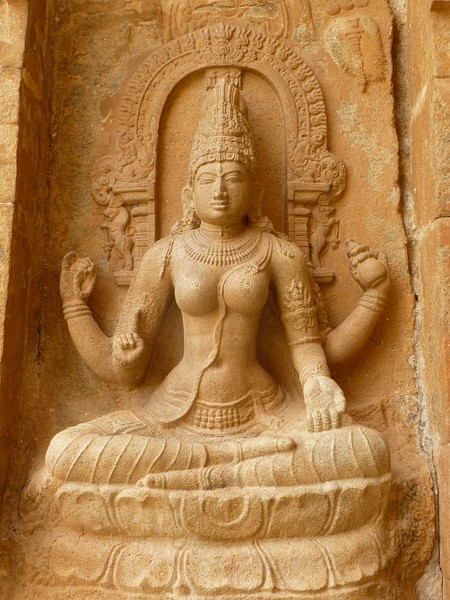 Saraswati, Gangaikondacholapuram Jonathan Freundlich (CC BY-SA) ](https://www.worldhistory.org/image/4238/saraswati-gangaikondacholapuram/ "Saraswati, Gangaikondacholapuram")### Saraswati in Art
In Hindu art, Saraswati is usually depicted as a graceful youth with white skin. She most often wears a white sari (which symbolises purity) which has a blue border. Not being concerned with worldly goods she rarely wears jewellery. She may have a crescent on her forehead and be seated on a lotus flower. Alternatively, she may be shown riding her vehicle (*vahana*), either a swan or goose.
Frequently represented in figure [sculpture](https://www.worldhistory.org/disambiguation/Sculpture/) on temples, the goddess may be accompanied by either her husband or a peacock, her traditional assistant. As with many Hindu deities, Saraswati is often depicted with four arms, each holding a symbolic object. In the left hands she can carry a palm-leaf manuscript and ritual water vessel. In the upper right hand she holds a white lotus flower while the lower right hand typically performs the *varada mudra*, the traditional gift-giving gesture of [Hinduism](https://www.worldhistory.org/hinduism/). Another object commonly seen in Saraswati's hands is the vina (the Hindu classical music instrument) which reminds of her gift of music to humanity.
#### Editorial Review
This human-authored definition has been reviewed by our editorial team before publication to ensure accuracy, reliability and adherence to academic standards in accordance with our [editorial policy](https://www.worldhistory.org/static/editorial-policy/).
## Bibliography
- [Anonymous. *Hindu Myths.* Penguin Classics, 2004.](https://www.worldhistory.org/books/0140449906/)
- [Craven, R.C. *Indian Art.* Thames & Hudson, 1997.](https://www.worldhistory.org/books/0500203024/)
- [Das, R. *The Illustrated Encyclopedia of Hinduism.* Lorenz Books, 2012.](https://www.worldhistory.org/books/0754820564/)
- [Dowson, J. *Classical Dictionary of Hindu Mythology and Religion; Geography, History.* DK Print World, 2000.](https://www.worldhistory.org/books/8124601089/)
- [Hackin, J. *Asiatic Mythology.* Crescent, 1988.](https://www.worldhistory.org/books/0517132257/)
## About the Author
Mark is WHE’s Publishing Director and has an MA in Political Philosophy (University of York). He is a full-time researcher, writer, historian and editor. Special interests include art, architecture and discovering the ideas that all civilizations share.
## Timeline
- **c. 1500 BCE - c. 500 BCE**: The Vedic Period in [India](https://www.worldhistory.org/india/) after a greater migration of the Indo-[Aryans](https://www.worldhistory.org/Aryan/) from Central Asia
- **c. 1500 BCE - c. 500 BCE**: Indian scholars of the so-called Vedic Period commit [the Vedas](https://www.worldhistory.org/The_Vedas/) to written form; basic tenets of [Hinduism](https://www.worldhistory.org/hinduism/) are established.
## Cite This Work
### APA
Cartwright, M. (2015, November 25). Saraswati. *World History Encyclopedia*.
### Chicago
Cartwright, Mark. "Saraswati." *World History Encyclopedia*, November 25, 2015. .
### MLA
Cartwright, Mark. "Saraswati." *World History Encyclopedia*, 25 Nov 2015, .
## License & Copyright
Submitted by [Mark Cartwright](https://www.worldhistory.org/user/markzcartwright/ "User Page: Mark Cartwright"), published on 25 November 2015. The copyright holder has published this content under the following license: [Creative Commons Attribution-NonCommercial-ShareAlike](https://creativecommons.org/licenses/by-nc-sa/4.0/deed.en). This license lets others remix, tweak, and build upon this content non-commercially, as long as they credit the author and license their new creations under the identical terms. When republishing on the web a hyperlink back to the original content source URL must be included. Please note that content linked from this page may have different licensing terms.