---
title: Samothrace
author: Mark Cartwright
source: https://www.worldhistory.org/Samothrace/
format: machine-readable-alternate
license: Creative Commons Attribution-NonCommercial-ShareAlike (https://creativecommons.org/licenses/by-nc-sa/4.0/)
updated: 1970-01-01
---
# Samothrace
_Authored by [Mark Cartwright](https://www.worldhistory.org/user/markzcartwright/)_
Samothrace (Samothrake) is a [Greek](https://www.worldhistory.org/disambiguation/greek/) island in the northern [Aegean](https://www.worldhistory.org/aegean/) which was prominent from the Classical period as a member of the [Delian League](https://www.worldhistory.org/Delian_League/). Its greatest claim to fame was as a cult centre favoured by [Macedon](https://www.worldhistory.org/macedon/) and visited by pilgrims from across the Aegean. Its name today is best known for the magnificent [Hellenistic](https://www.worldhistory.org/Hellenic_World/) [Nike](https://www.worldhistory.org/nike/) [sculpture](https://www.worldhistory.org/disambiguation/Sculpture/), the Nike of Samothrace, excavated on the island in the 19th century CE, which is now on display in the Louvre, [Paris](https://www.worldhistory.org/disambiguation/paris/).
### [Archaic](https://www.worldhistory.org/disambiguation/Archaic/) & Classical Periods
Samothrace, a mountainous Aegean island with an area of 178 km², was first inhabited in the [Neolithic period](https://www.worldhistory.org/Neolithic/) and then colonized by Greek settlers c. 700 BCE, probably from [Samos](https://www.worldhistory.org/samos/). In [literature](https://www.worldhistory.org/literature/), Samothrace appears in [Homer](https://www.worldhistory.org/homer/)'s *[Iliad](https://www.worldhistory.org/iliad/)* when [Poseidon](https://www.worldhistory.org/poseidon/) settles himself on the island's mountaintop to watch the spectacle of the [Trojan War](https://www.worldhistory.org/Trojan_War/) unfold. The [city](https://www.worldhistory.org/city/) was ruled by five tribes who had [Athena](https://www.worldhistory.org/athena/) as their patron, and they minted their own coins. In the [Persian Wars](https://www.worldhistory.org/Persian_Wars/), we know that at least one ship fought on the side of the Persians (and sunk an Athenian ship) during the [Battle of Salamis](https://www.worldhistory.org/Battle_of_Salamis/) (480 BCE). Nevertheless, following Greek victory, Samothrace was a tribute-paying member of the Delian League, the alliance of Greek city-states led by [Athens](https://www.worldhistory.org/Athens/), from 478 to 404 BCE. In the same period the island controlled a territory (*peraea*) on the Thracian mainland where colonies were established. Following a brief period when the island fell under the control of [Sparta](https://www.worldhistory.org/sparta/), Samothrace attracted the interest of Macedon.
### Hellenistic & [Roman](https://www.worldhistory.org/disambiguation/Roman/) Periods
Samothrace's importance increased dramatically when it received the patronage of the royal house of Macedon, a status which continued through the [Hellenistic period](https://www.worldhistory.org/Hellenistic_Period/). The sanctuary on the island was probably dedicated to the Cabiri (or *Kabitoi*, perhaps [Hermes](https://www.worldhistory.org/Hermes/) and [Hephaistos](https://www.worldhistory.org/Hephaistos/) here) or the undefined deities known as the Great Gods (*Theoi Megaloi*, most prominent among them here was likely Axieros, later identified with [Demeter](https://www.worldhistory.org/demeter/)). These gods were the focus of a mystery cult which was prevalent across the northern Aegean. According to [Herodotus](https://www.worldhistory.org/herodotus/) (Bk. 2.52) the cult had been introduced to the island by the Pelasgians centuries earlier.
The cult was second only to the Eleusinian Mysteries in importance in the Greek world. Pilgrims came from afar to seek protection (especially from the sea), moral improvement, a long-life, and a better afterlife. As the name suggests the details of the ceremonies involved at Samothrace remain a mystery, but we do know that first-time initiates (*mystai*) did whatever they did blindfolded while those already initiated were known as *epoptai* or 'viewers'. Ceremonies were performed at night and involved dancing. We also know that there was no class, wealth, or nationality barrier to participating in the mysteries and both [women](https://www.worldhistory.org/disambiguation/women/) and slaves were eligible too.
The Macedonians funded large building projects on the island and it grew to such importance that many Greek city-states sent ambassadors (*theoroi*) and some of these would remain as *proxenoi* or permanent residents who looked after the interests of their city at the site. During the Successor Wars following [Alexander the Great](https://www.worldhistory.org/Alexander_the_Great/)'s [death](https://www.worldhistory.org/disambiguation/Death/) the island switched hands between various Hellenistic rulers but continued to attract visitors to its sanctuary. In the Roman period Samothrace was made a free city giving it certain privileges regarding tax and political autonomy. Part of the [Byzantine empire](https://www.worldhistory.org/Byzantine_Empire/) until 1204 CE, it then came under Genoa's rule and was fortified. From the 15th century CE Samothrace was ruled by the Ottomans.
[ 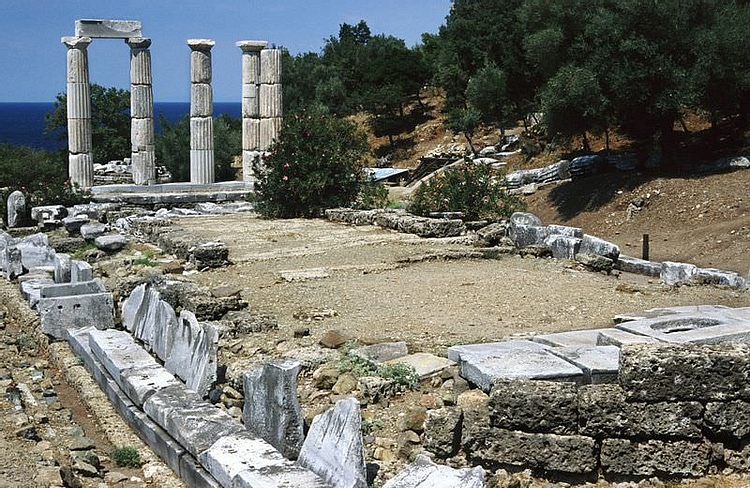 Temple of the Great Gods, Samothrace Gigia (CC BY-SA) ](https://www.worldhistory.org/image/5288/temple-of-the-great-gods-samothrace/ "Temple of the Great Gods, Samothrace")### Archaeological Remains
The sanctuary, located at the northern end of the island, was first systematically excavated in the 1930s CE by American archaeologists showing that it once covered 12.5 hectares. This revealed the remains of the largely 4th and 3rd-century BCE buildings and temples. The large [temple](https://www.worldhistory.org/temple/) dates to c. 340 BCE and once had a frieze of dancers, the shrine structure was likely where the mysteries were performed, and the Tholos of Arsinoe (288-281 BCE) was dedicated by Arsinoe, wife of [Lysimachus](https://www.worldhistory.org/Lysimachus/), to the Great Gods. Completing the most important buildings to be seen today, there is a large [propylon](https://www.worldhistory.org/Propylaea/) (monumental gate) dedicated by [Ptolemy II Philadelphus](https://www.worldhistory.org/Ptolemy_II_Philadelphus/) in 285-281 BCE, a 3rd-century BCE stoa (colonnaded building), and a [palace](https://www.worldhistory.org/disambiguation/palace/)-like structure dating to the 1st century BCE.
### The Nike of Samothrace
However, it is an earlier discovery, made in the 19th century CE, which has brought Samothrace worldwide fame. This is the magnificent marble statue of Victory known as the Nike of Samothrace. The statue was dedicated by worshippers at the cult sanctuary following a naval victory. Dating to c. 190 BCE, the goddess has powerful wings spread and seems to have just landed on a ship's prow. She was set up above an artificial lake at the sanctuary for an even greater dramatic effect. The Nike, considered one of the masterpieces of Hellenistic sculpture, is now on permanent display in the Louvre museum in Paris, France.
Other finds at the site include [pottery](https://www.worldhistory.org/pottery/) and stone monuments with Thracian inscriptions. Seals from the [Minoan civilization](https://www.worldhistory.org/Minoan_Civilization/) suggest contact with [Crete](https://www.worldhistory.org/crete/) in the Middle [Bronze Age](https://www.worldhistory.org/disambiguation/Bronze_Age/). There are fragments of the temple frieze and finds from tombs such as coins and jewellery which are all on display at the site museum. Finally, a famous relief sculpture from the island, also now in the Louvre, depicts a procession of [Agamemnon](https://www.worldhistory.org/disambiguation/Agamemnon/), a herald, and Epeios (maker of the Trojan Horse) who are identified by an inscription. Dating to c. 550 BCE, the scene is an unknown episode from the Trojan [War](https://www.worldhistory.org/disambiguation/War/) and a reminder that our knowledge of [Greek mythology](https://www.worldhistory.org/Greek_Mythology/) is far from complete.
#### Editorial Review
This human-authored definition has been reviewed by our editorial team before publication to ensure accuracy, reliability and adherence to academic standards in accordance with our [editorial policy](https://www.worldhistory.org/static/editorial-policy/).
## Bibliography
- [Ananiadis, D. *Ancient Greece - Temples & Sanctuaries.* Toubis Editions, 2016.](https://www.worldhistory.org/books/9605409291/)
- Bagnall, R. et al. *The Encyclopedia of Ancient History.* Wiley-Blackwell, 2012
- [Boardman, J. *Greek Sculpture.* Thames & Hudson, 1985.](https://www.worldhistory.org/books/0500181667/)
- [Cline, E H. *The Oxford Handbook of the Bronze Age Aegean Paperback.* 2016.](https://www.worldhistory.org/books/B012YXGYC8/)
- [Herodotus. *The Landmark Herodotus Publisher.* 2016.](https://www.worldhistory.org/books/B004OP2S8E/)
- [Hornblower, S. *The Oxford Classical Dictionary.* Oxford University Press, 2012.](https://www.worldhistory.org/books/0199545561/)
- [Kinzl, H. *A Companion to the Classical Greek World.* Wiley-Blackwell, 2010.](https://www.worldhistory.org/books/1444334123/)
## About the Author
Mark is WHE’s Publishing Director and has an MA in Political Philosophy (University of York). He is a full-time researcher, writer, historian and editor. Special interests include art, architecture and discovering the ideas that all civilizations share.
## Timeline
- **c. 700 BCE**: Settlers from mainland [Greece](https://www.worldhistory.org/greece/), possibly [Samos](https://www.worldhistory.org/samos/), settle on [Samothrace](https://www.worldhistory.org/Samothrace/).
- **480 BCE**: A ship from [Samothrace](https://www.worldhistory.org/Samothrace/) participates in the [Battle of Salamis](https://www.worldhistory.org/Battle_of_Salamis/) on the Persian side.
- **478 BCE - 404 BCE**: [Samothrace](https://www.worldhistory.org/Samothrace/) is a member of the [Delian League](https://www.worldhistory.org/Delian_League/).
- **340 BCE**: [Macedon](https://www.worldhistory.org/macedon/) funds the building of a large [temple](https://www.worldhistory.org/temple/) on [Samothrace](https://www.worldhistory.org/Samothrace/).
- **c. 285 BCE**: The Tholos of Arsione is built at [Samothrace](https://www.worldhistory.org/Samothrace/).
- **c. 285 BCE**: [Ptolemy II Philadelphus](https://www.worldhistory.org/Ptolemy_II_Philadelphus/) builds a large [propylon](https://www.worldhistory.org/Propylaea/) gate at [Samothrace](https://www.worldhistory.org/Samothrace/).
- **c. 190 BCE**: The [Nike](https://www.worldhistory.org/nike/) of [Samothrace](https://www.worldhistory.org/Samothrace/) is dedicated on the island to commemorate a naval victory.
## External Links
- [Winged Victory of Samothrace: Exploring the History of the Nike Statue](https://mymodernmet.com/winged-victory-of-samothrace/)
## Cite This Work
### APA
Cartwright, M. (2016, July 07). Samothrace. *World History Encyclopedia*.
### Chicago
Cartwright, Mark. "Samothrace." *World History Encyclopedia*, July 07, 2016. .
### MLA
Cartwright, Mark. "Samothrace." *World History Encyclopedia*, 07 Jul 2016, .
## License & Copyright
Submitted by [Mark Cartwright](https://www.worldhistory.org/user/markzcartwright/ "User Page: Mark Cartwright"), published on 07 July 2016. The copyright holder has published this content under the following license: [Creative Commons Attribution-NonCommercial-ShareAlike](https://creativecommons.org/licenses/by-nc-sa/4.0/deed.en). This license lets others remix, tweak, and build upon this content non-commercially, as long as they credit the author and license their new creations under the identical terms. When republishing on the web a hyperlink back to the original content source URL must be included. Please note that content linked from this page may have different licensing terms.