---
title: Salona
author: Cristian Violatti
source: https://www.worldhistory.org/Salona/
format: machine-readable-alternate
license: Creative Commons Attribution-NonCommercial-ShareAlike (https://creativecommons.org/licenses/by-nc-sa/4.0/)
updated: 1970-01-01
---
# Salona
_Authored by [Cristian Violatti](https://www.worldhistory.org/user/violatti/)_
Salona was an ancient [city](https://www.worldhistory.org/city/) located at the estuary of the river Jadro in present-day Solin, a suburb of Split on the Adriatic coast of Croatia. It became the capital of the [Roman](https://www.worldhistory.org/disambiguation/Roman/) province of Dalmatia in 9 CE.
Before the Romans Salona was a settlement of the Dalmatean, an Illyrian people who lived on the shore of the Adriatic. During the 3rd century BCE, [Greek](https://www.worldhistory.org/disambiguation/greek/) colonists from the island of Issa founded an *emporium* ([trade](https://www.worldhistory.org/disambiguation/trade/) centre) on the coast north of Salona and another one to the south. In 117 BCE the Roman general Metellus Macedonicus invaded Salona and finally in 78 BCE it was permanently conquered. About 33 BCE, during [Augustus](https://www.worldhistory.org/augustus/)' reign, Salona became a Roman colony.
A few years later, Augustus conquered the entire region from the Danube to the Adriatic coast. This newly conquered area came to be known as the province of Illyria with Salona as its capital. however, the province was too big and too challenging to be managed by a single governor and, therefore, Augustus decided to split Illyria in two: the southwestern half being named Dalmatia with Salona remaining as its capital. During this time the city flourished and acquired all the characteristics of an important Roman city: defensive walls, a [theatre](https://www.worldhistory.org/disambiguation/theatre/), an [amphitheatre](https://www.worldhistory.org/amphitheatre/) for 15,500 spectators and a forum. In 170 CE, during the time of [Marcus Aurelius](https://www.worldhistory.org/Marcus_Aurelius/), a new [wall](https://www.worldhistory.org/wall/) enclosing all three sections of the city was built and the population is estimated as around 50,000.
Salona remained Roman for longer than most of the other cities in the western half of the Roman [Empire](https://www.worldhistory.org/empire/). During the 5th century CE it was home to the governor of Dalmatia, [Julius](https://www.worldhistory.org/disambiguation/Julius/) Nepos, the last man entitled to claim the throne of the [Western Roman Empire](https://www.worldhistory.org/Western_Roman_Empire/). He was recognized as Emperor of the West for a brief length of time (473-475 CE) but ultimately he was deposed and returned to Salona. He was still accepted as Emperor by some until 480 CE. The city became part of the East Roman Empire and it was given to Theodoric, a Gothic king, in 493 CE. The Emperor Justinian brought Salona back under Roman control in 535 CE; he rebuilt its fortifications and Salona remained one of the key ports of the empire.
Salona is particularly important for the study of early Christian society and [architecture](https://www.worldhistory.org/disambiguation/architecture/). During the 5th and 6th centuries CE a number of churches were built in the city and also basilicas with large cemeteries containing martyrs' burials. In 530 and 533 CE, regional church councils were also held in Salona.
[ 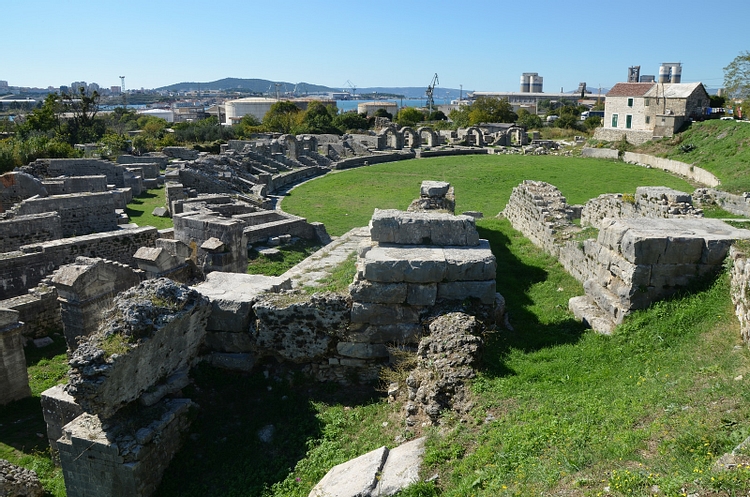 Salona Amphitheatre, Croatia Carole Raddato (CC BY-SA) ](https://www.worldhistory.org/image/2430/salona-amphitheatre-croatia/ "Salona Amphitheatre, Croatia")Shortly after this, invading Slav tribes from across the Danube began to threaten the region but they did not reach the [Aegean](https://www.worldhistory.org/aegean/) coast. During the rest of the 6th century CE Salona was a fairly secure place but by the beginning of the 7th century CE things had changed rapidly: all over the Balkans, Slav tribes moved freely as a result of the collapse of the frontier defences. Salona resisted for some time but about 614 CE its inhabitants abandoned their homes and fled to Split, where the emperor [Diocletian](https://www.worldhistory.org/Diocletian/) had a [palace](https://www.worldhistory.org/disambiguation/palace/) built for his retirement and which offered a more readily defensible haven.
#### Editorial Review
This human-authored definition has been reviewed by our editorial team before publication to ensure accuracy, reliability and adherence to academic standards in accordance with our [editorial policy](https://www.worldhistory.org/static/editorial-policy/).
## Bibliography
- [Anonymous. *The Encyclopedia of Ancient History.* Wiley-Blackwell, 2012.](https://www.worldhistory.org/books/140517935X/)
## About the Author
Cristian is a public speaker and independent author with a strong passion for the human past. Inspired by the rich lessons of history, Cristian's goal is to stimulate ideas and to spark the intellectual curiosity of his audience.
- [Facebook Profile](https://www.facebook.com/cviolatti)
- [X/Twitter Profile](https://twitter.com/@CristianViolatt)
- [Linkedin Profile](https://www.linkedin.com/in/cristian-violatti-48464458/)
## Timeline
- **c. 300 BCE - c. 200 BCE**: [Greek](https://www.worldhistory.org/disambiguation/greek/) colonists set up an *emporion* ([trade](https://www.worldhistory.org/disambiguation/trade/) centre) at [Salona](https://www.worldhistory.org/Salona/).
- **33 BCE**: [Salona](https://www.worldhistory.org/Salona/) becomes a [Roman](https://www.worldhistory.org/disambiguation/Roman/) colony.
- **9 CE**: [Salona](https://www.worldhistory.org/Salona/) becomes the capital of the [Roman](https://www.worldhistory.org/disambiguation/Roman/) province of Dalmatia.
- **493 CE - 535 CE**: [Salona](https://www.worldhistory.org/Salona/) is governed by the [Goths](https://www.worldhistory.org/Goths/).
- **614 CE**: [Salona](https://www.worldhistory.org/Salona/) is abandoned.
## External Links
- [Arheoloski muzej Split](http://www.mdc.hr/split-arheoloski/nj/index.html)
## Cite This Work
### APA
Violatti, C. (2013, April 21). Salona. *World History Encyclopedia*.
### Chicago
Violatti, Cristian. "Salona." *World History Encyclopedia*, April 21, 2013. .
### MLA
Violatti, Cristian. "Salona." *World History Encyclopedia*, 21 Apr 2013, .
## License & Copyright
Submitted by [Cristian Violatti](https://www.worldhistory.org/user/violatti/ "User Page: Cristian Violatti"), published on 21 April 2013. The copyright holder has published this content under the following license: [Creative Commons Attribution-NonCommercial-ShareAlike](https://creativecommons.org/licenses/by-nc-sa/4.0/deed.en). This license lets others remix, tweak, and build upon this content non-commercially, as long as they credit the author and license their new creations under the identical terms. When republishing on the web a hyperlink back to the original content source URL must be included. Please note that content linked from this page may have different licensing terms.