---
title: Saguntum
author: Mark Cartwright
source: https://www.worldhistory.org/Saguntum/
format: machine-readable-alternate
license: Creative Commons Attribution-NonCommercial-ShareAlike (https://creativecommons.org/licenses/by-nc-sa/4.0/)
updated: 1970-01-01
---
# Saguntum
_Authored by [Mark Cartwright](https://www.worldhistory.org/user/markzcartwright/)_
Saguntum (modern Sagunto), located near Valencia in Spain, was an Iberian, and then [Roman](https://www.worldhistory.org/disambiguation/Roman/), settlement. The town's most dramatic moment in history came in the late 3rd century BCE when it was attacked by [Hannibal](https://www.worldhistory.org/hannibal/), an act which famously sparked off the [Second Punic War](https://www.worldhistory.org/Second_Punic_War/) between [Rome](https://www.worldhistory.org/Rome/) and [Carthage](https://www.worldhistory.org/carthage/). In the early imperial period, Saguntum prospered once again, expanded and received many Roman architectural improvements. Remains of the [Roman forum](https://www.worldhistory.org/Roman_Forum/) can be visited within the impressive medieval fortifications of the [acropolis](https://www.worldhistory.org/Acropolis/), and the restored 1st-century CE [theatre](https://www.worldhistory.org/disambiguation/theatre/) still holds regular concert and theatre performances.
### Historical Overview
Saguntum, on the coast of southern Spain, was first settled by the Edetani, a local Iberian tribe, in the 6th century BCE, although the area had been populated since the [Bronze Age](https://www.worldhistory.org/disambiguation/Bronze_Age/). The small settlement, which was called Arse, was concentrated on the western part of the acropolis, and elements of its [wall](https://www.worldhistory.org/wall/) and some houses still survive. Arse prospered due to its location controlling access to inland [trade](https://www.worldhistory.org/disambiguation/trade/) routes and rich agricultural lands and minted its own [bronze](https://www.worldhistory.org/disambiguation/bronze/) and [silver](https://www.worldhistory.org/Silver/) [coinage](https://www.worldhistory.org/coinage/), which carried the town's name on the design.
In the late 3rd century BCE Saguntum became disposed towards Rome, but Carthage was another interested power in the area. The Carthaginians had lost the [First Punic War](https://www.worldhistory.org/First_Punic_War/) and now desperately needed a new source of income to carry on fighting for control of their [empire](https://www.worldhistory.org/empire/) and trade routes. Spain and its silver was the answer. [Hamilcar Barca](https://www.worldhistory.org/Hamilcar_Barca/) was dispatched with an army and soon controlled a large area of Iberia. With the Treaty of Ebro (226 BCE), the two powers then agreed on a line of separation between their two spheres of influence, and Saguntum was right on it.
In 219 BCE, matters came to a head when Hannibal besieged the [city](https://www.worldhistory.org/city/) knowing full well the Romans would be forced to respond, especially after the Saguntians called for Roman help. This they did by demanding Hannibal be handed over for suitable punishment. The [Carthaginian government](https://www.worldhistory.org/Carthaginian_Government/), which had actually backed the siege, understandably declined and Rome declared war in March 218 BCE even though Saguntum was not officially an ally. The town became the pretext for Rome to rid Iberia of the Carthaginians. The Second Punic War (218 – 201 BCE) was underway.
[](https://www.worldhistory.org/image/5593/)[ 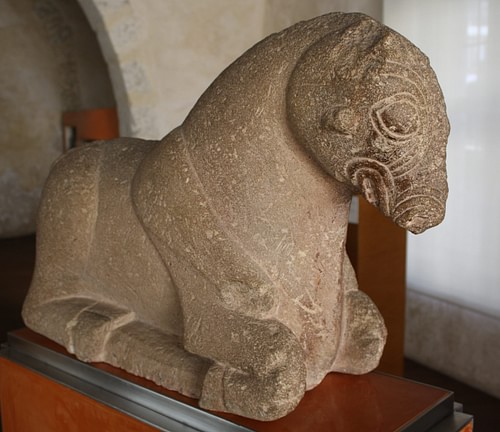 Iberian Bull Sculpture Mark Cartwright (CC BY-NC-SA) ](https://www.worldhistory.org/image/5593/iberian-bull-sculpture/ "Iberian Bull Sculpture")
Saguntum resisted the siege valiantly behind its impressive fortifications, even wounding Hannibal with one of their famous spears which they drenched in flaming pitch and hurled down on their attackers. After eight months the citizens finally gave up hope, though, and committed mass suicide by setting fire to the town. Saguntum fell to the Carthaginians. While Hannibal moved off into [Italy](https://www.worldhistory.org/italy/) and won spectacular victories there, Saguntum was retaken by a Roman force led by P. Cornelius [Scipio](https://www.worldhistory.org/disambiguation/Scipio/) and Gn. Cornelius Scipio Calvus in 212 BCE. Following their deaths in a defeat to Carthaginian forces in the Tader valley in 211 BCE [Scipio Africanus the Elder](https://www.worldhistory.org/Scipio_Africanus_the_Elder/) was charged with clearing Spain of the enemy, a feat he achieved by 206 BCE.
Sertorius Quintus occupied Saguntum as part of his [conquest](https://www.worldhistory.org/warfare/) of southern Spain during the turbulent in-fighting which beset Rome in the 1st century BCE, but he was removed by Q. Caecilius Metellus Pius and [Pompey](https://www.worldhistory.org/pompey/) in 75 BCE. During the reign of [Augustus](https://www.worldhistory.org/augustus/) (27 BCE – 14 CE) Saguntum was made a *municipium,* and a forum was built on the acropolis. Saguntum continued to thrive due to its location on the *Via Augusta* and as a wine producer. The latter fact is attested by ancient writers' descriptions of local wine cups and surviving stamped [amphorae](https://www.worldhistory.org/Amphora/). Consequently, the town spread to cover over 19 hectares and benefitted from a large theatre in the reign of [Tiberius](https://www.worldhistory.org/Tiberius/) (14 CE - 37 CE), an [amphitheatre](https://www.worldhistory.org/amphitheatre/), and a [circus](https://www.worldhistory.org/disambiguation/Circus/).
[](https://www.worldhistory.org/image/5592/)[ 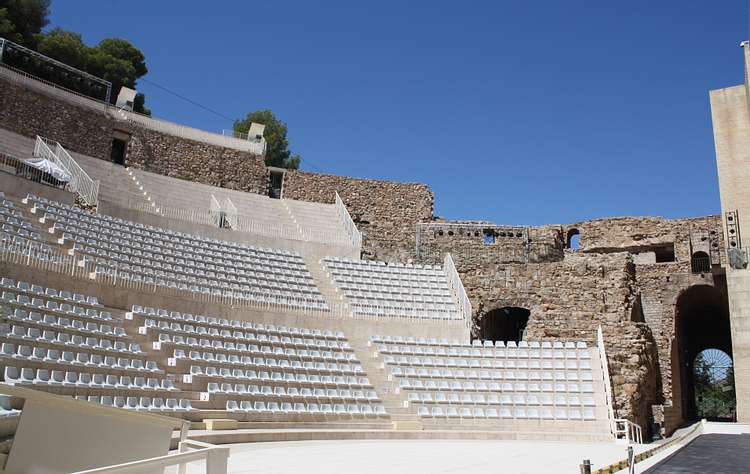 Roman Theatre, Saguntum Mark Cartwright (CC BY-NC-SA) ](https://www.worldhistory.org/image/5592/roman-theatre-saguntum/ "Roman Theatre, Saguntum")
Even though the port continued to function up to the mid-5th century CE, in the imperial period Saguntum was largely overshadowed by Valencia. Saguntum and the surrounding area then suffered from the successive invasions into southern [Europe](https://www.worldhistory.org/europe/) of the Alans, [Vandals](https://www.worldhistory.org/Vandals/), and [Visigoths](https://www.worldhistory.org/visigoth/). The fortifications of the acropolis were extended and improved upon in the 11th century CE by the Muslim invaders, again during the Renaissance, and once more during the War of Independence. From the medieval period the town was known as Murviedro, derived from *murum veterum* ('Old Walls').
### Architectural Highlights
**Roman Forum**
The Roman Forum, completed in the early 1st century CE, is located in the central area of the fortified acropolis. The forum had a [temple](https://www.worldhistory.org/temple/), a curia (Senate house), a basilica for administrators and to house the tribunal, a large rectangular cistern, and a line of small shops (*tabernae*). This area was also the site of the governor's residence in the early Christian period. Today, near the forum, is a small epigraphic museum with examples of Iberian, Latin, and Hebrew inscriptions. Larger finds such as statuary and mosaics are on display in the town's modern archaeological museum.
[](https://www.worldhistory.org/image/5596/)[ 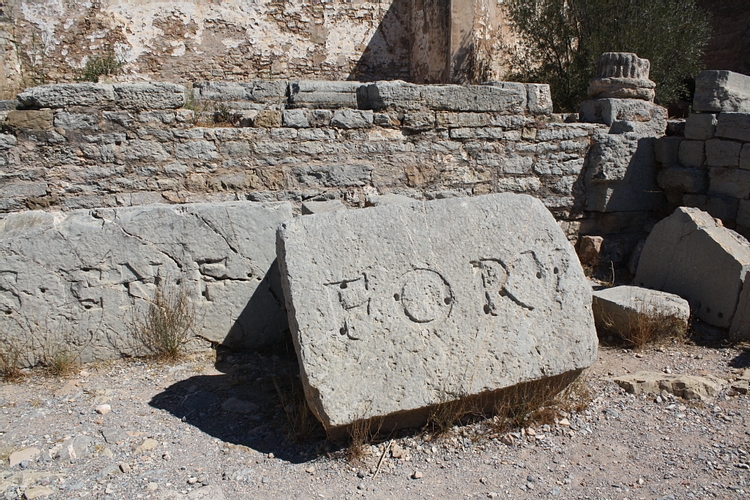 Inscription Stones, Forum of Saguntum Mark Cartwright (CC BY-NC-SA) ](https://www.worldhistory.org/image/5596/inscription-stones-forum-of-saguntum/ "Inscription Stones, Forum of Saguntum")
**Roman Theatre**
The theatre, built into the northern side of the acropolis (Castle Hill) in the first half of the 1st century CE, originally had a capacity for 4,000 spectators. The stage wall (*scaenae frons*) reached the height of the rear seats and had a wooden roof. Unfortunately, much of the theatre's stone blocks were reused for other buildings over the centuries, but some of the top row seats at either side of the stage survive. Restored today, the theatre continues to hold musical concerts.
#### Editorial Review
This human-authored definition has been reviewed by our editorial team before publication to ensure accuracy, reliability and adherence to academic standards in accordance with our [editorial policy](https://www.worldhistory.org/static/editorial-policy/).
## Bibliography
- [Bagnall, N. *The Punic Wars.* Thomas Dunne Books, 2005.](https://www.worldhistory.org/books/0312342144/)
- Bagnall, R. et al. *The Encyclopedia of Ancient History.* Wiley-Blackwell, 2012
- [Hornblower, S. *The Oxford Classical Dictionary.* Oxford University Press, 2012.](https://www.worldhistory.org/books/0199545561/)
- [Hoyos, D. et al. *A Companion to the Punic Wars.* Wiley-Blackwell, 2011.](https://www.worldhistory.org/books/1405176008/)
- [Miles, R. *Carthage Must Be Destroyed.* Penguin, 2016.](https://www.worldhistory.org/books/B00YDK13S6/)
## About the Author
Mark is WHE’s Publishing Director and has an MA in Political Philosophy (University of York). He is a full-time researcher, writer, historian and editor. Special interests include art, architecture and discovering the ideas that all civilizations share.
## Timeline
- **219 BCE**: [Hannibal](https://www.worldhistory.org/hannibal/) crosses the Ebro river in Spain and sacks the [city](https://www.worldhistory.org/city/) of [Saguntum](https://www.worldhistory.org/Saguntum/), [Rome](https://www.worldhistory.org/Rome/)'s ally, sparking off the [Second Punic War](https://www.worldhistory.org/Second_Punic_War/).
- **218 BCE - 201 BCE**: [Second Punic War](https://www.worldhistory.org/Second_Punic_War/).
- **212 BCE**: The Romans [conquer](https://www.worldhistory.org/warfare/) [Saguntum](https://www.worldhistory.org/Saguntum/) from the Carthaginians.
## Cite This Work
### APA
Cartwright, M. (2016, September 05). Saguntum. *World History Encyclopedia*.
### Chicago
Cartwright, Mark. "Saguntum." *World History Encyclopedia*, September 05, 2016. .
### MLA
Cartwright, Mark. "Saguntum." *World History Encyclopedia*, 05 Sep 2016, .
## License & Copyright
Submitted by [Mark Cartwright](https://www.worldhistory.org/user/markzcartwright/ "User Page: Mark Cartwright"), published on 05 September 2016. The copyright holder has published this content under the following license: [Creative Commons Attribution-NonCommercial-ShareAlike](https://creativecommons.org/licenses/by-nc-sa/4.0/deed.en). This license lets others remix, tweak, and build upon this content non-commercially, as long as they credit the author and license their new creations under the identical terms. When republishing on the web a hyperlink back to the original content source URL must be included. Please note that content linked from this page may have different licensing terms.