---
title: Ancient Rome
author: Joshua J. Mark
source: https://www.worldhistory.org/Rome/
format: machine-readable-alternate
license: Creative Commons Attribution-NonCommercial-ShareAlike (https://creativecommons.org/licenses/by-nc-sa/4.0/)
updated: 2024-03-04
---
# Ancient Rome
_Authored by [Joshua J. Mark](https://www.worldhistory.org/user/JPryst/)_
According to legend, Ancient Rome was founded by the two brothers, and demigods, [Romulus and Remus](https://www.worldhistory.org/Romulus_and_Remus/), on 21 April 753 BCE. The legend claims that in an argument over who would rule the [city](https://www.worldhistory.org/city/) (or, in another version, where the city would be located) [Romulus](https://www.worldhistory.org/Romulus_and_Remus/) killed Remus and named the city after himself. This story of the founding of Rome is the best known but it is not the only one.
Other legends claim the city was named after a woman, [Roma](https://www.worldhistory.org/disambiguation/Roma/), who traveled with [Aeneas](https://www.worldhistory.org/Aeneas/) and the other survivors from [Troy](https://www.worldhistory.org/troy/) after that city fell. Upon landing on the banks of the Tiber River, Roma and the other [women](https://www.worldhistory.org/disambiguation/women/) objected when the men wanted to move on. She led the women in the burning of the Trojan ships and so effectively stranded the Trojan survivors at the site which would eventually become Rome. Aeneas of Troy is featured in this legend and also, famously, in [Virgil](https://www.worldhistory.org/virgil/)'s *[Aeneid](https://www.worldhistory.org/The_Aeneid/)*, as a founder of Rome and the ancestor of Romulus and Remus, thus linking Rome with the grandeur and might which was once Troy.
Still other theories concerning the name of the famous city suggest it came from *Rumon*, the ancient name for the Tiber River, and was simply a place name given to the small trading center established on its banks or that the name derived from an [Etruscan](https://www.worldhistory.org/Etruscan_Civilization/) word which could have designated one of their settlements.
### Early Rome
Originally a small town on the banks of the Tiber, Rome grew in size and strength, early on, through [trade](https://www.worldhistory.org/disambiguation/trade/). The location of the city provided merchants with an easily navigable waterway on which to traffic their goods. The city was ruled by seven kings, from Romulus to Tarquin, as it grew in size and power. [Greek culture](https://www.worldhistory.org/disambiguation/Greek_Culture/) and [civilization](https://www.worldhistory.org/civilization/), which came to Rome via [Greek](https://www.worldhistory.org/disambiguation/greek/) colonies to the south, provided the early Romans with a model on which to build their own [culture](https://www.worldhistory.org/disambiguation/culture/). From the Greeks they borrowed literacy and [religion](https://www.worldhistory.org/religion/) as well as the fundamentals of [architecture](https://www.worldhistory.org/disambiguation/architecture/).
The [Etruscans](https://www.worldhistory.org/Etruscan_Civilization/), to the north, provided a model for trade and urban luxury. [Etruria](https://www.worldhistory.org/Etruscan_Civilization/) was also well situated for trade and the early Romans either learned the skills of trade from Etruscan example or were taught directly by the Etruscans who made incursions into the area around Rome sometime between 650 and 600 BCE (although their influence was felt much earlier). The extent of the role the [Etruscan civilization](https://www.worldhistory.org/Etruscan_Civilization/) played in the development of [Roman](https://www.worldhistory.org/disambiguation/Roman/) culture and society is debated but there seems little doubt they had a significant impact at an early stage.
From the start, the Romans showed a talent for borrowing and improving upon the skills and concepts of other cultures. The Kingdom of Rome grew rapidly from a trading town to a prosperous city between the 8th and 6th centuries BCE. When the last of the seven kings of Rome, Tarquin the Proud, was deposed in 509 BCE, his rival for power, Lucius Junius Brutus, reformed the system of government and established the [Roman Republic](https://www.worldhistory.org/Roman_Republic/).
### War & Expansion
Though the city owed its prosperity to trade in the early years, it was the [Roman warfare](https://www.worldhistory.org/Roman_Warfare/) which would make it a powerful force in the ancient world. The wars with the North African city of [Carthage](https://www.worldhistory.org/carthage/) (known as the [Punic Wars](https://www.worldhistory.org/Punic_Wars/), 264-146 BCE) consolidated Rome's power and helped the city grow in wealth and prestige. Rome and Carthage were rivals in trade in the Western [Mediterranean](https://www.worldhistory.org/disambiguation/mediterranean/) and, with Carthage defeated, Rome held almost absolute dominance over the region; though there were still incursions by pirates which prevented complete Roman control of the sea.
As the Republic of Rome grew in power and prestige, the city of Rome began to suffer from the effects of corruption, greed and the over-reliance on foreign slave labor. Gangs of unemployed Romans, put out of work by the influx of slaves brought in through territorial conquests, hired themselves out as thugs to do the bidding of whatever wealthy senator would pay them. The wealthy elite of the city, the [patricians](https://www.worldhistory.org/Patrician/), became ever richer at the expense of the working lower class, the [plebeians](https://www.worldhistory.org/Plebeians/).
[  Map of 2nd Century Roman Expansion US Military Academy (Public Domain) ](https://www.worldhistory.org/image/131/map-of-2nd-century-roman-expansion/ "Map of 2nd Century Roman Expansion")In the 2nd century BCE, the [Gracchi brothers](https://www.worldhistory.org/Gracchi_Brothers/), [Tiberius](https://www.worldhistory.org/Tiberius/) and Gaius, two Roman tribunes, led a movement for land reform and political reform in general. Though the brothers were both killed in this cause, their efforts did spur legislative reforms and the rampant corruption of the [Roman Senate](https://www.worldhistory.org/Roman_Senate/) was curtailed (or, at least, the senators became more discreet in their corrupt activities). By the time of the [First Triumvirate](https://www.worldhistory.org/First_Triumvirate/), both the city and the Republic of Rome were in full flourish.
### The Republic
Even so, Rome found itself divided across class lines. The ruling class called themselves *optimates* (the best men) while the lower classes, or those who sympathized with them, were known as the *populares* (the people). These names were applied simply to those who held a certain political ideology; they were not strict political parties nor were all of the ruling class *optimates* nor all of the lower classes *populares*.
In general, the *optimates* held with traditional political and social values which favored the power of the Senate of Rome and the prestige and superiority of the ruling class. The *populares*, again generally speaking, favored reform and democratization of the Roman Republic. These opposing ideologies would famously clash in the form of three men who would, unwittingly, bring about the end of the Roman Republic.
[Marcus Licinius Crassus](https://www.worldhistory.org/Marcus_Licinius_Crassus/) and his political rival, [Gnaeus Pompeius Magnus](https://www.worldhistory.org/pompey/) ([Pompey the Great](https://www.worldhistory.org/pompey/)) joined with another, younger, politician, Gaius [Julius Caesar](https://www.worldhistory.org/Julius_Caesar/), to form what modern historians call the First Triumvirate of Rome (though the Romans of the time never used that term, nor did the three men who comprised the triumvirate). [Crassus](https://www.worldhistory.org/Marcus_Licinius_Crassus/) and [Pompey](https://www.worldhistory.org/pompey/) both held the *optimate* political line while [Caesar](https://www.worldhistory.org/disambiguation/caesar/) was a *populare*.
The three men were equally ambitious and, vying for power, were able to keep each other in check while helping to make Rome prosper. Crassus was the richest man in Rome and was corrupt to the point of forcing wealthy citizens to pay him 'safety' money. If the citizen paid, Crassus would not burn down that person's house but, if no money was forthcoming, the fire would be lighted and Crassus would then charge a fee to send men to put the fire out. Although the motive behind the origin of these fire brigades was far from noble, Crassus did effectively create the first fire department which would, later, prove of great value to the city.
Both Pompey and Caesar were great generals who, through their respective conquests, made Rome wealthy. Though the richest man in Rome (and, it has been argued, the richest in all of Roman history), Crassus longed for the same respect people accorded Pompey and Caesar for their military successes. In 53 BCE he led a sizeable force against [Parthia](https://www.worldhistory.org/disambiguation/Parthia/) and was defeated at the [Battle](https://www.worldhistory.org/disambiguation/battle/) of Carrhae, in modern-day [Turkey](https://www.worldhistory.org/Asia_Minor/), where he was killed when truce negotiations broke down.
[ 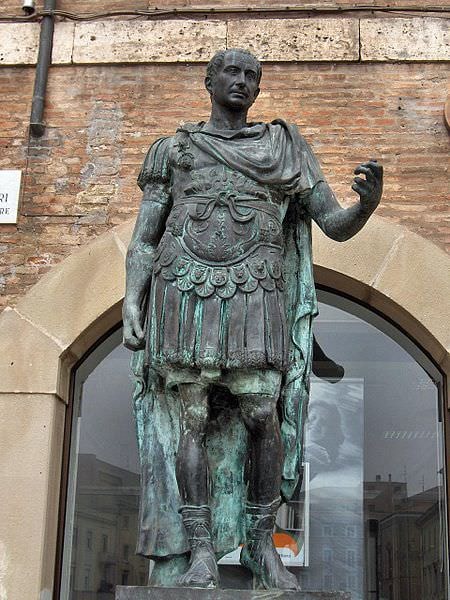 Julius Caesar Georges Jansoone (CC BY-NC-SA) ](https://www.worldhistory.org/image/2737/julius-caesar/ "Julius Caesar")With Crassus gone, the First Triumvirate disintegrated and Pompey and Caesar declared war on each other. Pompey tried to eliminate his rival through legal means and had the Senate order Caesar to Rome to stand trial on assorted charges. Instead of returning to the city in humility to face these charges, Caesar crossed the [Rubicon](https://www.worldhistory.org/disambiguation/Rubicon/) River with his army in 49 BCE and entered Rome at the head of it.
He refused to answer the charges and directed his focus toward eliminating Pompey as a rival. Pompey and Caesar met in battle at Pharsalus in [Greece](https://www.worldhistory.org/greece/) in 48 BCE where Caesar's numerically inferior force defeated Pompey's greater one. Pompey himself fled to [Egypt](https://www.worldhistory.org/egypt/), expecting to find sanctuary there, but was assassinated upon his arrival. News of Caesar's great victory against overwhelming numbers at Pharsalus had spread quickly and many former friends and allies of Pompey swiftly sided with Caesar, believing he was favored by the gods.
### Towards [Empire](https://www.worldhistory.org/empire/)
[Julius](https://www.worldhistory.org/disambiguation/Julius/) Caesar was now the most powerful man in Rome. He effectively ended the period of the Republic by having the Senate proclaim him *dictator*. His popularity among the people was enormous and his efforts to create a strong and stable central government meant increased prosperity for the city of Rome. He was assassinated by a group of Roman senators in 44 BCE, however, precisely because of these achievements.
The conspirators, Brutus and Cassius among them, seemed to fear that Caesar was becoming too powerful and that he might eventually abolish the Senate. Following his [death](https://www.worldhistory.org/disambiguation/Death/), his right-hand man, and cousin, [Marcus Antonius](https://www.worldhistory.org/Mark_Antony/) ([Mark Antony](https://www.worldhistory.org/Mark_Antony/)) joined forces with Caesar's nephew and heir, Gaius Octavius Thurinus ([Octavian](https://www.worldhistory.org/augustus/)) and Caesar's friend, Marcus Aemilius Lepidus, to defeat the forces of Brutus and Cassius at the Battle of Phillippi in 42 BCE.
[  Division of the Second Triumvirate ColdEl (CC BY-SA) ](https://www.worldhistory.org/image/4951/division-of-the-second-triumvirate/ "Division of the Second Triumvirate")Octavian, [Antony](https://www.worldhistory.org/Mark_Antony/), and Lepidus formed the [Second Triumvirate](https://www.worldhistory.org/Second_Triumvirate/) of Rome but, as with the first, these men were also equally ambitious. Lepidus was effectively neutralized when Antony and Octavian agreed that he should have Hispania and [Africa](https://www.worldhistory.org/disambiguation/africa/) to rule over and thereby kept him from any power play in Rome. It was agreed that Octavian would rule Roman lands in the west and Antony in the east.
Antony's involvement with the [Egyptian](https://www.worldhistory.org/disambiguation/Egyptian/) queen [Cleopatra VII](https://www.worldhistory.org/Cleopatra_VII/), however, upset the balance Octavian had hoped to maintain and the two went to war. Antony and [Cleopatra](https://www.worldhistory.org/disambiguation/cleopatra/)'s combined forces were defeated at the [Battle of Actium](https://www.worldhistory.org/Battle_of_Actium/) in 31 BCE and both later took their own lives. Octavian emerged as the sole power in Rome. In 27 BCE he was granted extraordinary powers by the Senate and took the name of [Augustus](https://www.worldhistory.org/augustus/), the first Emperor of Rome. Historians are in agreement that this is the point at which the history of Rome ends and the history of the [Roman Empire](https://www.worldhistory.org/Roman_Empire/) begins.
#### Editorial Review
This human-authored definition has been reviewed by our editorial team before publication to ensure accuracy, reliability and adherence to academic standards in accordance with our [editorial policy](https://www.worldhistory.org/static/editorial-policy/).
## About the Author
Joshua J. Mark is World History Encyclopedia's co-founder and Content Director. He was previously a professor at Marist College (NY) where he taught history, philosophy, literature, and writing. He has traveled extensively and lived in Greece and Germany.
- [Linkedin Profile](https://www.linkedin.com/pub/joshua-j-mark/38/614/339)
## Timeline
- **753 BCE**: The legendary founding date of [Rome](https://www.worldhistory.org/Rome/).
- **753 BCE - 510 BCE**: Regal Period of ancient [Rome](https://www.worldhistory.org/Rome/) from Founding to Birth of the Republic.
- **750 BCE - 510 BCE**: The (semi-mythological) seven kings of [Rome](https://www.worldhistory.org/Rome/): [Romulus](https://www.worldhistory.org/Romulus_and_Remus/), Numa Pompilius, Tulus Hostilius, Ancus Marcius, Lucius Tarquinius Priscus, Servius Tullius, [Lucius Tarquinius Superbus](https://www.worldhistory.org/Lucius_Tarquinius_Superbus/).
- **c. 620 BCE**: Posible founding date for [Ostia](https://www.worldhistory.org/Ostia/), the port of [Rome](https://www.worldhistory.org/Rome/).
- **599 BCE - 500 BCE**: The traditional date when the [Circus Maximus](https://www.worldhistory.org/Circus_Maximus/) of [Rome](https://www.worldhistory.org/Rome/) is first laid out.
- **534 BCE - 510 BCE**: Reign of [Lucius Tarquinius Superbus](https://www.worldhistory.org/Lucius_Tarquinius_Superbus/), last king of [Rome](https://www.worldhistory.org/Rome/).
- **510 BCE - 509 BCE**: First treaty between [Rome](https://www.worldhistory.org/Rome/) and [Carthage](https://www.worldhistory.org/carthage/).
- **509 BCE**: Foundation of the [Roman Republic](https://www.worldhistory.org/Roman_Republic/).
- **c. 508 BCE**: [Lars Porsenna](https://www.worldhistory.org/Lars_Porsenna/), [Etruscan](https://www.worldhistory.org/Etruscan_Civilization/) king of [Chiusi](https://www.worldhistory.org/Chiusi/), lays siege to [Rome](https://www.worldhistory.org/Rome/).
- **504 BCE**: Migration of Claudii from Sabine lands to [Rome](https://www.worldhistory.org/Rome/).
- **c. 499 BCE**: [Battle](https://www.worldhistory.org/disambiguation/battle/) of Lake Regillus between [Rome](https://www.worldhistory.org/Rome/) and the Latin League.
- **c. 497 BCE**: The first [temple](https://www.worldhistory.org/temple/) dedicated to [Saturn](https://www.worldhistory.org/Saturn/) is constructed in the [Forum Romanum](https://www.worldhistory.org/Roman_Forum/) of [Rome](https://www.worldhistory.org/Rome/).
- **495 BCE**: [Lucius Tarquinius Superbus](https://www.worldhistory.org/Lucius_Tarquinius_Superbus/), last king of [Rome](https://www.worldhistory.org/Rome/), dies in exile at Cumae.
- **495 BCE**: A [temple](https://www.worldhistory.org/temple/) is built in honour of Mercury near [Rome](https://www.worldhistory.org/Rome/)'s [Circus Maximus](https://www.worldhistory.org/Circus_Maximus/).
- **494 BCE**: Traditional date the office of the tribuni plebis is created in [Rome](https://www.worldhistory.org/Rome/).
- **493 BCE**: Foedus Cassianus - treaty by Spurius Cassius Vecellinus with the Latin League after the [Battle](https://www.worldhistory.org/disambiguation/battle/) of Lake Regillus.
- **484 BCE**: The first [temple](https://www.worldhistory.org/temple/) of the [Dioscuri](https://www.worldhistory.org/Castor_and_Pollux/) (Castor & Pollux) is dedicated in [Rome](https://www.worldhistory.org/Rome/)'s [Forum Romanum](https://www.worldhistory.org/Roman_Forum/) by Aulus Postumius following his victory over the Latins at the [Battle](https://www.worldhistory.org/disambiguation/battle/) of Lake Regillus.
- **451 BCE - 450 BCE**: Decemvirate and Publication of [Twelve Tables](https://www.worldhistory.org/Twelve_Tables/) of [Roman Law](https://www.worldhistory.org/Roman_Law/).
- **c. 400 BCE**: [Roman](https://www.worldhistory.org/disambiguation/Roman/) tale of mythical twins [Romulus and Remus](https://www.worldhistory.org/Romulus_and_Remus/) first recorded.
- **394 BCE**: [Etruscan](https://www.worldhistory.org/Etruscan_Civilization/) [Volsinii](https://www.worldhistory.org/volsinii/) and their ally Sappinum unsuccessfully attacks [Rome](https://www.worldhistory.org/Rome/).
- **390 BCE**: Gauls sack [Rome](https://www.worldhistory.org/Rome/).
- **c. 390 BCE**: "Gallic Catastrophe:" [Brennus](https://www.worldhistory.org/brennus/) of the Senones defeats the Romans at Allia, and subsequently sacks [Rome](https://www.worldhistory.org/Rome/).
- **380 BCE**: Rebuilding of [Rome](https://www.worldhistory.org/Rome/). Strong walls around the seven hills.
- **343 BCE - 341 BCE**: First Samnite [War](https://www.worldhistory.org/disambiguation/War/) ([Rome](https://www.worldhistory.org/Rome/) vs. Samnites).
- **340 BCE - 338 BCE**: Latin [War](https://www.worldhistory.org/disambiguation/War/), victory for [Rome](https://www.worldhistory.org/Rome/).
- **326 BCE - 304 BCE**: Second Samnite [War](https://www.worldhistory.org/disambiguation/War/).
- **321 BCE**: The Via Appia, a famous [Roman](https://www.worldhistory.org/disambiguation/Roman/) road, is constructed.
- **298 BCE - 290 BCE**: Third Samnite [War](https://www.worldhistory.org/disambiguation/War/) between [Rome](https://www.worldhistory.org/Rome/) and the Samnite people.
- **295 BCE**: [Roman](https://www.worldhistory.org/disambiguation/Roman/) victory over Samnites, Gauls and Umbrians at Sentinum.
- **292 BCE**: The Romans adopt the [Greek](https://www.worldhistory.org/disambiguation/greek/) [god](https://www.worldhistory.org/God/) of [medicine](https://www.worldhistory.org/disambiguation/medicine/) [Asclepius](https://www.worldhistory.org/Asclepius/) by stealing his sacred snake from [Epidaurus](https://www.worldhistory.org/epidaurus/) and setting up a [temple](https://www.worldhistory.org/temple/) on the Tiber Island.
- **Mar 218 BCE**: [Rome](https://www.worldhistory.org/Rome/) declares [war](https://www.worldhistory.org/disambiguation/War/) on [Carthage](https://www.worldhistory.org/carthage/) after [Hannibal](https://www.worldhistory.org/hannibal/) sacks [Saguntum](https://www.worldhistory.org/Saguntum/) in Spain. The [Second Punic War](https://www.worldhistory.org/Second_Punic_War/) begins.
- **213 BCE - 212 BCE**: [Roman](https://www.worldhistory.org/disambiguation/Roman/) commander [Marcus Claudius Marcellus](https://www.worldhistory.org/Marcus_Claudius_Marcellus/) lays seige to and ultimately sacks [Syracuse](https://www.worldhistory.org/syracuse/).
- **196 BCE**: The earliest known Triumphal Arches are built in [Rome](https://www.worldhistory.org/Rome/) by L.Sertinius.
- **184 BCE**: The first basilica is added to [Rome](https://www.worldhistory.org/Rome/)'s [Forum Romanum](https://www.worldhistory.org/Roman_Forum/).
- **168 BCE**: [Rome](https://www.worldhistory.org/Rome/) defeats [Macedon](https://www.worldhistory.org/macedon/) at [Battle of Pydna](https://www.worldhistory.org/Battle_of_Pydna/).
- **166 BCE**: [Rome](https://www.worldhistory.org/Rome/) puts [Delos](https://www.worldhistory.org/delos/) under the jurisdiction of [Athens](https://www.worldhistory.org/Athens/) and makes the island a free port.
- **146 BCE**: First [Roman](https://www.worldhistory.org/disambiguation/Roman/) all-marble building is constructed, the [temple](https://www.worldhistory.org/temple/) of [Jupiter](https://www.worldhistory.org/jupiter/) Stater in [Rome](https://www.worldhistory.org/Rome/).
- **121 BCE**: [Gallia](https://www.worldhistory.org/gaul/) Narbonensis becomes a [Roman](https://www.worldhistory.org/disambiguation/Roman/) province.
- **107 BCE - 100 BCE**: [Gaius Marius](https://www.worldhistory.org/Gaius_Marius/) reforms the [Roman army](https://www.worldhistory.org/Roman_Army/).
- **12 Jul 100 BCE - 15 Mar 44 BCE**: Life of Gaius [Julius Caesar](https://www.worldhistory.org/Julius_Caesar/), founder of the [Roman Empire](https://www.worldhistory.org/Roman_Empire/).
- **89 BCE**: All [poleis](https://www.worldhistory.org/Polis/) or [city](https://www.worldhistory.org/city/)-states in [Magna Graecia](https://www.worldhistory.org/Magna_Graecia/) come under [Roman](https://www.worldhistory.org/disambiguation/Roman/) control.
- **80 BCE**: [Sulla](https://www.worldhistory.org/sulla/) moves the [Olympic Games](https://www.worldhistory.org/Olympic_Games/) to [Rome](https://www.worldhistory.org/Rome/) for a single Olympiad.
- **70 BCE**: [Pompey](https://www.worldhistory.org/pompey/) and [Crassus](https://www.worldhistory.org/Marcus_Licinius_Crassus/) are made consuls.
- **59 BCE - 17 CE**: Life of [Livy](https://www.worldhistory.org/livy/).
- **58 BCE - 51 BCE**: [Julius Caesar](https://www.worldhistory.org/Julius_Caesar/)'s [conquest](https://www.worldhistory.org/warfare/) of [Gaul](https://www.worldhistory.org/gaul/).
- **55 BCE**: [Pompey the Great](https://www.worldhistory.org/pompey/) builds the first permanent stone [theatre](https://www.worldhistory.org/disambiguation/theatre/) in [Rome](https://www.worldhistory.org/Rome/).
- **55 BCE - 54 BCE**: [Julius Caesar](https://www.worldhistory.org/Julius_Caesar/)'s expeditions in [Britain](https://www.worldhistory.org/disambiguation/Britain/).
- **54 BCE - 29 BCE**: Forum of [Caesar](https://www.worldhistory.org/disambiguation/caesar/) constructed in [Rome](https://www.worldhistory.org/Rome/) by [Julius Caesar](https://www.worldhistory.org/Julius_Caesar/) as another area to conduct judicial business. It is the best surviving of his monuments.
- **15 Mar 44 BCE**: [Julius Caesar](https://www.worldhistory.org/Julius_Caesar/) is murdered.
- **43 BCE - 36 BCE**: [Second Triumvirate](https://www.worldhistory.org/Second_Triumvirate/): [Antony](https://www.worldhistory.org/Mark_Antony/), [Octavian](https://www.worldhistory.org/augustus/), and Lepidus (official approval by the [Roman Senate](https://www.worldhistory.org/Roman_Senate/)). Mass proscriptions including [Cicero](https://www.worldhistory.org/Cicero/).
- **43 BCE - 17 CE**: Life of the [Roman](https://www.worldhistory.org/disambiguation/Roman/) writer [Ovid](https://www.worldhistory.org/ovid/), author of Metamorphoses.
- **36 BCE**: [Agrippa](https://www.worldhistory.org/Marcus_Agrippa/) defeats the naval fleet of Sextus [Pompey](https://www.worldhistory.org/pompey/) in the [battle](https://www.worldhistory.org/disambiguation/battle/) of Naulochos.
- **31 BCE**: [Greece](https://www.worldhistory.org/greece/) absorbed into [Roman Empire](https://www.worldhistory.org/Roman_Empire/).
- **29 BCE**: [Augustus](https://www.worldhistory.org/augustus/) builds the [temple](https://www.worldhistory.org/temple/) of Divius Iulius on the spot of [Julius Caesar](https://www.worldhistory.org/Julius_Caesar/)'s funeral pyre in [Rome](https://www.worldhistory.org/Rome/)'s [Forum Romanum](https://www.worldhistory.org/Roman_Forum/).
- **c. 27 BCE**: The first [Pantheon](https://www.worldhistory.org/Pantheon/) is built in [Rome](https://www.worldhistory.org/Rome/) and dedicated by [Marcus Agrippa](https://www.worldhistory.org/Marcus_Agrippa/).
- **c. 20 BCE**: Military engineer and architect [Vitruvius](https://www.worldhistory.org/Vitruvius/) publishes his "De Architectura".
- **c. 20 BCE**: The Campus Martius baths in [Rome](https://www.worldhistory.org/Rome/) are constructed and donated to the people by [Agrippa](https://www.worldhistory.org/Marcus_Agrippa/).
- **19 BCE**: Arch of [Augustus](https://www.worldhistory.org/augustus/) built in [Rome](https://www.worldhistory.org/Rome/) to commemorate victory over the Parthians.
- **c. 13 BCE**: Official inauguration of the [Theatre of Marcellus](https://www.worldhistory.org/article/614/theatre-of-marcellus/) in [Rome](https://www.worldhistory.org/Rome/).
- **c. 10 BCE**: [Augustus](https://www.worldhistory.org/augustus/) rebuilds the [Temple of Castor and Pollux](https://www.worldhistory.org/article/632/temple-of-castor--pollux/) in [Rome](https://www.worldhistory.org/Rome/)'s [Forum Romanum](https://www.worldhistory.org/Roman_Forum/).
- **1 CE - 100 CE**: [Mithraism](https://www.worldhistory.org/Mithraic_Mysteries/) spreads in the [Roman empire](https://www.worldhistory.org/Roman_Empire/).
- **c. 13 CE**: [Augustus](https://www.worldhistory.org/augustus/) creates the [cohortes urbanae](https://www.worldhistory.org/Cohortes_Urbanae/) in [Rome](https://www.worldhistory.org/Rome/) to help maintain public order.
- **c. 23 CE**: The castra praetoria, permanent camp of the [Praetorian Guard](https://www.worldhistory.org/Praetorian_Guard/), is built in [Rome](https://www.worldhistory.org/Rome/) by [Sejanus](https://www.worldhistory.org/sejanus/).
- **42 CE - 62 CE**: [Paul the Apostle](https://www.worldhistory.org/Paul_the_Apostle/) goes on missionary journeys across [Asia Minor](https://www.worldhistory.org/Asia_Minor/), [Greece](https://www.worldhistory.org/greece/), and [Rome](https://www.worldhistory.org/Rome/).
- **c. 50 CE - c. 60 CE**: Establishment of various Christian communities in the Eastern [Mediterranean](https://www.worldhistory.org/disambiguation/mediterranean/), [Greece](https://www.worldhistory.org/greece/), [Egypt](https://www.worldhistory.org/egypt/), and at least the [city](https://www.worldhistory.org/city/) of [Rome](https://www.worldhistory.org/Rome/).
- **60 CE - 61 CE**: [Boudicca](https://www.worldhistory.org/Boudicca/)'s Revolt in [Britain](https://www.worldhistory.org/disambiguation/Britain/).
- **64 CE**: Fire destroys the [Circus Maximus](https://www.worldhistory.org/Circus_Maximus/) in [Rome](https://www.worldhistory.org/Rome/).
- **64 CE**: Unofficial persecution of Christians in [Rome](https://www.worldhistory.org/Rome/).
- **64 CE**: The great fire in [Rome](https://www.worldhistory.org/Rome/).
- **c. 64 CE**: The [Roman](https://www.worldhistory.org/disambiguation/Roman/) port of [Ostia](https://www.worldhistory.org/Ostia/) reaches its maximum size becoming a major urban centre.
- **c. 65 CE**: The [Circus Maximus](https://www.worldhistory.org/Circus_Maximus/) in [Rome](https://www.worldhistory.org/Rome/) is rebuilt and its capacity increased to 250,000.
- **c. 65 CE**: The Baths of [Nero](https://www.worldhistory.org/Nero/) are built in [Rome](https://www.worldhistory.org/Rome/).
- **66 CE - 73 CE**: The Jewish Revolt against [Rome](https://www.worldhistory.org/Rome/).
- **68 CE - 69 CE**: [Year of the Four Emperors](https://www.worldhistory.org/Year_of_the_Four_Emperors/): Civil [war](https://www.worldhistory.org/disambiguation/War/) in [Rome](https://www.worldhistory.org/Rome/).
- **70 CE**: The [city](https://www.worldhistory.org/city/) of [Jerusalem](https://www.worldhistory.org/jerusalem/) is besieged and captured by [Rome](https://www.worldhistory.org/Rome/); the Second [Temple](https://www.worldhistory.org/temple/) destroyed.
- **Jun 71 CE**: [Titus](https://www.worldhistory.org/disambiguation/Titus/) returns to [Rome](https://www.worldhistory.org/Rome/) from Jewish [War](https://www.worldhistory.org/disambiguation/War/).
- **72 CE**: [Vespasian](https://www.worldhistory.org/Vespasian/) begins construction of the [Colosseum](https://www.worldhistory.org/Colosseum/) in [Rome](https://www.worldhistory.org/Rome/).
- **Aug 79 CE - Oct 79 CE**: Eruption of Mt. Vesuvius in southern [Italy](https://www.worldhistory.org/italy/) burying the towns of [Pompeii](https://www.worldhistory.org/pompeii/) and [Herculaneum](https://www.worldhistory.org/Herculaneum/) in volcanic ash.
- **80 CE**: The [Colosseum](https://www.worldhistory.org/Colosseum/) in [Rome](https://www.worldhistory.org/Rome/) is officially opened by [Titus](https://www.worldhistory.org/disambiguation/Titus/) with a 100 day [gladiator](https://www.worldhistory.org/gladiator/) spectacular.
- **80 CE**: The first [Pantheon](https://www.worldhistory.org/Pantheon/) in [Rome](https://www.worldhistory.org/Rome/) is destroyed by fire.
- **81 CE - 96 CE**: Construction is finally completed on the [Colosseum](https://www.worldhistory.org/Colosseum/) of [Rome](https://www.worldhistory.org/Rome/) in the reign of [Domitian](https://www.worldhistory.org/domitian/).
- **83 CE**: [Battle](https://www.worldhistory.org/disambiguation/battle/) of Mons Graupius in [Scotland](https://www.worldhistory.org/disambiguation/Scotland/).
- **18 Sep 96 CE**: [Death](https://www.worldhistory.org/disambiguation/Death/) of [Roman Emperor](https://www.worldhistory.org/Roman_Emperor/) [Domitian](https://www.worldhistory.org/domitian/).
- **c. 110 CE**: First documented martydom in the [Colosseum](https://www.worldhistory.org/Colosseum/) of [Rome](https://www.worldhistory.org/Rome/), that of St. Ignatius of [Antioch](https://www.worldhistory.org/Antiochia/).
- **110 CE**: The second [Pantheon](https://www.worldhistory.org/Pantheon/) building in [Rome](https://www.worldhistory.org/Rome/) is hit by lightning and destroyed by fire.
- **113 CE**: [Trajan's column](https://www.worldhistory.org/Trajans_Column/) is constructed in [Rome](https://www.worldhistory.org/Rome/) which commemorates the emperor's campaigns in [Dacia](https://www.worldhistory.org/dacia/).
- **c. 125 CE**: The [Pantheon](https://www.worldhistory.org/Pantheon/) is completed in [Rome](https://www.worldhistory.org/Rome/).
- **10 Jul 138 CE - 9 Mar 161 CE**: Reign of [Roman Emperor](https://www.worldhistory.org/Roman_Emperor/) [Antoninus Pius](https://www.worldhistory.org/Antoninus_Pius/).
- **c. 180 CE**: The [Column of Marcus Aurelius](https://www.worldhistory.org/article/647/the-column-of-marcus-aurelius/) and Faustina is erected in [Rome](https://www.worldhistory.org/Rome/). It depicts in relief [sculpture](https://www.worldhistory.org/disambiguation/Sculpture/) the emperors' campaigns across the Danube.
- **192 CE**: Emperor [Commodus](https://www.worldhistory.org/commodus/) is murdered, civil [war](https://www.worldhistory.org/disambiguation/War/) ensues (until 197 CE).
- **202 CE**: The [Pantheon](https://www.worldhistory.org/Pantheon/) in [Rome](https://www.worldhistory.org/Rome/) is repaired by [Septimius Severus](https://www.worldhistory.org/Septimius_Severus/) and [Caracalla](https://www.worldhistory.org/Caracalla/).
- **227 CE**: The Baths of [Nero](https://www.worldhistory.org/Nero/) in [Rome](https://www.worldhistory.org/Rome/) are extensively renovated and expanded by [Alexander Severus](https://www.worldhistory.org/Alexander_Severus/) and renamed Thermae Alexandrinae.
- **c. 235 CE**: The Baths of [Caracalla](https://www.worldhistory.org/Caracalla/) in [Rome](https://www.worldhistory.org/Rome/) are completed.
- **238 CE**: Year of the Six Emperors in the [Roman Empire](https://www.worldhistory.org/Roman_Empire/).
- **272 CE**: Possible year of Emperor [Constantine](https://www.worldhistory.org/disambiguation/Constantine/)'s birth.
- **283 CE**: A fire devastates [Rome](https://www.worldhistory.org/Rome/)'s [Forum Romanum](https://www.worldhistory.org/Roman_Forum/), necessitating an extensive rebuilding programme.
- **286 CE**: Naval commander Carausius ([Marcus Aurelius](https://www.worldhistory.org/Marcus_Aurelius/) Mausaeus Valerius Carausius) declares himself emperor in [Britain](https://www.worldhistory.org/disambiguation/Britain/) and Northern [Gaul](https://www.worldhistory.org/gaul/).
- **293 CE**: Emperor Carausius assassinated by Allectus.
- **308 CE**: [Constantine I](https://www.worldhistory.org/Constantine_I/) named "[caesar](https://www.worldhistory.org/disambiguation/caesar/)" of the west.
- **312 CE**: [Constantine](https://www.worldhistory.org/disambiguation/Constantine/) defeats Maxentius at Milvian Bridge.
- **312 CE**: [Constantine I](https://www.worldhistory.org/Constantine_I/) reduces the [cohortes urbanae](https://www.worldhistory.org/Cohortes_Urbanae/) of [Rome](https://www.worldhistory.org/Rome/).
- **337 CE**: [Death](https://www.worldhistory.org/disambiguation/Death/) of Emperor [Constantine I](https://www.worldhistory.org/Constantine_I/).
- **c. 360 CE - c. 380 CE**: The [Temple](https://www.worldhistory.org/temple/) of [Saturn](https://www.worldhistory.org/Saturn/) is rebuilt in the [Forum Romanum](https://www.worldhistory.org/Roman_Forum/) of [Rome](https://www.worldhistory.org/Rome/).
- **402 CE**: Ravenna becomes the capital of the [Western Roman Empire](https://www.worldhistory.org/Western_Roman_Empire/).
- **408 CE**: [Alaric](https://www.worldhistory.org/Alaric/) I the [Visigoth](https://www.worldhistory.org/visigoth/) besieges [Rome](https://www.worldhistory.org/Rome/). As ransom, Rome pays 5,000 pounds of [gold](https://www.worldhistory.org/gold/), 30,000 pounds of [silver](https://www.worldhistory.org/Silver/), 4,000 silken tunics, 3,000 hides dyed scarlet, and 3,000 pounds of [pepper](https://www.worldhistory.org/Pepper/).
- **410 CE**: [Alaric](https://www.worldhistory.org/Alaric/) of the [Visigoths](https://www.worldhistory.org/visigoth/) sacks [Rome](https://www.worldhistory.org/Rome/).
- **24 Aug 410 CE**: [Alaric](https://www.worldhistory.org/Alaric/) sacks [Rome](https://www.worldhistory.org/Rome/).
- **422 CE**: The [Colosseum](https://www.worldhistory.org/Colosseum/) of [Rome](https://www.worldhistory.org/Rome/) is damaged by [earthquake](https://www.worldhistory.org/disambiguation/earthquake/).
- **455 CE**: [Vandals](https://www.worldhistory.org/Vandals/) sack [Rome](https://www.worldhistory.org/Rome/).
- **536 CE**: [Rome](https://www.worldhistory.org/Rome/) falls to [Belisarius](https://www.worldhistory.org/Belisarius/).
- **549 CE**: The last official [chariot](https://www.worldhistory.org/chariot/) race is held in [Rome](https://www.worldhistory.org/Rome/)'s [Circus Maximus](https://www.worldhistory.org/Circus_Maximus/).
- **608 CE**: The [Pantheon](https://www.worldhistory.org/Pantheon/) in [Rome](https://www.worldhistory.org/Rome/) is converted into a Christian church.
- **c. 730 CE**: First reference to the Flavian [Amphitheatre](https://www.worldhistory.org/amphitheatre/) as the [Colosseum](https://www.worldhistory.org/Colosseum/) by the Venerable [Bede](https://www.worldhistory.org/Bede/).
## External Links
- [Ancient Rome Live](http://www.ancientromelive.org/)
- [Rome Reborn](http://romereborn.frischerconsulting.com/)
- [Four sisters in Ancient Rome - Ray Laurence](http://ed.ted.com/lessons/four-sisters-in-ancient-rome-ray-laurence)
- [A glimpse of teenage life in ancient Rome - Ray Laurence](http://ed.ted.com/lessons/a-glimpse-of-teenage-life-in-ancient-rome-ray-laurence)
- [Roman Lives](https://history-podcasts.com/roman-lives)
- [S.P.Q.R.: A History of Ancient Rome - Episode - Free Library](https://libwww.freelibrary.org/podcast/?podcastID=1419)
- [33 Ancient Rome Facts That Will Change The Way You See History](https://allthatsinteresting.com/ancient-rome-facts)
- [Roman Emperors](http://www.roman-emperors.org/auggie.htm)
- [The History of Rome](https://thehistoryofrome.typepad.com/)
- [The Meaning of Myths, Folklore, Legends, and Fairy Tales](https://www.thoughtco.com/defining-terms-myth-folklore-legend-735039)
- [Julius Caesar](http://www.bbc.co.uk/history/historic_figures/caesar_julius.shtml)
- [Discover Ancient Rome in Google Earth](http://www.youtube.com/watch?v=MqMXIRwQniA)
- [Historical city travel guide: Rome, 1st century AD | British Museum](https://www.britishmuseum.org/blog/historical-city-travel-guide-rome-1st-century-ad)
## Cite This Work
### APA
Mark, J. J. (2009, September 02). Ancient Rome. *World History Encyclopedia*.
### Chicago
Mark, Joshua J.. "Ancient Rome." *World History Encyclopedia*, September 02, 2009. .
### MLA
Mark, Joshua J.. "Ancient Rome." *World History Encyclopedia*, 02 Sep 2009, .
## License & Copyright
Submitted by [Joshua J. Mark](https://www.worldhistory.org/user/JPryst/ "User Page: Joshua J. Mark"), published on 02 September 2009. The copyright holder has published this content under the following license: [Creative Commons Attribution-NonCommercial-ShareAlike](https://creativecommons.org/licenses/by-nc-sa/4.0/deed.en). This license lets others remix, tweak, and build upon this content non-commercially, as long as they credit the author and license their new creations under the identical terms. When republishing on the web a hyperlink back to the original content source URL must be included. Please note that content linked from this page may have different licensing terms.