---
title: Rhodes
author: Mark Cartwright
source: https://www.worldhistory.org/Rhodes/
format: machine-readable-alternate
license: Creative Commons Attribution-NonCommercial-ShareAlike (https://creativecommons.org/licenses/by-nc-sa/4.0/)
updated: 1970-01-01
---
# Rhodes
_Authored by [Mark Cartwright](https://www.worldhistory.org/user/markzcartwright/)_
Rhodes, with an area of 1,400 km², is the largest island in the [Greek](https://www.worldhistory.org/disambiguation/greek/) Dodecanese group located in the south-eastern [Aegean](https://www.worldhistory.org/aegean/). The island was an important protagonist in wider Greek and [Mediterranean](https://www.worldhistory.org/disambiguation/mediterranean/) affairs throughout the [Bronze Age](https://www.worldhistory.org/disambiguation/Bronze_Age/), [Archaic](https://www.worldhistory.org/disambiguation/Archaic/), and Classical periods and was particularly prosperous in [Hellenistic](https://www.worldhistory.org/Hellenic_World/) times. The island was also famed in antiquity as a cultural centre and for the [Colossus of Rhodes](https://www.worldhistory.org/Colossus_of_Rhodes/) statue, one of [the Seven Wonders](https://www.worldhistory.org/The_Seven_Wonders/) of the Ancient World.
### Rhodes in [Mythology](https://www.worldhistory.org/mythology/)
In [Greek Mythology](https://www.worldhistory.org/Greek_Mythology/) the name of the island derives from the [nymph](https://www.worldhistory.org/nymph/) Rhodos who bore seven sons to the sun [god](https://www.worldhistory.org/God/) [Helios](https://www.worldhistory.org/Helios/), the patron of the island. Three grandsons of these offspring were the heroes of the three principal [cities](https://www.worldhistory.org/city/) on the island: Camirus, Ialysus, and Lindus, which were named after them. In honour of Helios, Panhellenic games, the Halieia, were held on the island every five years, and each year a [chariot](https://www.worldhistory.org/chariot/) and four horses (*quadriga*) were thrown into the sea as an offering to the god (who was believed to ride such a chariot across the sky each day).
Other mythological associations with the islands include the belief that the Telchines had a workshop on the island. They were believed to be an ancient semi-divine race that invented and were particularly skilled at metalwork. [Hercules](https://www.worldhistory.org/hercules/) was also worshipped on the island as the founder of the first settlement. Other important cults were dedicated to [Apollo](https://www.worldhistory.org/apollo/), [Zeus](https://www.worldhistory.org/zeus/), [Athena](https://www.worldhistory.org/athena/), and [Dionysos](https://www.worldhistory.org/Dionysos/), and during the [Hellenistic period](https://www.worldhistory.org/Hellenistic_Period/), the island adopted several [Egyptian](https://www.worldhistory.org/disambiguation/Egyptian/) cults such as those of Sarapis and [Isis](https://www.worldhistory.org/isis/).
### Historical Overview
The island was first inhabited in the [Neolithic period](https://www.worldhistory.org/Neolithic/), and the first concrete remains of early [civilization](https://www.worldhistory.org/civilization/) are found at the prehistoric site of Trianda (Ialysos) on the north-west coast. The settlement became an important Bronze Age centre from the 16th century BCE, a period when the island was in close contact with the [Minoan](https://www.worldhistory.org/disambiguation/Minoan/) civilization based on [Crete](https://www.worldhistory.org/crete/). The evidence for [trade](https://www.worldhistory.org/disambiguation/trade/) and cultural links with the Minoans includes finds of Cretan measuring weights, [Linear A script](https://www.worldhistory.org/Linear_A_Script/), [pottery](https://www.worldhistory.org/pottery/), [fresco](https://www.worldhistory.org/disambiguation/Fresco/) design, and [architecture](https://www.worldhistory.org/disambiguation/architecture/).
Although Trianda was destroyed by earthquakes and buried in ash from the volcanic explosion of [Thera](https://www.worldhistory.org/thera/) in the late Bronze Age, the site was resettled by the [Mycenaean civilization](https://www.worldhistory.org/Mycenaean_Civilization/) (based on mainland [Greece](https://www.worldhistory.org/greece/)). The Mycenaeans also established other colonies on the island from the 14th century BCE. The presence of [Mycenaean](https://www.worldhistory.org/Mycenaean_Civilization/) [culture](https://www.worldhistory.org/disambiguation/culture/) is evidenced by pottery and rock-cut tombs, often arranged in rows and topped by large marker stones. The dedications found within such tombs and which include [gold](https://www.worldhistory.org/gold/), [silver](https://www.worldhistory.org/Silver/), and glass objects, suggest a high degree of prosperity in this period. The presence of Egyptian scarabs and Cypriot seals attests to the extensive trade network the island had established and would cultivate over the next millennium.
Following extensive floods and the end of the [Mycenaean period](https://www.worldhistory.org/Mycenaean_Civilization/) in the mid-11th century BCE, further Greek colonisation took place with the establishment of the tyrant-led [city](https://www.worldhistory.org/city/)-states of Lindus (south-east), Ialysus (north), and Camirus (north-east). These *[poleis](https://www.worldhistory.org/Polis/)* themselves created colonies, for example, [Gela](https://www.worldhistory.org/Gela/) in [Sicily](https://www.worldhistory.org/sicily/) and Phaselis in [Lycia](https://www.worldhistory.org/lycia/).
The island came under Persian rule in 490 BCE but in the later 5th century BCE, Rhodes became a member of the [Delian League](https://www.worldhistory.org/Delian_League/), led (and later to be dominated by) [Athens](https://www.worldhistory.org/Athens/). However, the island revolted against Athens in c. 412 BCE and sided with [Sparta](https://www.worldhistory.org/sparta/) in the [Peloponnesian War](https://www.worldhistory.org/Peloponnesian_War/), an action which was followed c. 408 BCE by the city-states forming together to create a federal state, probably for greater commercial opportunities. The capital of the new state was Rhodes (Rhodos) at the northernmost point of the island.
[  Colossus of Rhodes Sidney Barclay (Public Domain) ](https://www.worldhistory.org/image/2140/colossus-of-rhodes/ "Colossus of Rhodes")Loyalty to Sparta ended in 395 BCE when democracy was established on the island. Briefly a member of the Second Athenian Confederacy c. 378 BCE, the island became subject to the Carian [satrap](https://www.worldhistory.org/Persian_Governor/) Mausolus who stationed a garrison on the island in 357 BCE. The next foreign power to impose itself was [Alexander the Great](https://www.worldhistory.org/Alexander_the_Great/), who established a Macedonian garrison on the island; however, under his successors, Rhodes enjoyed another period of prosperity due to its five harbours and position near the newly established cities of the eastern Mediterranean. [Demetrius I of Macedon](https://www.worldhistory.org/Demetrius_I_of_Macedon/) attempted to take the island c. 305 BCE but was ultimately unsuccessful after a year-long siege. The entrepreneurial Rhodians sold Demetrius' siege equipment and used the proceeds to build a massive 33-metre high bronze statue of their patron god Helios - the Colossus of Rhodes and one of the [Seven Wonders](https://www.worldhistory.org/The_Seven_Wonders/) of the Ancient World. The statue, sculpted by Chares, a native of the island from Lindus, stood at the harbour entrance but was unfortunately toppled by an [earthquake](https://www.worldhistory.org/disambiguation/earthquake/) in 228 or 226 BCE.
The island remained independent and cultivated trade links, in particular, with the [Ptolemaic Dynasty](https://www.worldhistory.org/Ptolemaic_Dynasty/) of [Egypt](https://www.worldhistory.org/egypt/). In addition, the naval fleet of Rhodes took on the important role of policing the Aegean against [piracy](https://www.worldhistory.org/Piracy/), a problem of particular concern as islands such as Carpathos and Nisyros and the Peraea (an area of the eastern mainland) were now under the control of Rhodes.
Rhodes became an ally of [Rome](https://www.worldhistory.org/Rome/) in the wars against Phillip V and Antiochus III and received as thanks territory in Caria and Lycia. However, not all Rhodians supported friendly relations with Rome and the alliance was not always a peaceful one. Things took a turn for the worse when Rhodes' dominant trade position was compromised by the [Roman](https://www.worldhistory.org/disambiguation/Roman/) decision to make [Delos](https://www.worldhistory.org/delos/), in the [Cyclades](https://www.worldhistory.org/Cyclades/), a free port in 167 BCE. Besieged by [Mithridates VI](https://www.worldhistory.org/Mithridates_VI/) in 88 BCE and sacked by Cassius Longinus in 43 BCE, the role of Rhodes as a major political force came to an end. However, the island did still enjoy a certain economic prosperity and it continued to hold a reputation as an important cultural centre, notably in [sculpture](https://www.worldhistory.org/disambiguation/Sculpture/) and [philosophy](https://www.worldhistory.org/philosophy/) (especially the Stoics). [Cicero](https://www.worldhistory.org/Cicero/) also studied on Rhodes, continuing the island's literary tradition begun by one of its most famous sons, the writer and poet, Apollonius Rhodius.
[ 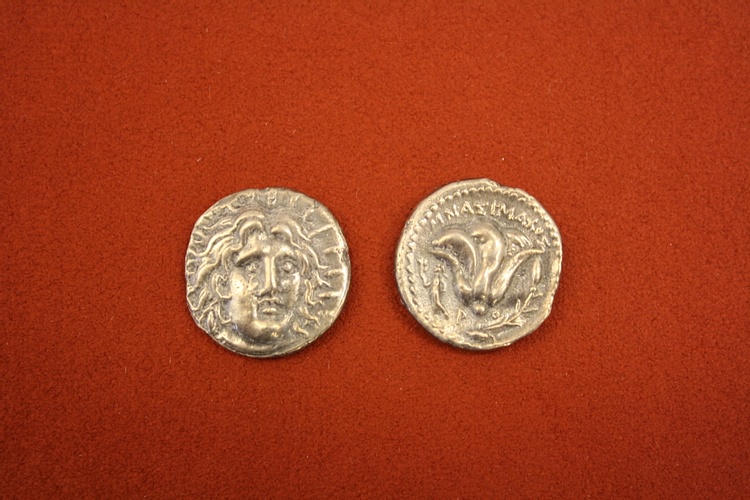 Rhodes Silver Didrachm Mark Cartwright (CC BY-NC-SA) ](https://www.worldhistory.org/image/836/rhodes-silver-didrachm/ "Rhodes Silver Didrachm")### The Archaeological Sites
Rhodes town, although extensively built upon in later periods, still shows the remains of temples, city walls, a [stadium](https://www.worldhistory.org/Stadium/), odeum, and harbour constructions. Camirus never had a fortified [acropolis](https://www.worldhistory.org/Acropolis/); nevertheless, excavations have revealed a [temple](https://www.worldhistory.org/temple/) to Athena, stoas, an [agora](https://www.worldhistory.org/agora/), and extensive private housing remains. Ialysus displays Mycenaean tombs, temples to Athena Polias and Zeus Polieus, and a fountain house.
Perhaps the most important archaeological site on the island is at Lindus, the capital before it was moved to Rhodes c. 408 BCE. A temple to Athena Lindia was built on the acropolis of the town, according to tradition, by Danaos in 1510 BCE. This was replaced with a new Doric temple in the 6th century BCE in the reign of the tyrant Cleoboulos. After this temple was destroyed by fire, another temple was rebuilt in 342 BCE. A large [propylon](https://www.worldhistory.org/Propylaea/) or gate and a monumental stairway were added to the sacred site c. 300 BCE. In the 2nd century BCE, a Hellenistic stoa was constructed. Also of interest are the remains of the [theatre](https://www.worldhistory.org/disambiguation/theatre/) which originally had 26 rows of seats and a capacity for some 18,000 spectators, a temple to Dionysos, and rock-cut tombs. All of these monuments are testimony to the wealth and prestige once enjoyed by the island from its role as a trade hub in the eastern Mediterranean.
#### Editorial Review
This human-authored definition has been reviewed by our editorial team before publication to ensure accuracy, reliability and adherence to academic standards in accordance with our [editorial policy](https://www.worldhistory.org/static/editorial-policy/).
## Bibliography
- Ananiades, D. *Ancient Greece: Temples & Sanctuaries.* Toubis, Athens, 2010
- [Cline, E.H. *The Oxford Handbook of the Bronze Age Aegean.* Oxford University Press, USA, 2012.](https://www.worldhistory.org/books/0199873607/)
- [Hornblower, S. *The Oxford Classical Dictionary.* Oxford University Press, USA, 2012.](https://www.worldhistory.org/books/0199545561/)
- [Kinzl, K.H. (ed). *A Companion to the Classical Greek World.* Wiley-Blackwell, 2010.](https://www.worldhistory.org/books/1444334123/)
## About the Author
Mark is WHE’s Publishing Director and has an MA in Political Philosophy (University of York). He is a full-time researcher, writer, historian and editor. Special interests include art, architecture and discovering the ideas that all civilizations share.
## Timeline
- **c. 1600 BCE**: [Rhodes](https://www.worldhistory.org/Rhodes/) has significant contact with [Minoan](https://www.worldhistory.org/disambiguation/Minoan/) [Crete](https://www.worldhistory.org/crete/).
- **1510 BCE**: The traditional date Danaos builds a [temple](https://www.worldhistory.org/temple/) to [Athena](https://www.worldhistory.org/athena/) Lindia at Lindus on [Rhodes](https://www.worldhistory.org/Rhodes/).
- **c. 1400 BCE**: [Rhodes](https://www.worldhistory.org/Rhodes/) has significant contact with the [Mycenaean civilization](https://www.worldhistory.org/Mycenaean_Civilization/).
- **c. 689 BCE**: [Rhodes](https://www.worldhistory.org/Rhodes/) and Cretans found [Gela](https://www.worldhistory.org/Gela/) in [Sicily](https://www.worldhistory.org/sicily/).
- **c. 580 BCE**: [Agrigento](https://www.worldhistory.org/agrigento/) in [Sicily](https://www.worldhistory.org/sicily/) is founded by colonists from [Gela](https://www.worldhistory.org/Gela/), [Crete](https://www.worldhistory.org/crete/) and [Rhodes](https://www.worldhistory.org/Rhodes/).
- **490 BCE**: [Rhodes](https://www.worldhistory.org/Rhodes/) comes under Persian rule.
- **c. 412 BCE**: [Rhodes](https://www.worldhistory.org/Rhodes/) revolts against [Athens](https://www.worldhistory.org/Athens/) and supports [Sparta](https://www.worldhistory.org/sparta/) in the [Peloponnesian War](https://www.worldhistory.org/Peloponnesian_War/).
- **c. 408 BCE**: The various [city](https://www.worldhistory.org/city/)-states of [Rhodes](https://www.worldhistory.org/Rhodes/) form a single federal state.
- **c. 408 BCE**: The capital of [Rhodes](https://www.worldhistory.org/Rhodes/) is moved from Lindos to Rhodes town.
- **395 BCE**: Democracy is established on [Rhodes](https://www.worldhistory.org/Rhodes/).
- **342 BCE**: Fire destroys the 6th century BCE [temple](https://www.worldhistory.org/temple/) to [Athena](https://www.worldhistory.org/athena/) at Lindos, [Rhodes](https://www.worldhistory.org/Rhodes/) and is replaced by a new one.
- **305 BCE - 304 BCE**: Demetrius I unsuccessfully lays siege to [Rhodes](https://www.worldhistory.org/Rhodes/).
- **c. 292 BCE - c. 280 BCE**: The [Colossus of Rhodes](https://www.worldhistory.org/Colossus_of_Rhodes/), a representation of [Helios](https://www.worldhistory.org/Helios/), is built in [Rhodes](https://www.worldhistory.org/Rhodes/) town harbour, one of [the Seven Wonders](https://www.worldhistory.org/The_Seven_Wonders/) of the Ancient World.
- **228 BCE - 226 BCE**: The [Colossus of Rhodes](https://www.worldhistory.org/Colossus_of_Rhodes/) is toppled by an [earthquake](https://www.worldhistory.org/disambiguation/earthquake/).
- **206 BCE - 204 BCE**: [Crete](https://www.worldhistory.org/crete/) is at [war](https://www.worldhistory.org/disambiguation/War/) with [Rhodes](https://www.worldhistory.org/Rhodes/).
- **197 BCE**: [Samos](https://www.worldhistory.org/samos/) comes under the jurisdiction of [Rhodes](https://www.worldhistory.org/Rhodes/).
- **189 BCE**: [Rome](https://www.worldhistory.org/Rome/) gives control of [Lycia](https://www.worldhistory.org/lycia/) to [Rhodes](https://www.worldhistory.org/Rhodes/).
- **164 BCE**: [Leonidas](https://www.worldhistory.org/disambiguation/Leonidas/) of [Rhodes](https://www.worldhistory.org/Rhodes/) wins the first of his 12 Olympic crowns in runnning events in four successive Olymic Games.
- **155 BCE - 153 BCE**: [Crete](https://www.worldhistory.org/crete/) is at [war](https://www.worldhistory.org/disambiguation/War/) with [Rhodes](https://www.worldhistory.org/Rhodes/) for a second time.
- **88 BCE**: [Rhodes](https://www.worldhistory.org/Rhodes/) is beseiged by [Mithradates VI](https://www.worldhistory.org/Mithridates_VI/).
- **43 BCE**: [Rhodes](https://www.worldhistory.org/Rhodes/) is sacked by Cassius Longinus.
- **c. 654 CE**: According to Theophanes, a Jewish merchant transports the pieces of the fallen [Colossus of Rhodes](https://www.worldhistory.org/Colossus_of_Rhodes/) to [Edessa](https://www.worldhistory.org/edessa/) for melting down.
## External Links
- [Episode 06 – The Island of Rhodes & Tyrrhenian Pirates – History of Pirates Podcast](http://www.historyofpiratespodcast.com/?p=136)
- [The Colossus Of Rhodes — What Happened To This Wonder Of The Ancient World?](https://allthatsinteresting.com/colossus-of-rhodes)
## Cite This Work
### APA
Cartwright, M. (2013, March 19). Rhodes. *World History Encyclopedia*.
### Chicago
Cartwright, Mark. "Rhodes." *World History Encyclopedia*, March 19, 2013. .
### MLA
Cartwright, Mark. "Rhodes." *World History Encyclopedia*, 19 Mar 2013, .
## License & Copyright
Submitted by [Mark Cartwright](https://www.worldhistory.org/user/markzcartwright/ "User Page: Mark Cartwright"), published on 19 March 2013. The copyright holder has published this content under the following license: [Creative Commons Attribution-NonCommercial-ShareAlike](https://creativecommons.org/licenses/by-nc-sa/4.0/deed.en). This license lets others remix, tweak, and build upon this content non-commercially, as long as they credit the author and license their new creations under the identical terms. When republishing on the web a hyperlink back to the original content source URL must be included. Please note that content linked from this page may have different licensing terms.