---
title: Rhea
author: Liana Miate
source: https://www.worldhistory.org/Rhea/
format: machine-readable-alternate
license: Creative Commons Attribution-NonCommercial-ShareAlike (https://creativecommons.org/licenses/by-nc-sa/4.0/)
updated: 2023-04-09
---
# Rhea
_Authored by [Liana Miate](https://www.worldhistory.org/user/lianamiate/)_
Rhea (also spelt Rheia) is a [Titan](https://www.worldhistory.org/Titan/) and a mother goddess in [Greek mythology](https://www.worldhistory.org/Greek_Mythology/). She is the daughter of [Gaia](https://www.worldhistory.org/Gaia/) (Earth) and [Uranus](https://www.worldhistory.org/Uranus/) (Heaven) and the mother of the great deities of Mount Olympus. Rhea was closely associated with the Phrygian (Anatolian) mother goddess, [Cybele](https://www.worldhistory.org/Cybele/). Her [Roman](https://www.worldhistory.org/disambiguation/Roman/) counterpart was Ops, a fertility deity and the goddess of the harvest.
Rhea is most well-known as the mother of the Olympian deities, especially [Zeus](https://www.worldhistory.org/zeus/), who she saved from being swallowed by his father, [Cronus](https://www.worldhistory.org/Cronus/). As an earth and fertility goddess, she was worshipped widely throughout the ancient [Greek](https://www.worldhistory.org/disambiguation/greek/) world.
### Birth & Family
According to [Hesiod](https://www.worldhistory.org/hesiod/) (c. 700 BCE) in his *[Theogony](https://www.worldhistory.org/Theogony/)*, Rhea was the daughter of Gaia (Earth) and Uranus (Heaven). Moreover, she was the sister of [Oceanus](https://www.worldhistory.org/Oceanus/), [Themis](https://www.worldhistory.org/Themis/) (Justice), Mnemosyne (Memory), Tethys (mother of the Oceanids) and Cronus, amongst other mythological figures.
Uranus hated his children and hid them under the earth so they never saw the light of day. Finally, Gaia devised a plan to rescue her children, but only Cronus was brave enough to volunteer to carry out the plan by striking his genitals off with a sickle.
After Cronus had defeated their father, he married Rhea, and she bore him several children.
> And Rhea, being forced by Kronus, bore
> Most brilliant offspring to him: [Hestia](https://www.worldhistory.org/Hestia/),
> [Demeter](https://www.worldhistory.org/demeter/), golden-slippered [Hera](https://www.worldhistory.org/Hera/), strong
> [Hades](https://www.worldhistory.org/Hades/), who has his home beneath the earth,
> The [god](https://www.worldhistory.org/God/) whose heart is pitiless, and him
> Who crashes loudly and who shakes the earth,
> And thoughtful Zeus, father of gods and men,
> Whose thunder makes the wide earth tremble.
> (Hesiod, *Theogony*, 453-461)
### Rhea & Zeus
Gaia and Uranus had warned their son that he was destined to face the same fate that his father had; being destroyed by his children. So, as Rhea gave birth, he swallowed each child straight away in a desperate attempt to avoid this prophecy.
While Rhea was pregnant with Zeus, she approached her parents for help, not wanting Cronus to swallow yet another one of her children. On the advice of Gaia and Uranus, Rhea travelled to the island of [Crete](https://www.worldhistory.org/crete/), where she gave birth to Zeus in a cave on Mount Dicte. Rhea went back to Cronus, where she tricked him by pretending to give birth and handing Cronus a stone that was swaddled in blankets. Not suspicious at all, Cronus swallowed his newest "child".
[ 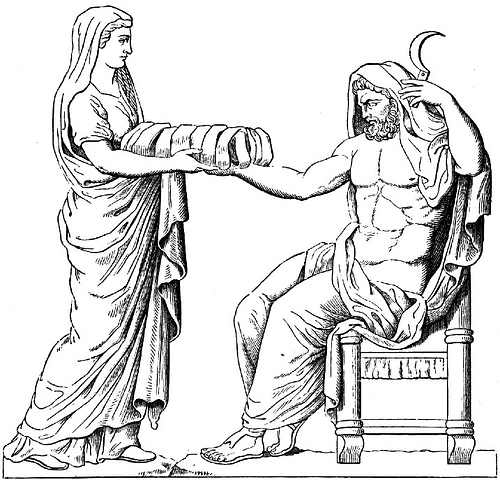 Rhea & Cronus Numérisation Google (Public Domain) ](https://www.worldhistory.org/image/16838/rhea--cronus/ "Rhea & Cronus")Meanwhile, back at Crete, Zeus was being raised by the nymphs Adrastia and Ida (the Meliae), who fed him the milk of the she-goat Amaltheia. Zeus was quickly growing in strength and knowledge, and Rhea knew that he would be the one to overthrow Cronus, just as Cronus had once overthrown his own father. Rhea's friend, the Oceanid Metis, gave Zeus a potion that would cause Cronus to throw up his children. Cronus threw up his children in reverse order: first came the stone, then [Poseidon](https://www.worldhistory.org/poseidon/), Hades, Hera, Demeter, and Hestia. Zeus' siblings swore allegiance to him, and so began the age of the Olympian gods.
### Rhea & [Dionysos](https://www.worldhistory.org/Dionysos/)
According to classical tradition, Dionysos was said to be thrice-born. His father, Zeus, disguised himself as a mortal to lie with his mother, Semele. After she became pregnant with Dionysos, Semele asked Zeus to reveal his true self to her. Sadly, Semele could not handle Zeus' godly splendour and instantly died upon seeing Zeus' true form. The unborn Dionysos was placed in Zeus' thigh, resulting in a divine birth.
After Hera learned of Dionysos' existence, she ordered the Titans to tear Dionysos apart. In some versions of the myth, Rhea, Dionysos' grandmother, found the pieces of his body and put him back together, resurrecting him. She returned him to Zeus, disguising him as a ram to protect him from Hera's wrath.
### Rhea, [Jason & the Argonauts](https://www.worldhistory.org/article/425/jason--the-argonauts/)
As told in the *Argonautica* by Apollonius Rhodius (c. 295 BCE), after King Cyzicus of the Dolionians had accidentally been killed by Jason and the Argonauts, they held funeral games in his honour. However, they remained stranded on the island of the Dolionians due to wild weather. Then, one night, a halcyon appeared with a message. The [nymph](https://www.worldhistory.org/nymph/) and argonaut Mopsus could understand what the bird was saying and woke Jason to relay the prophecy.
[  Map of the Quest of Jason and the Argonauts Simeon Netchev (CC BY-NC-ND) ](https://www.worldhistory.org/image/16219/map-of-the-quest-of-jason-and-the-argonauts/ "Map of the Quest of Jason and the Argonauts")According to the halcyon, the wild weather would stop only when they honoured the mother goddess (Rhea). So Jason and the Argonauts travelled to the Thracian shores, where they built an altar and wore wreaths of oak leaves. They beseeched Rhea to end the storm and poured libations to her. Rhea heard their pleas and sent them signs. Suddenly the trees were heavy with abundant fruit, and bright flowers were sprouting from the ground around them. Wild beasts came out of their lairs. Most impressive of all, however, was the wild gush of water she caused to stream down Mount Dindymum, where previously, there had never been water (this became known as the Spring of Jason). They held a feast in honour of the goddess on the Mount of Bears, where they sang her praises. By dawn, the wild weather had calmed down, and they were able to sail away from the island.
### Other Myths
Rhea had a small part to play in various Greek myths. As relayed in the *Argonautica* by Apollonius Rhodius, while Zeus was still being raised on the island of Crete, Cronus travelled to Mount Pelion, where he lay with the Oceanid Philyra. Rhea happened to come across them, and in a panic, Cronus jumped up, transformed into a stallion and ran off.
In the *Homeric Hymn to Demeter*, [Persephone](https://www.worldhistory.org/persephone/) is returned to earth and reunited with Demeter after being kidnapped and taken to the underworld by Hades. After her return, Zeus sent Rhea on his behalf to bring Demeter back to the gods.
> Come, my child,
> loid-thundering, far-seeing Zeus calls you
> to come back to the tribes of the gods,
> and he has promised to give you honours,
> whatever you wish among the immortal gods.
> He consented with a nod that for a third part
> of the circling year your daughter
> Shall go down to the gloomy darkness,
> but for the other two parts she shall be
> With you and the other [immortals](https://www.worldhistory.org/disambiguation/immortals/).
> (*The Homeric Hymns: Homeric Hymn to Demeter*, 460-466)
Demeter listened to her mother, and she and Persephone returned to Mount Olympus to live beside the rest of the gods.
[  Demeter & Persephone Osama Shukir Muhammed Amin (Copyright) ](https://www.worldhistory.org/image/5080/demeter--persephone/ "Demeter & Persephone")###
The Dactyls & the Kouretes (Korybantes)
According to some traditions, as Rhea was giving birth to Zeus, she pressed her fingers into the earth, and the Dactyls sprung from them; five females from her left hand and five males from her right hand. The male Dactyls discovered iron in Mount Berecynthus, while the females settled in [Samothrace](https://www.worldhistory.org/Samothrace/) and cast magical spells. One of the Dactyls, named Celmis, was said to be turned into iron by Rhea as punishment for insulting the goddess.
The Kouretes (also Kuretes or Curetes) were Rhea's attendants who helped bring up Zeus on Crete. They sang and danced and clashed their shields to drown out the cries of the infant Zeus and protect him from his father. This resulted in the followers of Rhea dancing, singing, and clashing shields.
The Korybantes were said to be the attendants of the goddess Cybele. However, some ancient writers, including [Euripides](https://www.worldhistory.org/Euripides/) (c. 484-407 BCE) and Strabo (63 BCE to 23 CE), used both terms for the attendants of Rhea and Cybele.
### Rhea & Cybele
Rhea was closely associated with Cybele, a Phrygian goddess who was worshipped across Greece, Rome and Anatolia. In the mid-6th century BCE, ancient writers began associating Cybele and Rhea with one another. For example, the cult figure known as Meter was referred to as both Rhea and Cybele interchangeably.
The association between the two goddesses reaffirmed Cybele's identity as a mother goddess – she was now known as a mother of the gods, just as Rhea was. It also explains the ecstatic worship carried out by both their worshippers, which is seen in the cult of Meter across the ancient Greek world. It is believed to have its origins in Crete as a direct connection to the story of Zeus and the Kouretes. Rhea and Cybele began as two separate identities, but they essentially became two manifestations of the same deity.
[  Cybele with Patera, Lion & Tympanon Nathalie Choubineh (CC BY) ](https://www.worldhistory.org/image/13515/cybele-with-patera-lion--tympanon/ "Cybele with Patera, Lion & Tympanon")Rhea began to be represented in Greek art during the 4th century BCE, where her connection to Cybele is evident in the visual iconography. Rhea's cult was located on Mount Ida in Crete, while Cybele's cult could be found on Mount Ida in Anatolia.
### Worship & Legacy
As a mother goddess, Rhea had multiple temples dedicated to her. A [temple](https://www.worldhistory.org/temple/) in [Athens](https://www.worldhistory.org/Athens/) was dedicated to both her and Cronus, while in [Thebes (Greece)](https://www.worldhistory.org/Thebes_(Greece)/), another temple was dedicated to her and [Pan](https://www.worldhistory.org/Pan/). In [Olympia](https://www.worldhistory.org/Olympia/), there was a temple known as the Metroön, which was built for Rhea in honour of her role as mother of the gods.
[  View of Mount Ida from Eleutherna, Crete Carole Raddato (CC BY-NC-SA) ](https://www.worldhistory.org/image/10636/view-of-mount-ida-from-eleutherna-crete/ "View of Mount Ida from Eleutherna, Crete")Bulls, rams, and goats were sacrificed to her, and a ritual known as the baptism of the blood (a renewal of life) was practised in honour of her.
The second largest moon of [Saturn](https://www.worldhistory.org/Saturn/) is named after Rhea. It was discovered by Italian astronomer Giovanni Domenico Cassini (1625-1712) in 1672. Her sister moons are Dione and Tethys.
#### Editorial Review
This human-authored definition has been reviewed by our editorial team before publication to ensure accuracy, reliability and adherence to academic standards in accordance with our [editorial policy](https://www.worldhistory.org/static/editorial-policy/).
## Bibliography
- [Apollodorus & Hard, Robin. *The Library of Greek Mythology .* Oxford University Press, 2008.](https://www.worldhistory.org/books/0199536325/)
- [Daly, Kathleen N & Rengel, Marian. *Greek and Roman Mythology A to Z.* Chelsea House Publications, 2009.](https://www.worldhistory.org/books/1604134127/)
- [Graf, Fritz & Johnston, Sarah & Johnston, Sarah Iles. *Ritual Texts for the Afterlife.* Routledge, 2013.](https://www.worldhistory.org/books/0415508037/)
- [Graves, Robert. *The Greek Myths\[May 15, 2018\] Graves, Robert.* Viking, 2018.](https://www.worldhistory.org/books/0241982359/)
- [Hesiod & Theognis & Wender, Dorothea & Wender, Dorothea. *Hesiod and Theognis .* Penguin Classics, 1976.](https://www.worldhistory.org/books/0140442839/)
- [Homer & Richardson, Nicholas & Cashford, Jules & Richardson, Nicholas. *Homeric Hymns .* Penguin Classics, 2003.](https://www.worldhistory.org/books/0140437827/)
- [In Depth | Rhea – NASA Solar System Exploration](https://solarsystem.nasa.gov/moons/saturn-moons/rhea/in-depth/ "In Depth | Rhea – NASA Solar System Exploration"), accessed 16 Dec 2022.
- [McCoppin, Rachel S. *The Lessons of Nature in Mythology.* McFarland, 2015.](https://www.worldhistory.org/books/B017ODNAM0/)
- [Roller, Lynn E. *In Search of God the Mother.* University of California Press, 1999.](https://www.worldhistory.org/books/0520210247/)
- [Scull, Sarah Amelia. *Greek mythology systematized 1880 \[Leather Bound\].* Generic, 2022.](https://www.worldhistory.org/books/B07QZQTSTX/)
- [The Argonautica, by Apollonius Rhodius](https://www.gutenberg.org/files/830/830-h/830-h.htm "The Argonautica, by Apollonius Rhodius"), accessed 16 Dec 2022.
## About the Author
Liana is the Social Media Editor for Ancient History Encyclopedia. She holds a Bachelor of Arts Degree with a major in ancient Greece, Rome & Late Antiquity. She is particularly passionate about Rome and Greece, and anything to do with mythology or wo
- [Linkedin Profile](https://www.linkedin.com/in/lian)
## Questions & Answers
### What is Rhea the goddess of?
Rhea is a mother goddess who is closely associated with the earth.
### What does Rhea mean in Greek?
In Greek, the name Rhea means 'flow' and 'ease'.
### What is Rhea's power?
As a Titaness and goddess, Rhea was immortal. Her powers included bringing people back to life, as is seen with Dionysos.
### Is Rhea the mother of Zeus?
Yes, Rhea is the mother of Zeus.
## Cite This Work
### APA
Miate, L. (2022, December 22). Rhea. *World History Encyclopedia*.
### Chicago
Miate, Liana. "Rhea." *World History Encyclopedia*, December 22, 2022. .
### MLA
Miate, Liana. "Rhea." *World History Encyclopedia*, 22 Dec 2022, .
## License & Copyright
Submitted by [Liana Miate](https://www.worldhistory.org/user/lianamiate/ "User Page: Liana Miate"), published on 22 December 2022. The copyright holder has published this content under the following license: [Creative Commons Attribution-NonCommercial-ShareAlike](https://creativecommons.org/licenses/by-nc-sa/4.0/deed.en). This license lets others remix, tweak, and build upon this content non-commercially, as long as they credit the author and license their new creations under the identical terms. When republishing on the web a hyperlink back to the original content source URL must be included. Please note that content linked from this page may have different licensing terms.