---
title: Quaestor
author: Donald L. Wasson
source: https://www.worldhistory.org/Quaestor/
format: machine-readable-alternate
license: Creative Commons Attribution-NonCommercial-ShareAlike (https://creativecommons.org/licenses/by-nc-sa/4.0/)
updated: 2023-08-23
---
# Quaestor
_Authored by [Donald L. Wasson](https://www.worldhistory.org/user/DWasson/)_
The *quaestor (*"the one who asks questions") was the oldest and lowest office on the *cursus honorum,* or "path of honor" in ancient [Rome](https://www.worldhistory.org/Rome/). Considered a stepping stone to higher office in the [Roman government](https://www.worldhistory.org/Roman_Government/), the duties of the *quaestor* ranged from administrating public properties and overseeing treasuries to collecting taxes and recruiting in the provinces, among other tasks.
Like all of the other magistrates, the *quaestor* was unpaid, leaving entry to the position to only those few with an alternate source of income. However, it still served as a gateway for many young Romans who wished for a life in politics. Although originally flexible, the ladder was codified by the *Lex Villia Annalis* of 180 BCE, which established the minimum age for entry into each office. The code would be later confirmed by the [Roman](https://www.worldhistory.org/disambiguation/Roman/) commander and dictator [Sulla](https://www.worldhistory.org/sulla/) around 82 BCE.
### Origins of the Quaestor
The *quaestor* or *quaestores parricidii* first existed under the rule of kings and was granted judicial powers: prosecuting murder cases and serving as a police inspector. The position continued to exist to some extent in the [Roman Republic](https://www.worldhistory.org/Roman_Republic/) but gradually faded out by the 2nd century BCE. During the time of the Roman Republic, new offices were introduced: the *[aedile](https://www.worldhistory.org/Aedile/)* supervised the markets, the *[censor](https://www.worldhistory.org/censor/)* registered citizens and soldiers, the *[praetor](https://www.worldhistory.org/praetor/)* served as a judicial official and secondary military commander, and lastly, the *quaestor* administered public properties and treasuries.
At the founding of the Republic, there existed only two *quaestors* – *quaestores aerarii* – one was assigned to each of the two consuls. With a staff of scribes, they were put in control of the treasury or *aerarium* under the supervision of the [Roman Senate](https://www.worldhistory.org/Roman_Senate/). The treasury controlled all state documents both financial and non-financial. The main treasury, the *aerarium Saturni,* was located at the foot of Capitoline Hill in Rome.
Although exceptions existed, most individuals entered the Roman Senate through the office of the *quaestor,* automatically receiving a seat in the Senate upon appointment. This first step on the path was usually achieved around the age of 30 – as established by the [law](https://www.worldhistory.org/disambiguation/law/) – after having served in the [Roman army](https://www.worldhistory.org/Roman_Army/) for at least ten years. The next step was the *aedile* at the age of 38, who supervised public maintenance: [Roman roads](https://www.worldhistory.org/article/758/roman-roads/), food and water supply and the games. The *praetor,* like the [consul](https://www.worldhistory.org/Consul/), had *imperium* power and, at the age of 43, held judicial duties, holding both civic and provincial jurisdiction. After the long climb, an individual was prepared to stand for a consul.
### Expanded Duties
After 447 BCE, the *quaestor* was elected by the tribal assembly, the *comitia tributa*. With the [plebeians](https://www.worldhistory.org/Plebeians/) coming into power under the authority of the Law of the [Twelve Tables](https://www.worldhistory.org/Twelve_Tables/), two more *quaestors* were added bringing the total to four: two of the *quaestors* served as quartermasters to the two consuls when in the field, while the other two remained in Rome to supervise the financial affairs of the treasury. Under Sulla (138-78 BCE), the number of *quaestors* was increased to 20, and to accommodate this increase, he also increased the size of the Senate. [Julius Caesar](https://www.worldhistory.org/Julius_Caesar/) (100-44 BCE) raised the number of quaestors to 40; however, his adopted son and successor, the [Roman emperor](https://www.worldhistory.org/Roman_Emperor/) [Augustus](https://www.worldhistory.org/augustus/) (r. 27 BCE to 14 CE) returned it to 20. Sulla had reaffirmed the minimum age for a *quaestor* to be 30 as in the law, but Augustus reduced it to 25 and transferred the election of the *quaestor* to the Senate. Another major change during the early days of the [Roman Empire](https://www.worldhistory.org/Roman_Empire/) was the appointment of two *quaestores Augusti* to serve as messengers for the emperor while still retaining their financial responsibilities.
[  Ancient Roman Society and Social Order Simeon Netchev (CC BY-NC-ND) ](https://www.worldhistory.org/image/17368/ancient-roman-society-and-social-order/ "Ancient Roman Society and Social Order")As new territories were added to the Republic, major changes in the provincial governments became necessary. When [Sicily](https://www.worldhistory.org/sicily/), Corsica, and Sardinia were acquired from [Carthage](https://www.worldhistory.org/carthage/) following the [First Punic War](https://www.worldhistory.org/First_Punic_War/) (264-241 BCE), a *praetor* was assigned to serve as governor while a *quaestor* accompanied him and oversaw tax collection and recruited soldiers to serve in the [Roman military](https://www.worldhistory.org/Roman_Army/). No additional provincial bureaucracy was provided. This concept would serve as a model for all provincial governments in the Republic. Although most *quaestors* only served one year, a *quaestor* assigned to a provincial magistrate often served for a minimum of two years, occasionally three. If the magistrate was absent for any reason, the *quaestor* was expected to assume command as *pro praetore* or envoy of the emperor.
Even after his time as a *quaestor* ended, he remained bound for life in faith (*fides*) to his former commander. His financial accounts could be used as evidence in a trial to recover or secure compensation for the illegal acquisition of money or property by a Roman. With a *praetor* presiding, by 70 BCE, the jury consisted of one-third senators, one-third equestrians, and one-third *tribuni aerarii*. Occasionally, a *quaestor* might be tempted to prosecute his own commander to advance his career.
### Cato, [Caesar](https://www.worldhistory.org/disambiguation/caesar/), & [Cicero](https://www.worldhistory.org/Cicero/)
Two of the Republic's most prominent statesmen had distinguished quaestorships: Porcius Cato ([Cato the Younger](https://www.worldhistory.org/Cato_the_Younger/), 95-46 BCE) and [Julius](https://www.worldhistory.org/disambiguation/Julius/) Caesar. Cato was assigned to supervise the treasury. Prior to Cato's time as *quaestor* (69 BCE), many *quaestors* neglected their responsibilities and allowed their clerks/scribes to manage the paperwork and daily activities of the treasury. Cato, however, saw it differently; his time in office was referred to as a nightmare. Having studied the obligations of the *quaestor* and the treasury's purpose beforehand, he demanded the scribes show him their accounts, which he tenaciously reviewed, finding errors – some were made through a scribe's ignorance while others were deliberate. He found uncollected debts and forged documents (even senatorial decrees).
[ 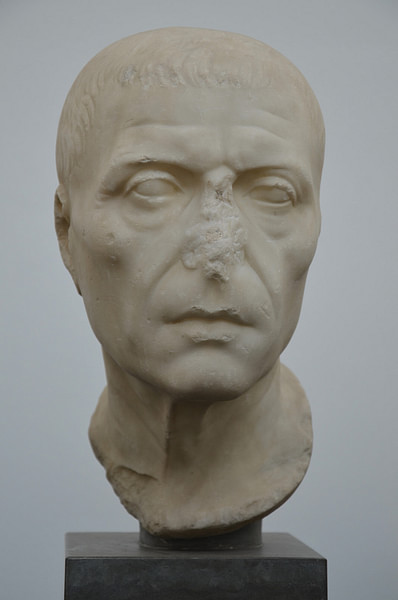 Cato the Younger Carole Raddato (CC BY-SA) ](https://www.worldhistory.org/image/2523/cato-the-younger/ "Cato the Younger")Although considering himself a friend, Cicero wrote that Cato's vigilance over the treasury was carried to the point of obstinacy. He mercilessly lectured the clerks on improper and sloppy bookkeeping and inadequate procedures and brought charges against many of the Roman nobility who owed money to the state. Scribes found guilty of misconduct were dismissed or prosecuted. The courts overflowed with new cases and special judges had to be appointed. Under his control, the treasury's reputation for efficiency and fairness increased.
Unlike Cato, Caesar, who happened to be one of the judges to hear Cato's cases, acquired a foreign assignment in Further Spain. Caesar took advantage of his time in Spain, preparing himself for his political future. During his time as a *quaestor*, he served under the governor Antistius Vetus. His position was tedious; he travelled from town to town dealing with tax payments, ruling on cases and settling disputes, but it gave him the opportunity to make himself known among the provincials. With his assignment as a *quaestor,* in 67 BCE, Caesar had achieved his first significant goal: a seat in the Senate.
Another *quaestor* of note was the Roman statesman, orator, and Stoic philosopher [Marcus Tullius Cicero](https://www.worldhistory.org/Cicero/) (106-43 BCE). Early in his career, he incurred the wrath of the Roman dictator Sulla and chose to leave Rome to study [philosophy](https://www.worldhistory.org/philosophy/) in [Athens](https://www.worldhistory.org/Athens/). In 78 BCE, Sulla died, and by 77 BCE, Cicero had returned to Rome with the good intentions of rebuilding his legal career and initiating a campaign to stand for election for a quaestorship. In 75 BCE, he won the election and was one of two *quaestors* stationed in Sicily. Acquired after the First [Punic](https://www.worldhistory.org/carthage/) [War](https://www.worldhistory.org/disambiguation/War/), Sicily was an important supplier of grain for Rome. Cicero's duties included calculating the price of the grain and the amount and price of the surplus. In 74 BCE, Cicero returned to Rome, having earned the respect of those in both Sicily and Rome. And, like with Caesar, the real point of being a *quaestor* was entry into the Senate. Cicero believed in honesty, and according to Anthony Everitt in his *Cicero*, "He had proved his worth as a public official. He had been able to practice and perfect his advocacy techniques in a more relaxed setting than the Forum" (70).
[  Cicero Mary Harrsch (Photographed at the Capitoline Museum) (CC BY-NC-SA) ](https://www.worldhistory.org/image/1026/cicero/ "Cicero")### Quaestors in the [Empire](https://www.worldhistory.org/empire/)
The emperors Augustus and [Nero](https://www.worldhistory.org/Nero/) (r. 54-68 CE) removed the *quaestors* from their duties at the treasury, although Emperor [Claudius](https://www.worldhistory.org/claudius/) (r. 41-54 CE) temporarily returned their number to 20. Nero reassigned them to supervise the games and had their responsibilities in Rome assigned to other imperial officers. In the provinces, however, they retained most of their financial responsibilities. Although *quaestors* acquired new duties elsewhere, the emperor, as well as both of the consuls, each had two *quaestores Caesaris*, chosen by the emperor, often from the [patrician](https://www.worldhistory.org/Patrician/) class.
In the late empire, the emperor's *quaestor's* duties grew in importance with his becoming the emperor's spokesman – the *quaestor sacri palatii* ("quaestor of the sacred [palace](https://www.worldhistory.org/disambiguation/palace/)") – and aiding in the drafting of laws. His function also increased under the emperors [Constantine the Great](https://www.worldhistory.org/Constantine_I/) (r. 306-337) and [Justinian I](https://www.worldhistory.org/Justinian_I/) (r. 527-565), where he became a legal counsel, drafting laws and answering petitions.
#### Editorial Review
This human-authored definition has been reviewed by our editorial team before publication to ensure accuracy, reliability and adherence to academic standards in accordance with our [editorial policy](https://www.worldhistory.org/static/editorial-policy/).
## Bibliography
- [Everitt, Anthony. *Cicero.* Random House Trade Paperbacks, 2003.](https://www.worldhistory.org/books/037575895X/)
- [Goldsworthy, Adrian. *Pax Romana.* Yale University Press, 2017.](https://www.worldhistory.org/books/0300230621/)
- [Gwynn, David M. *The Roman Republic.* Oxford University Press, 2012.](https://www.worldhistory.org/books/0199595119/)
- [Hornblower, Simon & Spawforth, Antony & Eidinow, Esther. *The Oxford Classical Dictionary.* Oxford University Press, 2012.](https://www.worldhistory.org/books/0199545561/)
- [Nigel Rodgers & Hazel Dodge. *Roman Empire.* Metro Books, 2023.](https://www.worldhistory.org/books/1435104552/)
- [Rosenstein, Nathan & Morstein-Marx, Robert. *A Companion to the Roman Republic.* Wiley-Blackwell, 2010.](https://www.worldhistory.org/books/1444334131/)
## About the Author
Donald has taught Ancient, Medieval and U.S. History at Lincoln College (Normal, Illinois)and has always been and will always be a student of history, ever since learning about Alexander the Great. He is eager to pass knowledge on to his students.
## Timeline
- **509 BCE**: Quaestors become a prominent position in the [Roman Republic](https://www.worldhistory.org/Roman_Republic/).
- **450 BCE**: The number of [Roman](https://www.worldhistory.org/disambiguation/Roman/) quaestors is increased to four and made open to plebians.
- **c. 440 BCE**: [Roman](https://www.worldhistory.org/disambiguation/Roman/) quaestors are chosen by the assembly rather than the consuls.
- **c. 21 BCE**: Varus is made [quaestor](https://www.worldhistory.org/Quaestor/).
- **7 CE**: [Germanicus](https://www.worldhistory.org/Germanicus/) is made [quaestor](https://www.worldhistory.org/Quaestor/).
## Questions & Answers
### What are the duties of a quaestor?
Over time, the duties of the quaestor changed a lot. Originating from an office created to prosecute murders, during the Roman Republic quaestors were responsible for administrating public properties, overseeing treasuries, and collecting taxes in the provinces. From the days of Augustus to the time of Justinian, the responsibilities of the quaestor had grown from the caretaker of the treasury to advising the emperor.
### Is praetor a higher rank than quaestor?
Yes. Quaestor was the lowest rank in the Roman government. Praetors served as judicial officials, secondary military commanders, and governors in the provinces.
## Cite This Work
### APA
Wasson, D. L. (2023, August 23). Quaestor. *World History Encyclopedia*.
### Chicago
Wasson, Donald L.. "Quaestor." *World History Encyclopedia*, August 23, 2023. .
### MLA
Wasson, Donald L.. "Quaestor." *World History Encyclopedia*, 23 Aug 2023, .
## License & Copyright
Submitted by [Donald L. Wasson](https://www.worldhistory.org/user/DWasson/ "User Page: Donald L. Wasson"), published on 23 August 2023. The copyright holder has published this content under the following license: [Creative Commons Attribution-NonCommercial-ShareAlike](https://creativecommons.org/licenses/by-nc-sa/4.0/deed.en). This license lets others remix, tweak, and build upon this content non-commercially, as long as they credit the author and license their new creations under the identical terms. When republishing on the web a hyperlink back to the original content source URL must be included. Please note that content linked from this page may have different licensing terms.