---
title: Pylos
author: Kelly Macquire
source: https://www.worldhistory.org/Pylos/
format: machine-readable-alternate
license: Creative Commons Attribution-NonCommercial-ShareAlike (https://creativecommons.org/licenses/by-nc-sa/4.0/)
updated: 1970-01-01
---
# Pylos
_Authored by [Kelly Macquire](https://www.worldhistory.org/user/kelly.mac144/)_
Pylos was a significant [Mycenaean](https://www.worldhistory.org/Mycenaean_Civilization/) [Bronze Age](https://www.worldhistory.org/disambiguation/Bronze_Age/) [city](https://www.worldhistory.org/city/) located in the region of Messenia,
[Greece](https://www.worldhistory.org/greece/). The site is situated on the hill of Ano Englianos and during its Late [Bronze](https://www.worldhistory.org/disambiguation/bronze/) Age occupation between c. 1600-1200 BCE it covered a maximum area of 200-300,000 square metres (20-30 hectares). Pylos has provided the largest collection of [Linear B](https://www.worldhistory.org/Linear_B_Script/) tablets on the mainland and is the best-preserved palatial centre of the [Mycenaean Civilization](https://www.worldhistory.org/Mycenaean_Civilization/). In [mythology](https://www.worldhistory.org/mythology/), Pylos was the home of the son of [Poseidon](https://www.worldhistory.org/poseidon/); Neleus, and his son Nestor.
### The [Palace](https://www.worldhistory.org/disambiguation/palace/) of Nestor
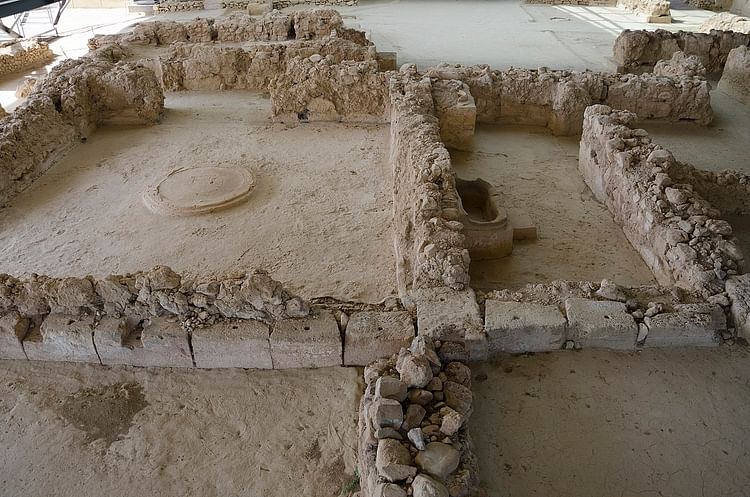
Central to the Mycenaean settlement at Pylos is the Palace of Nestor, named after the [Greek](https://www.worldhistory.org/disambiguation/greek/) hero Nestor; known from [Homer](https://www.worldhistory.org/homer/)'s *[Iliad](https://www.worldhistory.org/iliad/)* and *[Odyssey](https://www.worldhistory.org/Odyssey/)*; "among them uprose Nestor, that was king of sandy Pylos" (*Iliad* II. 2.76). The earliest settlement, uncovered by Lord William Taylour dates to the transition between the Early and Middle Bronze Age, c. 2000 BCE. From c. 1600 BCE, there was construction occurring on the hill of Ano Englianos, and by c. 1500 BCE, several monumental structures were completed. The structures on the hill burned down c. 1400 BCE, and the new complex built there was the final Palace of Nestor. It consisted of a "Main Building, Southwestern Building, Northeastern Building, and Wine Magazine;" structures that stood until its final destruction c. 1180 BCE (Davis, 684).
The rooms were highly decorated with frescoes; many of which have survived. Additionally, surviving decoration around the hearth in the megaron shows detail of flames encircling the base. The Mycenaean palatial centres were used as centralised spaces for economic and political activities, as well as spaces for specialised crafts and redistribution of goods. The Mycenaeans were known for their [trade](https://www.worldhistory.org/disambiguation/trade/) of perfumed oils, and large storage jars for oil were uncovered in the magazines at the palace. Additionally, discovered at the palace were smaller 'stirrup jars', so-called for their handle which looks like a stirrup; these were used for the storage and transport of oils.
[  Palace of Nestor Ruins Peulle (CC BY-SA) ](https://www.worldhistory.org/image/12826/palace-of-nestor-ruins/ "Palace of Nestor Ruins")### Pylos Archives
The Palace of Nestor is the best-surviving Mycenaean palatial site and has provided the most information about the social stratification, namely from the Pylos archives. When the Palace of Nestor burned c. 1180 BCE, the clay tablets for their short-term administrative records were baked; preserving documents from the final year of occupation. During excavations under Carl W. Blegen between 1952-1964 CE, William A. McDonald discovered two rooms containing the largest collection of Linear B tablets found in one location, which was hence referred to as the 'Archive Complex.' From these well-preserved archives, the social stratification of Pylos and administrative functions of the Palace of Nestor were revealed.
From these archives, we know that the Mycenaean site was ruled by a *wanax*, which translates as a 'lord' or 'king'. Underneath the *wanax* was the *lawagetas*, which has been understood as a governer and took part in economic activities and undertook military responsibilities. Additionally, due to the Linear B tablets uncovered in the Archive Complex, we are aware that Pylos split into two areas, the Hither and Further provinces. Our knowledge of the function and organisation of a Mycenaean site is the most thorough at Pylos thanks to the surviving tablets, however, the operation of the palace itself and its numerous rooms is still poorly understood.
### Burials & Artefacts
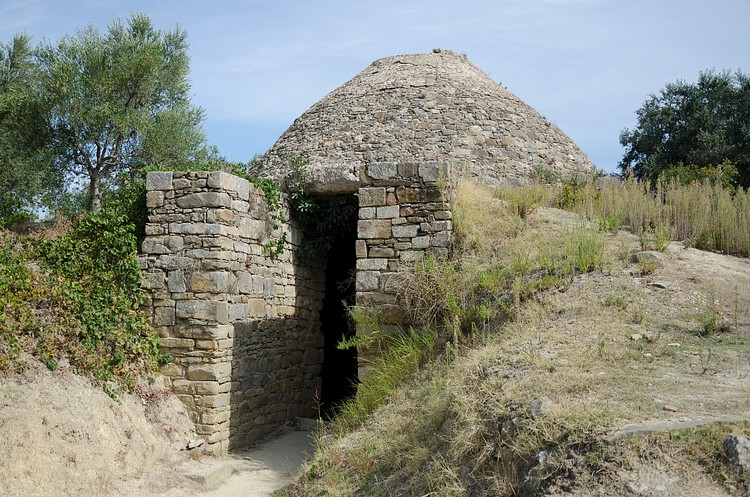
Surrounding the central Palace of Nestor is a rich mortuary landscape comprised of several chamber tombs, the so-called '[Grave](https://www.worldhistory.org/burial/) Circle' and multiple *tholoi* or beehive tombs. From the numerous burials located at Pylos, they are all considered 'elite'; the [burial](https://www.worldhistory.org/burial/) places for the rest of the Pylos community is unknown. Tholos IV may be the oldest *tholos* burial on the mainland and dates to the same period as the Grave Circles at [Mycenae](https://www.worldhistory.org/mycenae/); the Shaft Grave period. However, the Grave Circle at Pylos (originally considered a *tholos* [tomb](https://www.worldhistory.org/tomb/) by Lord William Taylour), exhibits burial practices which originate from the [Minoan Civilization](https://www.worldhistory.org/Minoan_Civilization/) on [Crete](https://www.worldhistory.org/crete/). In the Grave Circle, four large *pithoi* were uncovered which were used as burial jars. This practice was not transported to the mainland wholesale, however, but was altered by the Pylians by choosing to bury multiple people in a single *pithos*; a practice not observed on Crete.
[  Tholos IV at Pylos Peulle (CC BY-SA) ](https://www.worldhistory.org/image/12788/tholos-iv-at-pylos/ "Tholos IV at Pylos")The monumental *tholoi* are enough to identify the burials in them as elite, however, the material [culture](https://www.worldhistory.org/disambiguation/culture/) discovered in all of the burials at Pylos imply great wealth and status of those interred. The discoveries by Carl Blegen and his team comprised of [gold](https://www.worldhistory.org/gold/), [silver](https://www.worldhistory.org/Silver/), bronze, ivory, and numerous precious and semi-precious stones. These elite materials were utilised for jewellery, vessels, weapons, and seal stones, in addition to numerous examples of glass paste and [pottery](https://www.worldhistory.org/pottery/) in a range of shapes and styles.
Recent discoveries have added to this corpus of wealthy burial goods with the Griffin Warrior burial and two *tholoi* next to Tholos IV, named Tholos VI and Tholos VII. The Griffin Warrior has provided the Combat Agate seal stone, the most intricate warrior scene from the Bronze Age in addition to four incredibly detailed gold signet rings depicting [Minoan](https://www.worldhistory.org/disambiguation/Minoan/) religious scenes. The 30-35-year-old male dubbed the Griffin Warrior was buried with several artefacts showing provenance from the Minoans on Crete and crafted out of bronze, gold, and semi-precious stones. The two new *tholoi*, although not yet published, have yielded a gold pendant depicting the [Egyptian](https://www.worldhistory.org/disambiguation/Egyptian/) goddess [Hathor](https://www.worldhistory.org/Hathor/) and a gold signet ring detailed with shoots of barley flanking two bovids. These two new artefacts signify a stronger connection with [Egypt](https://www.worldhistory.org/egypt/) and the [Near East](https://www.worldhistory.org/Near_East/) than was previously understood.
### In Mythology
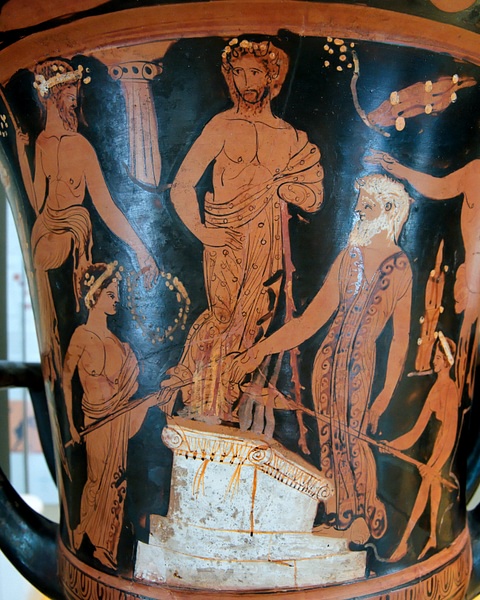
Neleus, twin to Pelias and the son of the [god](https://www.worldhistory.org/God/) Poseidon and Tyro, was the first king of Pylos. When Neleus and Pelias were born, Tyro left them on a mountainside where they were found and raised by a maid. Once the twins had reached adulthood, they went looking for their mother who, they discovered, was being mistreated by their stepmother, Sidero. Sidero fled the boys and took sanctuary in a [temple](https://www.worldhistory.org/temple/) for [Hera](https://www.worldhistory.org/Hera/), but Pelias killed her anyway. The brothers fought for the throne, and after Neleus' defeat, he was banished to Messenia where he became king of the maritime city of Pylos. Neleus had four children with his wife Chloris: Pero, Periclymenus, Alastor, and Nestor. In time, the hero [Hercules](https://www.worldhistory.org/hercules/) approached Neleus to cleanse him of the blood debt. After Neleus refused, Hercules killed him and all of his sons but spared Nestor, who would become one of the Argonauts on Jason's quest for the [golden fleece](https://www.worldhistory.org/Golden_Fleece/) and one of the central figures in Homer's *Iliad*.
[  Nestor and his Sons Sacrificing to Poseidon Marie-Lan Nguyen (CC BY) ](https://www.worldhistory.org/image/12824/nestor-and-his-sons-sacrificing-to-poseidon/ "Nestor and his Sons Sacrificing to Poseidon")### Legacy
At the site of Pylos, archaeologists are still working at both the Palace of Nestor and its surrounding mortuary landscape, with a new cover having been constructed for the palace very recently. Continual discoveries in the burial space will continue to add to the corpus of elite artefacts of the [Mycenaean period](https://www.worldhistory.org/Mycenaean_Civilization/). With the preservation of artefacts still underway for the Griffin Warrior tomb and two new *tholoi* discovered next to Tholos IV, there is still much to learn about the Mycenaeans at Pylos.
#### Editorial Review
This human-authored definition has been reviewed by our editorial team before publication to ensure accuracy, reliability and adherence to academic standards in accordance with our [editorial policy](https://www.worldhistory.org/static/editorial-policy/).
## Bibliography
- [Griffin Warrior](http://www.griffinwarrior.org/tholos-tombs/ "Griffin Warrior"), accessed 2 Oct 2020.
- [Homer, Iliad, Book 2, line 76](http://www.perseus.tufts.edu/hopper/text?doc=Perseus:text:1999.01.0134:book=2:card=76&highlight=pylos%2Csandy "Homer, Iliad, Book 2, line 76"), accessed 2 Oct 2020.
- [Davis, Jack L. & Bennet, John. *Sandy Pylos.* American School of Classical Studies at Athens, 2008.](https://www.worldhistory.org/books/0876619618/)
- Jack Davis. "Pylos." *Oxford Handbook of the Aegean Bronze Age*, edited by Eric Cline. Oxford University Press, 2012, 680-689.
- Joanne M.A. Murphy, Sharon Stocker, Jack Davis and Lynne A Schepartz. "Late Bronze Age Tombs at the Palace of Nestor, Pylos." *Death in Late Bronze Age Greece*, edited by Joanne M.A. Murphy. Oxford University Press, 2020, 26-44.
- Thomas G. Palaima and James C. Wright. "Ins and Outs of the Archives Rooms at Pylos: Form and Function in a Mycenaean Palace." *American Journal of Archaeology*, 89. 2. 1985, pp. 251–262.
## About the Author
Kelly is a graduate from Monash University who has completed her BA (Honours) in Ancient History and Archaeology, focussing on iconography and status in Pylos burials. She has a passion for mythology and the Aegean Bronze Age.
## Timeline
- **1700 BCE - 1100 BCE**: The [Mycenaean civilization](https://www.worldhistory.org/Mycenaean_Civilization/) dominates [Greece](https://www.worldhistory.org/greece/).
- **425 BCE**: Athenians capture [Pylos](https://www.worldhistory.org/Pylos/). Spartan general [Brasidas](https://www.worldhistory.org/Brasidas/) is injured in attempting to retake the [city](https://www.worldhistory.org/city/).
- **425 BCE**: [Pylos](https://www.worldhistory.org/Pylos/) campaign, under Cleon and [Demosthenes](https://www.worldhistory.org/Demosthenes/)' command [Athens](https://www.worldhistory.org/Athens/) defeats [Sparta](https://www.worldhistory.org/sparta/) at Pylos.
## Cite This Work
### APA
Macquire, K. (2020, October 06). Pylos. *World History Encyclopedia*.
### Chicago
Macquire, Kelly. "Pylos." *World History Encyclopedia*, October 06, 2020. .
### MLA
Macquire, Kelly. "Pylos." *World History Encyclopedia*, 06 Oct 2020, .
## License & Copyright
Submitted by [Kelly Macquire](https://www.worldhistory.org/user/kelly.mac144/ "User Page: Kelly Macquire"), published on 06 October 2020. The copyright holder has published this content under the following license: [Creative Commons Attribution-NonCommercial-ShareAlike](https://creativecommons.org/licenses/by-nc-sa/4.0/deed.en). This license lets others remix, tweak, and build upon this content non-commercially, as long as they credit the author and license their new creations under the identical terms. When republishing on the web a hyperlink back to the original content source URL must be included. Please note that content linked from this page may have different licensing terms.