---
title: Populonia
author: Mark Cartwright
source: https://www.worldhistory.org/Populonia/
format: machine-readable-alternate
license: Creative Commons Attribution-NonCommercial-ShareAlike (https://creativecommons.org/licenses/by-nc-sa/4.0/)
updated: 1970-01-01
---
# Populonia
_Authored by [Mark Cartwright](https://www.worldhistory.org/user/markzcartwright/)_
Populonia ([Etruscan](https://www.worldhistory.org/Etruscan_Civilization/) name: Pupluna or Fufluna), located on the western coast of [Italy](https://www.worldhistory.org/italy/), was an important Etruscan town which flourished between the 7th and 2nd century BCE. Rich in [metal](https://www.worldhistory.org/disambiguation/metal/) deposits and so noted for its production of pig iron, it has become known as the 'Pittsburgh of antiquity;' the town was a successful trading port, able to mint its own [coinage](https://www.worldhistory.org/coinage/). 7th and 5th century BCE tombs survive at the site, including large tumuli and square stone *aediculae* set in rows.
### Early Settlement
The earliest archaeological evidence of settlement are the cemeteries belonging to the [Villanovan culture](https://www.worldhistory.org/Villanovan_Culture/) (1000-750 BCE), a precursor of the [Etruscans](https://www.worldhistory.org/Etruscan_Civilization/). The settlement of Populonia benefitted from its location on the coast where it could act as a trading centre between incoming goods shipped by sea from the wider [Mediterranean](https://www.worldhistory.org/disambiguation/mediterranean/) and export the minerals mined from the interior of [Etruria](https://www.worldhistory.org/Etruscan_Civilization/). There were also long-standing [trade](https://www.worldhistory.org/disambiguation/trade/) relations with Sardinia. With its own port in the only Etrurian natural harbour (the Gulf of Baratti), Populonia was the only Etruscan town to be constructed directly on the coast. The Etruscan name for the town - Fufluna - is derived from the Etruscan [god](https://www.worldhistory.org/God/) of wine Fufluns, and this may indicate viticulture was an early source of wealth. More certain is that Populonia became prosperous based on its production of [bronze](https://www.worldhistory.org/disambiguation/bronze/), using [copper](https://www.worldhistory.org/copper/) and tin deposits found in the nearby hills.
Even more important than all its other resources put together, Populonia was particularly noted as a smelting centre for iron coming from Elba. The island had exhausted its supply of wood needed for charcoal used in the smelting process and so was forced to send iron ore across to the mainland for treatment. It is interesting to note that [archaeology](https://www.worldhistory.org/Archaeology/) has shown that the Populonians did not make the same mistake of mass deforestation. Analysis of charcoal remains at the town show that it typically came from trees which were 20 years old, suggesting there was some forest management and trees were cut on a rotation basis. Iron would bring great wealth to Populonia's ruling class, and as historian J. Heurgon points out, it would make the [city](https://www.worldhistory.org/city/) as famous in antiquity as Pittsburgh was in the 20th century CE for its steel.
### A THRIVING ETRUSCAN CITY
Populonia's prosperity is evidenced in the tumuli, rock-cut and stone block tombs, at the site and in the production of its own coinage, surviving examples of which from the early 5th century BCE show a lion's head. These coins were minted from [gold](https://www.worldhistory.org/gold/) and stamped with value marks of 25 or 50, probably in relation to their weight as in contemporary East [Greek](https://www.worldhistory.org/disambiguation/greek/) city-states. Examples of bronze coins carry a head of [Minerva](https://www.worldhistory.org/Minerva/) with the inscription *Pupluna* while [silver](https://www.worldhistory.org/Silver/) coins have a design showing a Gorgon's head. One such silver [coin](https://www.worldhistory.org/coinage/) has been found as far north as Lake Como, indicating the reach of Populonia's trade network. [Pottery](https://www.worldhistory.org/pottery/) fragments have been found across the site, and those with name inscriptions indicate that their owners could be slaves and foreigners, another measure of Populonia's successful links with the wider Mediterranean.
[  Etruscan Gold Coin Sailko (CC BY) ](https://www.worldhistory.org/image/6290/etruscan-gold-coin/ "Etruscan Gold Coin")Populonia was on of the 12 (or perhaps 15) Etruscan towns which formed the loose confederacy known as the Etruscan League. Very little is known of this league except that its members had common religious ties and that leaders met annually at the Fanum Voltumnae sanctuary near [Orvieto](https://www.worldhistory.org/volsinii/) (exact location as yet unknown). The other members of the league included [Cerveteri](https://www.worldhistory.org/Cerveteri/) (Cisra), [Chiusi](https://www.worldhistory.org/Chiusi/) (Clevsin), [Tarquinia](https://www.worldhistory.org/Tarquinia/) (Tarchna), [Vulci](https://www.worldhistory.org/Vulci/) (Velch), and [Veii](https://www.worldhistory.org/Veii/) (Vei). As in other Etruscan [cities](https://www.worldhistory.org/city/), Populonia's first form of government was a monarchy which was then replaced by a ruling oligarchy of the town's aristocracy.
Located some way to the north of other Etrurian settlements, Populonia seems to have avoided the mid-5th to mid-4th century BCE crisis that hit most southern Etruscan towns following the rise of [Syracuse](https://www.worldhistory.org/syracuse/). The Sicilian city took over the local sea trade and attacked the Etrurian coast further south during the reign of Dionysius I (405-367 BCE). The end of Etruscan Populonia came when [Rome](https://www.worldhistory.org/Rome/) conquered the region in the 2nd century BCE and Populonia was assimilated both politically and culturally, along with its still important iron production facilities, into the growing [empire](https://www.worldhistory.org/empire/) of the Republic.
[ 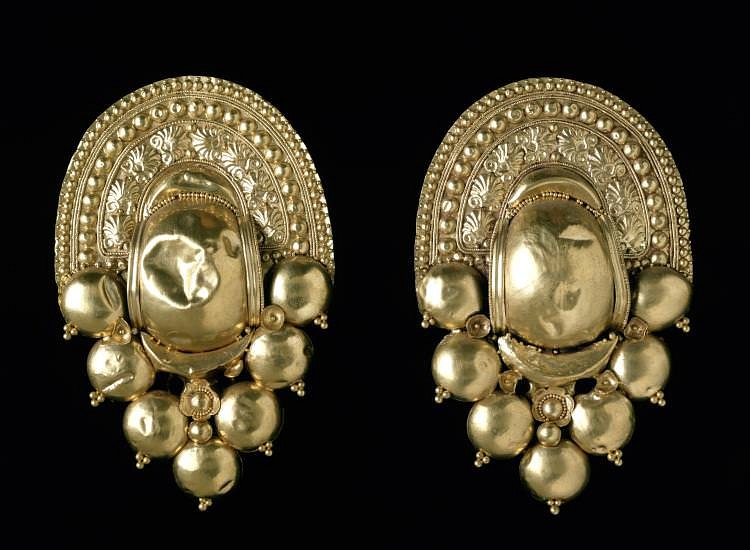 Gold Etruscan Earrings, Populonia The British Museum (Copyright) ](https://www.worldhistory.org/image/6294/gold-etruscan-earrings-populonia/ "Gold Etruscan Earrings, Populonia")### Archaeological Remains
Archaeological remains at Populonia include tombs from the 7th century BCE onwards, foundations of 5th-century BCE sacred and private buildings as well as metal workshops including a foundry with smelting furnaces, iron slag, and quarters for metal workers. In addition, there are substantial portions of the city's fortification walls – built in the 6th century BCE around the [acropolis](https://www.worldhistory.org/Acropolis/) and 4th-3rd century BCE for the portions linking the town to the port.
Tombs at Populonia include tumuli – structures with low chambers made of stone set on sloping stone pavings to aid drainage, a roof of stone slabs, and all covered with an earth and grass mound. Some examples have a short corridor entrance and stelae set on each side of the doorway. These tumuli tombs date to the 7th century BCE and were in use for several generations.
[ 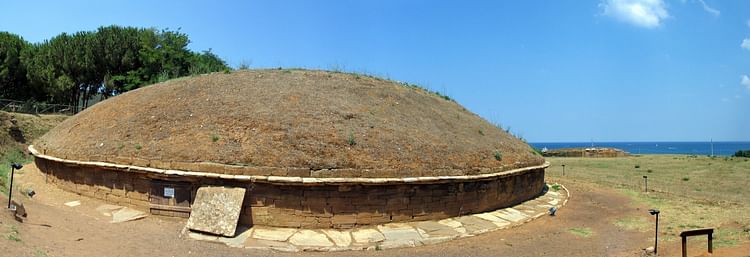 Tomb of the Chariots, Populonia Roberto Zanasi (Public Domain) ](https://www.worldhistory.org/image/6293/tomb-of-the-chariots-populonia/ "Tomb of the Chariots, Populonia")**[Tomb](https://www.worldhistory.org/tomb/) of the Chariots**
One of the biggest tumuli tombs is the 28 metres across Tomb of the Chariots (*Tombe dei Carri*). Dating from the mid-7th to early 6th century BCE, it contained the remains of four individuals. Like most of the tombs at Populonia, it was looted in antiquity, but excavations have revealed two gold pendants and a fibula from the main chamber. The small side chambers were, fortunately, intact and contained two horns (one of silver gilded ivory and another of bronze), a knife with ivory handle, iron weapons, horse bits, a [chariot](https://www.worldhistory.org/chariot/), and a two-wheeled carriage. The vehicles were made of iron, bronze, leather, and oak wood, the latter now perished. The bronze panels which once decorated the three sides of the chariot were inlaid with hunters and animals rendered in iron. The artwork on the finds indicates the influence of [Cyprus](https://www.worldhistory.org/cyprus/) and [Phoenicia](https://www.worldhistory.org/phoenicia/), a contact further attested by the presence of a Phoenician terracotta oil lamp in the tomb.
**Tomb of the Bronze Fans**
Another tomb of interest is the Tomb of the Bronze Fans (*Tombe dei Flabelli di Bronzo*) which was, remarkably, found intact. The entrance to the tumulus has a plain limestone stela standing on each side, probably originally painted. Within were four burials dating from 630 to 560 BCE. Gold jewellery pieces included a fibula, hair spirals, earrings, and a ring. Alabaster perfume bottles with tops carved into the bust of a woman, an ivory comb, weapons, bronze armour and shield, incense burners, food utensils and cooking paraphernalia, and pottery – both locally made [bucchero](https://www.worldhistory.org/Bucchero/) and examples from [Corinth](https://www.worldhistory.org/corinth/) and [Rhodes](https://www.worldhistory.org/Rhodes/). Giving the tomb its name were three fans made from thin sheets of embossed bronze. Fans were status symbols for both males and females of the Etruscan elite, and the most striking of the examples found here is almost a full circle with only a portion cut away to make room for the handle which is of wood covered in thin bronze. The central disk has two [women](https://www.worldhistory.org/disambiguation/women/) facing each other with each wearing a long check-pattern cloak.
[  Populonia Tumulus Tomb Dana Murray (CC BY-NC-SA) ](https://www.worldhistory.org/image/3633/populonia-tumulus-tomb/ "Populonia Tumulus Tomb")**Tomb of the Bronze Statuette of the Offering Bearer**
Most 5th-century BCE tombs at the site are shallow rock-cut graves known as *casone tombs. They are laid out along two roads in a straight line at the Casone necropolis. Wealthier families, meanwhile, buried their dead in more impressive but still small square buildings of stone blocks. These have gabled roofs made from stone slabs and are known as an *aedicula*. They were once decorated with painted stone or terracotta acroteria. A single doorway entrance leads to a single chamber, which was used for multiple internments over time. The finest, perhaps, is the 'Tomb of the Bronze Statuette of the Offering Bearer' (Tomba del Bronzetto di Offerente), so called after the discovery of a figurine of a man making a votive offering inside. The structure is also located in the Casone necropolis and dates to c. 530-500 BCE or perhaps a little later. It was used for interments for over a century.
Objects buried with the dead from these later tombs include bronze utensils, candelabras, and jewellery pieces. Amongst the more impressive finds are examples of fine [Greek pottery](https://www.worldhistory.org/Greek_Pottery/), especially from Attica. Two fine *hydrai* (for water) by the Meidias Painter, which are now in the Archaeological Museum of Florence, and a *kylix* (drinking cup), which is helpfully inscribed with the complete Etruscan [alphabet](https://www.worldhistory.org/alphabet/). The *kylix* is signed by a Greek whose name has been Etruscanised from Metron to Metru, another indicator not only of the Greek cultural influence on Etruria but also of Populonia's wider reach in the ancient Mediterranean.
#### Editorial Review
This human-authored definition has been reviewed by our editorial team before publication to ensure accuracy, reliability and adherence to academic standards in accordance with our [editorial policy](https://www.worldhistory.org/static/editorial-policy/).
## Bibliography
- [Haynes, S. *Etruscan Civilization.* J. Paul Getty Museum, 2005.](https://www.worldhistory.org/books/0892366001/)
- [Heurgon, J:. *Daily Life of the Etruscans.* Phoenix, 2002.](https://www.worldhistory.org/books/1842125923/)
- [Hornblower, S:. *The Oxford Classical Dictionary.* Oxford University Press, 2012.](https://www.worldhistory.org/books/0199545561/)
- [Keller, W. *The Etruscans.* Random House Inc (T), 1974.](https://www.worldhistory.org/books/0394473019/)
- [Spivey, N.J. *Etruscan Art.* Thames & Hudson, 1997.](https://www.worldhistory.org/books/0500203040/)
## About the Author
Mark is WHE’s Publishing Director and has an MA in Political Philosophy (University of York). He is a full-time researcher, writer, historian and editor. Special interests include art, architecture and discovering the ideas that all civilizations share.
## Timeline
- **630 BCE - 560 BCE**: The [Tomb](https://www.worldhistory.org/tomb/) of the [Bronze](https://www.worldhistory.org/disambiguation/bronze/) Fans is in use at the [Etruscan](https://www.worldhistory.org/Etruscan_Civilization/) site of [Populonia](https://www.worldhistory.org/Populonia/).
- **500 BCE**: The [Tomb](https://www.worldhistory.org/tomb/) of the [Bronze](https://www.worldhistory.org/disambiguation/bronze/) Statuette of the Offering Bearer is built at the [Etruscan](https://www.worldhistory.org/Etruscan_Civilization/) site of [Populonia](https://www.worldhistory.org/Populonia/).
- **c. 750 CE - c. 200 CE**: The [Etruscan](https://www.worldhistory.org/Etruscan_Civilization/) [city](https://www.worldhistory.org/city/) of [Populonia](https://www.worldhistory.org/Populonia/) flourishes in north-west [Italy](https://www.worldhistory.org/italy/).
## Cite This Work
### APA
Cartwright, M. (2017, January 25). Populonia. *World History Encyclopedia*.
### Chicago
Cartwright, Mark. "Populonia." *World History Encyclopedia*, January 25, 2017. .
### MLA
Cartwright, Mark. "Populonia." *World History Encyclopedia*, 25 Jan 2017, .
## License & Copyright
Submitted by [Mark Cartwright](https://www.worldhistory.org/user/markzcartwright/ "User Page: Mark Cartwright"), published on 25 January 2017. The copyright holder has published this content under the following license: [Creative Commons Attribution-NonCommercial-ShareAlike](https://creativecommons.org/licenses/by-nc-sa/4.0/deed.en). This license lets others remix, tweak, and build upon this content non-commercially, as long as they credit the author and license their new creations under the identical terms. When republishing on the web a hyperlink back to the original content source URL must be included. Please note that content linked from this page may have different licensing terms.