---
title: Polycrates
author: Athanasios Fountoukis
source: https://www.worldhistory.org/Polycrates/
format: machine-readable-alternate
license: Creative Commons Attribution-NonCommercial-ShareAlike (https://creativecommons.org/licenses/by-nc-sa/4.0/)
updated: 1970-01-01
---
# Polycrates
_Authored by [Athanasios Fountoukis](https://www.worldhistory.org/user/foufoufou/)_
Polycrates (r. c. 535-522 BCE) was the tyrant of [Samos](https://www.worldhistory.org/samos/) who established Samian naval supremacy in the eastern [Aegean](https://www.worldhistory.org/aegean/) and strove for control of the Aegean Sea and mainland towns of [Ionia](https://www.worldhistory.org/ionia/) in the 6th century BCE. Polycrates had a successful career until the Persian Oroetus (r. c. 530-520 BCE) lured him to the mainland and had him crucified.
### Ancient Samos
[Greek](https://www.worldhistory.org/disambiguation/greek/) tyrants originally arose in the 7th century BCE from conflict between aristocratic families seeking total authority over the communities. They employed appealing propagandistic policies to gain the favor and regard of the general public. This tactic may also be seen in modern times when dictators use populistic appeals to the lower classes to conceal other heinous crimes. The Greek tyrants were numerous, some of the most worth noting were Cypselus of [Corinth](https://www.worldhistory.org/corinth/) (c. 657-627 BCE) and [Peisistratus](https://www.worldhistory.org/Pisistratus/) of [Athens](https://www.worldhistory.org/Athens/) (c. 600-527 BCE).
The strategic location of Samos was crucial for the rapid generation of wealth by the local elites. The favorable geographical position of the Samos and its surrounding islands endorsed the Samian control of the merchant ships passing by, capturing the majority of the cargo transported from the eastern [Mediterranean](https://www.worldhistory.org/disambiguation/mediterranean/) Sea to the Aegean Sea and the Hellespont. Thus, since the 8th century BCE, the dawn of [Archaic](https://www.worldhistory.org/disambiguation/Archaic/) [Greece](https://www.worldhistory.org/greece/), Samians had created a plundering mentality to survive. That lifestyle of plunder was fused with a strong affinity with the goddess [Hera](https://www.worldhistory.org/Hera/), whose stone [temple](https://www.worldhistory.org/temple/) must have been erected after 800 BCE. With its impressive length of 30,5 meters (100 ft), this temple was one of the earliest and biggest temples found in the archaeological records, reflecting Hera's central role in the local community. The construction of a new Hera temple is almost the only other event that can be traced back to the reigns of the pre-Polycratean rulers.
The scene for the tyrant Polycrates' reign is set by the invasion of [Cyrus II](https://www.worldhistory.org/Cyrus_the_Great/) (c. 600-530 BCE), the king and founder of the Persian [Achaemenid Empire](https://www.worldhistory.org/Achaemenid_Empire/). According to [Herodotus](https://www.worldhistory.org/herodotus/), when [Cyrus](https://www.worldhistory.org/disambiguation/Cyrus/) looked towards the west, he must have had a significant numerical advantage against [Croesus](https://www.worldhistory.org/croesus/) (r. c. 585-546 BCE), the king of [Lydia](https://www.worldhistory.org/lydia/), despite the fact that Croesus had signed a treaty of hospitality and alliance with [Sparta](https://www.worldhistory.org/sparta/). After Cyrus' presence in Lydia was established, it appears that the Greeks dispatched no troops to [Sardis](https://www.worldhistory.org/sardis/), the capital. Cyrus struck in the midst of winter, catching the Lydian army off guard, and planned a fight at the [Battle of Thymbra](https://www.worldhistory.org/Battle_of_Thymbra/) near Sardis in 547 BCE. Croesus was obliged to seek refuge in the citadel, but the [city](https://www.worldhistory.org/city/) fell within 14 days. When Cyrus entered Sardis, Croesus surrendered and became Cyrus' vassal. As a result, the aspirant [Achaemenid](https://www.worldhistory.org/disambiguation/Achaemenid/) king controlled Lydia, a neighboring area of Samos. The western expansion of the Persian ruler forced the Samian elite to change their economic policy and redirect their plundering assaults toward the west.
### Rise to Power
[Piracy](https://www.worldhistory.org/Piracy/) was rife when the infamous Samian tyrant Polycrates, the son of Aeaces, grew up, and this may have inspired the blooming tales of a Samian thalassocracy – a naval dominion to arise. The history of Polycrates is mainly attested by Herodotus (c. 484-425/413 BCE), the Greek historian from [Halicarnassus](https://www.worldhistory.org/halicarnassus/). Although Polycrates is mentioned in other primary sources such as [Aristotle](https://www.worldhistory.org/aristotle/) (384-322 BCE), the most concluded and remarkably detailed version comes from Herodotus.
Polycrates' ancestors are not clearly established, and no transparent information exists on them. Two names appear before Polycrates: Syloson, who ruled Samos as a tyrant c. 590 BCE, and Aeaces, the probable father of Polycrates. Polycrates was probably born in the 570s BCE, followed by his two brothers Pantagnotos and Syloson. The earliest phase of Polycrates' reign was shared by his two brothers until he had Pantagnotos executed and Syloson exiled to Persia. According to the Bithynian author Polyaenus (c. 2nd century BCE), the tyrant seized power during the grand festival outside of the city walls, dedicated to Hera, the island's most celebrated deity. The works of Asius, the 6th-century BCE Samian poet, and Duris (c. 350 to c. 281 BCE), the [Hellenistic](https://www.worldhistory.org/Hellenic_World/) ruler of Samos, support Polyaenus' description.
[  Map of the Greek City-states c. 500 BCE Simeon Netchev (CC BY-NC-ND) ](https://www.worldhistory.org/image/14624/map-of-the-greek-city-states-c-500-bce/ "Map of the Greek City-states c. 500 BCE")Polycrates' career seems to have followed a similar pattern as the rest of the Greek tyrants. He probably started his coup d'etat by capturing the Samian [acropolis](https://www.worldhistory.org/Acropolis/), located in the center of the ancient city. Furthermore, the brothers were supported by many citizens who could afford a panoply; it is possible that these men were from Polycrates' immediate family or sympotic group. Their small number could imply there was no serious opposition to the coup, so the bulk of the aristocrats or the mass of the *demos* (Greek citizens) or both were either apathetic or positively in favor. A preserved passage from Duris' *Samian Annals* describes how Polycrates arranged for the mothers of those who died in the [war](https://www.worldhistory.org/disambiguation/War/) to be cared for by Samos' wealthiest people. This extract could probably indicate propaganda to reconcile the public.
### [Economy](https://www.worldhistory.org/disambiguation/economy/) & Government
Polycrates must have been a popular man, but those who opposed his reign, typically members of the old aristocracy, were either sent into exile or voluntarily left the island. The most famous was the philosopher [Pythagoras](https://www.worldhistory.org/Pythagoras/) (c. 570-495 BCE), who went to [Egypt](https://www.worldhistory.org/egypt/) and southern [Italy](https://www.worldhistory.org/italy/), while others settled in Dicaearchia (Puteoli) near Naples. The change to the Lydo-Milesian [coin](https://www.worldhistory.org/coinage/) standard popular among traders facilitated easier exchange in Persian territories from c. 525 BCE. Polycrates' introduction of exotic animals has often been seen as evidence of an attempt to bolster the economy and maybe to please the aristocrats that surrounded him. The variety of the imports justifies Polycrates' well-deserved sailing reputation. The years c. 570-530 BCE also saw the creation of the most exceptional and well-known Samian sculptures. Since Polycrates was born and reigned during these decades, both ancient and modern scholars associated him with the arts, although, there is no evidence to support such claims.
[ 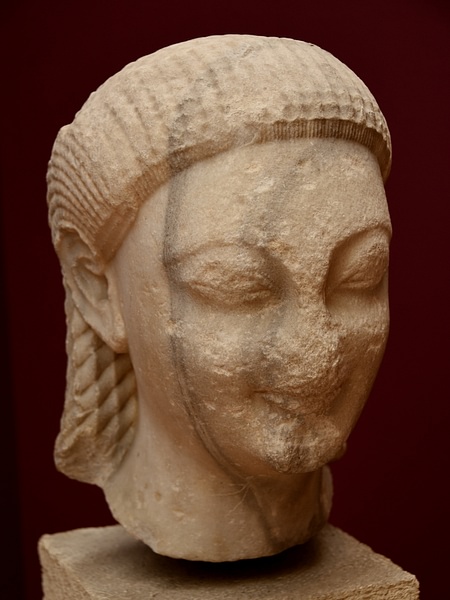 Head of a Greek Youth Osama Shukir Muhammed Amin (Copyright) ](https://www.worldhistory.org/image/8672/head-of-a-greek-youth/ "Head of a Greek Youth")A passage of Anacreon (c. 582- 485 BCE) suggests a Samian attempt to influence the city of Magnesia on the Meander through propaganda, which promotes the evidence for an invasion. As the Persians were too powerful on the mainland, Polycrates could not have permanently occupied Ionian [cities](https://www.worldhistory.org/city/) or linked them to Samos in a tribute alliance. Thus, Greeks living near the sea did not establish colonies to obtain supplies of grain and other commodities; they would have frequently captured ships instead. The theory of looting and plundering everybody equally may be the most accurate description of the thalassocracy, and many residents would have benefitted from plunder via employment in the fleet. Nevertheless, Herodotus says that the islanders submitted to Cyrus.
### Foreign Policy
At first, Polycrates merely exploited the geopolitical situation and had the support of Lygdamis (r. c. 546-524 BCE), the tyrant of [Naxos](https://www.worldhistory.org/Naxos/), who had been put in power by Peisistratus sometime after 546 BCE. Additionally, an alliance between the [Egyptian](https://www.worldhistory.org/disambiguation/Egyptian/) [pharaoh](https://www.worldhistory.org/pharaoh/) Amasis II (r. 570-526 BCE) and Polycrates is documented by Herodotus. Fearing a Persian attack, Amasis developed a naval strategy, built a navy, hired Carian and Greek mercenaries, conquered [Cyprus](https://www.worldhistory.org/cyprus/), and allied himself with Polycrates. Amasis also gave Polycrates a large sum of money, which the Samian used to build 100 ships, each with 50 rowers and ten archers. This contribution could have cost approximately eight tons of [silver](https://www.worldhistory.org/Silver/) per year.
The fleet of Polycrates, which was most likely composed, at least in part, of a special design known as the *samaina* exemplifies how the *penteconter* underwent several innovations in the [Archaic period](https://www.worldhistory.org/Archaic_Period/). During the 6th century BCE, changes to the *penteconter*'s design were made in the Aegean to make it a better vessel for transporting goods and soldiers, as well as a warship. Due to the threat posed by the Persian expansion in the 540s BCE, it is plausible that a coastal *[polis](https://www.worldhistory.org/Polis/)* ([city-state](https://www.worldhistory.org/Polis/)) like Samos maintained a *penteconter* fleet regardless of the expense. [Plutarch](https://www.worldhistory.org/plutarch/) (c. 45-50 CE to c. 120-125 CE) says that Polycrates commissioned a special type of ship, the *samaina*. The *samaina* was supposed to be bigger and more spacious than the ordinary two-level *penteconter*. It was both decked and swift and stable enough for open-sea excursions. Greek naval [warfare](https://www.worldhistory.org/warfare/) at the time was gradually shifting away from the archaic method of boarding the enemy ships and fighting hand-to-hand or overpowering the opponent with missile volleys.
After the death of Cyrus in 530 BCE, Polycrates decided to switch sides and join the new Persian king [Cambyses II](https://www.worldhistory.org/Cambyses_II/) (r. 530-522 BCE). When Cambyses purchased the formidable Phoenician navy in the 520s BCE, Samian piracy became limited to the [Cyclades](https://www.worldhistory.org/Cyclades/)' poorer cities. Thus, when the loot from the sailing ventures stopped flowing, the Samian aristocracy saw an opportunity to destabilize the tyrant. As the Persian influence increased towards the west, it was no longer safe not to be Amasis' enemy, and so Polycrates dispatched 40 ships to aid Cambyses' invasion of Egypt. The dispute with Amasis may have hampered [trade](https://www.worldhistory.org/disambiguation/trade/) at [Naucratis](https://www.worldhistory.org/Naukratis/), but Cambyses' [conquest](https://www.worldhistory.org/warfare/) of Egypt would put things right for the Samian. It must be noted that according to the ancient sources the admiral of the Egyptian navy also changed sides, so it is possible that Cambyses prepared his Egyptian expedition by bribing away Amasis' naval allies.
The naval attack was also a chance for Polycrates to get rid of disgruntled residents by loading the ships with them. Their relatively gentle, or at least covert, removal suggests that the majority of them were influential individuals. Their removal, however, had far-reaching implications, as they made their way to the [Peloponnese](https://www.worldhistory.org/Peloponnese/) and convinced Sparta and Corinth to prepare an expedition against Polycrates. Two possible reasons can be provided for Sparta's involvement: revenge for the theft of Spartan gifts or the repaying of a debt of gratitude, which scholars identified as an act of negative reciprocity. Corinth's involvement can be traced back to the memory of how Samos had once interfered with a plan of its ruler, [Periander](https://www.worldhistory.org/Periander/) (d. c. 587 BCE), to punish [Corcyra](https://www.worldhistory.org/corcyra/), a Corinthian colony. The interaction between Sparta and the Samian nobles supplied the impetus for the Spartans' first-ever Aegean voyage. An early [triumph](https://www.worldhistory.org/Roman_Triumph/) for them and the Corinthians was followed by a 40-day siege of the city that proved unsuccessful. The Peloponnesian intervention made it obvious that Samian piracy in the Cyclades would no longer be tolerated.
[  Heraion, Samos Ondra (CC BY-NC-SA) ](https://www.worldhistory.org/image/4994/heraion-samos/ "Heraion, Samos")### The Death of a Tyrant
In March 522 BCE, civil war broke out in the [Persian Empire](https://www.worldhistory.org/disambiguation/Persian_Empire/). During the summer, Polycrates was invited by the [satrap](https://www.worldhistory.org/Persian_Governor/) of Lydia, Oroetus, to come to [Sardes](https://www.worldhistory.org/sardis/) to provide him with [gold](https://www.worldhistory.org/gold/) to continue his ventures. According to Herodotus, Polycrates' daughter had a terrible nightmare, in which she saw how her father was washed by the [god](https://www.worldhistory.org/God/) [Zeus](https://www.worldhistory.org/zeus/) and anointed by the Sun.
> And Polycrates hanging in the air fulfilled his daughter's vision in every detail; for he was washed by Zeus when it rained, and he was anointed by [Helios](https://www.worldhistory.org/Helios/) as he exuded sweat from his body. (*Histories* 3.125.4.)
When the chaos in the Persian [Empire](https://www.worldhistory.org/empire/) came to an end, [Darius I](https://www.worldhistory.org/Darius_I/) (r. 522-486 BCE) restored order by executing Oroetus and conquering Samos. Syloson, the exiled brother of Polycrates, had met [Darius](https://www.worldhistory.org/disambiguation/darius/) in Egypt and gifted him a red cloak when the king was one of Cambyses' guards. Now that Darius was king, Syloson requested to return to Samos without bloodshed, and he governed Samos as a vassal ruler on behalf of the Achaemenid Persian Empire.
#### Editorial Review
This human-authored definition has been reviewed by our editorial team before publication to ensure accuracy, reliability and adherence to academic standards in accordance with our [editorial policy](https://www.worldhistory.org/static/editorial-policy/).
## Bibliography
- [Anonymous. *A Political History of the Achaemenid Empire - 1997 Edition.* Brill, 1970.](https://www.worldhistory.org/books/B01MF8J39A/)
- Boyd, Marcaline. "Polyneaus and Polycrates." *Cambridge: Francis Cairns*, Papers of the Langford Latin Seminar 17, 2018, pp. 71-88.
- [Briant, Pierre. *From Cyrus to Alexander.* Eisenbrauns, 2002.](https://www.worldhistory.org/books/1575060310/)
- [Carty, Aideen. *Polycrates, Tyrant of Samos.* Franz Steiner Verlag, 2015.](https://www.worldhistory.org/books/351510898X/)
- [Herodotus & Godley, A.D. *The Histories of Herodotus, A Translation By A.D. Godley.* Scribe Publishing, 2018.](https://www.worldhistory.org/books/1787801799/)
- [Plutarch & Clough, Arthur Hugh & Dryden, John & Atlas, James. *Plutarch's Lives Volume 1 .* Modern Library, 2001.](https://www.worldhistory.org/books/0375756760/)
- [Polycrates](https://www.livius.org/articles/person/polycrates/#:~:text=on%20a%20cross.-,%5B..%5D,long-continued%20prosperity%20of%20Polycrates. "Polycrates"), accessed 16 May 2022.
- [Shipley, Graham. *A History of Samos, 800-188 BC.* Clarendon Press, 1987.](https://www.worldhistory.org/books/0198148682/)
- Waterfield, Kathryn. " Penteconters and the Fleet of Polycrates." *2019*, The Ancient History Bulletin. Vol 33. No. 1-2.
## About the Author
A historian, who acquired a BA degree in History and Ethnology in Greece, and an MA degree in Ancient History in the Netherlands. He is fascinated by the ancient history of maritime and nomadic cultures.
## Timeline
- **535 BCE - 522 BCE**: [Polycrates](https://www.worldhistory.org/Polycrates/) rules as tyrant of [Samos](https://www.worldhistory.org/samos/).
- **525 BCE**: [Sparta](https://www.worldhistory.org/sparta/) and [Corinth](https://www.worldhistory.org/corinth/) unsuccessfully attack [Polycrates](https://www.worldhistory.org/Polycrates/) of [Samos](https://www.worldhistory.org/samos/).
- **522 BCE**: Persian [satrap](https://www.worldhistory.org/Persian_Governor/) Oroetus takes [Samos](https://www.worldhistory.org/samos/) and the tyrant [Polycrates](https://www.worldhistory.org/Polycrates/) is crucified.
- **c. 520 BCE**: A new [temple](https://www.worldhistory.org/temple/) is built and dedicated to [Hera](https://www.worldhistory.org/Hera/) on [Samos](https://www.worldhistory.org/samos/) during the reign of [Polycrates](https://www.worldhistory.org/Polycrates/).
## Questions & Answers
### Who was Polycrates?
Polycrates was the tyrant of Samos who established Samian naval supremacy in the eastern Aegean.
### How did Polycrates rise to power?
Polycrates killed his brother Pantagnotos and exiled the other one, Syloson. Then, according to Polyaenus, a Bithynian author, the tyrant seized power during the grand festival dedicated to Hera.
### Why was Polycrates' fleet unique?
Polycrates' fleet had a special vessel called the 'samaina,' which was bigger and more spacious than the ordinary two-level 'penteconter'. It was both decked and swift and stable enough for open-sea excursions.
### How did the Samian tyrant Polycrates die?
Polycrates died on a cross in 522 BCE, after a deceitful invitation by Oroetus, the satrap of Lydia. As Herodotus testifies, the satrap lured the Samian tyrant into his territory by offering him promises of gold and glory.
## Cite This Work
### APA
Fountoukis, A. (2022, June 01). Polycrates. *World History Encyclopedia*.
### Chicago
Fountoukis, Athanasios. "Polycrates." *World History Encyclopedia*, June 01, 2022. .
### MLA
Fountoukis, Athanasios. "Polycrates." *World History Encyclopedia*, 01 Jun 2022, .
## License & Copyright
Submitted by [Athanasios Fountoukis](https://www.worldhistory.org/user/foufoufou/ "User Page: Athanasios Fountoukis"), published on 01 June 2022. The copyright holder has published this content under the following license: [Creative Commons Attribution-NonCommercial-ShareAlike](https://creativecommons.org/licenses/by-nc-sa/4.0/deed.en). This license lets others remix, tweak, and build upon this content non-commercially, as long as they credit the author and license their new creations under the identical terms. When republishing on the web a hyperlink back to the original content source URL must be included. Please note that content linked from this page may have different licensing terms.