---
title: Pluto
author: Donald L. Wasson
source: https://www.worldhistory.org/Pluto/
format: machine-readable-alternate
license: Creative Commons Attribution-NonCommercial-ShareAlike (https://creativecommons.org/licenses/by-nc-sa/4.0/)
updated: 2023-07-10
---
# Pluto
_Authored by [Donald L. Wasson](https://www.worldhistory.org/user/DWasson/)_
Pluto is the [god](https://www.worldhistory.org/God/) of the Underworld in [Roman mythology](https://www.worldhistory.org/Roman_Mythology/). His [Greek](https://www.worldhistory.org/disambiguation/greek/) counterpart was [Hades](https://www.worldhistory.org/Hades/). Pluto chose never to sit on Olympus with the other gods and goddesses, preferring to remain in the Underworld.
### Family
Pluto (Hades) was the son of the Titans [Saturn](https://www.worldhistory.org/Saturn/) ([Cronus](https://www.worldhistory.org/Cronus/)) and Ops ([Rhea](https://www.worldhistory.org/Rhea/)) and the brother of [Jupiter](https://www.worldhistory.org/jupiter/) ([Zeus](https://www.worldhistory.org/zeus/)) and [Neptune](https://www.worldhistory.org/Neptune/) ([Poseidon](https://www.worldhistory.org/poseidon/)). After conquering the Titans, Jupiter assumed the vacant throne of Saturn as the sky god and ruler of the world. Maintaining supremacy, he divided part of his realm between his two brothers: Neptune was granted authority over the seas and all rivers while Pluto gained control of [Tartarus](https://www.worldhistory.org/Tartarus/) and the Lower World – sometimes called the Infernal Region or Hades – and as the ruler of the Underworld, he held dominion over the dead; it was the duty of the messenger god Mercury ([Hermes](https://www.worldhistory.org/Hermes/)) to conduct souls to the Underworld.
Pluto held court seated on an ebony throne next to his queen Proserpina ([Persephone](https://www.worldhistory.org/persephone/)), but she was a reluctant queen. Kidnapped by Pluto and made a virtual prisoner, she was forced to spend three (some claim six) unhappy months a year in the Underworld; the remainder of the year was spent on earth as the goddess of vegetation. While [Ceres](https://www.worldhistory.org/Ceres/) ([Demeter](https://www.worldhistory.org/demeter/)) was searching for her daughter after the kidnapping, she learned from the river [nymph](https://www.worldhistory.org/nymph/) Arethusa, who had seen her daughter in the Underworld, that Proserpina "seemed sad indeed and her face still perturbed with fear, but yet she was a queen, the great queen of that world of darkness, the mighty consort of the tyrant of the Underworld" ([Ovid](https://www.worldhistory.org/ovid/), 98).
### Character & Attributes
Unlike his brothers, Pluto not only invoked great fear in humans but he was also the most detested. He was "the grim robber who stole from people their nearest and dearest" (Berens 122). His name was so feared that it was never mentioned out loud by mortals. Whenever he was on earth in search of a victim, Pluto rode in a [chariot](https://www.worldhistory.org/chariot/) of [gold](https://www.worldhistory.org/gold/) drawn by four coal-black steeds. [Writing](https://www.worldhistory.org/writing/) about Pluto's chariot, Ovid said, "Her \[Proserpina's\] captor sped his chariot and urged on his horses calling each by name and shaking the dark-dyed reins on their necks and manes" (95). Sometimes wearing a helmet specially made for him by the [Cyclops](https://www.worldhistory.org/disambiguation/Cyclops/), he carried either a two-pronged fork as his scepter or the keys to the Underworld. The helmet could give its wearer the power of invisibility. Sometimes used by both mortals and [immortals](https://www.worldhistory.org/disambiguation/immortals/), it was made available to [Perseus](https://www.worldhistory.org/Perseus/) in his [battle](https://www.worldhistory.org/disambiguation/battle/) against the Gorgon [Medusa](https://www.worldhistory.org/Medusa/).
[  The Rape of Proserpina Gian Lorenzo Bernini (CC BY-SA) ](https://www.worldhistory.org/image/17526/the-rape-of-proserpina/ "The Rape of Proserpina")### [Cerberus](https://www.worldhistory.org/Cerberus/) & [Charon](https://www.worldhistory.org/Charon/)
Getting into the Underworld was much easier than getting out – a feat deemed almost impossible. The entrance was guarded by Cerberus, a three-headed dog whose mouth dripped poison, who invoked fear in all who entered. However, not all who entered there were afraid when confronted by Cerberus. When the hate-filled [Juno](https://www.worldhistory.org/Juno/) travelled into the Underworld to consult the [Furies](https://www.worldhistory.org/Furies/), "she made entrance there, and the threshold groaned beneath the weight of her sacred form. Cerberus reared up his threefold head and uttered his threefold baying. The goddess summoned the Furies, sisters born of Night, divinities deadly and implacable" (Ovid, 75). [Hesiod](https://www.worldhistory.org/hesiod/) in his *[Theogony](https://www.worldhistory.org/Theogony/)* writes: "A monstrous dog stands pitiless guard in front, with evil ways … lying in wait he eats up anyone he catches leaving by the gates …" (Hesiod, 48). Unlike an immortal, a mortal when facing his eternal fate, felt fear.
[  Statue of Hades and Cerberus Aviad Bublil (CC BY-SA) ](https://www.worldhistory.org/image/778/statue-of-hades-and-cerberus/ "Statue of Hades and Cerberus")The spirit (sometimes called a shade) of a mortal who entered the Underworld must first confront the crossing of the river Styx, the river of darkness. The river Styx was one of the five rivers of the Underworld – the others being the Cocytus, composed of the tears of those condemned to hard labor in Tartarus; the Acheron, the river of sorrow and woe; the Lethe, which had the power to make one forget all unpleasant things and separated the Elysian Fields from the rest of the Underworld; and lastly, the Phlegethon, the river of fire that surrounded Tartarus.
Crossing the Styx was made in an old boat steered by the aged and "appallingly filthy" ferryman Charon. In his *[Aeneid](https://www.worldhistory.org/The_Aeneid/)*, [Virgil](https://www.worldhistory.org/virgil/) writes of the Trojan hero [Aeneas](https://www.worldhistory.org/Aeneas/), who travels into the Underworld to find his father and learn of his destiny. He is told by his guide Sibyl "… that ferryman is Charon: the ones he conveys have had [burial](https://www.worldhistory.org/burial/). None may be taken across the bank to awesome bank of that harsh-voiced river until his bones are laid to rest" (139). To cross the Styx a spirit must pay the ferryman with a [coin](https://www.worldhistory.org/coinage/) – an *obolus* – usually placed under the tongue of the deceased. Otherwise, the spirit must wander for 100 years before crossing. Although often seen as dark and forbidding, the Styx also has the power to impart invincibility – as seen with the Greek hero [Achilles](https://www.worldhistory.org/achilles/)' near invulnerability.
### Judgment of the Dead
Near Pluto's throne sat the three judges – Minos (former king of [Crete](https://www.worldhistory.org/crete/)), Rhadamanthus (his brother), and Aeacus – who questioned all souls, sorting out their earthly thoughts and actions, good and bad, and placing them on the scales of [Themis](https://www.worldhistory.org/Themis/), the blindfolded goddess of justice, whose trenchant sword makes her decisions "mercilessly" enforced. It was the duty of Minos to deliver the judge's decision. If good outweighed the bad, the spirit would go to the Elysian Fields, or if bad outweighed good, the spirit must suffer the fires of Tartarus – a dark and gloomy place of endless sorrow and incessant torment. In the *Aeneid*, while in the Underworld, Aeneas is faced with the sound of clanking chains and asks, "What kinds of criminals are these?" Sibyl replies that "No righteous soul may tread on the threshold of the damned ... Here Rhadamanthus rules, and most severe his rule is, trying and chastising wrongdoers, forcing confessions from any who, on earth, went gleefully undetected..." (146)
### Furies, [Fates](https://www.worldhistory.org/Fates/) & Gorgons
To assist in governing his realm, Pluto employed the Furies, Fates, and Gorgons. Guilty souls were entrusted to the Furies, who drove them through the gates of Tartarus. Visually terrifying, the three sisters – Alecto, Tisiphone, and Megaera – had snakes entwined in their hair with blood dripping from their eyes. Showing little mercy, they were used by Pluto "to chastise and torment those shades who during their earthy career had committed crimes" (Berens 139). They pursued and punished, among others, murderers and perjurers.
The three Fates (Parcae for the Romans or [Moirai](https://www.worldhistory.org/Fates/) in [Greek mythology](https://www.worldhistory.org/Greek_Mythology/)) sat near Pluto's throne and determined the duration and direction of a person's life. Nona (Clotho) spun the thread of life, Decima (Lachesis) measured the thread, determining its length, while Morta (Atropos) used her scissors to cut the thread.
[  The Three Moirai Johann Gottfried Schadow (Public Domain) ](https://www.worldhistory.org/image/16813/the-three-moirai/ "The Three Moirai")Lastly, there were the Gorgons who invoked great fear in all humans – Stheno, Euryale, and Medusa – "and were the personification of those benumbing and petrifying sensations that result from sudden and extreme fear" (Berens 146). They were winged monsters with hissing snakes around their heads. Any mortal who beheld them would be instantly turned into stone. Medusa, the only mortal, was killed by Perseus.
### Tartarus
Tartarus has its share of notable sinners. Two made the mistake of disrespecting Juno. Tityus was a [giant](https://www.worldhistory.org/Giants/) who insulted Juno – he was chained, like [Prometheus](https://www.worldhistory.org/Prometheus/) – and a vulture ate at his liver. [Ixion](https://www.worldhistory.org/Ixion/), the king of Lapithae, made the mistake of flirting with Juno. Jupiter was not pleased, so Ixion was bound to a constantly revolving wheel of fire. [Tantalus](https://www.worldhistory.org/Tantalus/), king of [Corinth](https://www.worldhistory.org/corinth/), deceived the gods. Atoning for his actions, he invited them to a banquet where he served his son, [Pelops](https://www.worldhistory.org/Pelops/), killed and cooked. Sensing something was amiss, the gods refused to eat except for the grieving Ceres. She took a bite of what was his shoulder. The gods restored the boy to life – he received an ivory shoulder made by [Vulcan](https://www.worldhistory.org/Vulcan/) ([Hephaistos](https://www.worldhistory.org/Hephaistos/)) at the request of Ceres. In Tartarus, he must stand in a pool of water beneath a tree of fruit. Thirsty, he stooped to drink but the water receded. Hungry, he reached for fruit but the branch swung upward. He is forever hungry and thirsty. Lastly, [Sisyphus](https://www.worldhistory.org/sisyphus/), another deceiver, was condemned to roll a huge stone up a hill, but before reaching the summit, the stone rolls down the hill. He must forever roll the stone but never reach the top.
[Orpheus](https://www.worldhistory.org/Orpheus/) and Eurydice were in love but the young Eurydice died from a snake bite. Orpheus was heartbroken and vowed to go to the Underworld and retrieve his long love. Using his musical talents, he was able to soothe the three-headed guard dog Cerberus.
> As he spoke thus, accompanying words with the [music](https://www.worldhistory.org/disambiguation/Music/) of his [lyre](https://www.worldhistory.org/Lyre/), the bloodless spirits wept; Tantalus did not catch at the fleeing wave; Ixion's wheel stopped in wonder; the vultures did not pluck at the liver ... and you O Sisyphus, sat upon your stone. (Ovid 188)
Pluto allowed Orpheus to take his beloved and return to earth but with a warning not to turn around to see Eurydice or she will return to the Underworld. Orpheus did not heed the warning and lost her forever.
[ 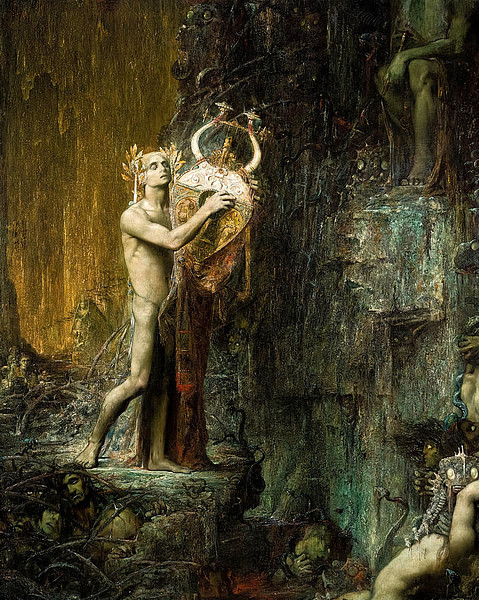 Orpheus in Hades Pierre Marcel-Beronneau (Public Domain) ](https://www.worldhistory.org/image/15086/orpheus-in-hades/ "Orpheus in Hades")### Worship & Legacy
There were no temples dedicated to Pluto, but there were altars. Conducted by a priest in black robes, sacrifices, usually made at night, consisted of black sheep or the occasional human. In [medieval literature](https://www.worldhistory.org/Medieval_Literature/), Pluto appears in [Dante Alighieri](https://www.worldhistory.org/Dante_Alighieri/)'s *Divine Comedy,* presiding over the fourth circle of Hell. The largest dwarf planet – formerly considered the ninth planet – of the solar system, was named after Pluto, with its moons being Charon, Styx, Nix, Kerberos, and Hydra.
#### Editorial Review
This human-authored definition has been reviewed by our editorial team before publication to ensure accuracy, reliability and adherence to academic standards in accordance with our [editorial policy](https://www.worldhistory.org/static/editorial-policy/).
## Bibliography
- [Aeschylus & Grene, David & Lattimore, Richmond & Griffith, Mark & Most, Glenn W. & Grene, David & Lattimore, Richmond & Griffith, Mark & Most, Glenn W. *Aeschylus II.* University of Chicago Press, 2013.](https://www.worldhistory.org/books/0226311473/)
- [Berens, E.M. *Mythology.* Crestline Books, 2020.](https://www.worldhistory.org/books/0785838414/)
- [Guerber, H.A. *Classical Mythology.* Fall River Press, 2018.](https://www.worldhistory.org/books/B0BBPMVP3P/)
- [Hesiod & West, M. L. *Theogony and Works and Days.* Oxford University Press, 2009.](https://www.worldhistory.org/books/019953831X/)
- [Martin J Dougherty. *Greek Myths.* Amber Books Ltd, 2019.](https://www.worldhistory.org/books/1782747508/)
- [Ovid & Raeburn, David & Feeney, Denis. *Metamorphoses.* Penguin Classics, 2004.](https://www.worldhistory.org/books/014044789X/)
- [Pluto — Everything you need to know about the dwarf planet | Space](https://www.space.com/43-pluto-the-ninth-planet-that-was-a-dwarf.html#section-does-pluto-have-any-moons "Pluto — Everything you need to know about the dwarf planet | Space"), accessed 6 Jul 2023.
- [Virgil & Fagles, Robert & Knox, Bernard. *The Aeneid.* Penguin Classics, 2008.](https://www.worldhistory.org/books/0143105132/)
## About the Author
Donald has taught Ancient, Medieval and U.S. History at Lincoln College (Normal, Illinois)and has always been and will always be a student of history, ever since learning about Alexander the Great. He is eager to pass knowledge on to his students.
## Questions & Answers
### What is Pluto the god of?
Pluto is the god of the Underworld in Roman mythology.
### Who is the Greek equivalent of Pluto?
In Greek mythology, Pluto's counterpart is Hades.
## Cite This Work
### APA
Wasson, D. L. (2023, July 06). Pluto. *World History Encyclopedia*.
### Chicago
Wasson, Donald L.. "Pluto." *World History Encyclopedia*, July 06, 2023. .
### MLA
Wasson, Donald L.. "Pluto." *World History Encyclopedia*, 06 Jul 2023, .
## License & Copyright
Submitted by [Donald L. Wasson](https://www.worldhistory.org/user/DWasson/ "User Page: Donald L. Wasson"), published on 06 July 2023. The copyright holder has published this content under the following license: [Creative Commons Attribution-NonCommercial-ShareAlike](https://creativecommons.org/licenses/by-nc-sa/4.0/deed.en). This license lets others remix, tweak, and build upon this content non-commercially, as long as they credit the author and license their new creations under the identical terms. When republishing on the web a hyperlink back to the original content source URL must be included. Please note that content linked from this page may have different licensing terms.