---
title: Battle of Plataea
author: Mark Cartwright
source: https://www.worldhistory.org/Plataea/
format: machine-readable-alternate
license: Creative Commons Attribution-NonCommercial-ShareAlike (https://creativecommons.org/licenses/by-nc-sa/4.0/)
updated: 1970-01-01
---
# Battle of Plataea
_Authored by [Mark Cartwright](https://www.worldhistory.org/user/markzcartwright/)_
The [Battle](https://www.worldhistory.org/disambiguation/battle/) of Plataea was a land battle between Greeks and Persians near the small town of Plataea in Boeotia in 479 BCE. Following up their naval victory at the [Battle of Salamis](https://www.worldhistory.org/Battle_of_Salamis/) in September 480 BCE against the same enemy, the Greeks again defeated an invading army sent by the Persian ruler [Xerxes I](https://www.worldhistory.org/Xerxes_I/) (r. 486-465 BCE), this time thanks to their [hoplite](https://www.worldhistory.org/hoplite/) warriors. The victory ensured the continued independence of their [city](https://www.worldhistory.org/city/)-states and permitted an astonishingly rich period of artistic and cultural endeavour to begin which would lay the cultural foundations of all future Western civilizations.
### Context: The [Persian Wars](https://www.worldhistory.org/Persian_Wars/)
By the first years of the 5th century BCE, [Persia](https://www.worldhistory.org/Persia/), under the rule of [Darius I](https://www.worldhistory.org/Darius_I/) (r. 522-486 BCE), was already expanding into mainland [Europe](https://www.worldhistory.org/europe/) and had subjugated Thrace and Macedonia. The next objective was to quell once and for all the collection of potentially troublesome rebel states on the western border of the [Achaemenid Empire](https://www.worldhistory.org/Achaemenid_Empire/). In 490 BCE [Greek](https://www.worldhistory.org/disambiguation/greek/) forces led by [Athens](https://www.worldhistory.org/Athens/) met the Persians at the Battle of [Marathon](https://www.worldhistory.org/marathon/) and defeated the invaders. The battle would take on mythical status amongst the Greeks, but in reality, it was merely the opening overture of a long [war](https://www.worldhistory.org/disambiguation/War/) with several other battles making up the principal acts. In 486 BCE [Xerxes](https://www.worldhistory.org/Xerxes_I/) became king, and he invaded first the [Cyclades](https://www.worldhistory.org/Cyclades/) and then the Greek mainland after victory against a token Greek force at the [Battle of Thermopylae](https://www.worldhistory.org/thermopylae/) in August 480 BCE. At the same time as [Thermopylae](https://www.worldhistory.org/thermopylae/), an indecisive naval battle took place at Artemision, where the Greeks held off the superior numbers of the Persian fleet but were obliged to regroup at [Salamis](https://www.worldhistory.org/disambiguation/Salamis/). In September 480 BCE, with the brilliant general [Themistocles](https://www.worldhistory.org/Themistocles/) dictating strategy, the allied Greek fleet drew the Persians into the narrow confines of the straits between Salamis and the mainland and won a resounding victory.
Following the defeat of his armada and the close of the campaign season, Xerxes returned home to his [palace](https://www.worldhistory.org/disambiguation/palace/) at Sousa and left the gifted general Mardonius in charge of the invasion. The Persian position was still strong despite the defeat at sea - they still controlled much of [Greece](https://www.worldhistory.org/greece/) and their huge land army was intact. Xerxes may well have hoped that the fragile Greek alliance between such age-old rivals as Athens and [Sparta](https://www.worldhistory.org/sparta/) would break if appropriate diplomatic overtures were made, but after a series of political negotiations, it became clear that the Persians would not gain victory through diplomacy and only war would settle the issue.
### The Persian Army at Plataea
The vast [Persian Empire](https://www.worldhistory.org/disambiguation/Persian_Empire/) stretched from the Danube to [Egypt](https://www.worldhistory.org/egypt/) and from [Ionia](https://www.worldhistory.org/ionia/) to [Bactria](https://www.worldhistory.org/Bactria/), and Xerxes was able to draw on a huge reserve of resources to amass his huge invasion force. Overall command was now taken by Mardonius, the son-in-[law](https://www.worldhistory.org/disambiguation/law/) and nephew of [Darius](https://www.worldhistory.org/disambiguation/darius/) and cousin of Xerxes. By his side was Artabazus (a cousin of Darius) who led the Parthian and Chorasmian contingents.
Our numbers for the soldiers involved in the battle come principally from [Herodotus](https://www.worldhistory.org/herodotus/) who wrote an account of Plataea in his *Histories*; however, the absolute accuracy of Herodotus' estimates are disputed amongst scholars. According to Herodotus, the Persians fielded 350,000 troops against the Greek forces of 108,200. The figures for the Persians may have been exaggerated in order to make the Persians into a more formidable opponent, and perhaps, in reality, they fielded a very similar number of combatants to the Greeks. However, even with a more conservative estimate, the battle involved some 200,000 armed men, the largest such battle Greece had seen and a figure comparable with the battles of Waterloo and Gettysburg.
[  Persian Archers mshamma (CC BY) ](https://www.worldhistory.org/image/147/persian-archers/ "Persian Archers")The Persian force was divided into units of the various nationalities involved but, unfortunately, Herodotus does not specify the strength of each. However, approximate estimates are:
- Persians (the best troops): 40,000
- [Medes](https://www.worldhistory.org/Medes/): 20,000
- Bactrians, Indians & Sacae: 20,000
- Pro-Persian Greeks: 50,000
- Total: 130,000
All of these groups supplied cavalry, creating a combined force of perhaps 5,000 horsemen.
### The Greek Army at Plataea
The Greek army was led by [Pausanias](https://www.worldhistory.org/disambiguation/Pausanias/), the nephew of King [Leonidas](https://www.worldhistory.org/disambiguation/Leonidas/) who fell at Thermopylae, and regent for the young king, Leonidas' son Pleistarchus. Secondary commanders included the two Athenian generals [Aristides](https://www.worldhistory.org/Aristides/) and Xanthippus, the father of [Pericles](https://www.worldhistory.org/pericles/).
According to Herodotus the Greek hoplite forces were divided as follows:
- Athenians: 8,000
- Corinthians: 5,000
- Lacedaemonians: 5,000
- Spartans: 5,000
- Megarians: 3,000
- Sicyonians: 3,000
- Tegeans: 1,500
- Phleiasians: 1,000
- Troezenians: 1,000
- Anactorians/Leucadians: 800
- Epidaurians: 800
- Orchomenus: 600
- Plataeans: 600
- Aeginetans: 500
- Ambraciots: 500
- Eretrians/Styrians: 600
- Chalcidians: 400
- [Mycenaean](https://www.worldhistory.org/Mycenaean_Civilization/)/Tirynthians: 400
- Hermionians: 300
- Potidaeans: 300
- Lepreans: 200
- Paleans: 200
- Thespians: unspecified
- Total: 38,700
The Greeks had no cavalry at Plataea and only the Athenians had a contingent of archers. Herodotus also numbers the non-hoplite forces which are (conveniently) exactly the same as the number of hoplites each city provided. The exception is Sparta which supplied some 35,000 helots in addition to their 5,000 hoplites.
[ 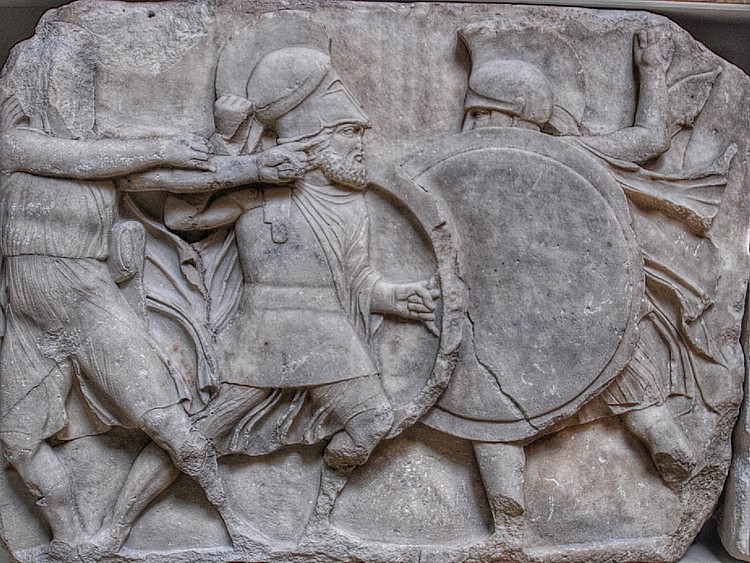 Greek Hoplites Fighting Jan van der Crabben (CC BY-NC-SA) ](https://www.worldhistory.org/image/3012/greek-hoplites-fighting/ "Greek Hoplites Fighting")### Weapons & Strategies
The Persians were no doubt confident of success. They had a massive army, the Greeks were potentially divided, and the only blip in the long chain of land victories they had enjoyed in the previous 50 years had been the setback at Marathon.
The two opposing armies were essentially representative of the two approaches to Classical [warfare](https://www.worldhistory.org/warfare/) - [Persian warfare](https://www.worldhistory.org/Persian_Warfare/) favoured long-range assault using archers followed up with a cavalry charge, whilst [Greek warfare](https://www.worldhistory.org/Greek_Warfare/) favoured heavily-armoured hoplites, arranged in a densely packed formation at least eight men deep called the phalanx, with each man carrying a heavy round [bronze](https://www.worldhistory.org/disambiguation/bronze/) shield and fighting at close quarters using spears and swords. The Persian infantry carried a lightweight wicker shield and were armed with a long dagger or battleaxe, a short spear, and composite bow. The Persian forces also included the [Immortals](https://www.worldhistory.org/disambiguation/immortals/) - an elite force who were probably better protected with armour and armed with spears, a contingent of well-armed [Egyptian](https://www.worldhistory.org/disambiguation/Egyptian/) marines and several thousand hoplites from allied Greek states, notably the Thebans. The Persian cavalry were armed, as the foot soldiers, with a bow and an additional two javelins for throwing and thrusting. Cavalry, usually operating on the flanks of the main battle, were used to mop up opposing infantry put in disarray after they had been subjected to repeated salvos from the archers. Although the Persians had enjoyed the upper hand in previous contests with Greeks during the recent Ionian revolt, Thermopylae had shown that organised Greek hoplites could be a tough military nut to crack.
[  Greek Phalanx CA (Copyright) ](https://www.worldhistory.org/image/2567/greek-phalanx/ "Greek Phalanx")Another important factor was that although the Persian tactic of rapidly firing vast numbers of arrows into the enemy must have been an awesome sight, the lightness of the arrows meant that they were largely ineffective against the bronze-armoured hoplites unless fired at close range and at unprotected body parts. At close quarters, the longer spears, heavier swords, better armour, and rigid discipline of the phalanx formation meant that the Greek hoplites would have all of the advantages on broken terrain. The Persians would have to entice the enemy into good flat land to optimise their cavalry advantage and the greater degree of mobility offered by their lighter-armoured troops.
### The Battle - Phase 1
In the spring of 479 BCE the Persian fleet regrouped at [Samos](https://www.worldhistory.org/samos/), whilst in June Mardonius left his winter quarters in [Thessaly](https://www.worldhistory.org/disambiguation/Thessaly/) and once again invaded Attica before withdrawing to hold a line in Boeotia, north of the river Asopus, where he built a large fortified camp.
The Greek fleet, meanwhile, regrouped at [Aegina](https://www.worldhistory.org/Aegina/) and then sailed to hold station at [Delos](https://www.worldhistory.org/delos/) whilst the land army mobilised. In July the Spartan army moved towards Plataea and met up with the other Greek contingents at [Eleusis](https://www.worldhistory.org/Eleusis/) before all moved into position, forming a 7 km long front just 3-4 km opposite the Persians, below the low hills of Cithaeron.
Mardonius had the Persians hold the right flank, and in the centre were the Medes and the Bactrians, Indians, and Sacae groups. On the left flank were the pro-Persian Greeks. Cavalry forces sat slightly back, one group on each flank. Along the Greek front, the Spartans, Tegeans, and Thespians held the right flank and the Athenians, Megarians, and Plataeans the left flank, with everyone else in the centre. Once in position, everybody waited. After two days of stand-off when each side clung to the terrain best suited to their fighting tactics - the Persians on the plain and the Greeks in the broken terrain near the hills - Mardonius finally sent in his cavalry and in particular attacked the Megarians and Athenians. In the skirmish, only the presence of Athenian archers seems to have allowed the Greeks to hold their lines and the Persian commander Masistius was killed, a great morale booster for the Greeks.
[  Spartan Warriors The Creative Assembly (Copyright) ](https://www.worldhistory.org/image/1225/spartan-warriors/ "Spartan Warriors")### Phase 2
The Greeks then advanced to the northwest, just south of the river on the Pyrgos ridge, to obtain a better water supply, but this movement brought no response from Mardonius. Both sides then held position for another week or so, once again reluctant to abandon their advantageous terrain. This is also a possible hint that the two forces were evenly matched in size and no commander wanted to risk outright battle. Mardonius did send his cavalry on a mission around the right flank of the Greek forces, and there they met a large supply [column](https://www.worldhistory.org/column/). The Persians slaughtered the poorly-armed Greeks and burnt the supplies - a serious blow to the enemy's logistics, as with so many men in the field, they were struggling to provide sufficient quantities of food and water, especially as Persian archers meant the river was out of bounds.
Two more days passed before Mardonius finally unleashed his cavalry in full frontal attack on the Greek lines. Causing great havoc amongst the Greeks, the invaders even managed to spoil and block the Gargaphia spring which was the Greeks' main source of water. It is quite probable that the Persian cavalry was also now harrying the enemy rear, cutting off their supply lines.
### Phase 3
Pausanias, in order to protect his flanks and rear and in an effort to reach a water supply, now, under the cover of darkness, moved the Greek centre back to the base of the Cithaeron hill, just in front of Plataea. After some delay, caused either by confusion or disagreement with the decision to withdraw, the Greek right followed suit, while the left flank held position and, therefore, became isolated. When the left flank also retreated they were attacked from all sides by the pro-Persian hoplites, and the left Persian flank crossed the river in pursuit. At this point the cavalry had withdrawn, probably to rearm themselves with fresh arrows.
Just as the Persians looked like they were getting the upper-hand, though, the Greek right flank of Spartans and Tegeans counter-attacked. When the Greek left flank joined them, the Persian forces, boxed in by their own centre coming in behind them, lacking a disciplined formation and finally, inadequately defending themselves behind a barricade of wicker shields, were routed. Even more significantly, Mardonius was felled by a rock thrown by the Spartan Arimnestus and killed. The superior weapons and armour of the hoplites in the end proved decisive. The remnants of the Persians were forced back across the river in some disarray, their retreat only prevented from turning into a disaster by the cover offered by the Theban cavalry which allowed them to reoccupy their fortified camp. The pro-Persian Greek hoplites on the right flank were also forced to retreat under pressure from the Athenians, taking position behind the walls of nearby [Thebes](https://www.worldhistory.org/disambiguation/Thebes/).
The Greek centre, no doubt inspired by the Spartan success, also entered the fray but did so without strict discipline of formation and so was outflanked by the pro-Persian cavalry and suffered heavy losses. Meanwhile, the Athenians, Spartans, and Tegeans were now at the Persian camp which they eventually stormed, causing more heavy casualties amongst the invaders. The Greeks then turned their attention to Thebes which was attacked and sacked. Victory had been won and the Persian invasion plans were now in tatters.
### The Aftermath
Following the usual post-battle rituals - burials, taking of war-booty, and the setting up of trophies - the Greeks were far from finished. At the roughly contemporary Battle of Mycale in Ionia, the Greek fleet led by Leotychides landed an army which wiped out the Persian garrison there and killed the commander Tigranes. The Ionian states were sworn back into the [Hellenic](https://www.worldhistory.org/greece/) Alliance and the [Delian League](https://www.worldhistory.org/Delian_League/) established. Further, the Chersonnese controlling the Black Sea and [Byzantium](https://www.worldhistory.org/Byzantium/) controlling the Bosphorus were both retaken. The Greeks had sent a loud and clear message to Xerxes that Greece would not allow herself to be subjugated by foreign rule. Perhaps inevitably, wars continued in the following decades and the Greek states would be involved in the long and damaging Peloponnesian Wars, but victories at Marathon, Salamis, and now Plataea had ensured the survival of Greece and provided the opportunity for [Greek culture](https://www.worldhistory.org/disambiguation/Greek_Culture/) and artistic excellence to flourish and become the foundation upon which all Western cultures would be based for millennia.
#### Editorial Review
This human-authored definition has been reviewed by our editorial team before publication to ensure accuracy, reliability and adherence to academic standards in accordance with our [editorial policy](https://www.worldhistory.org/static/editorial-policy/).
## Bibliography
- Campbell B. (ed). *The Oxford Handbook of Warfare in the Classical World.* OUP, Oxford, 2013
- Herodotus. *The Histories (trans. A. De Sélincourt ).* Penguin, London, 2003
- [Kinzl K.H. (ed). *A Companion to the Classical Greek World.* Wiley-Blackwell, 2010.](https://www.worldhistory.org/books/1444334123/)
- [Simon Hornblower. *The Oxford Classical Dictionary.* Oxford University Press, USA, 2012.](https://www.worldhistory.org/books/0199545561/)
- [William Shepherd. *Plataea 479 BC.* Osprey Publishing, 2012.](https://www.worldhistory.org/books/1849085544/)
## About the Author
Mark is WHE’s Publishing Director and has an MA in Political Philosophy (University of York). He is a full-time researcher, writer, historian and editor. Special interests include art, architecture and discovering the ideas that all civilizations share.
## Timeline
- **c. 650 BCE - c. 350 BCE**: Hoplites are the major protagonists in [Greek](https://www.worldhistory.org/disambiguation/greek/) land [warfare](https://www.worldhistory.org/warfare/).
- **11 Sep 490 BCE**: A combined force of [Greek](https://www.worldhistory.org/disambiguation/greek/) hoplites defeat the Persians at [Marathon](https://www.worldhistory.org/marathon/).
- **Aug 480 BCE**: The indecisive [battle](https://www.worldhistory.org/disambiguation/battle/) of Artemision between the [Greek](https://www.worldhistory.org/disambiguation/greek/) and Persian fleets of [Xerxes I](https://www.worldhistory.org/Xerxes_I/). The Greeks withdraw to [Salamis](https://www.worldhistory.org/disambiguation/Salamis/).
- **Aug 480 BCE**: [Battle of Thermopylae](https://www.worldhistory.org/thermopylae/). 300 Spartans under King [Leonidas](https://www.worldhistory.org/disambiguation/Leonidas/) and other [Greek](https://www.worldhistory.org/disambiguation/greek/) allies hold back the Persians led by [Xerxes I](https://www.worldhistory.org/Xerxes_I/) for three days but are defeated.
- **Sep 480 BCE**: [Battle of Salamis](https://www.worldhistory.org/Battle_of_Salamis/) where the [Greek](https://www.worldhistory.org/disambiguation/greek/) naval fleet led by [Themistocles](https://www.worldhistory.org/Themistocles/) defeats the invading armada of [Xerxes I](https://www.worldhistory.org/Xerxes_I/) of [Persia](https://www.worldhistory.org/Persia/).
- **479 BCE**: Cycladic [city](https://www.worldhistory.org/city/) states contribute to the victorious [Greek](https://www.worldhistory.org/disambiguation/greek/) forces against the Persians at the [battle](https://www.worldhistory.org/disambiguation/battle/) of [Plataea](https://www.worldhistory.org/Plataea/).
- **479 BCE**: [Xerxes](https://www.worldhistory.org/Xerxes_I/)' Persian forces are defeated by [Greek](https://www.worldhistory.org/disambiguation/greek/) forces at [Plataea](https://www.worldhistory.org/Plataea/) effectively ending [Persia](https://www.worldhistory.org/Persia/)'s imperial ambitions in [Greece](https://www.worldhistory.org/greece/).
- **479 BCE**: [Alexander I the Philhellene](https://www.worldhistory.org/Alexander_I_the_Philhellene/) allegedly reveals Mardonius' [battle](https://www.worldhistory.org/disambiguation/battle/) plans to the Greeks in the eve of the Battle of [Plataea](https://www.worldhistory.org/Plataea/).
- **c. 430 BCE - 415 BCE**: The *Histories* of [Herodotus](https://www.worldhistory.org/herodotus/) is published. The work is divided into nine chapters, each dedicated to one of the [Muses](https://www.worldhistory.org/muse/).
## Cite This Work
### APA
Cartwright, M. (2013, May 11). Battle of Plataea. *World History Encyclopedia*.
### Chicago
Cartwright, Mark. "Battle of Plataea." *World History Encyclopedia*, May 11, 2013. .
### MLA
Cartwright, Mark. "Battle of Plataea." *World History Encyclopedia*, 11 May 2013, .
## License & Copyright
Submitted by [Mark Cartwright](https://www.worldhistory.org/user/markzcartwright/ "User Page: Mark Cartwright"), published on 11 May 2013. The copyright holder has published this content under the following license: [Creative Commons Attribution-NonCommercial-ShareAlike](https://creativecommons.org/licenses/by-nc-sa/4.0/deed.en). This license lets others remix, tweak, and build upon this content non-commercially, as long as they credit the author and license their new creations under the identical terms. When republishing on the web a hyperlink back to the original content source URL must be included. Please note that content linked from this page may have different licensing terms.