---
title: Pindar
author: Donald L. Wasson
source: https://www.worldhistory.org/Pindar/
format: machine-readable-alternate
license: Creative Commons Attribution-NonCommercial-ShareAlike (https://creativecommons.org/licenses/by-nc-sa/4.0/)
updated: 2025-02-07
---
# Pindar
_Authored by [Donald L. Wasson](https://www.worldhistory.org/user/DWasson/)_
Pindar (c. 518 to c. 448/7 BCE) was an ancient [Greek](https://www.worldhistory.org/disambiguation/greek/) lyric poet, probably the greatest of his time. His works have been divided into 17 books of different types of poetry, but only those containing 44 choral victory songs composed for the formal celebrations at the four Panhellenic festivals remain intact, the others only survive in fragments. His works often contained references to contemporary history, [religion](https://www.worldhistory.org/religion/), and [Greek mythology](https://www.worldhistory.org/Greek_Mythology/), reflecting his learning and aristocratic background, and are notoriously difficult to read and translate.
### Life
Although he is better known as the adopted son of the Peloponnesian [city](https://www.worldhistory.org/city/) of [Thebes](https://www.worldhistory.org/disambiguation/Thebes/), Pindar was actually from the town of Cynoscephalae in the [city-state](https://www.worldhistory.org/Polis/) of Boeotia. He was born into an aristocratic family c. 518 BCE; his parents were Daiphantus and Cleodice. While there is some indication that he traveled to [Athens](https://www.worldhistory.org/Athens/) to further his education, it is known that in 497 BCE he won first prize in the dithyrambic competition at the Dionysia. Whether or not this victory was the catalyst for his future career is not known; however, at the early age of 20, he was commissioned by a ruling family from the Greek city-state of [Thessaly](https://www.worldhistory.org/disambiguation/Thessaly/) to write an ode celebrating the athletic victory of a young man named Hippocleas. This victory song is simply called Pythian 10 - named for the Pythian Games. In the ode's opening line, he mentions Lakedaimon, the capital of the city-state of Laconia and another name for [Sparta](https://www.worldhistory.org/sparta/), an adversary of Pindar's beloved Thebes.
> Blessed is Lakedaimon
> happy Thessaly. Both have kings of one line
> from Heracles, best in [battle](https://www.worldhistory.org/disambiguation/battle/).
> Is this boasting to no point? But Pytho and Pelinna lead me
> on, and Aleuas' sons, to bring to Hippokleas
> ringing praise of a chorus of men.
> (quoted in Auden, 243)
Eventually, the poet would celebrate victories at all of the major festivals throughout [Greece](https://www.worldhistory.org/greece/): the [Olympic Games](https://www.worldhistory.org/Olympic_Games/), the Nemean, the Pythian, and the Isthmian Games. His commissions would come from across the Greek world: Macedonia and Thrace in the north to [Cyrene](https://www.worldhistory.org/cyrene/) in the south, [Sicily](https://www.worldhistory.org/sicily/) and [Italy](https://www.worldhistory.org/italy/) in the west, and [Asia Minor](https://www.worldhistory.org/Asia_Minor/) in the east. These odes not only dealt with the victor, his victory, and the gods but also the poet's views on life.
Pindar lived during a difficult period in Theban history. It was the time of the [Persian Wars](https://www.worldhistory.org/Persian_Wars/), the invasion under [Darius the Great](https://www.worldhistory.org/Darius_I/) (492 BCE), and the aristocracy of the city and Boeotia chose to follow a pro-Persian policy while Athens and Sparta resisted. While Pindar had loyalties to his beloved Thebes, he appreciated the Athenian resistance, and despite his allegiance to Thebes, he still gave praise to Athens. Thebes' pro-Persian stance would not be soon forgiven or forgotten, and Pindar's association with the city would sully his reputation. However, because of his association with the Sicilian tyrants Theron of Acragas and Hieron of [Syracuse](https://www.worldhistory.org/syracuse/) who appreciated his works (he was in Sicily in 476-474 BCE), his reputation grew and the call for his talent increased. Despite this and his strong sense of values, he was often accused of selling out to the highest bidder regardless of their moral or political stance.
He had a wife, Megacleia, and three children (two daughters and a son): Protomache, Eumentis, and Daiphantus. By his [death](https://www.worldhistory.org/disambiguation/Death/) in [Argos](https://www.worldhistory.org/argos/) around 448/7 BCE at the age of 80, he would be acknowledged as one of the foremost authors of lyric poetry. Almost two centuries later in 335 BCE, out of respect for Pindar, [Alexander the Great](https://www.worldhistory.org/Alexander_the_Great/) (r. 336-323 BCE) refused to destroy the poet's home in Thebes while his Macedonians sacked the city.
### Style
Classicist Edith Hamilton, in her book *The Greek Way,* says that he was the most difficult of all the Greek poets to read and "of all the poets that ever were" the most impossible to translate. She adds, however, that he is "seated among the [immortals](https://www.worldhistory.org/disambiguation/immortals/)." He was, in her words, the "consummate craftsman" and an artist in the "fullest command of the technique of his art" (69). Norman F. Cantor in his book *Antiquity* named Pindar the "greatest of the poets who wrote choral works" (127). Despite his popularity, Pindar was also a man who never forgot his noble birth and as expressed by Hamilton "the last spokesman for the Greek aristocracy" (69).
The old aristocratic society and the values it represented meant everything to him, and its dying ideals were clearly visible in his poems. His attitude and class consciousness can be seen in one simple sentence. He wrote: "A state is strongest when ruled by the counsels of old men and the fighting spirit of young men" (Stavropoulos, 169). Obviously, he feared the demise of the aristocracy, but unlike other aristocrats, he believed the great should use their power for the benefit of others and that the "nobility of birth must be matched by nobility of conduct" (Hamilton, 69). Those with privilege must protect the unprivileged.
[ 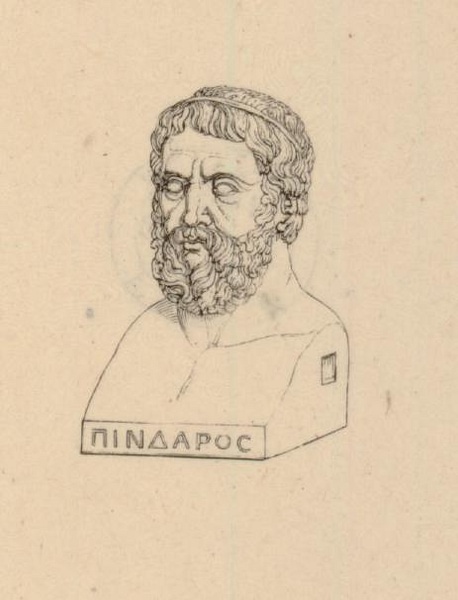 Head of Pindar Illustration The Trustees of the British Museum (Copyright) ](https://www.worldhistory.org/image/13228/head-of-pindar-illustration/ "Head of Pindar Illustration")While he may have been accused of associating with tyrants, selling out, and being a mercenary, his verses still reflect a man who did not change his beliefs. He once said: "Even wisdom has to yield to self-interest" (Stavropoulos, 119). If Pindar is a difficult poet to understand and translate, it becomes challenging to see his role in history. Hamilton maintained that the "band of his veritable admirers is and always has been small" (65). It is certain, however, that poets such as the 1st-century BCE [Roman](https://www.worldhistory.org/disambiguation/Roman/) Quintus Horatius Flaccus ([Horace](https://www.worldhistory.org/Horace/)) copied and paid homage to him. She quoted part of an ode written by Horace who said "Pindar's torrent of song sweeps on resistless deep-voiced, tremendous" (65).
### Works
Pindar's works have been divided into 17 books by its Alexandrian editors: hymns, paeans, two books of dithyrambs, two books of *prosodia* (professional songs), three books of *partheneia* (maiden songs), two books of *hyporchemata* (dance songs), *encomia* (songs of praise), *threnoi* (dirges), and, lastly, four books of *epinicia* (victory songs). Of these, the only ones to survive intact are the 44 choral victory songs composed for the Panhellenic festivals. These are considered by many to be his masterpieces. Remnants of the other books survive only in fragments and through quotes by other authors.
His odes or songs often contained allusions to contemporary history, religion, and mythology. He usually chose a myth or hero associated with the victor's city. He would put the victor in a direct relationship to a particular [god](https://www.worldhistory.org/God/) or goddess. In the Pythian 10, he writes: "Olympic winner twice in the warlike armor of [Ares](https://www.worldhistory.org/Ares/)." Later, Pindar makes reference to the Greek hero [Perseus](https://www.worldhistory.org/Perseus/): "…Danae's son came that day, breathing strength in his heart, and Athene led him to mix with those blessed men. He killed the Gorgon" (244-245).
Historian Anthony Everitt cites one of Pindar's odes that demonstrates this relationship between the human and the divine. It not only celebrates a victor in boys' wrestling at the Nemean Games but also contains a moral perspective:
> Single is the race, single
> of men and gods;
> from a single mother we both draw breath
> But a difference of power in everything
> keeps us apart;
> for the one is as Nothing, but the brazen sky
> stays a fixed habitation forever.
> Yet we can in greatest of mind
> or of body be like he immortals. (300)
Pindar was extremely proud of his aristocratic heritage and was often accused by his contemporaries of lacking finesse and tact. According to [Paul](https://www.worldhistory.org/disambiguation/Paul/) Cartledge in his book *Thebes*, Pindar's goal was to achieve imperishable fame and glory not only for the victor and client but also for himself. He adds that the victory odes helped Pindar display his great learning. Oddly, his odes often praised the victor but failed to mention any details of the victory; it was a fixation on the victor, not the achievement.
[  Greek Athletes Mark Cartwright (CC BY-NC-SA) ](https://www.worldhistory.org/image/4347/greek-athletes/ "Greek Athletes")In one of his more notable odes, he made reference to the Macedonian prince [Alexander I the Philhellene](https://www.worldhistory.org/Alexander_I_the_Philhellene/), (ancestor of [Alexander](https://www.worldhistory.org/disambiguation/Alexander/) the Great), who had difficulty qualifying for a footrace and pentathlon at the Olympic Games. The young prince, who had been harassed by the Greeks for being a barbarian, tied for first place. Pindar's ode dismisses the taunts of the other competitors and honors Alexander and gives praise for his victory:
> It is right for the good to be hymned
> with the most beautiful songs
> For this is the only tribute that comes near to the honors
> Due to the gods, but every act dies, if passed over in silence.
> (quoted in Cartledge, 11-12)
Pindar's odes contain more than just praise for a young victor. They reveal, in the words of Everitt, a man with a deep sense of the tragedy of life and of the "glory, however fleeting, of human achievement" (97). He cites an ode that demonstrates this tragic sense:
> Creatures for a day! What is a man?
> What is he not? A dream of a shadow
> Is our mortal being. But when there comes to men
> A gleam of splendor given of heaven
> Then rests on them a light of glory
> And blessed are their days. (97)
Since most of his works are lost, modern historians may find it difficult to assess his place among others of that era. However, despite these difficulties, the odes allow them to look into the cultural, social, and political lives of those aristocrats and ruling families that paid him his commissions.
#### Editorial Review
This human-authored definition has been reviewed by our editorial team before publication to ensure accuracy, reliability and adherence to academic standards in accordance with our [editorial policy](https://www.worldhistory.org/static/editorial-policy/).
## Bibliography
- [Auden, W. H. *The Portable Greek Reader.* Penguin Classics, 1948.](https://www.worldhistory.org/books/0140150390/)
- [Bagnall, Roger S. & Brodersen, Kai & Champion, Craige B. & Erskine, Andrew & Huebner, Sabine R. *The Encyclopedia of Ancient History, 13 Volume Set.* Wiley-Blackwell; 1 edition (2012-12-03), 2021.](https://www.worldhistory.org/books/B01A1MJCWI/)
- [Cantor, Norman F. *Antiquity.* Harper Perennial, 2004.](https://www.worldhistory.org/books/0060930985/)
- [Cartledge, Paul. *Thebes.* Harry N. Abrams, 2020.](https://www.worldhistory.org/books/1468316060/)
- [Everitt, Anthony. *Alexander the Great.* Random House, 2019.](https://www.worldhistory.org/books/0425286525/)
- [Hamilton, Edith. *The Greek Way.* W. W. Norton & Company, 2017.](https://www.worldhistory.org/books/039335444X/)
- [Hornblower, Simon & Spawforth, Antony & Eidinow, Esther. *The Oxford Classical Dictionary.* Oxford University Press, 2012.](https://www.worldhistory.org/books/0199545561/)
- [Stavropoulos, Steven. *The Wisdom of the Ancient Greeks.* Fall River Press, 2013.](https://www.worldhistory.org/books/0760772908/)
## About the Author
Donald has taught Ancient, Medieval and U.S. History at Lincoln College (Normal, Illinois)and has always been and will always be a student of history, ever since learning about Alexander the Great. He is eager to pass knowledge on to his students.
## Timeline
- **c. 518 CE - c. 448 CE**: Life of ancient [Greek](https://www.worldhistory.org/disambiguation/greek/) lyric poet [Pindar](https://www.worldhistory.org/Pindar/). .
## Cite This Work
### APA
Wasson, D. L. (2021, January 06). Pindar. *World History Encyclopedia*.
### Chicago
Wasson, Donald L.. "Pindar." *World History Encyclopedia*, January 06, 2021. .
### MLA
Wasson, Donald L.. "Pindar." *World History Encyclopedia*, 06 Jan 2021, .
## License & Copyright
Submitted by [Donald L. Wasson](https://www.worldhistory.org/user/DWasson/ "User Page: Donald L. Wasson"), published on 06 January 2021. The copyright holder has published this content under the following license: [Creative Commons Attribution-NonCommercial-ShareAlike](https://creativecommons.org/licenses/by-nc-sa/4.0/deed.en). This license lets others remix, tweak, and build upon this content non-commercially, as long as they credit the author and license their new creations under the identical terms. When republishing on the web a hyperlink back to the original content source URL must be included. Please note that content linked from this page may have different licensing terms.