---
title: Philippi
author: Mark Cartwright
source: https://www.worldhistory.org/Philippi/
format: machine-readable-alternate
license: Creative Commons Attribution-NonCommercial-ShareAlike (https://creativecommons.org/licenses/by-nc-sa/4.0/)
updated: 1970-01-01
---
# Philippi
_Authored by [Mark Cartwright](https://www.worldhistory.org/user/markzcartwright/)_
Philippi was an important [city](https://www.worldhistory.org/city/) in eastern [Macedon](https://www.worldhistory.org/macedon/) which flourished in the [Hellenistic](https://www.worldhistory.org/Hellenic_World/), [Roman](https://www.worldhistory.org/disambiguation/Roman/), and [Byzantine](https://www.worldhistory.org/disambiguation/Byzantine/) Periods. Situated between the Strymon and Nestos rivers, the city was valued in antiquity for its nearby [gold](https://www.worldhistory.org/gold/) mines. Site of the famous [Battle](https://www.worldhistory.org/disambiguation/battle/) of Philippi at the end of the [Roman Republic](https://www.worldhistory.org/Roman_Republic/), the city prospered in the Roman imperial era and, after a visit from St. [Paul](https://www.worldhistory.org/disambiguation/Paul/), became an important centre of [early Christianity](https://www.worldhistory.org/article/1205/early-christianity/). Philippi continued to flourish as a major Byzantine city. Today the archaeological site has substantial remains including a [theatre](https://www.worldhistory.org/disambiguation/theatre/) and four basilicas. Philippi is listed by UNESCO as a World Heritage Site.
### [Hellenistic Period](https://www.worldhistory.org/Hellenistic_Period/)
According to tradition, the city, under its first name of Crenides (or Datum), was founded c. 360 BCE by settlers from nearby Thasos who were led by the Athenian Kallistratos. There is no archaeological evidence of a significant settlement prior to the 4th century BCE but there had been small communities in the area since [Neolithic](https://www.worldhistory.org/Neolithic/) times as attested by local rock art.
When Krenides was attacked by Thracians the inhabitants looked to [Philip II of Macedon](https://www.worldhistory.org/Philip_II_of_Macedon/) for protection. Philip, no doubt with an eye on the wealth of the local gold mines, responded by taking the city and renaming it Philippi (or Philippoi), after himself, in c. 357 BCE. Fortifications and a theatre were amongst the architectural additions made under Philip's reign and he also drained the surrounding swamps. The city maintained its independence but to ensure continued loyalty from this new asset a number of Macedonians were permanently relocated to the city. According to the ancient historian Diodorus, the mines near Philippi produced a very respectable 1,000 talents each year.
Following the [death](https://www.worldhistory.org/disambiguation/Death/) of [Alexander](https://www.worldhistory.org/disambiguation/Alexander/) and the subsequent Successor Wars, Phillipi was much sought after for its gold and convenient harbour, Neapolis (modern Kavala) but continued to act as an independent city under the Antigonid regime. This is attested in a decree found on [Kos](https://www.worldhistory.org/Kos/) which dates to 243 BCE and which grants the island's sanctuary to [Hera](https://www.worldhistory.org/Hera/) the right of asylum.
### Roman Period
When the Romans defeated the Macedon king at the [Battle of Pydna](https://www.worldhistory.org/Battle_of_Pydna/) in 168 BCE, they divided Macedonia into four administrative districts. Philippi is not mentioned specifically but it is assumed it was in the first zone, the *prima regio*. In 146 BCE Macedon became a single Roman province and Philippi one of its prominent centres. The city benefitted greatly from the construction of the via Egnatia, the major road which connected the area to the Adriatic in the south and the Dardanelles in the north. A well-planned forum was built, along with a basilica, and a commercial street joined the heart of the city to the via Egnatia.
In 42 BCE the city famously gave its name to the battle which saw [Mark Antony](https://www.worldhistory.org/Mark_Antony/) and [Octavian](https://www.worldhistory.org/augustus/) gain revenge on [Julius Caesar](https://www.worldhistory.org/Julius_Caesar/)'s assassins, Brutus and Cassius. The battle had involved the largest number of troops in [Roman warfare](https://www.worldhistory.org/Roman_Warfare/) up to that point. 19 legions of 110,000 men on the Triumvirate side faced 17 Republican legions of 90,000 men, and the result was 40,000 casualties and another nail in the coffin of the Republic.
[  Macedonia under Philip II Marsyas (GNU FDL) ](https://www.worldhistory.org/image/224/macedonia-under-philip-ii/ "Macedonia under Philip II")Philippi then became a Roman colony settled by army veterans and produced its own [coinage](https://www.worldhistory.org/coinage/). When Octavian defeated [Mark](https://www.worldhistory.org/disambiguation/Mark/) [Antony](https://www.worldhistory.org/Mark_Antony/) at the [Battle of Actium](https://www.worldhistory.org/Battle_of_Actium/) in 31 BCE, the city received another influx of new residents, this time settlers who had lost their land during reforms in [Italy](https://www.worldhistory.org/italy/). From 27 BCE the city gained the honorary title of *Colonia Iulia Augusta Philippensis*.
The first Christian church in [Europe](https://www.worldhistory.org/europe/) was founded at Philippi (built on top of a [tomb](https://www.worldhistory.org/tomb/) of a Hellenistic hero) which had become an important early Christian centre following a visit to the city by [Paul the Apostle](https://www.worldhistory.org/Paul_the_Apostle/) in 49 CE. [Lydia](https://www.worldhistory.org/lydia/) was notable as the first European to be baptized there. In the following centuries Philippi flourished and benefitted from an extensive building programme. In Late Antiquity Philippi was a prominent city in the Eastern [Empire](https://www.worldhistory.org/empire/) and an episcopal seat. Once more the city's urban landscape evolved to include large churches, towered buildings, and new city walls.
[  Via Egnatia in Philippi Carole Raddato (CC BY-SA) ](https://www.worldhistory.org/image/3058/via-egnatia-in-philippi/ "Via Egnatia in Philippi")### Archaeological Remains
Portions of the city's fortifications, built by Philip and employing large marble blocks, are still visible today. The walls originally encircled the city and joined the nearby hill which protrudes from Mt. Orvelos. The ancient fortified [acropolis](https://www.worldhistory.org/Acropolis/) was built on top of this hill and a square tower from the Byzantine period, built during the reign of [Justinian I](https://www.worldhistory.org/Justinian_I/) (527 to 565 CE), still stands there. The city's outer fortifications had square towers built at intervals and gates gave access to the city, three of which survive today. The eastern Naples Gate, which led to the port of Neapolis, has a tower on each side.
The 4th-century BCE theatre built by [Philip II](https://www.worldhistory.org/disambiguation/Philip_II/), one of the largest built in [Greece](https://www.worldhistory.org/greece/), has been excavated and been partially reconstructed. The forum, built around a central square, can be seen today, as can four support pillars of its basilica (Basilica B) built c. 550 CE and which had three aisles and a dome. A curiosity is the so-called 'cell of St. Paul' where it is claimed the apostle was imprisoned but it is, in fact, an old water cistern which was subsequently converted into a cult shrine. On the other side of the via Egnatia, opposite the forum and reached by a monumental staircase, was another basilica (known simply as Basilica A) which was constructed in the 5th century CE. Measuring 130 x 50 metres and having three aisles, it was the largest basilica built in that period.
[ 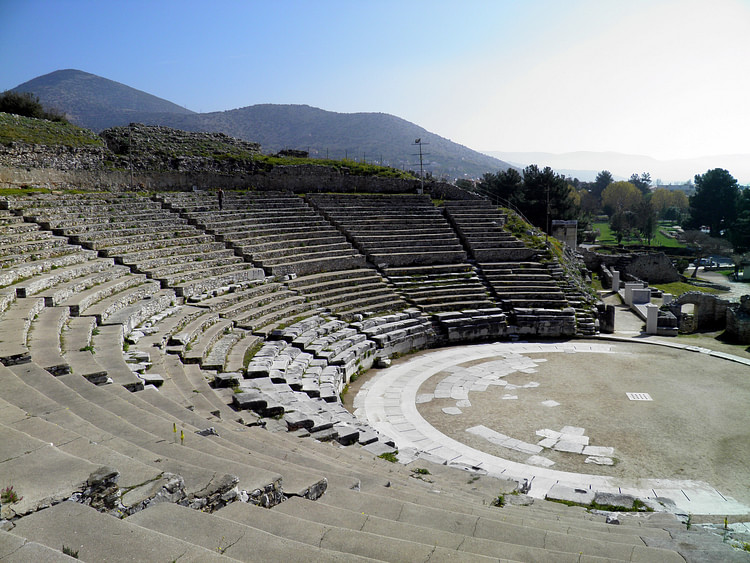 Theatre of Philippi Carole Raddato (CC BY-SA) ](https://www.worldhistory.org/image/5029/theatre-of-philippi/ "Theatre of Philippi")Finally, the small first Christian church has a surviving [mosaic](https://www.worldhistory.org/Mosaic/) floor with an inscription indicating that the church was dedicated to St. Paul. The church was replaced by a larger octagonal one, built on the same site c. 400 CE. This new building had a double colonnade inside and a [pyramid](https://www.worldhistory.org/pyramid/) roof but was altered some 50 years later to take on a square form. The area around the church was made into an enclosure with *stoas* (colonnaded halls), accommodation for pilgrims, a large two-storey bishopric building for priests, and a monumental gate leading to the via Egnatia.
#### Editorial Review
This human-authored definition has been reviewed by our editorial team before publication to ensure accuracy, reliability and adherence to academic standards in accordance with our [editorial policy](https://www.worldhistory.org/static/editorial-policy/).
## Bibliography
- [Ananiadis, D. *Ancient Greece - Temples & Sanctuaries.* Toubis Editions, 2016.](https://www.worldhistory.org/books/9605409291/)
- Bagnall, R. et al. *The Encyclopedia of Ancient History.* Wiley-Blackwell, 2012
- [Hornblower, S. *The Oxford Classical Dictionary.* Oxford University Press, 2012.](https://www.worldhistory.org/books/0199545561/)
- [Kinzl, H. *A Companion to the Classical Greek World.* Wiley-Blackwell, 2010.](https://www.worldhistory.org/books/1444334123/)
## About the Author
Mark is WHE’s Publishing Director and has an MA in Political Philosophy (University of York). He is a full-time researcher, writer, historian and editor. Special interests include art, architecture and discovering the ideas that all civilizations share.
## Timeline
- **c. 360 BCE**: Traditional founding date of [Philippi](https://www.worldhistory.org/Philippi/) in [Macedon](https://www.worldhistory.org/macedon/) with its original name as Crenides.
- **c. 357 BCE**: [Philip II of Macedon](https://www.worldhistory.org/Philip_II_of_Macedon/) renames the Macedonian [city](https://www.worldhistory.org/city/) of Crrenides after himself: [Philippi](https://www.worldhistory.org/Philippi/).
- **42 BCE**: [Octavian](https://www.worldhistory.org/augustus/) and [Antony](https://www.worldhistory.org/Mark_Antony/) defeat Republicans under Brutus and Cassius at the [Battle](https://www.worldhistory.org/disambiguation/battle/) of [Philippi](https://www.worldhistory.org/Philippi/) ([Greece](https://www.worldhistory.org/greece/)).
- **27 BCE**: [Philippi](https://www.worldhistory.org/Philippi/) gains the honorary title of Colonia Iulia Augusta Philippensis.
- **c. 49 CE**: [Paul the Apostle](https://www.worldhistory.org/Paul_the_Apostle/) visits [Philippi](https://www.worldhistory.org/Philippi/) in [Macedon](https://www.worldhistory.org/macedon/).
## Cite This Work
### APA
Cartwright, M. (2016, May 04). Philippi. *World History Encyclopedia*.
### Chicago
Cartwright, Mark. "Philippi." *World History Encyclopedia*, May 04, 2016. .
### MLA
Cartwright, Mark. "Philippi." *World History Encyclopedia*, 04 May 2016, .
## License & Copyright
Submitted by [Mark Cartwright](https://www.worldhistory.org/user/markzcartwright/ "User Page: Mark Cartwright"), published on 04 May 2016. The copyright holder has published this content under the following license: [Creative Commons Attribution-NonCommercial-ShareAlike](https://creativecommons.org/licenses/by-nc-sa/4.0/deed.en). This license lets others remix, tweak, and build upon this content non-commercially, as long as they credit the author and license their new creations under the identical terms. When republishing on the web a hyperlink back to the original content source URL must be included. Please note that content linked from this page may have different licensing terms.