---
title: Phaistos
author: Mark Cartwright
source: https://www.worldhistory.org/Phaistos/
format: machine-readable-alternate
license: Creative Commons Attribution-NonCommercial-ShareAlike (https://creativecommons.org/licenses/by-nc-sa/4.0/)
updated: 1970-01-01
---
# Phaistos
_Authored by [Mark Cartwright](https://www.worldhistory.org/user/markzcartwright/)_
Located on the fertile Mesara plain in central [Crete](https://www.worldhistory.org/crete/), Phaistos has been inhabited since the Final [Neolithic period](https://www.worldhistory.org/Neolithic/) (c. 3600-3000 BCE). The settlements greatest period of influence was from the 20th to 15th century BCE, during which time it was, along with [Knossos](https://www.worldhistory.org/knossos/), [Malia](https://www.worldhistory.org/Malia/) and [Zakros](https://www.worldhistory.org/Zakros/), one of the most important centres of the [Minoan civilization](https://www.worldhistory.org/Minoan_Civilization/).
The settlement of Phaistos continued into the [Mycenaean](https://www.worldhistory.org/Mycenaean_Civilization/) era and this period was followed by a brief resurgence in the 7th century BCE. Phaistos' independence was finally lost when it was conquered in c. 180 BCE by [Gortyn](https://www.worldhistory.org/Gortyn/), the [Roman](https://www.worldhistory.org/disambiguation/Roman/) capital of Crete. Artefacts from the site include many [Linear A](https://www.worldhistory.org/Linear_A_Script/) tablets, seals, and the celebrated but mysterious [Phaistos disk](https://www.worldhistory.org/Phaistos_Disk/), a clay disc covered in undeciphered symbols.
### Origin of the Name
Tradition attributes the founding of Phaistos to either Minos, ruler of Knossos, or to his brother Radhamanthys. The name derives from Phaistos (the son or grandson of [Herakles](https://www.worldhistory.org/hercules/)), who was killed by the Cretan King Idomeneus. It was Idomeneus who led the Cretans in the [Trojan War](https://www.worldhistory.org/Trojan_War/) and Phaistos is described in [Homer](https://www.worldhistory.org/homer/)'s *[Iliad](https://www.worldhistory.org/iliad/)* as 'a well-founded [city](https://www.worldhistory.org/city/)'.
### [Architecture](https://www.worldhistory.org/disambiguation/architecture/)
The first large scale buildings date back to c. 3000 BCE but it was from 2000 BCE that the first palaces were built on the site. The first and finest [palace](https://www.worldhistory.org/disambiguation/palace/) was constructed between 2000 BCE and 1700 BCE. This large scale [Minoan](https://www.worldhistory.org/disambiguation/Minoan/) palace was built on a wide plateau on the lowest of three hills, 97m high. The palace, at its widest extent, occupied an area of 8,400 square metres and was second only to Knossos in size and importance. Constructed on three terraces and ranging from one to three stories, it was a splendid building, with the large courts (the biggest being 1,100 square metres), royal apartments, colonnades, stairways and light wells so typical of Minoan palatial architecture.
It has been suggested that the palace was an administrative, manufacturing, and commercial centre with storage of goods for domestic and foreign [trade](https://www.worldhistory.org/disambiguation/trade/) and shrines for religious worship - in particular, of the Mother Goddess. Some scholars argue that the thousands of sealings, Linear A tablets and the quality and variety of ceramics found - particularly, Kamares ware - would suggest that the palace was something more than a communal gathering place and was perhaps the seat of a theocratic power. However, the archaeological evidence is inconclusive as to the specific role of the palace in the community. Certainly, the splendour of the buildings and richness of [pottery](https://www.worldhistory.org/pottery/) finds suggest a period of great affluence for the city as part of the wider network of sites on Minoan Crete.
The first palace complex was destroyed by two earthquakes around 1700 BCE and the second palace was soon built over the first. More modest than its predecessor, the second palace was itself destroyed mid-1600 BCE and abandoned until a brief revival in the 16th century BCE, after which Phaistos became second in importance to nearby Hagia Triada, the local seat of power under the Mycenaeans.
[ 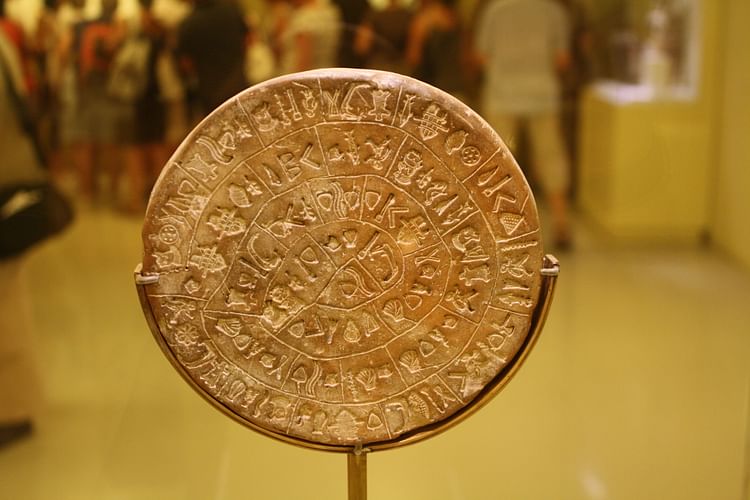 Phaistos Disk (Side B) Mark Cartwright (CC BY-NC-SA) ](https://www.worldhistory.org/image/365/phaistos-disk-side-b/ "Phaistos Disk (Side B)")### Archaeological Finds
Excavations of the site were begun in the early 20th century by the Italian Archaeological School and continue to the present day. The extensive remains visible today are principally from the second palace. There are two large staircases - the monumental entrance to the main court (14m wide) and the entrance to the west court, (6m in height); a large [theatre](https://www.worldhistory.org/disambiguation/theatre/) area with nine ranks of stone seats or steps, 24m long and with a possible capacity of over 400 standing spectators; the western court, where the celebrated bull-games were possibly held; two walled, circular pits; a lobby with benches; magazine rooms; remains of light wells; and large apartments, one - the so-called King's *Megaron* - still with original alabaster flagstones and red plaster interstices.
Amongst the many artefacts found at the site, the most celebrated is the unique Phaistos Disk. This clay disk, dated to 1600 BCE, is imprinted on both sides with 241 symbols or Cretan [hieroglyphics](https://www.worldhistory.org/Egyptian_Hieroglyphs/) in a spiral pattern. The disk may be said to be an ancestor of typography as each symbol was separately printed using a stamp. Despite much scholarly endeavour and debate, these symbols remain undeciphered. Artefacts from Phaistos now reside primarily in the Archaeological Museum of Iraklion, Crete.
#### Editorial Review
This human-authored definition has been reviewed by our editorial team before publication to ensure accuracy, reliability and adherence to academic standards in accordance with our [editorial policy](https://www.worldhistory.org/static/editorial-policy/).
## Bibliography
- [Cline, E.H. *The Oxford Handbook of the Bronze Age Aegean.* Oxford University Press, USA, 2012.](https://www.worldhistory.org/books/0199873607/)
- Davaras, C. *Phaistos - Hagia Tirada - Gortyn.* Hannibal, Athens, 1987
- [Homer. *The Iliad.* Penguin Classics, 1998.](https://www.worldhistory.org/books/0140275363/)
## About the Author
Mark is WHE’s Publishing Director and has an MA in Political Philosophy (University of York). He is a full-time researcher, writer, historian and editor. Special interests include art, architecture and discovering the ideas that all civilizations share.
## Timeline
- **3600 BCE - 3000 BCE**: First inhabitation of [Phaistos](https://www.worldhistory.org/Phaistos/).
- **2000 BCE - 1700 BCE**: First [Minoan](https://www.worldhistory.org/disambiguation/Minoan/) [palace](https://www.worldhistory.org/disambiguation/palace/) at [Phaistos](https://www.worldhistory.org/Phaistos/).
- **2000 BCE - 1400 BCE**: [Phaistos](https://www.worldhistory.org/Phaistos/)' greatest cultural height.
- **1850 BCE - 1550 BCE**: [Phaistos disk](https://www.worldhistory.org/Phaistos_Disk/) manufactured on [Crete](https://www.worldhistory.org/crete/).
- **1700 BCE - 1600 BCE**: Second [palace](https://www.worldhistory.org/disambiguation/palace/) at [Phaistos](https://www.worldhistory.org/Phaistos/).
- **c. 1600 BCE**: [Phaistos disk](https://www.worldhistory.org/Phaistos_Disk/) manufactured.
- **700 BCE - 600 BCE**: Brief resurgence in [Phaistos](https://www.worldhistory.org/Phaistos/) settlement.
- **c. 180 BCE**: [Phaistos](https://www.worldhistory.org/Phaistos/) conquered by [Gortyn](https://www.worldhistory.org/Gortyn/).
## External Links
- [The Phaistos Disk of Minoan Crete](https://www.missedinhistory.com/podcasts/the-phaistos-disk-of-minoan-crete.htm)
## Cite This Work
### APA
Cartwright, M. (2012, May 15). Phaistos. *World History Encyclopedia*.
### Chicago
Cartwright, Mark. "Phaistos." *World History Encyclopedia*, May 15, 2012. .
### MLA
Cartwright, Mark. "Phaistos." *World History Encyclopedia*, 15 May 2012, .
## License & Copyright
Submitted by [Mark Cartwright](https://www.worldhistory.org/user/markzcartwright/ "User Page: Mark Cartwright"), published on 15 May 2012. The copyright holder has published this content under the following license: [Creative Commons Attribution-NonCommercial-ShareAlike](https://creativecommons.org/licenses/by-nc-sa/4.0/deed.en). This license lets others remix, tweak, and build upon this content non-commercially, as long as they credit the author and license their new creations under the identical terms. When republishing on the web a hyperlink back to the original content source URL must be included. Please note that content linked from this page may have different licensing terms.