---
title: Pezhetairoi
author: Donald L. Wasson
source: https://www.worldhistory.org/Pezhetairoi/
format: machine-readable-alternate
license: Creative Commons Attribution-NonCommercial-ShareAlike (https://creativecommons.org/licenses/by-nc-sa/4.0/)
updated: 2024-04-17
---
# Pezhetairoi
_Authored by [Donald L. Wasson](https://www.worldhistory.org/user/DWasson/)_
The *pezhetairoi* (foot companions) were part of the imposing army that accompanied the Macedonian commander [Alexander the Great](https://www.worldhistory.org/Alexander_the_Great/) (r. 336-323 BCE) when he crossed the Hellespont to face the Persian king [Darius](https://www.worldhistory.org/disambiguation/darius/) III in 334 BCE. Armed with long pikes (*sarissas*), the *pezhetairoi* fought in a [Greek phalanx](https://www.worldhistory.org/article/110/the-greek-phalanx/) formation and played an important role in the battles of the [Granicus](https://www.worldhistory.org/Battle_of_the_Granicus/), [Issus](https://www.worldhistory.org/disambiguation/Issus/), and [Gaugamela](https://www.worldhistory.org/Battle_of_Gaugamela/).
### Origin
Like with the *[hypaspist](https://www.worldhistory.org/Hypaspist/)*, the origin and evolution of the *pezhetairos (*plural*: pezhetairoi)* are shrouded in mystery. Except for references to them in discussions of [Philip II](https://www.worldhistory.org/disambiguation/Philip_II/) and [Alexander](https://www.worldhistory.org/disambiguation/Alexander/), the term *pezhetairoi* is hardly found in ancient [literature](https://www.worldhistory.org/literature/). In his *The [Army of Alexander the Great](https://www.worldhistory.org/article/676/the-army-of-alexander-the-great/),* historian Stephen English wrote that, at some inexact point, the peasantry was recruited territorially and organized into infantry, and, according to the historian [Anaximenes](https://www.worldhistory.org/Anaximenes/), it was given the name *pezhetairoi*. He added that the *pezhetairoi* were "essentially an evolution of the standard phalanx" (3).
However, disagreements still persist: some scholars refer to all of the Macedonian infantry as *pezhetairoi* while others believe they were not front-line infantry but bodyguards to the king. English contends that the *pezhetairoi* may have been created as a select, elite infantry acting as royal bodyguards under the Macedonian king Alexander I (498-454 BCE). It is claimed by some that this elite infantry eventually became the *hypaspists*. It was Alexander III (the Great) who would extend the term *pezhetairoi* to include all of the heavy phalanx infantry with the exception of the *hypaspists*.
### The Military Reforms of Philip II
In 359 BCE, [Philip II of Macedon](https://www.worldhistory.org/Philip_II_of_Macedon/) (r. 359-336 BCE) inherited a kingdom sorely in need of military reform. [Macedon](https://www.worldhistory.org/macedon/) had been known for possessing an excellent cavalry but did not have an equally strong infantry. At that time, the men who fought in a [Greek](https://www.worldhistory.org/disambiguation/greek/) phalanx had only been recruited to serve when needed and therefore lacked proper training. They were not a professional army and were considered inflexible and incapable of maneuvers. A strong believer in training and discipline, Philip took undisciplined men and turned them into a formidable army that brought much of [Greece](https://www.worldhistory.org/greece/) under his influence. To accomplish this, he made a number of reforms. He increased the size of the army from 10,000 to 24,000 and created a corps of engineers to develop siege engines such as towers and catapults. But one of the first roadblocks to overcome was the regional ties of the troops, especially in the infantry, where little if any loyalty to the king existed.
[  Philip II of Macedon (Artist's Impression) Mohawk Games (Copyright) ](https://www.worldhistory.org/image/12937/philip-ii-of-macedon-artists-impression/ "Philip II of Macedon (Artist's Impression)")To overcome this disparity, erasing regional ties, one of Philip's first reforms was to provide new uniforms: a simple idea that gave each man a sense of unity and solidarity. A typical *pezhetairoi* wore a Phrygian helmet with cheekpieces to provide better hearing and visibility, a light cuirass of glued layers of linen (*linothroax*), a short-sleeved tunic, greaves, little or no armor (the first rank of the phalanx wore armor), and a leather sling worn over the shoulder to support the concave shield (*aspis*).
Next came their equipment: the 5 to 7 meters (16 to 23 ft) long *sarissa* was ideal for the *pezhetairoi* while a shorter spear served the *hypaspists*. The *sarissa* had a sharp iron blade and a spoke on the end of the shaft used to impale a charging horseman or infantryman. Historians differ on whether or not the *pezhetairoi* carried a secondary weapon; some contend that a *xiphos*, a double-edged slashing weapon, was provided. With new uniforms and equipment, the last essential reform was to completely sever all regional ties. To accomplish this, an oath of allegiance to the king was required.
### Macedonian Infantry
The Macedonian heavy infantry became a highly-trained, professional strike force, extremely flexible and capable of fighting on any terrain. This latter aspect would prove beneficial to Alexander the Great at the [Battle of Gaugamela](https://www.worldhistory.org/Battle_of_Gaugamela/) (331 BCE) against Darius III (r. 336-330 BCE). The army that followed Alexander into [Asia Minor](https://www.worldhistory.org/Asia_Minor/) was purely offensive, designed to attack an enemy as quickly as possible. Macedonian kings had no interest in a defensive operation. An integral part of this was the *pezhetairoi*. According to some sources, within the *pezhetairoi* was an elite corps recruited from Upper Macedonia: the well-trained *asthetairoi*, not to be confused with the *hypaspists*. The 9,000 *pezhetairoi* that accompanied Alexander across the Hellespont were divided into six *taxeis.* Serving under a *taxiarch,* each individual *taxis* could be used as a separate tactical unit or together as one. The six *taxiarchs* were Coenus, [Perdiccas](https://www.worldhistory.org/Perdiccas/), [Meleager](https://www.worldhistory.org/Meleager/), Polyperchon, Philippus, and Craterus. There was no overall commander.
A Macedonian phalanx consisted of at least 16 ranks. Each individual phalanx could easily advance to meet an attack. The *sarissa* was a perfect weapon for the *pezhetairoi*, for it extended their reach advantage over the spears of the enemy. The men of the first four ranks lowered their *sarissas,* while those standing in the back held them upward, preventing any airborne missiles launched by an enemy's archers and slingers from attacking the formation. To be an effective fighting force, the phalanx had to maintain their rank under all circumstances. The very nature of the phalanx required constant drilling, and both Philip and Alexander demanded strict obedience. However, the phalanx had one drawback: it was a linear formation and thereby vulnerable to flank attacks. To remedy this, Philip and Alexander used light infantry to protect their flanks. Historian Barry Strauss in his *Masters of Command* wrote that "A Macedonian [battle](https://www.worldhistory.org/disambiguation/battle/) represented an orchestrated balance of cavalry and infantry" (32). After intense training, in Philip's mind, the army was ready to engage the Persians in battle. After bringing much of Greece under his influence and having proved his capabilities, Philip longed to face the [Achaemenid Empire](https://www.worldhistory.org/Achaemenid_Empire/). To him, it was an act of revenge for the [Persian Wars](https://www.worldhistory.org/Persian_Wars/), the invasions of [Darius I](https://www.worldhistory.org/Darius_I/) and [Xerxes](https://www.worldhistory.org/Xerxes_I/) in 490 and 480 BCE. However, it was not to happen.
### [Battle of the Granicus](https://www.worldhistory.org/Battle_of_the_Granicus/)
After the [death](https://www.worldhistory.org/disambiguation/Death/) of Philip II in 336 BCE, the young Alexander, barely 20 years old, had to prove himself to the people of Greece and his own men. Before he crossed the Hellespont into Asia Minor, he had accomplished both. After the crossing, Alexander first visited the site of [Troy](https://www.worldhistory.org/troy/) to pay homage to [Achilles](https://www.worldhistory.org/achilles/) and then traveled southward to meet the Persians at the Granicus River, but Darius III paid little attention to the unknown Alexander despite the warnings of his Greek commander Memnon of [Rhodes](https://www.worldhistory.org/Rhodes/), who suggested a scorched-earth policy. Both Darius and the satraps ([ancient Persian governors](https://www.worldhistory.org/Persian_Governor/)) dismissed the idea. They arrogantly considered [Persian warfare](https://www.worldhistory.org/Persian_Warfare/) far superior to the tactics of invading Greeks.
[  Battle of the Granicus Hohum (Public Domain) ](https://www.worldhistory.org/image/12055/battle-of-the-granicus/ "Battle of the Granicus")To move swiftly and reach the Granicus, Alexander believed he only needed the Macedonian infantry (the six *taxeis* of *sarissa*-bearing *pezhetairoi),* the *hypaspists*, and after considerable thought, all available cavalry. Upon approaching the Granicus, Alexander marched his army in a double-phalanx formation: two phalanxes of heavy infantry, flanked by the cavalry, screened by the light infantry. After the scouts reported the presence of the Persians on the far bank of the river, Alexander arranged his army into battle formation: the *pezhetairoi* phalanx in the center, with the companion cavalry and Alexander stationed on the right. The Persian cavalry was at the river with the infantry behind them. The Persian cavalry could neither move forward because of the river banks nor pull back because of the infantry. As the Battle of the Granicus progressed, Alexander and his cavalry engaged the Persian cavalry on the right while the *pezhetairoi* moved forward across the river.
Throughout the battle, the Greek mercenary infantry remained in its position and did not move. Strauss described the meeting: "With terrifying efficiency and their huge pikes held out before them, the men of the phalanx crossed the river and forced the enemy back." (52) With Alexander and his cavalry routing the Persian cavalry on the right, they became disorganized and collapsed. To many, Alexander had demonstrated not only the superiority of his army but also his ability to command. The king chose not to pursue the Persians; instead, the Greek mercenaries were attacked *en masse.* Encircled by the cavalry on three sides and the *pezhetairoi* on the fourth, 2,000 of them were led away in chains.
### [Battle of Issus](https://www.worldhistory.org/Battle_of_Issus/)
After recovering from a serious illness, Alexander and his army moved southward to meet Darius at the Penarus River, south of Issus. Arriving at the river, his order of battle showed the heavy infantry, as always, in the center (a place of honor) with the *hypaspists* and cavalry to the right. The Persians had their heavy cavalry on the left screened by archers and slingers. The terrain did not favor the Persians. The Greek mercenaries fighting for Darius were stationed opposite the *pezhetairoi* and *hypaspists*. As the battle progressed the *pezhetairoi* and *hypaspists* attacked the Persian center although the steep river bank made it difficult for them. When a gap between Alexander and the infantry phalanx emerged, the mercenaries entered, enabling them to force the *pezhetairoi* back towards the river. They took on a number of casualties, but with Alexander's aid, the mercenaries were pushed back.
[  The Alexander Mosaic Carole Raddato (CC BY-SA) ](https://www.worldhistory.org/image/2965/the-alexander-mosaic/ "The Alexander Mosaic")According to English's account, two *taxeis* of *pezhetairoi* plus the *hypaspists* crossed the river and flanked the mercenary infantry while the remaining four *taxeis* attacked the front. This attack at the river and Alexander's flanking attack forced the Persians to retreat. In the end, the *hypaspists* advanced toward Darius while Alexander attacked from the extreme right. Seeing little chance for victory, the Persian king fled and his soldiers followed his lead. Strauss believed that "Issus turned out as it did for three reasons: prebattle maneuvers, the skill of the Macedonian army, and the great judgment of Alexander" (79). About Alexander, he added: "His ability to size an enemy on a battlefield and come up with a quick and effective answer made him the embodiment of strategic intuition." (239)
### Battle of Gaugamela
Following success at [Tyre](https://www.worldhistory.org/Tyre/), Gaza, and [Egypt](https://www.worldhistory.org/egypt/), Alexander and his army prepared to meet Darius at Gaugamela. Gaugamela presented a challenge for the Macedonian king: the terrain favored Darius' cavalry and scythed chariots, something Alexander's scouts had relayed to him. The Persian king's order of battle was designed to counter the tactics Alexander used at Issus. During his earlier battles, Alexander had used only the core of his army; however, Gaugamela was the first instance where he needed every available man. To accommodate the terrain, Alexander's formation varied slightly from what he had normally used. Toward the center was the companion cavalry; to the left were the *hypaspists* and the *pezhetairoi*. The six *taxeis* of *pezhetairoi* were under the command of Craterus – the only time all six were under the command of one individual.
One of Alexander's major attributes was his ability to think ahead. Knowing the phalanx could become isolated, Alexander arranged it so it could extend its base or close ranks before engaging in battle. In her *Alexander the Great at [War](https://www.worldhistory.org/disambiguation/War/),* Ruth Sheppard wrote that the phalanxes were organized to act as a "self-contained and self-reliant unit" with the ability to keep its position, functioning until help could arrive.
[ 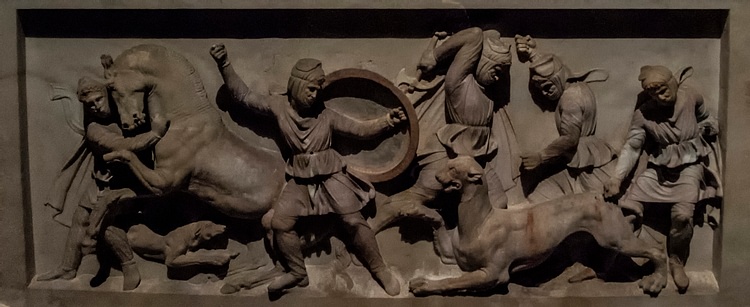 Alexander Sarcophagus James Carnehan (CC BY) ](https://www.worldhistory.org/image/2918/alexander-sarcophagus/ "Alexander Sarcophagus")As the battle began Darius failed in an early attempt to encircle Alexander, who retaliated, attacking the Persian center. The Persian king, as Alexander had assumed, then sent his scythed chariots towards the *pezhetairoi* phalanx, but as the chariots approached, the phalanx opened up, allowing the chariots to pass through. In another demonstration of his innate understanding of the mind of Darius, Alexander had ordered the phalanx infantry to join shields and beat them with their *sarissas*. As the chariots approached, the noise frightened the horses into bolting, and as the gap appeared the chariots simply drove through; they were then attacked by troops at the phalanx's rear. Meanwhile, Alexander and the companion cavalry moved to the far right onto uneven ground. The Persian commander Bessus, under the orders of Darius, followed, causing a gap to appear. Alexander formed his men into a wedge and entered the gap. Seeing his army failing, Darius, as he had done at Issus, fled the field. Alexander pursued, but before he could reach the fallen king, Darius had been killed by Bessus. Bessus' own men turned him over to Alexander, who had him tortured and executed.
After Gaugamela, Alexander sacked and burned [Persepolis](https://www.worldhistory.org/persepolis/) and captured [Susa](https://www.worldhistory.org/susa/). After capturing [Bactria](https://www.worldhistory.org/Bactria/) and marrying [Roxanne](https://www.worldhistory.org/Roxanne/), Alexander fought the Indian king Porus at the Battle of the Hydaspes. He used all six *taxeis* of *pezhetairoi* to win a decisive victory.
#### Editorial Review
This human-authored definition has been reviewed by our editorial team before publication to ensure accuracy, reliability and adherence to academic standards in accordance with our [editorial policy](https://www.worldhistory.org/static/editorial-policy/).
## Bibliography
- [Anglim, Simon. *Fighting Techniques of the Ancient World, 3000 BC - AD 500.* Metro Books, 2002.](https://www.worldhistory.org/books/1853675229/)
- [English, Stephen. *The Army of Alexander the Great.* Pen & Sword History, 2009.](https://www.worldhistory.org/books/B009EE1B42/)
- [English, Stephen. *The Field Campaigns of Alexander the Great.* Pen & Sword Military, 2011.](https://www.worldhistory.org/books/B0091WB552/)
- [Sheppard, Ruth. *Alexander the Great at War.* Osprey Publishing, 2010.](https://www.worldhistory.org/books/1435126963/)
- [Strauss, Barry. *Masters of Command.* Simon & Schuster, 2013.](https://www.worldhistory.org/books/1439164495/)
- [Tsouras, Peter G. *Alexander.* Potomac Books Inc., 2004.](https://www.worldhistory.org/books/B005CWJ728/)
## About the Author
Donald has taught Ancient, Medieval and U.S. History at Lincoln College (Normal, Illinois)and has always been and will always be a student of history, ever since learning about Alexander the Great. He is eager to pass knowledge on to his students.
## Timeline
- **334 BCE - 323 BCE**: Campaigns of [Alexander the Great](https://www.worldhistory.org/Alexander_the_Great/).
- **May 334 BCE**: [Alexander the Great](https://www.worldhistory.org/Alexander_the_Great/) invades the Persian [Achaemenid Empire](https://www.worldhistory.org/Achaemenid_Empire/).
- **5 Nov 333 BCE**: [Battle of Issus](https://www.worldhistory.org/Battle_of_Issus/). [Alexander the Great](https://www.worldhistory.org/Alexander_the_Great/) is victorious against [Darius](https://www.worldhistory.org/disambiguation/darius/) III of [Persia](https://www.worldhistory.org/Persia/).
- **1 Oct 331 BCE**: [Battle of Gaugamela](https://www.worldhistory.org/Battle_of_Gaugamela/). [Alexander the Great](https://www.worldhistory.org/Alexander_the_Great/) calls himself "King of Asia."
## Questions & Answers
### Who were the Pezhetairoi?
The pezhetairoi (foot companions) were Macedonian infantry soldiers armed with long sarissas and fighting in phalanx formation. They were an essential part of the army of Alexander the Great.
### How did the Macedonian phalanx work?
A Macedonian phalanx was a linear formation, consisting of at least 16 ranks. The men of the first four ranks lowered their sarissas to meet the enemy up front, while those standing in the back held their sarissas upward, protecting the formation from enemy archers and slingers.
## Cite This Work
### APA
Wasson, D. L. (2024, April 17). Pezhetairoi. *World History Encyclopedia*.
### Chicago
Wasson, Donald L.. "Pezhetairoi." *World History Encyclopedia*, April 17, 2024. .
### MLA
Wasson, Donald L.. "Pezhetairoi." *World History Encyclopedia*, 17 Apr 2024, .
## License & Copyright
Submitted by [Donald L. Wasson](https://www.worldhistory.org/user/DWasson/ "User Page: Donald L. Wasson"), published on 17 April 2024. The copyright holder has published this content under the following license: [Creative Commons Attribution-NonCommercial-ShareAlike](https://creativecommons.org/licenses/by-nc-sa/4.0/deed.en). This license lets others remix, tweak, and build upon this content non-commercially, as long as they credit the author and license their new creations under the identical terms. When republishing on the web a hyperlink back to the original content source URL must be included. Please note that content linked from this page may have different licensing terms.