---
title: Persis
author: Antoine Simonin
source: https://www.worldhistory.org/Persis/
format: machine-readable-alternate
license: Creative Commons Attribution-NonCommercial-ShareAlike (https://creativecommons.org/licenses/by-nc-sa/4.0/)
updated: 2025-10-15
---
# Persis
_Authored by [Antoine Simonin](https://www.worldhistory.org/user/Deathfinger/)_
Persis (in [Greek](https://www.worldhistory.org/disambiguation/greek/), derived from Persian *pars*) is the ancient name of the approximate area of modern Fars in Central Iran, as well as a state of the [Hellenistic](https://www.worldhistory.org/Hellenic_World/) and Imperial periods in this same province. Its name is derived from the Persians who settled in the area in the 7th century BCE, the place being called Anšan before.
### Province of Persis
Persis was the Persian homeland, a land of river basins and plateaus that stretched forth from the Zagros Mountains. Its heart roughly corresponded to modern Fars, consisting of river-drained plains between two ridges of the Zagros Mountains, running horizontally from east to west. This land, composed of basins and valleys, was fertile; [agriculture](https://www.worldhistory.org/disambiguation/Agriculture/) was sustained by a complex web of irrigation ditches.
The north-western plains were characterized by more hills and valleys at a higher altitude and so received more rain than their south-eastern counterpart. In the higher altitudes, temperate forests could be found, including oaks, date palms, and pomegranates.
Here lay Pasargade, the early capital of the Persian Kings of Kings, as well as the equally famous [city](https://www.worldhistory.org/city/) of [Persepolis](https://www.worldhistory.org/persepolis/). Nearer the salt lakes in the north lay Anšan, the ancient seat of Persian power and original home of [Cyrus the Great](https://www.worldhistory.org/Cyrus_the_Great/), founder of the [Persian Empire](https://www.worldhistory.org/disambiguation/Persian_Empire/). The Mand River separated Anšan from other [cities](https://www.worldhistory.org/city/) in the east.
[  All Nations Gate at Persepolis dynamosquito (CC BY-SA) ](https://www.worldhistory.org/image/83/all-nations-gate-at-persepolis/ "All Nations Gate at Persepolis")### Kingdom of Persis
Persis is also the name given today to a small kingdom of the eponymous area, which lasted roughly from 300 BCE to 211/212 CE.
The history of the Kingdom of Persis is surrounded by shadows and contradictory hypotheses, but according to the most recent analysis, this state appeared under [Seleucos I](https://www.worldhistory.org/Seleucos_I/)'s reign (305-281 BCE), when Persis and the whole Middle East were under [Seleucid](https://www.worldhistory.org/Seleucid_Empire/) control. Seleucus seems to have formed an alliance with a local Persian dynasty, which gained substantial power in Persis. Persis rulers took the title of *frataraka*, “keeper of the fire,” equivalent to a sub-[satrap](https://www.worldhistory.org/Persian_Governor/) title. Their power in Persis was completed by the presence of a Seleucid satrap of Persis, leading to a relationship of coexistence, but the precise details of this situation are not fully understood in the modern day.
[  Map of the Hellenistic Kingdoms after Alexander, c.301 BCE Simeon Netchev (CC BY-NC-ND) ](https://www.worldhistory.org/image/14355/map-of-the-hellenistic-kingdoms-after-alexander-c3/ "Map of the Hellenistic Kingdoms after Alexander, c.301 BCE")The first four rulers were Artaxares I (Persian Ardaxshir), Oborzes (Persian Wahabarz), Autophradates I (Persian Vadfradad), and Bagadates (Persian Bagdan). They kept the *frataraka* title and minted coins, probably keeping good relations with the Seleucids. The exception is the reign of Oborzes (c. 270-240 BCE?), who killed 3000 Greek colonists according to Polyaenus (7.40). Further evidence of turbulent reigns can be found in [coin](https://www.worldhistory.org/coinage/) overstrikes, showing that the rulers Autophradates I and Bagadates were not on good terms with each other.
When the Seleucid Antiochus III came to power, he put [Alexander](https://www.worldhistory.org/disambiguation/Alexander/), a Greek, at the head of the Persis satrapy, alongside Alexander's brother Molon in [Media](https://www.worldhistory.org/disambiguation/media/). Despising the king on account of his youth, Alexander helped his brother Molon to revolt against Antiochus III in 222-220 BCE, along with the Upper Satrapies ([Polybius](https://www.worldhistory.org/Polybius/) V.40.6 - V.53.12). Defeated, Molon and Alexander killed themselves (Polybius V.53.9), then Antiochus III sent Tychon, the chief secretary of his army, to “take the command of the Persian gulf province”.
Following this revolt, which should have involved the *frataraka*, the Persis dynasty disappeared from sight until Autophradates II (Persian Vadfradad). From this ruler until the last one, kings all bear the title (*malakh*) instead of *frataraka*.
Persis kings seemed to be loyal to the [Seleucid Empire](https://www.worldhistory.org/Seleucid_Empire/) until their defeat by the rising Parthians in 141 BCE. The Parthians then kept them as vassals, as they did later with several little kingdoms in [Mesopotamia](https://www.worldhistory.org/Mesopotamia/). One of the kings of Persis, [Ardashir I](https://www.worldhistory.org/Ardashir_I/) (r. 224-240 CE), revolted against Parthian King Artabanus IV (r. 213-224 CE) and founded the [Sassanian Empire](https://www.worldhistory.org/Sasanian_Empire/), virtually ending the kingdom of Persis by merging it with the former [Parthian Empire](https://www.worldhistory.org/Parthia_(Empire)/) under his rule.
[ 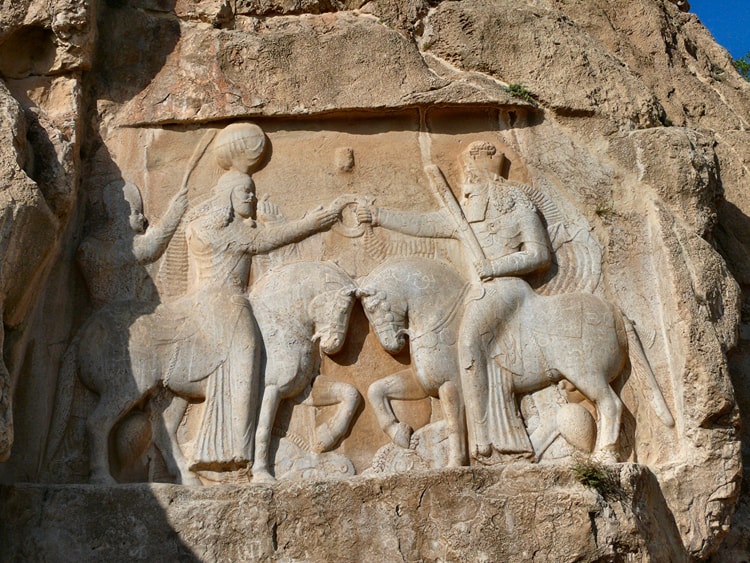 Ardashir I dynamosquito (CC BY-SA) ](https://www.worldhistory.org/image/11783/ardashir-i/ "Ardashir I")Very little is known of the cultural aspects of the kingdom of Persis. They ruled from Estakhr, where [Achaemenid](https://www.worldhistory.org/disambiguation/Achaemenid/) tombs are located. The dynasty shows several indications of Hellenization on their coins and on the scarce representation they left us, alongside reminiscent pictures from Achaemenid art.
Administration aspects were probably similar to those used by the early Sassanids, with a king giving orders to several *kyrios* (Lords). Ultimately, the legacy of the kingdom of Persis became visible through [Sassanid](https://www.worldhistory.org/Sasanian_Empire/) cultural elements, even though many important aspects remain unknown.
#### Editorial Review
This human-authored definition has been reviewed by our editorial team before publication to ensure accuracy, reliability and adherence to academic standards in accordance with our [editorial policy](https://www.worldhistory.org/static/editorial-policy/).
## Bibliography
- Engels, D. "A new Frataraka chronology." *LATOMUS. Revue d'études latines*, vol.72, 2013, pp. p. 28-82.
- [Planhol, X. d, “Fars. I.Geographyâ€, Encyclopaedia Iranica, online edition, 2009](http://www.iranicaonline.org/articles/fars-i "Planhol, X. d, “Fars. I.Geographyâ€, Encyclopaedia Iranica, online edition, 2009"), accessed 1 Dec 2016.
- Sarkosh Curtis, V. "The Frataraka coins of Persis: bridging the gap between Achaemenid and Sasanian Persia." *The World of Achaemenid Persia:History, Art and Society in Iran and the Ancient Near East*, Bruxelles 2010, pp. p. 379-396.
- [Susan Sherwin-White. *From Samarkhand to Sardis.* University of California Press, 1993, p. 76-77.](https://www.worldhistory.org/books/0520081838/)
- [Wiesehöfer, J, “Persis; kings ofâ€, Encyclopaedia Iranica, online edition, 2009](http://www.iranicaonline.org/articles/persis-kings-of "Wiesehöfer, J, “Persis; kings ofâ€, Encyclopaedia Iranica, online edition, 2009"), accessed 1 Dec 2016.
## About the Author
Passionate about ancient Central Asia. Maintains the website From Bactria to Taxila. Works in the Europa Barbarorum project.
- [Linkedin Profile](https://www.linkedin.com/in/antoine-simonin/52/685/a9a/e)
## Timeline
- **316 BCE**: [Satrap](https://www.worldhistory.org/Persian_Governor/) of [Persis](https://www.worldhistory.org/Persis/) Peucestas is defeated at the Gabiene [Battle](https://www.worldhistory.org/disambiguation/battle/), alongside of Eumenes. Evagros is appointed in Persis by [Antigonus I](https://www.worldhistory.org/Antigonus_I/) Monopthalmus.
- **312 BCE**: Evagros is killed in [battle](https://www.worldhistory.org/disambiguation/battle/) by [Seleucos I](https://www.worldhistory.org/Seleucos_I/). [Persis](https://www.worldhistory.org/Persis/) comes under [Seleucid](https://www.worldhistory.org/Seleucid_Empire/) rule.
- **c. 295 BCE**: [Seleucos I](https://www.worldhistory.org/Seleucos_I/) makes an alliance with local [Persis](https://www.worldhistory.org/Persis/) dynast, Ardaxsir, becoming the first frataraka of Persis.
- **c. 270 BCE**: Wahabarz (oborzes) succeeds to the frataraka Ardaxsir in [Persis](https://www.worldhistory.org/Persis/).
- **222 BCE - 220 BCE**: [Satrap](https://www.worldhistory.org/Persian_Governor/) of [Persis](https://www.worldhistory.org/Persis/) [Alexander](https://www.worldhistory.org/disambiguation/Alexander/), alongside of his brother Molon, satrap of Mediare, revolt against [Antiochos](https://www.worldhistory.org/disambiguation/antiochos/) III. Their defeat begins a period of time without a known frataraka in Persis.
- **141 BCE**: [Persis](https://www.worldhistory.org/Persis/) passes from [Seleucid](https://www.worldhistory.org/Seleucid_Empire/) to Parthian domination.
- **c. 211 CE**: Ardashir, king (malakh) of [Persis](https://www.worldhistory.org/Persis/), revolts against the Parthians and founds the [Sasanian Empire](https://www.worldhistory.org/Sasanian_Empire/).
## External Links
- [AN ARCHAEOLOGICAL TOUR IN THE ANCIENT PERSIS](https://www.cambridge.org/core/services/aop-cambridge-core/content/view/8930BE316E54E3D55E34B92BAF47A63D/S0021088900020660a.pdf/an-archaeological-tour-in-the-ancient-persis.pdf)
- [Persia: Ancient Iran and the Classical World - Getty Museum](https://www.getty.edu/art/exhibitions/persia/explore.html)
## Cite This Work
### APA
Simonin, A. (2014, November 14). Persis. *World History Encyclopedia*.
### Chicago
Simonin, Antoine. "Persis." *World History Encyclopedia*, November 14, 2014. .
### MLA
Simonin, Antoine. "Persis." *World History Encyclopedia*, 14 Nov 2014, .
## License & Copyright
Submitted by [Antoine Simonin](https://www.worldhistory.org/user/Deathfinger/ "User Page: Antoine Simonin"), published on 14 November 2014. The copyright holder has published this content under the following license: [Creative Commons Attribution-NonCommercial-ShareAlike](https://creativecommons.org/licenses/by-nc-sa/4.0/deed.en). This license lets others remix, tweak, and build upon this content non-commercially, as long as they credit the author and license their new creations under the identical terms. When republishing on the web a hyperlink back to the original content source URL must be included. Please note that content linked from this page may have different licensing terms.