---
title: Penelope: The Loyal Wife of Odysseus
author: Liana Miate
source: https://www.worldhistory.org/Penelope/
format: machine-readable-alternate
license: Creative Commons Attribution-NonCommercial-ShareAlike (https://creativecommons.org/licenses/by-nc-sa/4.0/)
updated: 2026-07-02
---
# Penelope: The Loyal Wife of Odysseus
_Authored by [Liana Miate](https://www.worldhistory.org/user/lianamiate/)_
In [Greek mythology](https://www.worldhistory.org/Greek_Mythology/), Penelope is the wife of [Odysseus](https://www.worldhistory.org/odysseus/), the king of Ithaca, and the mother of Telemachus. She is best known for her unwavering loyalty and fidelity to her husband during his 20-year-long absence and her clever plan to elude the many suitors who sought to win her hand during Odysseus's absence. Her story is famously told in [Homer](https://www.worldhistory.org/homer/)'s (c. 750 BCE) *[Odyssey](https://www.worldhistory.org/Odyssey/)*.
### Family & Marriage to Odysseus
Penelope was the daughter of the Spartan king Icarius and the naiad [nymph](https://www.worldhistory.org/nymph/) Periboia. She had five brothers, including Thoas, Damasippos, Imeusimos, Aletes, and Perileos.
Odysseus was originally one of [Helen](https://www.worldhistory.org/disambiguation/Helen/) of [Sparta](https://www.worldhistory.org/sparta/)'s suitors, but he made an agreement with Helen's father, Tyndareus; if Tyndareus helped Odysseus win Penelope's hand, he would come up with a plan to prevent any conflict between the large number of men who had come to win Helen's hand in marriage. Following Odysseus' advice, Tyndareus made all the suitors swear an oath that they would answer a call for help from the chosen bridegroom if he faced harm from another regarding his marriage. True to his word, Tyndareus then asked his brother Icarius to give Penelope to Odysseus in marriage. Odysseus and Penelope had one son together, Telemachus, who was born shortly before the [Trojan War](https://www.worldhistory.org/Trojan_War/) began.
### The Mournful Wife
At the beginning of *The Odyssey*, Penelope mourns her husband while multiple suitors occupy the [palace](https://www.worldhistory.org/disambiguation/palace/) of Ithaca in her husband's absence, hoping to win her hand. One night, as the famous bard Phemius sings about the ill-fated journey home of the Achaeans, Penelope comes down from her chambers with her loyal handmaidens and pleads with him to stop singing the song, as it is too painful for her to be reminded of Odysseus' loss:
> How I long for my husband – alive in memory, always,
> That great man whose fame resounds through Hellas
> Right to the depths of [Argos](https://www.worldhistory.org/argos/)!
> (Homer, *The Odyssey*, 1.395-398)
Telemachus attempts to calm his mother and sends her back to her chambers, where she weeps for her husband until [Athena](https://www.worldhistory.org/athena/) lures her into a blissful sleep.
### Penelope & the Disgruntled Suitors
In Book 2 of *The Odyssey*, before departing Ithaca to seek answers about his father, Telemachus calls for an assembly of the Achaeans, the first without his father, and addresses his fellow countrymen. In anger, he bemoans the large number of suitors who have taken over the palace, killed their livestock, feasted on their meat, and drunk their wine.
[Antinous](https://www.worldhistory.org/antinous/), one of the suitors present, took great offence at Telemachus' outburst and blamed Penelope for being cunning and giving the men false hope for almost four years. Penelope had promised the suitors that she would choose a new husband only after she had finished weaving a funeral shroud for her father-in-[law](https://www.worldhistory.org/disambiguation/law/), Laertes. The suitors believed her and waited for three years in the palace, while she worked on the shroud in the royal halls. As Penelope continued working on the shroud for the fourth year, the men's patience finally ran out, and one of Penelope's maids revealed her secret.
You see, Penelope had devised a clever plan to delay choosing a suitor for as long as possible: during the day, she wove the shroud for Laertes, but at night, she would unravel her work and start over from the beginning every morning. Once the suitors were aware of this, they made her complete the shroud against her will. Antinous continues with his tirade: the suitors had never seen a queen as intriguing as Penelope, who was gifted with a smart mind and a skilled hand, but she had gone too far with her tricks. As long as she kept delaying the inevitable, the suitors would stay in the palace. Antinous implores Telemachus to encourage Penelope to go back to her father's house in Sparta and to marry whoever he chooses for her.
[ 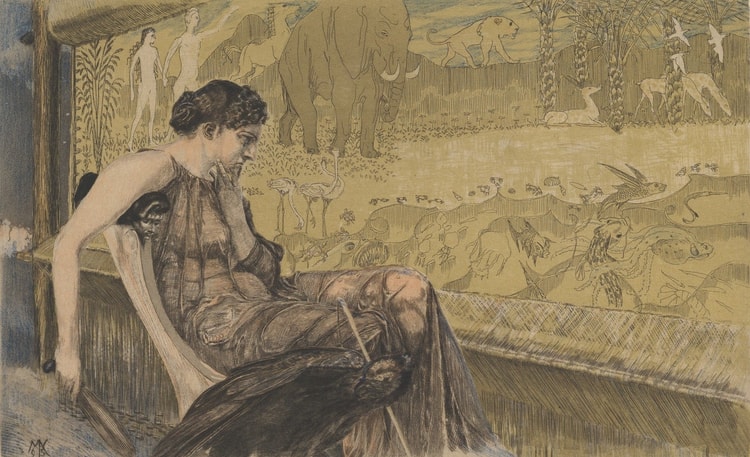 Penelope Stares at Her Shroud Max Klinger (Public Domain) ](https://www.worldhistory.org/image/21904/penelope-stares-at-her-shroud/ "Penelope Stares at Her Shroud")Telemachus argues that he would never kick Penelope out of her home and that if the suitors had any shame, they would leave the palace themselves. He vows that [Zeus](https://www.worldhistory.org/zeus/) will punish the suitors for the disrespect they have shown. To show that he has heard Telemachus' prayer, Zeus sends down two eagles, who engage in a violent fight, shocking onlookers. As the men fight amongst themselves about what the omen means, Telemachus silences them, saying that he will search for his father for one more year, and if he has evidence of his [death](https://www.worldhistory.org/disambiguation/Death/), he will give his mother's hand to another man. Before leaving on his mission, Telemachus ensures that Penelope will not learn of his voyage until 12 days have passed.
### Athena Hears Penelope's Prayer
With Telemachus off on his quest to find Odysseus, Antinous hatches a dark plan to ambush him in the straits between Ithaca and the rocky Same and get rid of him once and for all. The suitors eagerly agree with this plan. Luckily, the herald Medon overhears their plotting and reports back to Penelope, who is understandably shocked and dismayed. She questions why her son has left her and worries about the fate that awaits him.
[ 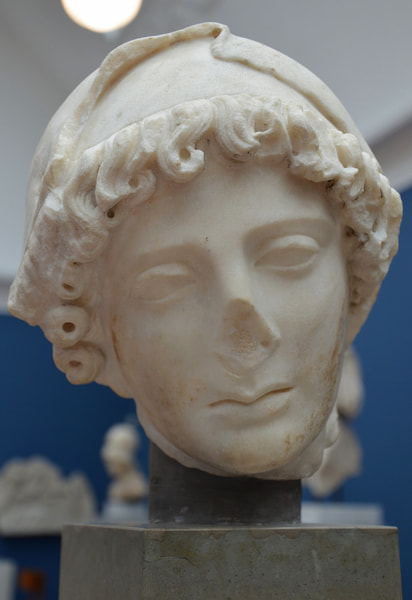 Head of Penelope Carole Raddato (CC BY-SA) ](https://www.worldhistory.org/image/2683/head-of-penelope/ "Head of Penelope")Penelope collapses and weeps for her losses; first her beloved husband, and now her son. Angered at her handmaidens' silence, she asks why none of them informed her about her son's trip. She begs that her father-in-law, Laertes, be informed so he can devise a plan to rescue Telemachus. Her old handmaiden, Eurycleia, takes pity on Penelope and asks for her forgiveness for keeping such a secret. She implores Penelope to pray to Athena to keep Telemachus safe and reassures her that the gods will not let another heir of King Arcesius die. Heeding her advice, Penelope prays to Athena:
> Hear me, daughter of Zeus whose shield is thunder -
> tireless one, Athena! If ever, here in his halls,
> resourceful King Odysseus
> burned rich thighs of sheep or oxen in your honour,
> oh remember it now for my sake, save my darling son,
> defend him from these outrageous, overbearing suitors! -
> (*The Odyssey*, 4.859-864)
As Penelope turns down food and drink, too worried to focus on anything but her son, Athena allows the sweet escape of sleep to find her and appears to Penelope as the phantom figure of her sister Iphthime, to comfort and reassure her that no harm would come to Telemachus, as he had never wronged the gods. Now half-asleep and believing she is talking to her sister, Penelope again expresses concern for her husband and son. Athena, disguised as Iphthime, tells Penelope that powerful Athena winged her over to let Penelope know that she is watching over Telemachus and that his escort would keep him safe. Penelope asks about Odysseus' fate, and Athena responds that she can not tell her whether he is alive or dead, as it would be wrong to give her false hope. Athena exits on a breeze, and Penelope awakes, her soul finally feeling some peace.
### Penelope Confronts Her Suitors
On the fifth day of Telemachus' absence, a herald arrives in the royal palace to let Penelope know that her son has returned safely home. The suitors are not happy at this news, gathering outside the palace to watch Telemachus' ship pull into the harbour. Antinous once again stirs up discontent among the suitors, stating that they need to kill Telemachus so they can steal his land and money and split it among themselves, while Penelope and her new husband would continue to live in the palace. He encourages the suitors to fight for Penelope's hand by showering her with gifts and showing their wealth. The one who could offer the most would be the one marked by the gods to be her husband.
Penelope finally feels inspired to confront her suitors about their plan to kill Telemachus. Joined by her handmaidens, she enters the [great hall](https://www.worldhistory.org/Great_Hall/) and directs the majority of her anger at Antinous, tearing down his character and calling him a madman. She reminds him that his father once sought refuge in the royal palace of Ithaca after he had joined some Taphian pirates who set out to attack their allies. Another leading suitor, Eurymachus, attempts to calm Penelope down, promising that no man alive could lay a hand on Telemachus while he is around. Placated for the moment, Penelope retreated to her chambers, weeping once again for Odysseus and being lured to sleep by Athena.
[ 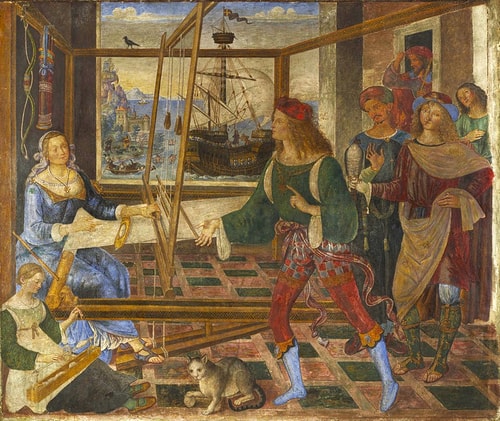 Penelope with the Suitors Pintoricchio (CC BY-NC-ND) ](https://www.worldhistory.org/image/21906/penelope-with-the-suitors/ "Penelope with the Suitors")### Telemachus Returns with a Disguised Odysseus
Telemachus returns to the royal palace of Ithaca and is reunited with Penelope, who asks him if any discoveries have been made about Odysseus. An emotional Telemachus tells her that he had just escaped from death, and instructs Penelope to bathe, pray to the gods, and promise them a generous sacrifice if Zeus avenges them. He informs her that he needs to go and collect a guest who had travelled with him back to Ithaca. Penelope is unaware that this ‘guest' is actually her much-loved husband Odysseus, who has disguised himself as a beggar.
Penelope dines with her son and once again begs for news about Odysseus. Telemachus recounts his travels, finally telling Penelope what she has waited years for: Odysseus had been sighted on an island where he is held prisoner by the nymph Calypso and has no way to return home. The seer Theoclymenus, overhearing the conversation, swears that Odysseus is on Ithaca soil at that present moment and is currently plotting the ruin of Penelope's suitors. Penelope promises him affection and gifts if his vision comes to pass.
[ 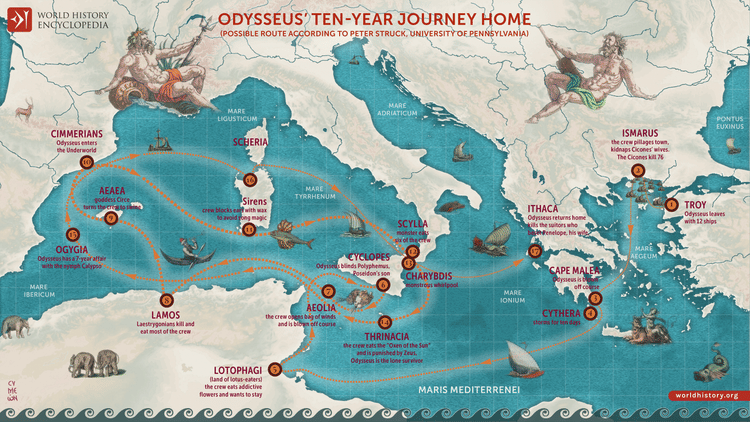 Map of Odysseus’ 10-year Journey Home Simeon Netchev (CC BY-NC-ND) ](https://www.worldhistory.org/image/15906/map-of-odysseus-10-year-journey-home/ "Map of Odysseus’ 10-year Journey Home")Odysseus, disguised as a beggar, enters the royal palace to beg for food. While some of the suitors take pity on him, Antinous has no such compassion in his heart, berating him and striking him in the back with a footstool. Penelope finds out about Antinous' behaviour and prays that [Apollo](https://www.worldhistory.org/apollo/) would strike him just as he had struck the beggar. Penelope tells her housekeeper, Eurynome, that all the suitors are hateful, but Antinous is the worst with his black heart. She instructs the swineherd Eumaeus to bring the beggar to her, wanting to give him a warm welcome and see if he has any news about her husband. If she senses that his answers are truthful, she would give him clean clothes to wear. The disguised Odysseus agrees to meet with Penelope, but only at sunset, so they can talk in private.
### The Suitors Give Penelope Gifts
Penelope plans to meet with her suitors and her son before meeting the beggar. Athena made Penelope fall asleep and lavished upon her immortal gifts; she made her taller and fuller in form, and cleansed her face. Penelope awoke feeling refreshed and vowed to stop wasting her life away. When Penelope appears in front of her suitors, their jaws go slack, and their minds go crazy with lust. Penelope berates Telemachus for allowing the beggar to be treated so badly, and Telemachus says he, too, feels bad and is driven mad by the suitors and their evil plots.
The suitor Eurymachus approaches Penelope and praises her beauty, stating that she surpasses all [women](https://www.worldhistory.org/disambiguation/women/). Penelope replies that the gods had destroyed her beauty the day that Odysseus sailed to [Troy](https://www.worldhistory.org/troy/). She criticises her suitors, saying that past suitors brought gifts for the woman they were courting and their own food and supplies, but her suitors took Ithaca's food and used up its supplies. Odysseus overhears this and glows with pride at how Penelope puts her suitors in their place. Antinous encourages Penelope to accept their gifts and says that they will not return home until she has wed one of them.
One by one, the suitors bring in expensive and lavish gifts for Penelope: a resplendent robe, an [amber](https://www.worldhistory.org/Amber/) necklace, earrings, and a choker amongst them. Penelope withdraws with her maids, who carry the abundance of gifts in their arms.
### Penelope Meets with the Beggar
Penelope takes a seat in her favourite chair by the fire. Hearing one of her handmaidens attack the disguised Odysseus, she threatens the maid and instructs the beggar to sit on a chair. She asks him where he is from, tells him she yearns for her husband, and pays her suitors no heed. She confides in him about her trickery with her weaving and how her suitors caught on after 3 years. The beggar tells Penelope how he met Odysseus on his way to Troy, telling the truth of his journey, even while lying about who he is. Penelope weeps as she hears this and asks the beggar more questions about her husband. He reassures Penelope that Odysseus is alive and that he will return to Ithaca. As much as Penelope wants to believe him, she knows in her heart that he is never coming back.
[ 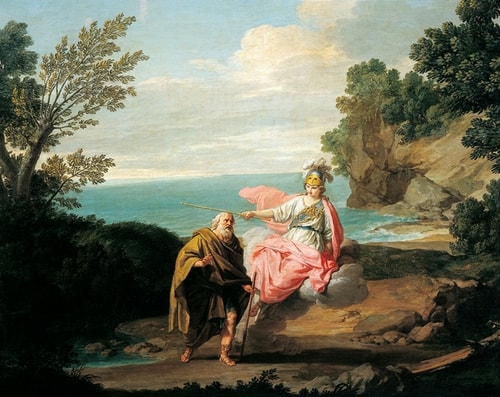 Odysseus Transformed by Athena into Beggar Giuseppe Bottani (Public Domain) ](https://www.worldhistory.org/image/21907/odysseus-transformed-by-athena-into-beggar/ "Odysseus Transformed by Athena into Beggar")The next morning, Penelope and the disguised Odysseus meet again, and Penelope asks him to make sense of a dream she had. Once he hears what her dream included, the beggar knowingly replies that it was a sign that Odysseus was going to rescue Penelope from her suitors.
### Penelope Tests Her Suitors
Penelope sets a test for her suitors, inspired by Athena, to see which one of the men could string Odysseus' bow and shoot an arrow through twelve axes. She goes to fetch the treasured and mighty bow from its hidden vault, letting herself cry before it. Appearing before her suitors, she explains the test to them, promising to wed the man who strikes the twelve axes.
One by one, the suitors attempt the challenge, but each one fails. Odysseus, disguised as a beggar, decides to take a turn, much to the contempt of the other men. Penelope promises that if he succeeds at the test, she will dress him in fine clothes, give him a sword, and send him on his way. Telemachus, aware of the bloodshed that was about to occur, sends Penelope to her chambers before Odysseus and he murders the suitors.
[ 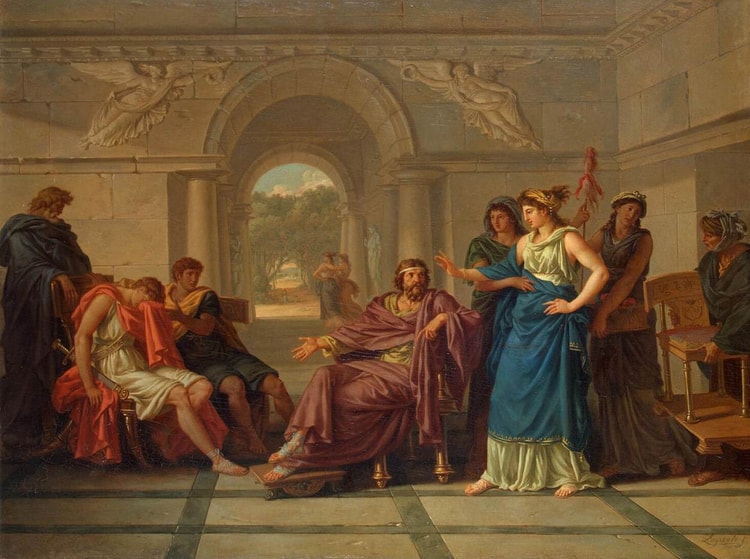 Helen Recognising Telemachus, Son of Odysseus Jean-Jacques Lagrenée (Public Domain) ](https://www.worldhistory.org/image/21908/helen-recognising-telemachus-son-of-odysseus/ "Helen Recognising Telemachus, Son of Odysseus")### Penelope Reunites with Odysseus
Penelope is awakened by her old nurse, who tells her that Odysseus is finally home and he has killed her suitors. Naturally, Penelope fears for the sanity of the old nurse, despite her insistence that she is telling the truth. Penelope asks many questions, wanting to believe but not quite ready to. She decides to go downstairs to check for herself. Telemachus asks her why she does not engage with his father, and Penelope replies that she is powerless and cannot look him in the eyes, but if it is truly Odysseus, she would know, as they have secret signs that only the two of them know.
Odysseus bathes, and Athena lavishes splendour over him, so he emerges from his bath looking like a [god](https://www.worldhistory.org/God/). Odysseus accuses Penelope of being coldhearted, and Penelope replies that she will not be fooled just because he looks different after his bath and is similar to what her husband looked like when he sailed off for Troy all those years ago.
She instructs her maid, Eurycleia, to move her and Odysseus' bed out of their bridal chamber. Odysseus is angered by this command and asks how anyone can move the bed he built himself, since he had carved it into an olive tree. Penelope finally realises that this man is her husband and runs to embrace him, both of them in tears. Odysseus tells her that there is one more trial that he will have to face: a journey in honour of the sea god [Poseidon](https://www.worldhistory.org/poseidon/). Penelope replies that, hopefully, it means she and Odysseus will live happy lives after this. They retreat to their bed, where Odysseus tells her all about his adventures. Penelope does not close her eyes until she has heard all he has to say.
[ 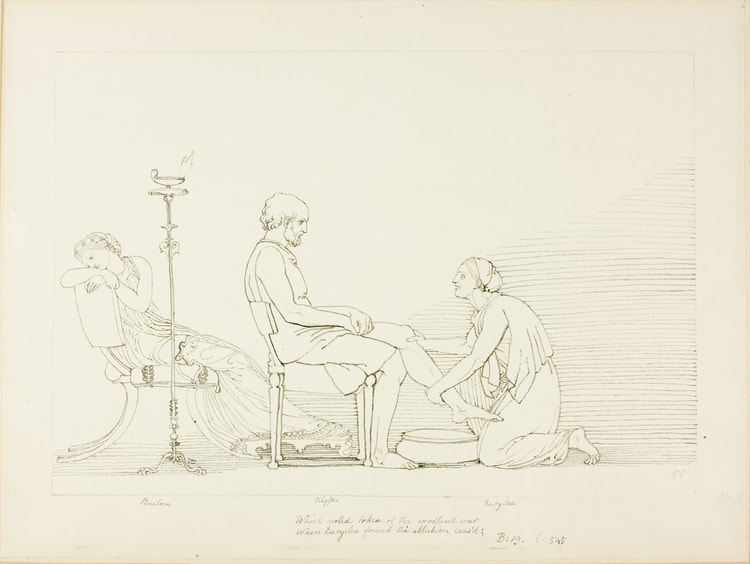 Ulysses, Penelope and Euryclea John Flaxman (Public Domain) ](https://www.worldhistory.org/image/21909/ulysses-penelope-and-euryclea/ "Ulysses, Penelope and Euryclea")### Different Views of Penelope
Some sources, such as the lyric poet [Pindar](https://www.worldhistory.org/Pindar/) (circa 518 BCE) and the [Greek](https://www.worldhistory.org/disambiguation/greek/) historian Hecateus of Miletus (circa 550 to circa 476 BCE), mention Penelope as being the mother of [Pan](https://www.worldhistory.org/Pan/), either with [Hermes](https://www.worldhistory.org/Hermes/), Apollo, or Mercury, while the historian Duris of [Samos](https://www.worldhistory.org/samos/) (circa 350 BCE) wrote that Pan's birth was the result of Penelope sleeping with all her suitors. This challenged the portrayal of the loyal and chaste wife found in Homer's *Odyssey and was also repeated by the travel writer [Pausanias](https://www.worldhistory.org/disambiguation/Pausanias/) (circa 110 to circa 180 CE), who claimed that the Mantineans in the [Peloponnese](https://www.worldhistory.org/Peloponnese/) told a very different story from what is portrayed in *The Odyssey;* that Odysseus returned home to find Penelope being unfaithful and threw her out of Ithaca. However, many authors push back against this narrative by presenting Penelope as a victim of seduction, either by her suitors or by Hermes, rather than as an adultress.
Today, it is widely believed that the Penelope who was named Pan's mother was actually a nymph, who, because of her name, was mistakenly identified throughout history as the more famous Penelope.
### Penelope's Legacy
Throughout history, Penelope has been admired and respected for her loyalty to Odysseus. Over time, she became more than just Odysseus's wife and transformed into a heroine in her own right. The [Etruscans](https://www.worldhistory.org/Etruscan_Civilization/) featured her in their art. The [Roman](https://www.worldhistory.org/disambiguation/Roman/) poet [Ovid](https://www.worldhistory.org/ovid/) (circa 43 BCE to 17 CE) viewed her as a symbol of love and fidelity, and the women of ancient [Rome](https://www.worldhistory.org/Rome/) aspired to have her wisdom and faithfulness. She was even talked about in ancient [Egypt](https://www.worldhistory.org/egypt/).
[  Ulysses and Penelope, Hit Comics 43 Pete Riss (Public Domain) ](https://www.worldhistory.org/image/21910/ulysses-and-penelope-hit-comics-43/ "Ulysses and Penelope, Hit Comics 43")The fascination with Penelope continues in the modern day, as she is featured in short stories, novels, and poems, including Margaret Atwood's 2005 book *The Penelopiad*, in which Penelope reminisces about her life from [Hades](https://www.worldhistory.org/Hades/) in the 21st century. Modern authors and scholars tend to write Penelope as a powerful woman in her own right and celebrate her key role in *The Odyssey.*
Homer's epic poems continue to inspire and be celebrated today, with director Christopher Nolan's much-anticipated movie *The Odyssey* set for release in July 2026, starring an A-list cast. Penelope will be portrayed by the American actress Anne Hathaway.
#### Editorial Review
This human-authored definition has been reviewed by our editorial team before publication to ensure accuracy, reliability and adherence to academic standards in accordance with our [editorial policy](https://www.worldhistory.org/static/editorial-policy/).
## Bibliography
- [Apollodorus & Hard, Robin. *The Library of Greek Mythology.* Oxford University Press, 2008.](https://www.worldhistory.org/books/0199536325/)
- [Dell’Abate-Çelebi, Barbara. *Penelope's Daughters.* Zea Books, 2016.](https://www.worldhistory.org/books/1609620836/)
- [Graves, Robert. *The Greek Myths\[May 15, 2018\] Graves, Robert.* Viking, 2018.](https://www.worldhistory.org/books/0241982359/)
- [Homer & Robert Fagles & Bernard Knox. *The Odyssey.* Penguin Classics, 1997.](https://www.worldhistory.org/books/0140268863/)
- [Katz, Marylin A. *Penelope's Renown.* Princeton University Press, 2016.](https://www.worldhistory.org/books/069163596X/)
- [Woodard, Roger D. *The Cambridge Companion to Greek Mythology.* Cambridge University Press, 2007.](https://www.worldhistory.org/books/0521845203/)
## About the Author
Liana is the Social Media Editor for Ancient History Encyclopedia. She holds a Bachelor of Arts Degree with a major in ancient Greece, Rome & Late Antiquity. She is particularly passionate about Rome and Greece, and anything to do with mythology or wo
- [Linkedin Profile](https://www.linkedin.com/in/lian)
## Timeline
- **c. 800 BCE - c. 700 BCE**: [Homer](https://www.worldhistory.org/homer/) of [Greece](https://www.worldhistory.org/greece/) writes his *[Iliad](https://www.worldhistory.org/iliad/)* and *[Odyssey](https://www.worldhistory.org/Odyssey/)*.
## Cite This Work
### APA
Miate, L. (2026, July 02). Penelope: The Loyal Wife of Odysseus. *World History Encyclopedia*.
### Chicago
Miate, Liana. "Penelope: The Loyal Wife of Odysseus." *World History Encyclopedia*, July 02, 2026. .
### MLA
Miate, Liana. "Penelope: The Loyal Wife of Odysseus." *World History Encyclopedia*, 02 Jul 2026, .
## License & Copyright
Submitted by [Liana Miate](https://www.worldhistory.org/user/lianamiate/ "User Page: Liana Miate"), published on 02 July 2026. The copyright holder has published this content under the following license: [Creative Commons Attribution-NonCommercial-ShareAlike](https://creativecommons.org/licenses/by-nc-sa/4.0/deed.en). This license lets others remix, tweak, and build upon this content non-commercially, as long as they credit the author and license their new creations under the identical terms. When republishing on the web a hyperlink back to the original content source URL must be included. Please note that content linked from this page may have different licensing terms.