---
title: Pasiphaë
author: Liana Miate
source: https://www.worldhistory.org/Pasiphae/
format: machine-readable-alternate
license: Creative Commons Attribution-NonCommercial-ShareAlike (https://creativecommons.org/licenses/by-nc-sa/4.0/)
updated: 2023-07-13
---
# Pasiphaë
_Authored by [Liana Miate](https://www.worldhistory.org/user/lianamiate/)_
Pasiphaë ("all-shining") is the wife of King Minos of [Crete](https://www.worldhistory.org/crete/) and the mother of the fearsome [Minotaur](https://www.worldhistory.org/Minotaur/) (half-bull, half-man creature) in [Greek mythology](https://www.worldhistory.org/Greek_Mythology/). She is the [daughter of the sun](https://www.worldhistory.org/article/2562/the-daughter-of-the-sun/) [god](https://www.worldhistory.org/God/) [Helios](https://www.worldhistory.org/Helios/) and Perse, an Oceanid. Like her sister [Circe](https://www.worldhistory.org/Circe/) and her niece [Medea](https://www.worldhistory.org/Medea/), Pasiphaë also possessed the gift of sorcery.
The best-known myth involving Pasiphaë is her love affair with the beautiful [white bull](https://www.worldhistory.org/White_Bull/), which subsequently led to her giving birth to the monstrous creature famously known as the Minotaur. This story is told by many ancient authors, including [Ovid](https://www.worldhistory.org/ovid/) (43 BCE to 17 CE), Pseudo-Apollodorus, and [Seneca](https://www.worldhistory.org/Seneca/) (4 BCE to 65 CE). It is also featured in [Greek tragedy](https://www.worldhistory.org/Greek_Tragedy/) playwright [Euripides](https://www.worldhistory.org/Euripides/)' (c. 484-407 BCE) lost play *The Cretans,* of which only a small fragment survives, including a speech where Pasiphaë defends her actions.
### Family
Pasiphaë was the daughter of the sun god Helios and the Oceanid Perse. She was the sister of the sorceress Circe, Aeëtes, the king of Colchis and owner of the [Golden Fleece](https://www.worldhistory.org/Golden_Fleece/), and Perses of Colchis. She was also the aunt of the enchantress Medea.
### King Minos, Pasiphaë & the Minotaur
Pasiphaë was married to Minos, who sought to become the king of Crete after his adoptive father's [death](https://www.worldhistory.org/disambiguation/Death/). To prove that he had the divine right to rule, he declared that the gods would answer whatever he asked of them. He built an altar for his uncle [Poseidon](https://www.worldhistory.org/poseidon/), prepared for a sacrifice, and prayed for a bull to appear from the sea, which he promised he would then sacrifice. A beautiful snow-white bull emerged from the sea, and Minos was so struck by its beauty that he could not bear to kill it. Instead, he sent it off to be with his other bulls and sacrificed another one in its place.
Minos' broken promise angered Poseidon. Still, instead of punishing Minos, he punished his wife, Pasiphaë, by making her fall madly in love with the bull. Driven mad by her lust for the animal, she sought the help of [Daedalus](https://www.worldhistory.org/Daedalus/), a gifted inventor and architect who was living in the [palace](https://www.worldhistory.org/disambiguation/palace/). He built a hollow wooden cow and covered it with cowhide, taking it to the paddock where the bull was kept. Pasiphaë hid inside the fake cow, and before too long, the bull approached and copulated with it.
> And by this trick, she enjoyed her bull.
> She at least had a lover to cheat into taking her.
> (Ovid, *Metamorphoses*, 9.740-741)
[ 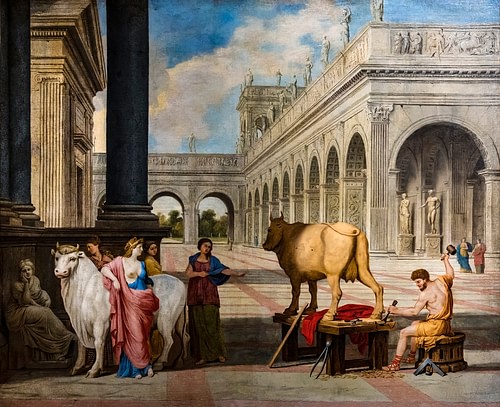 Daedalus and Pasiphaë Jean Lemaire (Public Domain) ](https://www.worldhistory.org/image/17594/daedalus-and-pasiphae/ "Daedalus and Pasiphaë")Before too long, Pasiphaë found herself pregnant from her encounter with the bull and, to her horror, gave birth to a monstrous creature with the head and tail of a bull and a human body. The monster was named Asterius but is more famously known as the Minotaur ("Bull of Minos"). To stop the Minotaur from causing havoc in the court, Minos asked Daedalus to build something that would trap the beast. Daedalus created the [Labyrinth](https://www.worldhistory.org/Labyrinth/) – an underground maze so cleverly designed that anybody who found themselves there would never find their way out again.
In one other version of the myth, Pasiphaë had neglected to honour [Aphrodite](https://www.worldhistory.org/Aphrodite/) with sacrifices, and the goddess punished her by making her fall in love with the bull. Yet another says that Minos offended [Zeus](https://www.worldhistory.org/zeus/), not Poseidon. In some traditions, Minos consulted an oracle to find out how he could avoid any scandal from his wife's affair. The Oracle suggested that Daedalus built him a hideaway at [Knossos](https://www.worldhistory.org/knossos/), where Minos could live out the rest of his life in peace and where Pasiphaë and the Minotaur were both concealed from public view. This hideaway was the Labyrinth.
According to the [Greek](https://www.worldhistory.org/disambiguation/greek/) historian [Diodorus Siculus](https://www.worldhistory.org/Diodorus_Siculus/) (c. 1st century BCE), Daedalus feared the wrath of Minos for his part in helping Pasiphaë mate with the bull. Pasiphaë helped him and his son Icarus escape Crete on a ship. Diodorus Siculus recounts how other ancient authors stated that Pasiphaë helped Daedalus hide on Crete while Minos searched all the ships in the harbour. Yet another tradition states how Minos was so angry that he locked both Daedalus and Icarus up in the Labyrinth that Daedalus had himself designed and that Pasiphaë had freed them both.
[  Mosaic of Daedalus, Icarus, and Pasiphaë from Zeugma Carole Raddato (CC BY-NC-SA) ](https://www.worldhistory.org/image/16864/mosaic-of-daedalus-icarus-and-pasiphae-from-zeugma/ "Mosaic of Daedalus, Icarus, and Pasiphaë from Zeugma")### King Minos' Curse
King Minos had many affairs while married to Pasiphaë, and it was not too long before Pasiphaë became so tired of her husband's philandering ways that she slipped him a potion. From then on, he would ejaculate scorpions and snakes whenever he engaged in sexual intercourse with other [women](https://www.worldhistory.org/disambiguation/women/).
> Now if any woman had intercourse with Minos,
> it was impossible for her to escape with life;
> for because Minos cohabited with many women,
> Pasiphae bewitched him, and whenever he took another woman to his bed,
> he discharged wild beasts at her joints, and so the women perished.
> (Pseudo-Apollodorus, *Bibliotheca*, 3.314-315)
Procris, the daughter of King Erechtheus of [Athens](https://www.worldhistory.org/Athens/), was seduced by Minos when she visited Crete. She made Minos take an elixir invented by Circe so that he would not fill her with scorpions and snakes when they lay together. However, Procris feared Pasiphaë and her magic and quickly returned to Athens.
As the daughter of Helios, Pasiphaë is assumed to be immortal, which is why she was not affected by Minos' curse. However, this differs depending on the source. In [Virgil](https://www.worldhistory.org/virgil/)'s (70-19 BCE) *[Aeneid](https://www.worldhistory.org/The_Aeneid/)*, for example, [Aeneas](https://www.worldhistory.org/Aeneas/) sees Pasiphaë when he visits the Underworld, suggesting that she is mortal. She is in a place known as the Mourning Fields, which is where the victims of unhappy relationships come to spend their afterlife.
> Here he saw Evadne and Pasiphae with Laodamia walking by their side.
> (Virgil, *Aeneid*, 6.447-448)
Like her other female relatives, Circe and Medea, Pasiphaë's powers disrupted the natural order of the world. This is perhaps why Pasiphaë, Circe, and Medea were never able to have successful relationships, especially with mortal men, and were always doomed to end up alone.
### Pasiphaë's Children
Minos and Pasiphaë had many children together, including Androgeus, Catreus, Deucalion, Glaucus, Acacallis, Xenodice, [Ariadne](https://www.worldhistory.org/Ariadne/), and [Phaedra](https://www.worldhistory.org/Phaedra/). Most of them led sad lives and died young. The most famous of Minos and Pasiphaë's children was their daughter Ariadne, who played a key role in the myth of the Greek hero [Theseus](https://www.worldhistory.org/Theseus/) and the Minotaur. Phaedra, another one of their daughters, killed herself after she had married Theseus or after [Hippolytus](https://www.worldhistory.org/Hippolytus/), Aphrodite's son, rejected her.
Minos and Pasiphaë's son Androgeus was killed in Athens either by ambush or by facing the Cretan Bull (the bull that his mother Pasiphaë had fallen in love with). To punish Athens for his death, Minos demanded that King Aegeus of Athens send seven men and women every nine years to be sacrificed to the Minotaur.
Pasiphaë was also believed to have been the mother of Cydon, a hero from the Cydonian colony on Crete, and of [Ammon](https://www.worldhistory.org/disambiguation/Ammon/), the hero and Libyan deity.
[  Minotaur Mark Cartwright (CC BY-NC-SA) ](https://www.worldhistory.org/image/3255/minotaur/ "Minotaur")### Worship
According to [Pausanias](https://www.worldhistory.org/disambiguation/Pausanias/) (c. 115 to c. 180 CE), in his *Description of [Greece](https://www.worldhistory.org/greece/)*, on the road from Oitylon to Thalamai (Thalamae) in Laconia, there was a sanctuary and oracle of [Ino](https://www.worldhistory.org/Ino/) (a queen turned goddess). In the sanctuary are [bronze](https://www.worldhistory.org/disambiguation/bronze/) sculptures of Pasiphaë and her father, Helios. Pausanias mentioned that Pasiphaë is worshipped as a goddess of the moon and not a local goddess of Thalamae.
In his *De Divinatione*, [Cicero](https://www.worldhistory.org/Cicero/) (106-43 BCE) mentions that the kings of [Sparta](https://www.worldhistory.org/sparta/) slept in a shrine dedicated to Pasiphaë so she could send them prophetic dreams. This shrine was located in a field near the [city](https://www.worldhistory.org/city/).
### Women & Animals in Greek [Mythology](https://www.worldhistory.org/mythology/)
A recurring theme in Greek mythology is the sexual relationship between mortal or immortal women and animals. In most cases, the animals were actually deities in disguise who, for some reason or another, tricked the woman they were lying with or seduced them in their animal form. This included Zeus appearing to [Leda](https://www.worldhistory.org/Leda/) as a swan and [Europa](https://www.worldhistory.org/Europa/) as a bull, Poseidon appearing as a horse to [Demeter](https://www.worldhistory.org/demeter/), a bird to [Medusa](https://www.worldhistory.org/Medusa/), and a dolphin to Melantho.
While the myth of Pasiphaë and the white bull followed an already present trend in Greek mythology, it was also unique, as it was a rare example of a woman having sexual intercourse with an animal who was not a god in disguise. However, she was cursed by a god to fall in love with the animal.
Over the years, scholars have tried to explain the reason for this common theme. They speculate that the traditions and morals held by the ancient Greeks could be an explanation for why women were seduced by animals in Greek mythology. [Women in ancient Greece](https://www.worldhistory.org/article/927/women-in-ancient-greece/) were expected to be chaste until they got married. The animal disguises that the gods used were viewed as a way to symbolically get rid of any resistance that women had to preserve their chastity.
[  Daedalus & Pasiphaë Unknown Artist (Public Domain) ](https://www.worldhistory.org/image/5056/daedalus--pasiphae/ "Daedalus & Pasiphaë")### Legacy & Popular [Culture](https://www.worldhistory.org/disambiguation/culture/)
Pasiphaë is a character in several book and TV adaptions, including the fantasy TV series *[Atlantis](https://www.worldhistory.org/atlantis/)* (2013-2015), which aired on BBC One. She also features in [Dante Alighieri](https://www.worldhistory.org/Dante_Alighieri/)'s (1265-1321) *Inferno*, Rick Riordan's fantasy book *The House of [Hades](https://www.worldhistory.org/Hades/)* (2013), Madeline Miller's *Circe* (2018), and Jennifer Saint's *Ariadne* (2021).
Pasiphaë is the name of one of [Jupiter](https://www.worldhistory.org/jupiter/)'s moons. It is the largest moon in the Pasiphaë group, which features multiple Jovian satellites. It was discovered in 1908 by the British astronomer Philibert Jacques (1880-1961). The moon was believed to have originally been an asteroid, which then broke into pieces.
#### Editorial Review
This human-authored definition has been reviewed by our editorial team before publication to ensure accuracy, reliability and adherence to academic standards in accordance with our [editorial policy](https://www.worldhistory.org/static/editorial-policy/).
## Bibliography
- [Apollodorus & Hard, Robin. *The Library of Greek Mythology.* Oxford University Press, 2008.](https://www.worldhistory.org/books/0199536325/)
- [APOLLODORUS, THE LIBRARY BOOK 3 - Theoi Classical Texts Library](https://www.theoi.com/Text/Apollodorus3.html#1 "APOLLODORUS, THE LIBRARY BOOK 3 - Theoi Classical Texts Library"), accessed 2 Jul 2023.
- [Graves, Robert. *The Greek Myths\[May 15, 2018\] Graves, Robert.* Viking, 2018.](https://www.worldhistory.org/books/0241982359/)
- [In Depth | Pasiphae – NASA Solar System Exploration](https://solarsystem.nasa.gov/moons/jupiter-moons/pasiphae/in-depth/ "In Depth | Pasiphae – NASA Solar System Exploration"), accessed 2 Jul 2023.
- [LacusCurtius • Cicero — De Divinatione: Book I](http://penelope.uchicago.edu/Thayer/e/roman/texts/cicero/de_divinatione/1*.html "LacusCurtius • Cicero — De Divinatione: Book I"), accessed 2 Jul 2023.
- [LacusCurtius • Diodorus Siculus — Book IV Chapters 59‑85](https://penelope.uchicago.edu/Thayer/E/Roman/Texts/Diodorus_Siculus/4D*.html#p63 "LacusCurtius • Diodorus Siculus — Book IV Chapters 59‑85"), accessed 2 Jul 2023.
- [Marshall Cavendish Corporation. *Heroes and Heroines of Greece and Rome.* Cavendish Square, 2011.](https://www.worldhistory.org/books/076147952X/)
- [Ovid & Raeburn, David & Feeney, Denis. *Metamorphoses.* Penguin Classics, 2004.](https://www.worldhistory.org/books/014044789X/)
- [Pausanias & Newberry, John & Levi, Peter & Levi, Peter. *Guide to Greece, Vol. 2.* Penguin Classics, 1984.](https://www.worldhistory.org/books/014044226X/)
- [Pausanias & Peter Levi. *Guide to Greece, Vol. 1.* Penguin Classics, 1984.](https://www.worldhistory.org/books/0140442251/)
- [Virgil & West, David & West, David & West, David. *The Aeneid.* Penguin Classics, 2003.](https://www.worldhistory.org/books/0140449329/)
## About the Author
Liana is the Social Media Editor for Ancient History Encyclopedia. She holds a Bachelor of Arts Degree with a major in ancient Greece, Rome & Late Antiquity. She is particularly passionate about Rome and Greece, and anything to do with mythology or wo
- [Linkedin Profile](https://www.linkedin.com/in/lian)
## Questions & Answers
### Why was Pasiphaë punished?
Pasiphaë was punished on behalf of her husband King Minos of Crete because he failed to sacrifice a beautiful white bull and keep his promise to Poseidon.
### Who did Pasiphaë fall in love with?
Pasiphaë fell in love with the beautiful white bull.
### What did Daedalus do to Pasiphaë?
Daedalus built a fake cow so that Pasiphaë could crawl into it and satisfy her desire for the beautiful white bull.
### Who is Pasiphaë to Medea?
Pasiphaë is Medea's aunt.
## Cite This Work
### APA
Miate, L. (2023, July 11). Pasiphaë. *World History Encyclopedia*.
### Chicago
Miate, Liana. "Pasiphaë." *World History Encyclopedia*, July 11, 2023. .
### MLA
Miate, Liana. "Pasiphaë." *World History Encyclopedia*, 11 Jul 2023, .
## License & Copyright
Submitted by [Liana Miate](https://www.worldhistory.org/user/lianamiate/ "User Page: Liana Miate"), published on 11 July 2023. The copyright holder has published this content under the following license: [Creative Commons Attribution-NonCommercial-ShareAlike](https://creativecommons.org/licenses/by-nc-sa/4.0/deed.en). This license lets others remix, tweak, and build upon this content non-commercially, as long as they credit the author and license their new creations under the identical terms. When republishing on the web a hyperlink back to the original content source URL must be included. Please note that content linked from this page may have different licensing terms.