---
title: Pasargadae
author: Livius
source: https://www.worldhistory.org/Pasargadae/
format: machine-readable-alternate
license: Creative Commons Attribution-NonCommercial-ShareAlike (https://creativecommons.org/licenses/by-nc-sa/4.0/)
updated: 1970-01-01
---
# Pasargadae
_Authored by Livius_
Pasargadae was one of the oldest residences of the [Achaemenid](https://www.worldhistory.org/disambiguation/Achaemenid/) kings, founded by [Cyrus the Great](https://www.worldhistory.org/Cyrus_the_Great/) (r.559-530). It resembled a park of 2x3 km in which several monumental buildings were to be seen. According to the [Roman](https://www.worldhistory.org/disambiguation/Roman/) geographer Strabo of Amasia, the [palace](https://www.worldhistory.org/disambiguation/palace/) of Pasargadae was built on the site where king [Cyrus](https://www.worldhistory.org/disambiguation/Cyrus/) (r.559-530) defeated the leader of the [Medes](https://www.worldhistory.org/Medes/), Astyages, in 550 BCE (Strabo, Geography, 15.3.8). The [battle](https://www.worldhistory.org/disambiguation/battle/) is a fact, also mentioned in the Nabonidus Chronicle, and there is no evidence to contradict that it took place on the Murghab plain, but the context contains errors, so we should not place too much confidence on it. However, that Cyrus was indeed the builder of this town, can be corroborated from the fact that the building inscriptions in the palace, known as CMa, mention Cyrus, the great king, an Achaemenid. If he did not build the palace on this site because of a military victory, there may have been other reasons: the place is beautifully situated in the center of a fertile plain, on all sides surrounded by mountains. It is essentially a valley that was filled by sediments from the river Pulvar. Pasargadae is listed by UNESCO as a World Heritage Site.
If we ignore the prehistoric site at Tall-e Nokhodi and similar sites, the oldest monument of Pasargadae is the citadel, which is known as Tall-i Takht or "throne hill". Situated on one of the few hills in the valley, it overlooks the palace complex itself. The citadel may or may not predate the reign of Cyrus, and reminds one of the fortified terrace complex at Masjid-e Solaiman, although masonry is more refined. Cyrus' palace, situated to the southwest of the Tall-i Takht, consists of two units: the residential Palace P (built from cold white natural stone) and a columned audience hall, Palace S. The audience hall was approached from the south-east; the visitor first had to pass a gate and then had to cross a bridge over a branch of the river Pulvar.
[ 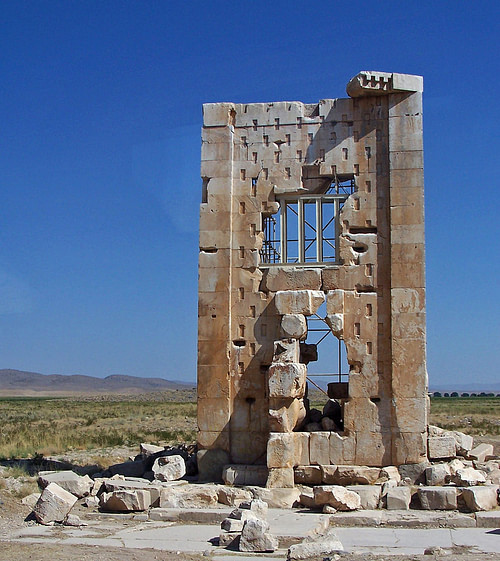 Prison of Solomon Sebastià Giralt (CC BY-SA) ](https://www.worldhistory.org/image/263/prison-of-solomon/ "Prison of Solomon")It is best to imagine Pasargadae as a group of garden pavilions in a park: essentially a camp of nomads, but made out of natural stone. Stylistically, the Audience Hall, the Residential Palace, the garden pavilions A and B, and the Gate belonged to the architectural tradition of the Iranian nomads, who lived in large tents. However, Cyrus used elements from other cultures as well: sculptures from the Assyrian palaces were used as models, work may have been done by stonemasons from [Greek](https://www.worldhistory.org/disambiguation/greek/) [Ionia](https://www.worldhistory.org/ionia/), and a hybrid demon guarded the gate. Perhaps the population of the [city](https://www.worldhistory.org/city/) had a similar, mixed character. The small [tomb](https://www.worldhistory.org/tomb/) of king Cyrus is situated a little to the southwest. It was venerated by later rulers, a.o. the Macedonian king [Alexander the Great](https://www.worldhistory.org/Alexander_the_Great/), who ordered restorations in January 324 BCE. King [Darius I](https://www.worldhistory.org/Darius_I/) the Great (522-486) built a new capital, [Persepolis](https://www.worldhistory.org/persepolis/), forty-three kilometers downstream along the river Pulvar. However, Pasargadae remained an important place, probably as the religious capital of the [Achaemenid empire](https://www.worldhistory.org/Achaemenid_Empire/) where the inauguration of the kings took place. You can read a description over here. Perhaps, the sanctuary in the northwest played a role in the ceremonies.
The site remained occupied after the end of the Achaemenid [Empire](https://www.worldhistory.org/empire/). There's some evidence for a great fire on the citadel in c.280, and the presence of [coin](https://www.worldhistory.org/coinage/) hoards in the stratum of destruction suggests that the fire was caused by enemies. There is no evidence for [war](https://www.worldhistory.org/disambiguation/War/) in [Persis](https://www.worldhistory.org/Persis/) at that moment, but there is a very tantalizing reference to Bactrian troops (?) at the End of Seleucus Chronicle (rev.8). Reportedly, the remains of the tomb of king Cambyses were identified in 2006.
#### Editorial Review
This human-authored definition has been reviewed by our editorial team before publication to ensure accuracy, reliability and adherence to academic standards in accordance with our [editorial policy](https://www.worldhistory.org/static/editorial-policy/).
## Timeline
- **550 BCE**: [Cyrus the Great](https://www.worldhistory.org/Cyrus_the_Great/) defeats Astyages of the [Medes](https://www.worldhistory.org/Medes/) and decides to found [Pasargadae](https://www.worldhistory.org/Pasargadae/) at the site of the [battle](https://www.worldhistory.org/disambiguation/battle/).
- **c. 546 BCE**: [Cyrus the Great](https://www.worldhistory.org/Cyrus_the_Great/) begins construction of [Pasargadae](https://www.worldhistory.org/Pasargadae/).
- **c. 515 BCE**: [Darius I](https://www.worldhistory.org/Darius_I/) moves the capital of [Persia](https://www.worldhistory.org/Persia/) from [Pasargadae](https://www.worldhistory.org/Pasargadae/) to [Persepolis](https://www.worldhistory.org/persepolis/).
- **Jan 324 BCE**: [Alexander the Great](https://www.worldhistory.org/Alexander_the_Great/) orders restoration work in [Pasargadae](https://www.worldhistory.org/Pasargadae/).
## External Links
- [World Heritage List](http://whc.unesco.org/pg.cfm?cid=31)
## Cite This Work
### APA
Livius. (2011, April 28). Pasargadae. *World History Encyclopedia*.
### Chicago
Livius. "Pasargadae." *World History Encyclopedia*, April 28, 2011. .
### MLA
Livius. "Pasargadae." *World History Encyclopedia*, 28 Apr 2011, .
## License & Copyright
© Jona Lendering of [Livius.org](http://www.livius.org/ "Livius"). Republished with the author's permission.' sfdffdsgsgssd Original definition by **Livius**. Submitted by [Jan van der Crabben](https://www.worldhistory.org/user/jvdc/ "User Page: Jan van der Crabben"), published on 28 April 2011. The copyright holder has published this content under the following license: [Creative Commons Attribution-NonCommercial-ShareAlike](https://creativecommons.org/licenses/by-nc-sa/4.0/deed.en). This license lets others remix, tweak, and build upon this content non-commercially, as long as they credit the author and license their new creations under the identical terms. When republishing on the web a hyperlink back to the original content source URL must be included. Please note that content linked from this page may have different licensing terms.