---
title: Paestum
author: Mark Cartwright
source: https://www.worldhistory.org/Paestum/
format: machine-readable-alternate
license: Creative Commons Attribution-NonCommercial-ShareAlike (https://creativecommons.org/licenses/by-nc-sa/4.0/)
updated: 1970-01-01
---
# Paestum
_Authored by [Mark Cartwright](https://www.worldhistory.org/user/markzcartwright/)_
Paestum, also known by its original [Greek](https://www.worldhistory.org/disambiguation/greek/) name as Poseidonia, was a Greek colony founded on the west coast of [Italy](https://www.worldhistory.org/italy/), some 80 km south of modern-day Naples. Prospering as a [trade](https://www.worldhistory.org/disambiguation/trade/) centre it was conquered first by the Lucanians and then, with the new Latin name of Paestum, the [city](https://www.worldhistory.org/city/) became an important [Roman](https://www.worldhistory.org/disambiguation/Roman/) colony in the 3rd century BCE. Today it is one of the most visited archaeological sites in the world due to its three excellently preserved large Greek temples.
### Founding of the Colony
In the 7th century BCE a second wave of [Greek colonization](https://www.worldhistory.org/Greek_Colonization/) occurred in [Magna Graecia](https://www.worldhistory.org/Magna_Graecia/) and, in c. 600 BCE, colonists from Sybaris in southern Italy founded the colony or [city-state](https://www.worldhistory.org/Polis/) (*[polis](https://www.worldhistory.org/Polis/)*) of Poseidonia (meaning sacred to [Poseidon](https://www.worldhistory.org/poseidon/)) at a spot chosen for its fertile plain, land access through the Lucanian hills, and sea port. According to the ancient historian Strabo, the colonists first built fortifications on the coast before later moving inland to build their city proper. The colony prospered so that by the 6th century BCE there was an important sanctuary (Foce del Sele) and monumental temples dedicated to the Greek goddesses [Hera](https://www.worldhistory.org/Hera/) and [Athena](https://www.worldhistory.org/athena/). The city was planned out in a precise grid pattern and surrounded by walls. The town benefitted from a large [agora](https://www.worldhistory.org/agora/) and became wealthy enough to mint its own [coinage](https://www.worldhistory.org/coinage/) and expand its territorial control to the wider countryside. Eventually, Poseidonia administered the plain between the river Sele in the north and the Agropoli promontory to the south.
### The Temples
Paestum is most famous today for its three magnificent temples which are amongst the best surviving examples of ancient Greek [architecture](https://www.worldhistory.org/disambiguation/architecture/) anywhere. There are two Doric temples dedicated to Hera, which were part of the same sanctuary - [Temple](https://www.worldhistory.org/temple/) of Hera I, also known as the Basilica, and Temple of Hera II, also known as the Temple of [Neptune](https://www.worldhistory.org/Neptune/). The third temple, which was dedicated to Athena, is also known as the Temple of [Ceres](https://www.worldhistory.org/Ceres/).
The oldest temple is the Temple of Hera I which was built c. 550 BCE. Constructed using brown-tinted local limestone it was originally covered in stucco and measured 54 x 24 metres. Unusually for a Doric temple, each facade has 9 columns with 18 presented along the long sides.
The Temple of Athena was built between c. 510 and 500 BCE. Unusually, the outer columns are of the Doric order while those of the inner *pronaos* are of the Ionic order. The facades present six fluted columns while the long sides have 13 columns.
The Doric Temple of Hera II was built c. 460 BCE and is the best preserved of the three temples. Also constructed in limestone, it is a little bigger than Temple I. The facades have six fluted columns and the long sides 14. Inside, a double row of slim Doric columns divided the *cella* into three aisles and once supported a ridged roof of wood and tiles.
[ 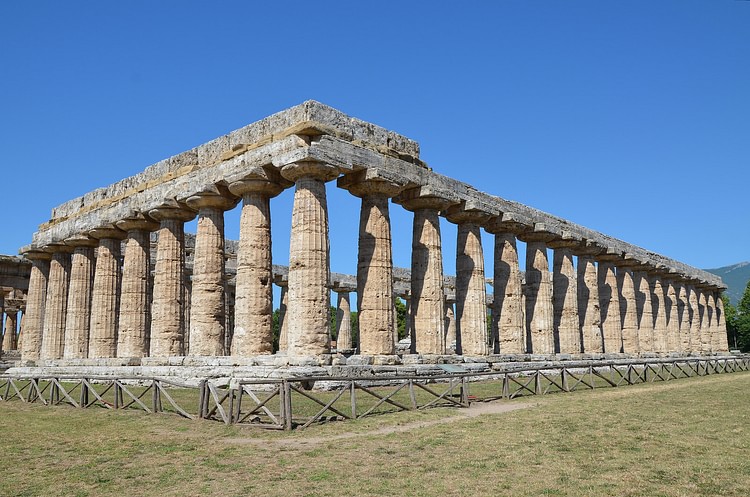 Temple of Hera I, Paestum Carole Raddato (CC BY-SA) ](https://www.worldhistory.org/image/4443/temple-of-hera-i-paestum/ "Temple of Hera I, Paestum")### Conquered by the Lucanians
In the late 5th century BCE Poseidonia's fortunes took a downturn when it was attacked c. 410 BCE by the native Samnite-Oscan people known as the Lucanians. Now under Lucanian control, along with most of the Campania region, Poseidonia, nevertheless, continued to thrive in artistic terms, notably producing large quantities of [red-figure pottery](https://www.worldhistory.org/Red-Figure_Pottery/). The surviving painted tombs of this period also attest to the skills of Poseidonia's artists. Slabs taken from these tombs can be seen today in the archaeological museum of Paestum. Among the most famous of these [fresco](https://www.worldhistory.org/disambiguation/Fresco/) [wall](https://www.worldhistory.org/wall/)-paintings are the depictions of reclining aristocrats at a [symposium](https://www.worldhistory.org/Symposium/) and, from a ceiling slab, a young diver leaping from a platform into a pool, painted c. 480 BCE.
Lucanian control of the city was maintained until the 3rd century BCE, despite a short-lived revolt led by the king of Epirus, [Alexander](https://www.worldhistory.org/disambiguation/Alexander/) I. The city became fully Oscanized over the centuries but political control of Poseidonia would once again change hands with the arrival of the Romans.
[ 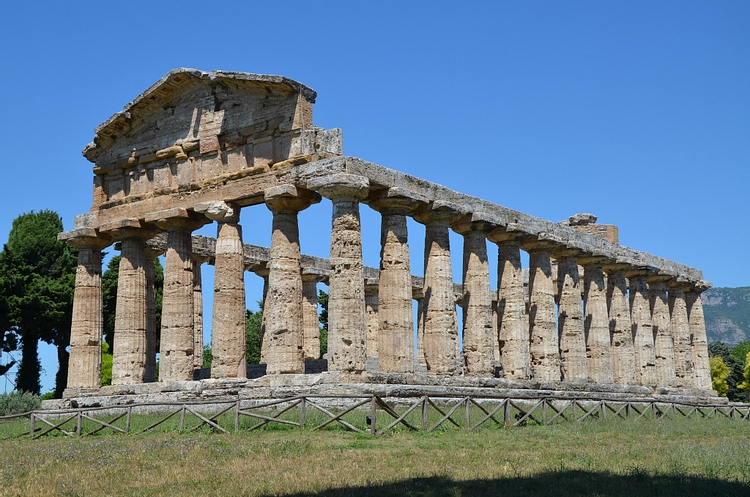 Temple of Athena, Paestum Carole Raddato (CC BY-SA) ](https://www.worldhistory.org/image/4411/temple-of-athena-paestum/ "Temple of Athena, Paestum")### Roman Paestum
In 273 BCE [Rome](https://www.worldhistory.org/Rome/), expanding ever southwards down the Italian peninsula, established a Latin colony at the site. The name was then changed to Paestum, which derived from its Lucanian name of Paistom. Given Latin rights and permitted to continue minting its own coinage (an unusual privilege), the city once more prospered even if it came under direct threat from the Carthaginians during the 3rd century BCE [Punic Wars](https://www.worldhistory.org/Punic_Wars/). According to [Livy](https://www.worldhistory.org/livy/), Paestum gave both [gold](https://www.worldhistory.org/gold/) and ships to the Roman [war](https://www.worldhistory.org/disambiguation/War/) effort and so earned special status compared to other colonies.
In the 2nd century BCE Paestum's economic fortunes declined as it slipped into relative obscurity, principally because, in c. 133 BCE, the new Roman highway, the Via Popilia, which ran from Rhegion to Capua, bypassed the city. Still, in c. 71 CE a second colony was founded and surviving inscriptions attest to the city regaining at least some of its lost glory. By the end of the 1st century CE, though, it seems Paestum's days as a major Roman city were over. Affected by the earthquakes and 79 CE eruption of Vesuvius, which destroyed [Pompeii](https://www.worldhistory.org/pompeii/), the city's sanitation system was badly damaged and some buildings show evidence of never having been repaired.
In later centuries the city shrank dramatically in size and wealth and slowly slipped into obscurity as the region's tendency to flooding and poor drainage gained the city a reputation for being an unhealthy place to spend much time in - the marshy land being a breeding ground for malaria-carrying mosquitoes.
#### Editorial Review
This human-authored definition has been reviewed by our editorial team before publication to ensure accuracy, reliability and adherence to academic standards in accordance with our [editorial policy](https://www.worldhistory.org/static/editorial-policy/).
## Bibliography
- Bagnall, R.S. *The Encylopedia of Ancient History.* Wiley-Blackwell, 2012
- [Durando, F. *Ancient Greece.* White Star, 2004.](https://www.worldhistory.org/books/8854400459/)
- [Hornblower, S. *The Oxford Classical Dictionary.* Oxford University Press, 2012.](https://www.worldhistory.org/books/0199545561/)
- [Wheeler, M. *Roman Art and Architecture.* Thames & Hudson, 1985.](https://www.worldhistory.org/books/0500200211/)
## About the Author
Mark is WHE’s Publishing Director and has an MA in Political Philosophy (University of York). He is a full-time researcher, writer, historian and editor. Special interests include art, architecture and discovering the ideas that all civilizations share.
## Timeline
- **c. 740 BCE - c. 433 BCE**: [Greek](https://www.worldhistory.org/disambiguation/greek/) [poleis](https://www.worldhistory.org/Polis/) or [city](https://www.worldhistory.org/city/)-states establish colonies in [Magna Graecia](https://www.worldhistory.org/Magna_Graecia/).
- **c. 600 BCE**: [Paestum](https://www.worldhistory.org/Paestum/) is founded by colonists from Sybaris.
- **c. 550 BCE**: The [Temple](https://www.worldhistory.org/temple/) of [Hera](https://www.worldhistory.org/Hera/) I is built at [Paestum](https://www.worldhistory.org/Paestum/).
- **c. 510 BCE**: The [Temple](https://www.worldhistory.org/temple/) of [Athena](https://www.worldhistory.org/athena/) is built at [Paestum](https://www.worldhistory.org/Paestum/).
- **c. 480 BCE**: The [tomb](https://www.worldhistory.org/tomb/) frescoes of [Paestum](https://www.worldhistory.org/Paestum/) are painted.
- **c. 460 BCE**: The [temple](https://www.worldhistory.org/temple/) of [Hera](https://www.worldhistory.org/Hera/) II is built at [Paestum](https://www.worldhistory.org/Paestum/).
- **c. 410 BCE**: [Paestum](https://www.worldhistory.org/Paestum/) is attacked and conquered by the Lucanians.
- **273 BCE**: [Rome](https://www.worldhistory.org/Rome/) establishes a colony at [Paestum](https://www.worldhistory.org/Paestum/).
- **c. 71 CE**: [Rome](https://www.worldhistory.org/Rome/) establishes a second colony at [Paestum](https://www.worldhistory.org/Paestum/).
## Cite This Work
### APA
Cartwright, M. (2016, February 02). Paestum. *World History Encyclopedia*.
### Chicago
Cartwright, Mark. "Paestum." *World History Encyclopedia*, February 02, 2016. .
### MLA
Cartwright, Mark. "Paestum." *World History Encyclopedia*, 02 Feb 2016, .
## License & Copyright
Submitted by [Mark Cartwright](https://www.worldhistory.org/user/markzcartwright/ "User Page: Mark Cartwright"), published on 02 February 2016. The copyright holder has published this content under the following license: [Creative Commons Attribution-NonCommercial-ShareAlike](https://creativecommons.org/licenses/by-nc-sa/4.0/deed.en). This license lets others remix, tweak, and build upon this content non-commercially, as long as they credit the author and license their new creations under the identical terms. When republishing on the web a hyperlink back to the original content source URL must be included. Please note that content linked from this page may have different licensing terms.