---
title: Pachacamac
author: Mark Cartwright
source: https://www.worldhistory.org/Pachacamac/
format: machine-readable-alternate
license: Creative Commons Attribution-NonCommercial-ShareAlike (https://creativecommons.org/licenses/by-nc-sa/4.0/)
updated: 1970-01-01
---
# Pachacamac
_Authored by [Mark Cartwright](https://www.worldhistory.org/user/markzcartwright/)_
Pachacamac, located on the coast of Peru and 32 km south of Lima, was an important sacred site, oracle, and place of [burial](https://www.worldhistory.org/burial/), which was visited by pilgrims of many ancient Andean cultures, including the [Incas](https://www.worldhistory.org/Inca_Civilization/). The site, active for over 2,000 years, was named after the [god](https://www.worldhistory.org/God/) of the same name (Pacha Kamaq) who was worshipped there and considered the 'Maker of the Earth' by coastal peoples.
### Sacred Site of Pachacamac
Pachacamac, located in the Lurin Valley, may have been in use as a sacred oracle site from the 1st millennium BCE while its settlement began sometime in the early 1st millennium CE. The god Pachacamac, also known as the 'Maker of the Earth', was a creator god who was also associated with earthquakes. In coastal [mythology](https://www.worldhistory.org/mythology/), Pachacamac had defeated the rival creator god Con who had stopped all rainfall as punishment for humanity's wickedness. Pachacamac then changed the existing human race into animals and created a whole new race of men and [women](https://www.worldhistory.org/disambiguation/women/). In some versions of the myths the god sent four stars to earth, the two male stars became the kings and nobility while the two female stars became the commoners.
The god's sacred wooden statue was worshipped at the site, situated inside a large [temple](https://www.worldhistory.org/temple/) complex built on a stepped earthen platform. This structure is contemporary with the [Moche](https://www.worldhistory.org/Moche_Civilization/) and [Nazca](https://www.worldhistory.org/Nazca_Civilization/) civilizations (200 BCE – 600 CE). Built overlooking a colonnaded plaza and sitting on an eight-level platform on a natural hill, the temple buildings must have dominated the site. Each level of the adobe brick platform is around one metre high, and they were painted in bright colours with plant and animal designs. The figures were made more striking by outlining them in black. A set of artist's brushes (of human hair and reeds) and a bag of pigments were found buried at the site in 1935 CE. The temple was well-maintained as some areas of decoration show as many as 16 re-coats. Buildings on the highest platform were arranged around a courtyard, and some were used as accommodation.
### The Oracle of Pachacamac
The site attracted pilgrims from far and wide to consult its oracle although just how this functioned is not known in detail. We know that a High Priest interpreted the oracle from the privacy of a chamber only he was permitted to enter. Pilgrims had to undergo many weeks of initiation, fasting and cleansing rituals before they could be considered worthy of consulting the oracle. They were also expected to make offerings such as foodstuffs, coca, textiles, and any other precious goods they could afford. Indeed, the priests of Pachacamac established a network of subsidiary shrines throughout the region which extracted tributes from local populations. As at ancient oracles the world over, questions posed would have concerned the weather for agricultural purposes, [warfare](https://www.worldhistory.org/warfare/), health issues, family problems, and so on.
Such was the popularity of the site that the historian Alden Mason described Pachacamac as 'the Mecca of Peru'. This is attested by the finds in tombs of [pottery](https://www.worldhistory.org/pottery/) and textiles coming from many different cultures such as the [Lambayeque](https://www.worldhistory.org/Lambayeque_Civilization/), Nazca, [Wari](https://www.worldhistory.org/Wari_Civilization/), [Tiwanaku](https://www.worldhistory.org/Tiwanaku/), and [Chimu](https://www.worldhistory.org/Chimu_Civilization/). Eventually, the religious buildings spread with many shrines to lesser deities and a residential area sprang up to cover an area of 4 square miles (c. 10 square km). It thus became the largest centre in central and southern Peru. In the residential zones many of the floors and [column](https://www.worldhistory.org/column/) bases, which must have supported roofs of matting, survive.
[ 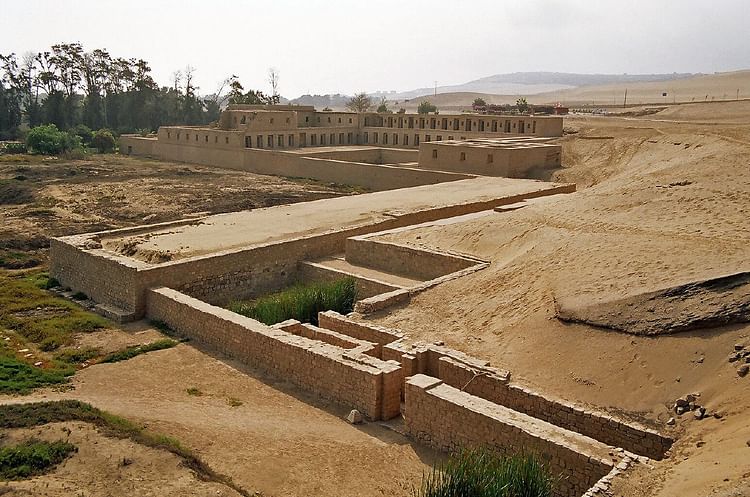 Nunnery, Pachacamac Bruno Girin (CC BY-SA) ](https://www.worldhistory.org/image/5195/nunnery-pachacamac/ "Nunnery, Pachacamac")### Under [Inca](https://www.worldhistory.org/Inca_Civilization/) Rule
The Incas took over the site during the reign of Thupa Inka Yupanki (1471 - 1493 CE) and, in typical fashion, incorporated it and the deity Pachacamac into the [Inca religion](https://www.worldhistory.org/Inca_Religion/). They built a temple dedicated to the Inca Sun god [Inti](https://www.worldhistory.org/Inti/) with whom Pachacamac was given, unusually for the gods of conquered peoples, equal status. Constructed on a six-level earthen platform and painted red, the temple was actually two parallel rectangular buildings measuring 52 x 23 metres and reaching a height of 7.3 metres. Used as an accommodation for priests the walls have many niches and are decorated with animal paintings. Other Inca structures include a large colonnaded residence for holy women known as the 'Painted Building' ('Nunnery'), a large raised plaza for pilgrims to congregate in, and the residential section of the site known as Tauri Chumbi.
Excavations at the Sun temple's entrance and inside it have revealed a burial space made by the Incas containing 20 young sacrificed women. Artefacts buried with them suggest the girls were of coastal origin. We also know that human sacrifices were made to Pachacamac in order to appease him following the presence of this new rival Inti. The people of Pachacamac, no doubt because of the antiquity of the oracle and the importance of the site to many Andean cultures, were given a higher degree of autonomy than most conquered areas by their Inca overlords.
[ 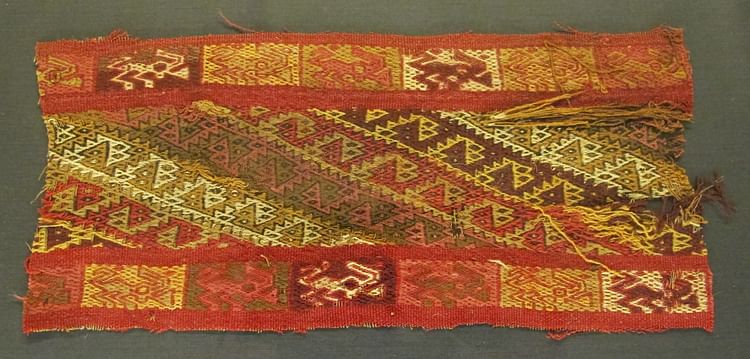 Textile Fragment, Pachacamac Sailko (CC BY) ](https://www.worldhistory.org/image/5197/textile-fragment-pachacamac/ "Textile Fragment, Pachacamac")### Later History
The site's oracle continued to be consulted by the Incas but lost royal favour when it wrongly predicted that Washkar would win the civil [war](https://www.worldhistory.org/disambiguation/War/) against [Atahualpa](https://www.worldhistory.org/Atahualpa/) between 1526 and 1532 CE. Accordingly, the latter ruler gave permission for [Pizarro](https://www.worldhistory.org/Francisco_Pizarro/) to send his brother to destroy the statue of Pachacamac. As with any Inca tombs they could find, the Spanish almost certainly would have looted the site as well.
Pachacamac was damaged by further looting and environmental factors over the centuries so that its original form has been difficult to establish. Although parts have been excavated, indeed, the site was the first in Peru to be investigated by archaeologists, some of the modern reconstructions at the site are not necessarily an accurate replica of the original buildings, notably the 'Nunnery' structure. Nevertheless, portions of its well-made walls which used the typical Inca method of neatly fitted stones without mortar, can still be admired. Artefacts excavated from tombs, remarkably well-preserved in the dry desert climate of the region, include richly painted pottery and fine textiles with bold geometrical designs, much like those of the Nazca.
#### Editorial Review
This human-authored definition has been reviewed by our editorial team before publication to ensure accuracy, reliability and adherence to academic standards in accordance with our [editorial policy](https://www.worldhistory.org/static/editorial-policy/).
## Bibliography
- [Alden Mason, J. *Ancient Civilizations of Peru.* Viking Penguin, 1975.](https://www.worldhistory.org/books/B003F9528I/)
- [Baudin, L. *Daily Life of the Incas.* Dover Publications, 2011.](https://www.worldhistory.org/books/0486428001/)
- [D'Altroy, T.N. *The Incas.* Wiley-Blackwell, 2014.](https://www.worldhistory.org/books/1444331159/)
- [Jones, D.M. *Mythology of the Incas.* Southwater, 2007.](https://www.worldhistory.org/books/1844763382/)
- [Jones, D.M. *The Complete Illustrated History of the Inca Empire.* Lorenz Books, 2012.](https://www.worldhistory.org/books/075482358X/)
## About the Author
Mark is WHE’s Publishing Director and has an MA in Political Philosophy (University of York). He is a full-time researcher, writer, historian and editor. Special interests include art, architecture and discovering the ideas that all civilizations share.
## Timeline
- **c. 1425 CE - 1532 CE**: The [Inca](https://www.worldhistory.org/Inca_Civilization/) [Empire](https://www.worldhistory.org/empire/) flourishes in South America.
- **1471 CE - 1493 CE**: The sacred site of [Pachacamac](https://www.worldhistory.org/Pachacamac/) is taken over by the [Incas](https://www.worldhistory.org/Inca_Civilization/).
## Cite This Work
### APA
Cartwright, M. (2016, June 13). Pachacamac. *World History Encyclopedia*.
### Chicago
Cartwright, Mark. "Pachacamac." *World History Encyclopedia*, June 13, 2016. .
### MLA
Cartwright, Mark. "Pachacamac." *World History Encyclopedia*, 13 Jun 2016, .
## License & Copyright
Submitted by [Mark Cartwright](https://www.worldhistory.org/user/markzcartwright/ "User Page: Mark Cartwright"), published on 13 June 2016. The copyright holder has published this content under the following license: [Creative Commons Attribution-NonCommercial-ShareAlike](https://creativecommons.org/licenses/by-nc-sa/4.0/deed.en). This license lets others remix, tweak, and build upon this content non-commercially, as long as they credit the author and license their new creations under the identical terms. When republishing on the web a hyperlink back to the original content source URL must be included. Please note that content linked from this page may have different licensing terms.