---
title: Orion: The Hunter Who Became a Constellation
author: Mark Cartwright
source: https://www.worldhistory.org/Orion/
format: machine-readable-alternate
license: Creative Commons Attribution-NonCommercial-ShareAlike (https://creativecommons.org/licenses/by-nc-sa/4.0/)
updated: 2025-04-18
---
# Orion: The Hunter Who Became a Constellation
_Authored by [Mark Cartwright](https://www.worldhistory.org/user/markzcartwright/)_
Orion was the great hunter of [Greek mythology](https://www.worldhistory.org/Greek_Mythology/) who was famed for his good looks and many love affairs. Either his assault of or admiration from [Artemis](https://www.worldhistory.org/artemis/) resulted in the gods transforming the [giant](https://www.worldhistory.org/Giants/) into a constellation. Referred to by such ancient writers as [Hesiod](https://www.worldhistory.org/hesiod/) and [Homer](https://www.worldhistory.org/homer/), the constellation of Orion was used as an important navigation and agricultural aid throughout antiquity.
### Genealogy & Birth
The myths involving Orion are varied and contradictory. In some versions, he is the son of [Poseidon](https://www.worldhistory.org/poseidon/) and Euryale, one of the three Gorgon sisters. Other writers have him as the son of Hyrieus, the son of Alcyone (one of the Pleiades) and Poseidon. In this version, Hyrieus, a poor old farmer and beekeeper, provides hospitality to [Zeus](https://www.worldhistory.org/zeus/) and [Hermes](https://www.worldhistory.org/Hermes/) and in return is granted the favour of a son. Orion was thus born when Hyrieus followed the gods' instructions and buried the hide of a sacrificed bull in his wife's [grave](https://www.worldhistory.org/burial/). For the trick to work, the farmer first had to add water to the hide and, lo and behold, Orion sprang from the earth nine months later. This miraculous birth involving water explains the association with the coming of rains on the rise and fall of the Orion constellation.
Traditionally, then, Orion came from Hyria in Boeotia, and what is not disputed is that he was of fine physique, good looks, and possessed great prowess as a hunter. Orion was one of the great [Greek](https://www.worldhistory.org/disambiguation/greek/) lovers, too, said to have fathered 50 sons from sleeping with 50 nymphs.
### Orion & Merope
Not satisfied with his [conquest](https://www.worldhistory.org/warfare/) of the nymphs, Orion then landed on Chios and chased after and assaulted Merope, one of the Pleiades, daughter of Oenopion and so grandaughter of [Dionysos](https://www.worldhistory.org/Dionysos/). Oenopion had promised his daughter to the great hunter if he could clear the island of its troublesome wild beasts. This Orion did, but Oenopion, loathe to lose his daughter, would not make good on his promise and pretended there were still plenty of wild animals roaming about Chios. Orion then took his prize anyway and assaulted Merope in her chambers. When Oenopion discovered the crime, he asked Dionysos for help, and the [god](https://www.worldhistory.org/God/) of wine first made the hunter drunk and then had him blinded by satyrs. The unfortunate Merope would later become the wife of [Sisyphus](https://www.worldhistory.org/sisyphus/), and it is her shame at having been the only one of her sisters who married a mortal that explains why her star shines less brightly in the Pleiades constellation.
Fortunately for Orion, his sight would be restored if he could only get himself to the point where [Helios](https://www.worldhistory.org/Helios/) – the Sun – first rises above the Ocean each day, far away to the east. So, taking a rowing boat he made his way across the sea, picking up [Hephaistos](https://www.worldhistory.org/Hephaistos/)' assistant Cedalion as a guide along the way when he stopped on Lemnos. Reaching his destination, Helios duly restored Orion's sight, and [Eos](https://www.worldhistory.org/Eos/), the personification of Dawn and Helios' sister, promptly fell in love with the handsome hunter. Their illicit affair is said to account for the beautiful morning blush of dawn.
### Orion & Artemis
Orion's next pursuit proved a rather more ambitious and fateful one for he attacked the goddess Artemis, herself a great huntress. For his audacity, Orion was transformed into the constellation that bears his name and his dog was, likewise, changed into the bright star Sirius. However, an alternative version (and Homer's) of the story has Eos fall in love with the powerful hunter while he was visiting Helios, and Artemis kills him with her arrows in jealousy somewhere near Ortygia ([Syracuse](https://www.worldhistory.org/syracuse/)?).
[ 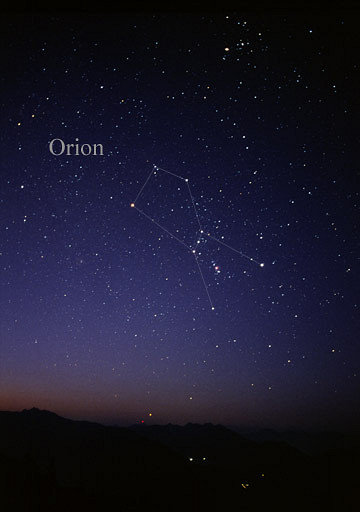 Orion - the Constellation Till Credner (CC BY-SA) ](https://www.worldhistory.org/image/6353/orion---the-constellation/ "Orion - the Constellation")In yet another version, Artemis killed Orion by accident after being tricked by [Apollo](https://www.worldhistory.org/apollo/) into thinking the hunter was, in fact, a villain who had attacked one of her priestesses. Orion, whilst swimming to escape a giant scorpion (again sent by Apollo) is killed by Artemis' arrows after the goddess could only see his distant bobbing head and failed to recognise the hunter. This tragedy was after the two great hunters had been sporting around [Crete](https://www.worldhistory.org/crete/) together. Artemis tried to enlist the medically-gifted [Asclepius](https://www.worldhistory.org/Asclepius/) to bring Orion back to life, but he was just then struck down by Zeus' thunderbolt for being rather too handy at bringing the dead back to life and blurring the distinction between mortals and gods. In this version, it was Artemis' regret at the loss of her hunting companion which allowed him to become a constellation and gain immortality amongst the stars.
Another tradition sprang up that Orion was not at all in the stars but, rather less romantically, entombed at Tanagra, north of [Athens](https://www.worldhistory.org/Athens/). The 2nd-century CE Greek travel writer [Pausanias](https://www.worldhistory.org/disambiguation/Pausanias/) claimed to have even visited the site which was also considered the place of the pole where [Atlas](https://www.worldhistory.org/Atlas/) sat and meditated.
### Orion the Constellation
In Homer's *[Iliad](https://www.worldhistory.org/iliad/)* (Bk. 18:487) Orion appears on the great shield of [Achilles](https://www.worldhistory.org/achilles/) (as the constellation) made by Hephaistos. He appears again in Homer's *[Odyssey](https://www.worldhistory.org/Odyssey/)* (Bk. 5:121 & 274, Bk. 11:310 & 572) where, far from the stars, he is down in the depths of [Hades](https://www.worldhistory.org/Hades/), collecting all the animals he had hunted during his lifetime. Seen by [Odysseus](https://www.worldhistory.org/odysseus/), Orion is still not satisfied and now chases his prey all over again, armed with a club of indestructible [bronze](https://www.worldhistory.org/disambiguation/bronze/). The hunter's constellation is also mentioned by Calypso as a guide for Odysseus on his voyage home. Hesiod mentions the position of Orion in the night sky in several passages of his *Works & Days* to guide farmers when to perform certain agricultural tasks. Other constellations are also useful guides, notably the Pleiades and their pursuit by Orion in myth reflects the fact that, as the constellation, they rise and appear just before Orion does.
#### Editorial Review
This human-authored definition has been reviewed by our editorial team before publication to ensure accuracy, reliability and adherence to academic standards in accordance with our [editorial policy](https://www.worldhistory.org/static/editorial-policy/).
## Bibliography
- [Graves, R. *The Greek Myths.* Penguin UK, 2011.](https://www.worldhistory.org/books/0241952743/)
- [Homer. *The Iliad.* Penguin Classics, 1998.](https://www.worldhistory.org/books/0140275363/)
- [Homer. *The Odyssey.* Penguin Classics, 1999.](https://www.worldhistory.org/books/0140268863/)
- Hope Moncrieff, A.R. *Classcial Mythology.* Senate, 1994
- [Hornblower, S. *The Oxford Classical Dictionary.* Oxford University Press, 2012.](https://www.worldhistory.org/books/0199545561/)
## About the Author
Mark is WHE’s Publishing Director and has an MA in Political Philosophy (University of York). He is a full-time researcher, writer, historian and editor. Special interests include art, architecture and discovering the ideas that all civilizations share.
## External Links
- [13 Legendary Constellations & Their Stories From Greek Mythology](https://mymodernmet.com/famous-constellations/)
## Cite This Work
### APA
Cartwright, M. (2017, February 13). Orion: The Hunter Who Became a Constellation. *World History Encyclopedia*.
### Chicago
Cartwright, Mark. "Orion: The Hunter Who Became a Constellation." *World History Encyclopedia*, February 13, 2017. .
### MLA
Cartwright, Mark. "Orion: The Hunter Who Became a Constellation." *World History Encyclopedia*, 13 Feb 2017, .
## License & Copyright
Submitted by [Mark Cartwright](https://www.worldhistory.org/user/markzcartwright/ "User Page: Mark Cartwright"), published on 13 February 2017. The copyright holder has published this content under the following license: [Creative Commons Attribution-NonCommercial-ShareAlike](https://creativecommons.org/licenses/by-nc-sa/4.0/deed.en). This license lets others remix, tweak, and build upon this content non-commercially, as long as they credit the author and license their new creations under the identical terms. When republishing on the web a hyperlink back to the original content source URL must be included. Please note that content linked from this page may have different licensing terms.