---
title: Olympia
author: Mark Cartwright
source: https://www.worldhistory.org/Olympia/
format: machine-readable-alternate
license: Creative Commons Attribution-NonCommercial-ShareAlike (https://creativecommons.org/licenses/by-nc-sa/4.0/)
updated: 1970-01-01
---
# Olympia
_Authored by [Mark Cartwright](https://www.worldhistory.org/user/markzcartwright/)_
Ancient Olympia was an ancient [Greek](https://www.worldhistory.org/disambiguation/greek/) sanctuary site dedicated to the worship of [Zeus](https://www.worldhistory.org/zeus/) located in the western [Peloponnese](https://www.worldhistory.org/Peloponnese/). The [Pan](https://www.worldhistory.org/Pan/)-[Hellenic](https://www.worldhistory.org/greece/) [Olympic Games](https://www.worldhistory.org/Olympic_Games/) were held at the site in honour of Zeus every four years from 776 BCE to 393 CE. Olympia is listed by UNESCO as a World Heritage Site.
### Early History
First inhabited in the second millennium BCE, the first archaeological record of dwellings dates from 1900 to 1600 BCE. The Kronion hill at the site was perhaps the first place of worship, dedicated to Kronos. However, other sacred buildings at the foot of the hill in the sacred grove of wild olive trees, or Altis, indicate other deities were worshipped such as [Gaia](https://www.worldhistory.org/Gaia/), [Themis](https://www.worldhistory.org/Themis/), [Aphrodite](https://www.worldhistory.org/Aphrodite/), and [Pelops](https://www.worldhistory.org/Pelops/). With the descent of western Greek tribes into the Peloponnese, though, it was Zeus, father of the Olympian gods, who would become the dominant cult figure at Olympia.
### [Temple](https://www.worldhistory.org/temple/) of Zeus
The first large building at the famous ancient sanctuary site was the Heraion, a temple dedicated to [Hera](https://www.worldhistory.org/Hera/) built around 650-600 BCE. In the 5th century BCE the sanctuary reached its peak of prosperity, and the massive 6 x 13 [column](https://www.worldhistory.org/column/) Temple of Zeus was completed in 457 BCE in order to house a huge ivory and [gold](https://www.worldhistory.org/gold/) statue of the leader of the Olympian gods. Designed by Libon of Elis, the Doric temple was the biggest in [Greece](https://www.worldhistory.org/greece/) at that time and measured 64.12 m x 27.68 m with columns 10.53 m in height. The pediments of the Temple of Zeus displayed magnificent [sculpture](https://www.worldhistory.org/disambiguation/Sculpture/): on the east side the mythical [chariot](https://www.worldhistory.org/chariot/) race between Pelops and Oinomaos, and on the western pediment a Centauromachy with the majestic central figure of [Apollo](https://www.worldhistory.org/apollo/). Metopes from the temple represented the labours of [Hercules](https://www.worldhistory.org/hercules/). The statue of Zeus within the temple was by [Phidias](https://www.worldhistory.org/Phidias/) (who had worked on the [Parthenon](https://www.worldhistory.org/parthenon/) and its statue of [Athena](https://www.worldhistory.org/athena/)) and was a 12 m high gold and ivory statue of Zeus seated on a throne and regarded as one of [the Seven Wonders](https://www.worldhistory.org/The_Seven_Wonders/) of the Ancient World.
Other important building projects over the centuries included baths and a swimming pool (5th century BCE), the new [stadium](https://www.worldhistory.org/Stadium/) with embankments for spectators (mid-4th century BCE), a *palaistra* (3rd century BCE), a *gymnasion* (2nd century BCE), hippodrome (780 m long), the large Leonidaion or guest houses (330 BCE), and the Theikoloi (priest's residence).
### The Olympic Games
Sporting events were originally associated with funeral rituals, for example, the funeral games instigated by [Achilles](https://www.worldhistory.org/achilles/) in honour of Patroklos in [Homer](https://www.worldhistory.org/homer/)'s *[Iliad](https://www.worldhistory.org/iliad/)*. Some mythological accounts credit Zeus with beginning the Games to celebrate his victory over Kronos; other accounts state Pelops began them in honour of Oinomaos. In any case, sport, a healthy body and the competitive spirit were a large part of Greek education, and so it is hardly surprising that organised athletic competitions would at some point be created.
The first Olympic Games were held in 776 BCE at the first full moon after the summer solstice. The winner of the first and only event, the *stadion* foot-race (one length of the stadium track, 600 feet or 192 m), was Koroibos of Elis, and from then on every victor was recorded and each Olympiad named after them, thus giving us the first accurate chronology of the Greek world. During a three-month Pan-Hellenic truce, athletes and as many as 40,000 spectators came from Greek [cities](https://www.worldhistory.org/city/) all across the [Mediterranean](https://www.worldhistory.org/disambiguation/mediterranean/) to participate in the Games. Individuals and [city](https://www.worldhistory.org/city/)-states brought offerings to Zeus which included money, statues (including the magnificent [Nike](https://www.worldhistory.org/nike/) of Paionios, c. 424 BCE, and the [Hermes](https://www.worldhistory.org/Hermes/) of Praxiteles, late 4th century BCE), [bronze](https://www.worldhistory.org/disambiguation/bronze/) tripods, shields, helmets, and weapons resulting in Olympia becoming a living museum of Greek art and [culture](https://www.worldhistory.org/disambiguation/culture/). Many cities also built treasuries - small but impressive buildings to house their offerings and raise the prestige of their city.
Over time other events were added to the Games such as longer foot-races, wrestling, boxing, chariot racing, discus, javelin, jumping, and the pentathlon. At its peak there were 18 events spread over five days. However, it was always the original *stadion* which remained the most important event. Victors won crowns of olive leaves and an olive branch cut from the sacred grove, but much more importantly they won glory, fame, and in a very real sense historical immortality.
[ 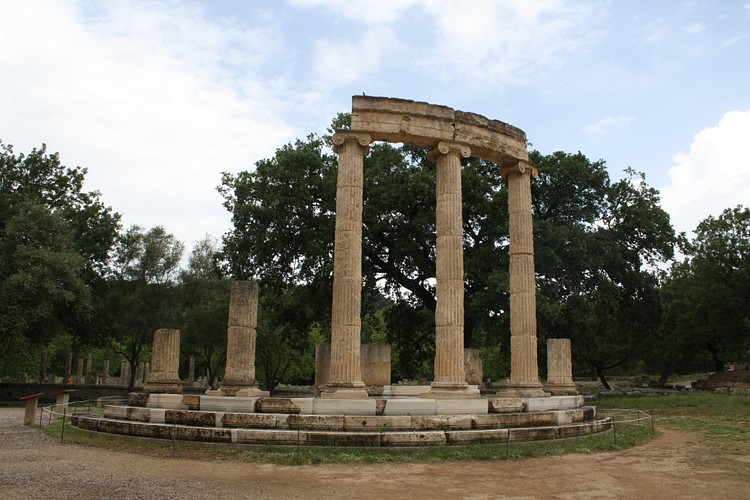 The Philippeion of Olympia Mark Cartwright (CC BY-NC-SA) ](https://www.worldhistory.org/image/441/the-philippeion-of-olympia/ "The Philippeion of Olympia")A second important event held at Olympia was the Heraia Games for [women](https://www.worldhistory.org/disambiguation/women/), held every four years in honour of the goddess, Hera. Children, adolescents, and young women ran in separate foot-races over 500 feet of the stadium track (160 m). Prizes for victors included olive crowns and the right to set up a portrait of themselves on the site. The responsibility for the organisation of both Games and for maintenance of the site when not in use lay with the Eleans.
The Games continued through the [Hellenistic period](https://www.worldhistory.org/Hellenistic_Period/) with the notable architectural addition of the Philippeion, a circular colonnaded building erected by [Philip II](https://www.worldhistory.org/disambiguation/Philip_II/) of Macedonia which contained gold statues of the royal family (c. 338 BCE). The Romans, whilst giving little importance to the religious significance of the Games, continued to hold them in high regard and despite the attempt by [Sulla](https://www.worldhistory.org/sulla/) in 80 BCE to permanently move the Games to [Rome](https://www.worldhistory.org/Rome/), continued to embellish Olympia with new buildings, heated baths, fountains (notably the Nymphaion of Herodes Atticus, 150 CE), and statues. Most famously, emperor [Nero](https://www.worldhistory.org/Nero/) strove to win the glory of Olympic victory in 67 CE, competing in, and unsurprisingly winning, every event he entered.
### Decline
With Emperor Theodosios' decree to prohibit all cult practices and pagan festivals, the Games came to an end in 393 CE after a run of 293 [Olympics](https://www.worldhistory.org/Olympic_Games/) over more than a millennium. The famous sanctuary site gradually fell into decline, was partially destroyed under the decree of emperor Theodosios II in 426 CE, and was taken over by a Christian community who built a basilica on the site in the early [Byzantine](https://www.worldhistory.org/disambiguation/Byzantine/) period. Earthquakes in 522 and 551 CE destroyed much of the remaining ruins, and silt from the nearby rivers Alpheios and Kladeos eventually covered the site until its rediscovery in 1829 by the French Archaeological Mission and systematic excavation by the German Archaeological Institute from 1875. Most of the once-fine temples are now mere ruins but the visitor can at least today run along the track of the very first Olympic stadium.
#### Editorial Review
This human-authored definition has been reviewed by our editorial team before publication to ensure accuracy, reliability and adherence to academic standards in accordance with our [editorial policy](https://www.worldhistory.org/static/editorial-policy/).
## Bibliography
- Andronicos, M. *Olympia.* Ekdotike Athenon, Athens, 2002
- Kaltsas, N. *Olympia.* MOCARF, Athens, 2009
- Koursi, M (ed.). *The Olympic Games in Ancient Greece.* Ekdotike Athenon, Athens, 2003
## About the Author
Mark is WHE’s Publishing Director and has an MA in Political Philosophy (University of York). He is a full-time researcher, writer, historian and editor. Special interests include art, architecture and discovering the ideas that all civilizations share.
## Timeline
- **c. 1900 BCE**: First evidence of settlement at [Olympia](https://www.worldhistory.org/Olympia/).
- **776 BCE**: First athletic games in honour of [Zeus](https://www.worldhistory.org/zeus/) are held at [Olympia](https://www.worldhistory.org/Olympia/) with one event, the *stadion* foot race.
- **724 BCE**: The *diaulos* foot-race (two lengths of the [stadium](https://www.worldhistory.org/Stadium/)) is added to the schedule of the [Olympic Games](https://www.worldhistory.org/Olympic_Games/).
- **720 BCE**: The *dolichos* foot-race is added to the schedule of the [Olympic Games](https://www.worldhistory.org/Olympic_Games/) and is won by Akanthos of [Sparta](https://www.worldhistory.org/sparta/).
- **720 BCE**: Orsippos is the first athlete to discard his loincloth at the [Olympic Games](https://www.worldhistory.org/Olympic_Games/), establishing the convention for athletes to compete naked.
- **708 BCE**: Wrestling and the pentathlon are added to the schedule of the [Olympic Games](https://www.worldhistory.org/Olympic_Games/).
- **688 BCE**: Boxing is added to the schedule of the [Olympic Games](https://www.worldhistory.org/Olympic_Games/).
- **680 BCE**: [Chariot](https://www.worldhistory.org/chariot/) races are added to the schedule of the [Olympic Games](https://www.worldhistory.org/Olympic_Games/) which are extended to two days for the first time.
- **680 BCE**: The *tethrippon* (four-horse [chariot](https://www.worldhistory.org/chariot/) race) is added to the schedule of the [Olympic Games](https://www.worldhistory.org/Olympic_Games/).
- **650 BCE - 600 BCE**: Heraion, [temple](https://www.worldhistory.org/temple/) dedicated to [Hera](https://www.worldhistory.org/Hera/) built at [Olympia](https://www.worldhistory.org/Olympia/).
- **648 BCE**: The *[Pankration](https://www.worldhistory.org/pankration/)* (a mix of wrestling and boxing) is added to the schedule of the [Olympic Games](https://www.worldhistory.org/Olympic_Games/).
- **632 BCE**: Events for boys are added to the schedule of the [Olympic Games](https://www.worldhistory.org/Olympic_Games/) which are extended to three days for the first time.
- **532 BCE**: Milon of Kroton wins the first of five consecutive wrestling competitions at the [Olympic Games](https://www.worldhistory.org/Olympic_Games/).
- **521 BCE**: Phanas of Pellene wins the *stadion*, *diaulos* and race in armour in the same [Olympic Games](https://www.worldhistory.org/Olympic_Games/).
- **520 BCE**: The *hoplitodromos* (a foot-race in [hoplite](https://www.worldhistory.org/hoplite/) armour is added to the schedule of the [Olympic Games](https://www.worldhistory.org/Olympic_Games/).
- **488 BCE**: Runner Astylos of Kroton wins the first of his six victories over three [Olympic Games](https://www.worldhistory.org/Olympic_Games/).
- **488 BCE**: Kroton of [Magna Graecia](https://www.worldhistory.org/Magna_Graecia/) wins the first of three consecutive *stadion* races in the [Olympic Games](https://www.worldhistory.org/Olympic_Games/).
- **c. 460 BCE**: The west pediment of the [Temple](https://www.worldhistory.org/temple/) of [Zeus](https://www.worldhistory.org/zeus/) at [Olympia](https://www.worldhistory.org/Olympia/) is decorated with a Centauromachy of centaurs fighting Lapiths at the wedding of Peirithoos.
- **c. 460 BCE - 457 BCE**: [Temple](https://www.worldhistory.org/temple/) of [Zeus](https://www.worldhistory.org/zeus/) is built at [Olympia](https://www.worldhistory.org/Olympia/) with a statue of [Apollo](https://www.worldhistory.org/apollo/) dominating the west pediment and containing the cult statue of Zeus by [Phidias](https://www.worldhistory.org/Phidias/).
- **c. 457 BCE**: Metopes on the [Temple](https://www.worldhistory.org/temple/) of [Zeus](https://www.worldhistory.org/zeus/) at [Olympia](https://www.worldhistory.org/Olympia/) depict the twelve labours of [Hercules](https://www.worldhistory.org/hercules/).
- **c. 430 BCE**: The cult statue of [Zeus](https://www.worldhistory.org/zeus/) by [Phidias](https://www.worldhistory.org/Phidias/) is dedicated in the [Temple](https://www.worldhistory.org/temple/) of Zeus, [Olympia](https://www.worldhistory.org/Olympia/). It is one of [the Seven Wonders](https://www.worldhistory.org/The_Seven_Wonders/) of the Ancient World.
- **424 BCE - 420 BCE**: The [Nike](https://www.worldhistory.org/nike/) of Paionios is erected at [Olympia](https://www.worldhistory.org/Olympia/) to commemorate the Messenian and Naupaktian victory over [Sparta](https://www.worldhistory.org/sparta/) at the [battle](https://www.worldhistory.org/disambiguation/battle/) of Sphakteria.
- **420 BCE**: [Sparta](https://www.worldhistory.org/sparta/) is excluded from the [Olympic Games](https://www.worldhistory.org/Olympic_Games/) for breaking the *ekecheiria* or sacred truce.
- **416 BCE**: [Alcibiades](https://www.worldhistory.org/Alcibiades/) wins three [chariot](https://www.worldhistory.org/chariot/) races at the [Olympic Games](https://www.worldhistory.org/Olympic_Games/).
- **408 BCE**: The *synoris* (two-horse [chariot](https://www.worldhistory.org/chariot/) race) was added to the schedule of the [Olympic Games](https://www.worldhistory.org/Olympic_Games/).
- **396 BCE**: Competitions for heralds and trumpeters were added to the schedule of the [Olympic Games](https://www.worldhistory.org/Olympic_Games/).
- **392 BCE**: The horse owner Kyniska becomes the first woman to win a victor's crown at the [Olympic Games](https://www.worldhistory.org/Olympic_Games/).
- **356 BCE**: [Philip II of Macedon](https://www.worldhistory.org/Philip_II_of_Macedon/) wins the horse race at the [Olympic Games](https://www.worldhistory.org/Olympic_Games/).
- **352 BCE**: [Philip II of Macedon](https://www.worldhistory.org/Philip_II_of_Macedon/) wins the [chariot](https://www.worldhistory.org/chariot/) race at the [Olympic Games](https://www.worldhistory.org/Olympic_Games/) and retains the crown in 348 BCE.
- **c. 338 BCE**: Philippeion built at [Olympia](https://www.worldhistory.org/Olympia/) by [Philip II](https://www.worldhistory.org/disambiguation/Philip_II/) of Macedonia.
- **328 BCE**: Herodoros of [Megara](https://www.worldhistory.org/disambiguation/Megara/) wins the first of ten consecutive trumpet competitions at the [Olympic Games](https://www.worldhistory.org/Olympic_Games/).
- **164 BCE**: [Leonidas](https://www.worldhistory.org/disambiguation/Leonidas/) of [Rhodes](https://www.worldhistory.org/Rhodes/) wins the first of his 12 Olympic crowns in runnning events in four successive Olymic Games.
- **72 BCE**: Gaius becomes the first [Roman](https://www.worldhistory.org/disambiguation/Roman/) victor at the [Olympic Games](https://www.worldhistory.org/Olympic_Games/).
- **17 CE**: [Roman emperor](https://www.worldhistory.org/Roman_Emperor/) [Tiberius](https://www.worldhistory.org/Tiberius/) is victorious at the [Olympic Games](https://www.worldhistory.org/Olympic_Games/).
- **c. 67 CE**: Emperor [Nero](https://www.worldhistory.org/Nero/) competes at the panhellenic Games of [Olympia](https://www.worldhistory.org/Olympia/) and [Delphi](https://www.worldhistory.org/delphi/).
- **81 CE**: Hermogenes of Xanthos wins the first of his 8 Olympic running crowns over three consecutive [Olympic Games](https://www.worldhistory.org/Olympic_Games/).
- **150 CE**: Nymphaion fountain of Herodes Atticus built at [Olympia](https://www.worldhistory.org/Olympia/).
- **261 CE**: The list of victors running back to 776 BCE ends for the [Olympic Games](https://www.worldhistory.org/Olympic_Games/).
- **393 CE**: [Roman Emperor](https://www.worldhistory.org/Roman_Emperor/) Theodosius definitively ends all pagan Games in [Greece](https://www.worldhistory.org/greece/).
- **426 CE**: Emperor Theodosios II orders the destruction of [Olympia](https://www.worldhistory.org/Olympia/).
- **522 CE - 551 CE**: Earthquakes destroy many of the buildings at [Olympia](https://www.worldhistory.org/Olympia/).
## External Links
- [The ancient origins of the Olympics - Armand D'Angour](http://ed.ted.com/lessons/the-ancient-origins-of-the-olympics-armand-d-angour)
## Cite This Work
### APA
Cartwright, M. (2012, July 02). Olympia. *World History Encyclopedia*.
### Chicago
Cartwright, Mark. "Olympia." *World History Encyclopedia*, July 02, 2012. .
### MLA
Cartwright, Mark. "Olympia." *World History Encyclopedia*, 02 Jul 2012, .
## License & Copyright
Submitted by [Mark Cartwright](https://www.worldhistory.org/user/markzcartwright/ "User Page: Mark Cartwright"), published on 02 July 2012. The copyright holder has published this content under the following license: [Creative Commons Attribution-NonCommercial-ShareAlike](https://creativecommons.org/licenses/by-nc-sa/4.0/deed.en). This license lets others remix, tweak, and build upon this content non-commercially, as long as they credit the author and license their new creations under the identical terms. When republishing on the web a hyperlink back to the original content source URL must be included. Please note that content linked from this page may have different licensing terms.