---
title: Oceanus
author: Liana Miate
source: https://www.worldhistory.org/Oceanus/
format: machine-readable-alternate
license: Creative Commons Attribution-NonCommercial-ShareAlike (https://creativecommons.org/licenses/by-nc-sa/4.0/)
updated: 2023-03-21
---
# Oceanus
_Authored by [Liana Miate](https://www.worldhistory.org/user/lianamiate/)_
Oceanus (also Okeanos) was the eldest of the Titans and a son of [Uranus](https://www.worldhistory.org/Uranus/) (Heaven) and [Gaia](https://www.worldhistory.org/Gaia/) (Earth) in [Greek mythology](https://www.worldhistory.org/Greek_Mythology/). He was the [god](https://www.worldhistory.org/God/) and personification of the freshwater river Oceanus, which was thought to encircle the earth and was said to be the source of all living gods and creatures. However, in early [mythology](https://www.worldhistory.org/mythology/), Oceanus was often viewed as an element rather than a god.
Oceanus was married to his sister, Tethys, and they had 3,000 sons together (the rivers of the earth) and 3,000 daughters (the nymphs of land and water). He was said to dwell on the western shores of the earth and never left his home, not even to attend the assemblies of the gods.
### Birth & Family
According to [Hesiod](https://www.worldhistory.org/hesiod/) (c. 700 BCE) in his *[Theogony](https://www.worldhistory.org/Theogony/)*, Oceanus is the son of Uranus (Heaven) and Gaia (Earth) and is the oldest of the Titans. His siblings include [Cronus](https://www.worldhistory.org/Cronus/), Hyperion, Mnemosyne, [Rhea](https://www.worldhistory.org/Rhea/), Tethys, and [Themis](https://www.worldhistory.org/Themis/). Oceanus married his sister Tethys, and together they had 3,000 sons who were the rivers of the world and 3,000 daughters who were the nymphs of the land and water (Oceanids).
Their most well-known children were the River Styx (the barrier between earth and the underworld), Inachos, the king of [Argos](https://www.worldhistory.org/argos/), and the Oceanids Eurynome, [Electra](https://www.worldhistory.org/disambiguation/electra/), Metis ([Zeus](https://www.worldhistory.org/zeus/)' first notable wife), and Theia.
> Tethys bore whirling Rivers to her mate
> Ocean: the [Nile](https://www.worldhistory.org/nile/), Alpheios, and the deep
> Eddying Eridanus, Strymon; then,
> Meander, Ister's lovely-flowing stream,
> And Phasis, Rhesus, and the [silver](https://www.worldhistory.org/Silver/) pools
> Of Achelous and Nessus, Rhodius,
> Then Haliacmon Heptaporus, and
> [Granicus](https://www.worldhistory.org/Battle_of_the_Granicus/), Aesepus, bright Simois,
> Peneus, Hermus, gentle Caicus,
> Sangarius the great, Parthenius,
> Ladon, Euenus, and Aldescus; last
> She bore Scamander, shining holy stream.
> (*Theogony,* 337-347)
### The River Oceanus
The ancient Greeks believed that the great freshwater river Oceanus surrounded the world where the sky touched the earth's surface. Its furthest boundaries lie to the north, south, east and west. Multiple ancient authors, such as [Homer](https://www.worldhistory.org/homer/) (c. 750 BCE) in his *[Iliad](https://www.worldhistory.org/iliad/)*, [Greek comedy](https://www.worldhistory.org/Greek_Comedy/) playwright [Aristophanes](https://www.worldhistory.org/Aristophanes/) (c. 460 to c. 380 BCE) in his *The Birds,* and [Plato](https://www.worldhistory.org/plato/) (428/427 to 348/347 BCE) in his *Theaetetus*, mention Oceanus as being the place where all creation was formed, which would suggest that Oceanus and Tethys were viewed as the parents of all the gods, in certain sources. This was most likely why Oceanus and Tethys were held in such high esteem by their fellow [immortals](https://www.worldhistory.org/disambiguation/immortals/).
On the far side of Oceanus lay strange, mysterious places like the Garden of the [Hesperides](https://www.worldhistory.org/Hesperides/) and the island of Erytheia. [Hades](https://www.worldhistory.org/Hades/) (Underworld) was also believed to have been located near Oceanus, as, according to Homer, [Odysseus](https://www.worldhistory.org/odysseus/) had to cross the Oceanus river before he entered the underworld. [Helios](https://www.worldhistory.org/Helios/), the sun god, lived in the east, near the banks of Oceanus. Every morning he drove his [chariot](https://www.worldhistory.org/chariot/) across the sky from east to west, while at night, he sailed home along the Oceanus River in a golden bowl. All the waters that flow from fountains, springs, wells, and rivers came from the mighty Oceanus.
[  The Titan Oceanus Mary Harrsch (CC BY-NC-SA) ](https://www.worldhistory.org/image/1083/the-titan-oceanus/ "The Titan Oceanus")### Oceanus & the Titanomachy
Oceanus was viewed as being the noblest of the Titans, as, unlike his siblings, Oceanus did not personally get involved in the Titanomachy – the conflict between the Titans and the Olympian gods – and so he did not share their dreadful fate of being imprisoned in [Tartarus](https://www.worldhistory.org/Tartarus/) (the deepest part of the underworld). As a reward, Oceanus was allowed to rule over Oceanus in undisturbed peace.
However, he was not wholly absent from the Titanomachy. In the *Theogony*, Hesiod mentions that Oceanus sent his daughter Styx and her children to fight on Zeus' side during the revolt. In the *Iliad*, [Hera](https://www.worldhistory.org/Hera/) mentions that she was returning to Oceanus and Tethys to find a safe refuge during the fighting, as they had raised her in their home and treated her with great kindness.
### Oceanus & [Hercules](https://www.worldhistory.org/hercules/)
Hercules' tenth labour required him to capture the cattle of Geryon from the island of Erytheia. Geryon was a [Giant](https://www.worldhistory.org/Giants/) and the grandson of Oceanus; he was believed to be the strongest man alive. Helios gave Hercules his golden goblet or bowl (depending on the source) so that he could sail to Erytheia.
[  Mosaic of Oceanus Carole Raddato (CC BY-NC-SA) ](https://www.worldhistory.org/image/17184/mosaic-of-oceanus/ "Mosaic of Oceanus")In an attempt to stop Hercules from reaching his grandson, Oceanus caused great waves to overcome the golden vessel that Hercules clung to. Hercules drew his bow and frightened Oceanus into calming the waters so he could reach Erytheia safely.
### Oceanus in *[Prometheus Bound](https://www.worldhistory.org/Prometheus_Bound/)*
Oceanus is featured in the [Greek tragedy](https://www.worldhistory.org/Greek_Tragedy/) *[Prometheus](https://www.worldhistory.org/Prometheus/) Bound*, believed to have been written by the ancient [Greek](https://www.worldhistory.org/disambiguation/greek/) playwright [Aeschylus](https://www.worldhistory.org/Aeschylus/) (c. 525 to c. 456 BCE). In *Prometheus Bound*, Prometheus, the [Titan](https://www.worldhistory.org/Titan/) god of fire and brother and son-in-[law](https://www.worldhistory.org/disambiguation/law/) to Oceanus, lies chained to a rock as punishment from Zeus after Prometheus gave fire to humankind, which was a threat to Zeus' power. The chorus is sung by Oceanus' many children who step onto the stage to welcome their father, who enters on a giant bird, most likely a griffin.
Oceanus travels to where Prometheus lies in chains and sympathised with his plight, telling him that even beyond their blood relation, there is nobody he is more fond of. He asks Prometheus what he could do to help. A bitter Prometheus thinks that Oceanus has come to make fun of his situation. Oceanus advises him to give up his bad mood and find a way to free himself from troubles by submitting to Zeus.
> Yet I shall go to him. I'll do what I can
> to free you from the pains that now beset you.
> Just hold your peace. Don't give your tongue free rein.
> With all your wisdom, you find it hard to see
> That useless ranting brings on punishment.
> (*Prometheus Bound*, 325-331)
Oceanus is adamant that he would be able to change Zeus' mind and that Zeus will free him as a gift to him. Prometheus is grateful but tells Oceanus not to waste his breath. Oceanus replies that words could heal and cure a sick mind. Growing tired of Oceanus' advice, Prometheus tells him to leave, and so Oceanus flies off on his bird.
[  Oceanus Mark Cartwright (CC BY-NC-SA) ](https://www.worldhistory.org/image/4460/oceanus/ "Oceanus")### Purifying Glaucus
Glaucus was a fisherman who was transformed into a sea god. In *Metamorphoses* by [Ovid](https://www.worldhistory.org/ovid/) (43 BCE to 17 CE), Glaucus comes upon a mortal [Scylla](https://www.worldhistory.org/Scylla_and_Charybdis/) and is taken aback by her beauty. Scylla flees from him in horror after seeing his appearance. Glaucus assures her that his blue-green body and fishtail result from him being a sea god, not a dangerous creature.
He tells Scylla how he became a god after eating some magical seagrass. The sea gods welcomed him as one of their own, with Oceanus and Tethys purging him of all his mortal characteristics and performing a ritual cleansing. They chanted a spell nine times and then instructed Glaucus to immerse himself in 100 streams. All the rivers flowed over him from every direction, and he woke up with a different body.
### In Art
Oceanus is depicted in Greek art with a long fishtail, a man's torso, and a horned head (often with one or two horns). He holds a sceptre to represent his power and rides on a sea creature alone or by the side of his wife, Tethys. On [Roman](https://www.worldhistory.org/disambiguation/Roman/) sarcophagi, he is depicted as a god with a beard. Oceanus is a rare figure to find in ancient vase paintings; however, he can be found on the famed [François Vase](https://www.worldhistory.org/Francois_Vase/) and the Sophilos Dinos in a depiction of [Thetis](https://www.worldhistory.org/Thetis/) (his granddaughter) and Peleus' wedding.
As described in the *Iliad*, Oceanus is featured on [Achilles](https://www.worldhistory.org/achilles/)' shield, which [Hephaestus](https://www.worldhistory.org/Hephaistos/), the god of metallurgy, made. The Oceanus river was shown on the shield's edges, surrounding all the other images depicted on the shield. Oceanus is also represented on the shield in Hesiod's *[Shield of Hercules](https://www.worldhistory.org/Shield_of_Heracles/)*, with swans flying over him and fish swimming on the surface of his waters.
[ 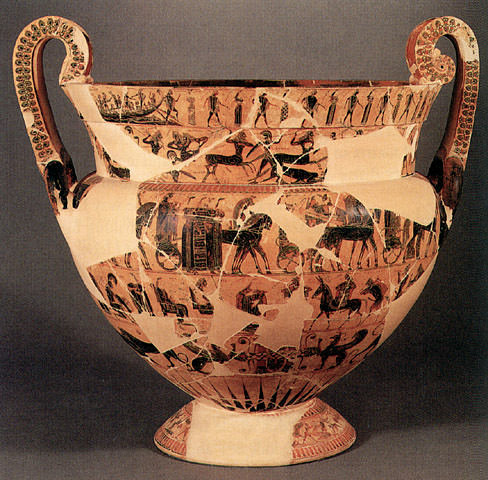 François Vase Fiona Willis (CC BY) ](https://www.worldhistory.org/image/995/francois-vase/ "François Vase")### Worship
Because of their great importance to the fertility and health of the ground, the ancient Greeks greatly loved and revered the river gods, including Oceanus. However, their worship was local, and there is no evidence that Oceanus ever had a cult or specific cult worship dedicated to him. He is, however, featured in *The Orphic Hymns* and has an Orphic Hymn dedicated to him. In the hymn, he is mentioned as being the creator of mortal men and gods.
> I summon Okeanos,
> Ageless, eternal father,
> begetter of immortal gods,
> begetter of mortal men.
> Your waves, O Okeanos,
> gird the boundaries of the earth.
> From you comes all the seas,
> From you come all the rivers,
> From you come the pure, flowing waters
> of earth's springs.
> Hear me, O blessed god,
> O highest, O divine purifier,
> where you end the earth ends,
> the pole begins where shipslide on,
> come, grant favour,
> Grant grace to the initiates.
> (*The Orphic Hymns*, 83.1-7)
Although Oceanus' name eventually faded into oblivion over time, unlike [Poseidon](https://www.worldhistory.org/poseidon/)'s, whose worship was widely practised and his feats spoken about for many years, Oceanus was given the ultimate honour of having the largest body of saltwater that encircles the earth named after him – the ocean.
#### Editorial Review
This human-authored definition has been reviewed by our editorial team before publication to ensure accuracy, reliability and adherence to academic standards in accordance with our [editorial policy](https://www.worldhistory.org/static/editorial-policy/).
## Bibliography
- [Apollodorus & Hard, Robin. *The Library of Greek Mythology.* Oxford University Press, 2008.](https://www.worldhistory.org/books/0199536325/)
- [Athanassakis, Apostolos N. & Wolkow, Benjamin M. *The Orphic Hymns.* Johns Hopkins University Press, 2013.](https://www.worldhistory.org/books/1421408821/)
- [Bane, Theresa. *Encyclopedia of Giants and Humanoids in Myth, Legend and Folklore.* McFarland & Company, 2016.](https://www.worldhistory.org/books/1476663513/)
- [Daly, Kathleen N & Rengel, Marian. *Greek and Roman Mythology A to Z.* Chelsea House Publications, 2009.](https://www.worldhistory.org/books/1604134127/)
- [Graves, Robert. *The Greek Myths\[May 15, 2018\] Graves, Robert.* Viking, 2018.](https://www.worldhistory.org/books/0241982359/)
- [Hesiod & Theognis & Wender, Dorothea & Wender, Dorothea. *Hesiod and Theognis.* Penguin Classics, 1976.](https://www.worldhistory.org/books/0140442839/)
- [Homer & Robert Fagles & Bernard Knox. *The Iliad.* Penguin Classics, 1998.](https://www.worldhistory.org/books/0140275363/)
- [March, Jennifer R. *Dictionary of Classical Mythology.* Oxbow Books, 2014.](https://www.worldhistory.org/books/1782976353/)
- [Murray, Alexander S. & Klapp, William H. *Handbook of World Mythology.* Dover, 2005.](https://www.worldhistory.org/books/0486443744/)
- [Ovid & Raeburn, David & Feeney, Denis. *Metamorphoses.* Penguin Classics, 2004.](https://www.worldhistory.org/books/014044789X/)
- [Seemann, Otto, -. *The mythology of Greece and Rome. With special reference to its use in art from..* Generic, 2023.](https://www.worldhistory.org/books/B0BVQW1G75/)
- [Sophocles & Aeschylus & Euripides & Lefkowitz, Mary & Romm, James. *The Greek Plays.* Modern Library, 2017.](https://www.worldhistory.org/books/0812983092/)
## About the Author
Liana is the Social Media Editor for Ancient History Encyclopedia. She holds a Bachelor of Arts Degree with a major in ancient Greece, Rome & Late Antiquity. She is particularly passionate about Rome and Greece, and anything to do with mythology or wo
- [Linkedin Profile](https://www.linkedin.com/in/lian)
## Questions & Answers
### What Was Oceanus the god of?
Oceanus was the god of the great freshwater river that encircled the earth and who some believed was the source of all the gods.
### Who is stronger? Poseidon or Oceanus?
Poseidon was stronger, as the Olympian gods were generally seen as being more powerful than the Titans, as shown in the Titanomachy.
### What is Oceanus known for?
Oceanus is known for being the god of the great river Oceanus and for being the father of all the rivers that covered the earth.
### What is the difference between Poseidon and Oceanus?
Poseidon is an Olympian god and the god of the sea, while Oceanus is a Titan and the god of the great river, Oceanus.
## Cite This Work
### APA
Miate, L. (2023, March 10). Oceanus. *World History Encyclopedia*.
### Chicago
Miate, Liana. "Oceanus." *World History Encyclopedia*, March 10, 2023. .
### MLA
Miate, Liana. "Oceanus." *World History Encyclopedia*, 10 Mar 2023, .
## License & Copyright
Submitted by [Liana Miate](https://www.worldhistory.org/user/lianamiate/ "User Page: Liana Miate"), published on 10 March 2023. The copyright holder has published this content under the following license: [Creative Commons Attribution-NonCommercial-ShareAlike](https://creativecommons.org/licenses/by-nc-sa/4.0/deed.en). This license lets others remix, tweak, and build upon this content non-commercially, as long as they credit the author and license their new creations under the identical terms. When republishing on the web a hyperlink back to the original content source URL must be included. Please note that content linked from this page may have different licensing terms.