---
title: Numismatics
author: Jenni Irving
source: https://www.worldhistory.org/Numismatics/
format: machine-readable-alternate
license: Creative Commons Attribution-NonCommercial-ShareAlike (https://creativecommons.org/licenses/by-nc-sa/4.0/)
updated: 1970-01-01
---
# Numismatics
_Authored by [Jenni Irving](https://www.worldhistory.org/user/jenni.irving/)_
Numismatics the study of [coinage](https://www.worldhistory.org/coinage/), and is a wonderfully useful tool in the archaeologist's and historian's toolbox. One of the best things for an archaeologist to find while digging is a [coin](https://www.worldhistory.org/coinage/). The reason is simple; it can instantly provide some date for the layer they are digging. Additionally, coins provide information for [trade](https://www.worldhistory.org/disambiguation/trade/), [economy](https://www.worldhistory.org/disambiguation/economy/), social organisation, [mythology](https://www.worldhistory.org/mythology/), ideologies, personages, leadership, military, important events, and the list goes on.
### Parts of coins
To analyse ancient coinage there are some terms that one must first understand:
**The Obverse**: The obverse is the heads side or the front of the coin. [Roman](https://www.worldhistory.org/disambiguation/Roman/) Imperial coins usually display the head of the Emperor or a significant relative. It can be difficult to identify the obverse on a [Greek](https://www.worldhistory.org/disambiguation/greek/) coins because of the images depicted.
**The Reverse**: The reverse is the opposite side of the coin to the obverse. It is the tails side or back of the coin. Roman Imperial coins usually display some sort of propaganda on the reverse, while Republican coins depict a theme glorifying a certain ancestor. Again with Greek coins it can be more difficult to identify.
**Legend**: This refers to the inscription on the coin excluding mint characters. It typically runs round the exterior edge of the coin but there are exceptions.
The legend can contain abbreviations, particularly on Roman coins, which are significant to the analysis of the coins. Some of the most common are:
AVG = [Augustus](https://www.worldhistory.org/augustus/)
C or CAES = [Caesar](https://www.worldhistory.org/disambiguation/caesar/)
[COS](https://www.worldhistory.org/Kos/) = [Consul](https://www.worldhistory.org/Consul/)
IMP = Imperator/Commander
PERP or PP = Perpetuus/Continuous
P F = Pius Felix/dutiful to the gods, the state or one's family
P M = Ponifex Maximus
P P = Pater Patriae/Father of his country
S C = Senatus Consulto/by degree of the state
S P Q R = Senatus Populusque Romus/The [Roman Senate](https://www.worldhistory.org/Roman_Senate/) and People
**Field**: The field is a flat undecorated area which sometimes contains mint or control marks, which are a sequence of letters or symbols indicating who produced the coins.
**Exergue**: The exergue is a space at the bottom of the reverse which often separated from the image by a line. Sometimes this space houses part of the legend or a mint [mark](https://www.worldhistory.org/disambiguation/Mark/).
[  Man-headed Bull, Gela Mark Cartwright (CC BY-NC-SA) ](https://www.worldhistory.org/image/4351/man-headed-bull-gela/ "Man-headed Bull, Gela")**Type**: The central design on the reverse which is generally surrounded by the legend and on top of the exergue.
### Important Terms to Remember when Analysing:
**AE**: AE is often found in the description of coins and is an abbreviation meaning that the coin is of a base [metal](https://www.worldhistory.org/disambiguation/metal/) or alloy (eg. [Copper](https://www.worldhistory.org/copper/) or [bronze](https://www.worldhistory.org/disambiguation/bronze/)). When used alongside a number it refers to the size of the coin. This measurement is done in millimetres of the diameter of the coin but does not represent the millimetres themselves but a certain category which they belong to. For instance, with Roman coins, AE1 are alloy coins over 25mm and AE2 are 21-25mm etc.
**AR**: Is an abbreviation indicating that the coin is made of [silver](https://www.worldhistory.org/Silver/) derived from the Latin 'argentum' meaning silver.
**AU**: Is an abbreviation indicating that the coin is made from [gold](https://www.worldhistory.org/gold/) derived from the Latin 'aurum' meaning gold.
[ 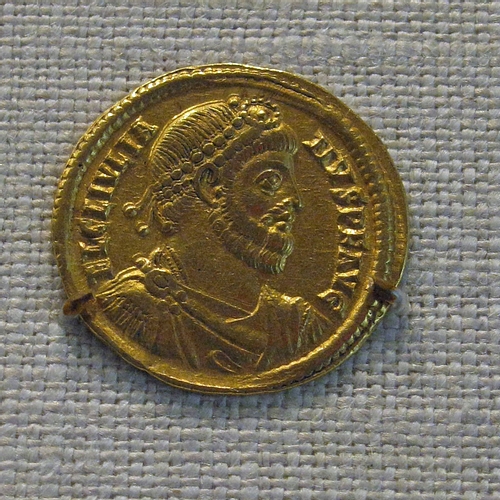 Gold Solidus of Antioch Peter Roan (CC BY-NC-SA) ](https://www.worldhistory.org/image/1065/gold-solidus-of-antioch/ "Gold Solidus of Antioch")**Brockage**: Refers to a coin which has been mis-struck and the reverse image appears incuse on the obverse of the coin.
**Restoration**: Refers to an issue of a coin which replicates a previous coin with few minor changes. Often this is to keep the reverence of previously depicted persons by keeping coins in circulation.
**Serrated/Serratus**: Refers to a coin with a notched edge.
**Transverse**: Something held at an angle in the image.
#### Editorial Review
This human-authored definition has been reviewed by our editorial team before publication to ensure accuracy, reliability and adherence to academic standards in accordance with our [editorial policy](https://www.worldhistory.org/static/editorial-policy/).
## Bibliography
- [Forum Ancient Coins](http://forumancientcoins.com "Forum Ancient Coins"), accessed 1 Dec 2016.
- [Graecomuse](http://graecomuse.wordpress.com "Graecomuse"), accessed 1 Dec 2016.
- [Jenkins, K. *Ancient Greek Coins.* Numismatic Fine Arts Intl, 1989.](https://www.worldhistory.org/books/1852640146/)
- [Metcalf, W.E. *The Oxford Handbook of Greek and Roman Coinage.* Oxford University Press, USA, 2012.](https://www.worldhistory.org/books/0195305744/)
- [Watson Hands, A. *Roman Coins Elementary Manual .* 1903.](https://www.worldhistory.org/books/5876072680/)
## Timeline
- **c. 635 BCE - 585 BCE**: Reign of Alyattes of [Lydia](https://www.worldhistory.org/lydia/). Minting of first coins made from electrum.
- **600 BCE - 550 BCE**: The [silver](https://www.worldhistory.org/Silver/) stater [coin](https://www.worldhistory.org/coinage/) of Calymna in Caria depicts a tortoise shell [lyre](https://www.worldhistory.org/Lyre/) on its reverse side.
- **c. 550 BCE**: The [silver](https://www.worldhistory.org/Silver/) drachma of [Delos](https://www.worldhistory.org/delos/) depicts a [lyre](https://www.worldhistory.org/Lyre/) - symbolic of [Apollo](https://www.worldhistory.org/apollo/) - on its reverse side.
- **c. 360 BCE**: [Pan](https://www.worldhistory.org/Pan/) appears on the reverse of coins of the Arcadian League.
- **326 BCE**: The first [Roman](https://www.worldhistory.org/disambiguation/Roman/) coins are minted at Neapolis.
- **c. 211 BCE**: A new system of [Roman coinage](https://www.worldhistory.org/Roman_Coinage/) is introduced which includes the [silver](https://www.worldhistory.org/Silver/) denarius.
- **c. 200 BCE**: [Rome](https://www.worldhistory.org/Rome/) now dominates the production of [coinage](https://www.worldhistory.org/coinage/) in [Italy](https://www.worldhistory.org/italy/).
- **c. 157 BCE**: There is a boom in the production of [Roman](https://www.worldhistory.org/disambiguation/Roman/) [silver](https://www.worldhistory.org/Silver/) [coinage](https://www.worldhistory.org/coinage/), in part thanks to the acquisition of silver mines in Macedonia.
- **c. 141 BCE**: The [Roman](https://www.worldhistory.org/disambiguation/Roman/) [bronze](https://www.worldhistory.org/disambiguation/bronze/) as [coin](https://www.worldhistory.org/coinage/) is devalued so that now 16 as equal one [silver](https://www.worldhistory.org/Silver/) denarius.
- **c. 135 BCE**: The [Roman](https://www.worldhistory.org/disambiguation/Roman/) magistrates responsible for [coinage](https://www.worldhistory.org/coinage/) begin to stamp coins with images of landmarks, events and personalities.
- **c. 100 BCE**: Coins of [Kos](https://www.worldhistory.org/Kos/) and Thespiai depict a [lyre](https://www.worldhistory.org/Lyre/) on their reverse side.
- **c. 46 BCE**: [Julius Caesar](https://www.worldhistory.org/Julius_Caesar/) mints the largest quantity of [gold](https://www.worldhistory.org/gold/) coins ever seen in [Rome](https://www.worldhistory.org/Rome/).
- **c. 23 BCE**: The brass [orichalcum](https://www.worldhistory.org/Orichalcum/) sestertius is first minted in [Rome](https://www.worldhistory.org/Rome/).
- **16 BCE**: The [Roman](https://www.worldhistory.org/disambiguation/Roman/) mint at Lugdunum is established.
- **64 CE**: [Nero](https://www.worldhistory.org/Nero/) reduces the weight and percentage of precious [metal](https://www.worldhistory.org/disambiguation/metal/) in [Roman](https://www.worldhistory.org/disambiguation/Roman/) coins, a trend continued by several subsequent Roman emperors.
- **293 CE**: [Diocletian](https://www.worldhistory.org/Diocletian/) reforms the [Roman coinage](https://www.worldhistory.org/Roman_Coinage/) system, guaranteeing the [gold](https://www.worldhistory.org/gold/) aurei at 60 to a pound and minting the nummus [coin](https://www.worldhistory.org/coinage/).
- **301 CE**: [Diocletian](https://www.worldhistory.org/Diocletian/) reasseses the values of [Roman](https://www.worldhistory.org/disambiguation/Roman/) coins and limits minting rights to between 12 and 15 mints across the [empire](https://www.worldhistory.org/empire/).
## External Links
- [Online English-Georgian Catalogue of Georgian Numismatics](http://geonumismatics.tsu.ge/en/)
## Cite This Work
### APA
Irving, J. (2012, May 14). Numismatics. *World History Encyclopedia*.
### Chicago
Irving, Jenni. "Numismatics." *World History Encyclopedia*, May 14, 2012. .
### MLA
Irving, Jenni. "Numismatics." *World History Encyclopedia*, 14 May 2012, .
## License & Copyright
Submitted by [Jenni Irving](https://www.worldhistory.org/user/jenni.irving/ "User Page: Jenni Irving"), published on 14 May 2012. The copyright holder has published this content under the following license: [Creative Commons Attribution-NonCommercial-ShareAlike](https://creativecommons.org/licenses/by-nc-sa/4.0/deed.en). This license lets others remix, tweak, and build upon this content non-commercially, as long as they credit the author and license their new creations under the identical terms. When republishing on the web a hyperlink back to the original content source URL must be included. Please note that content linked from this page may have different licensing terms.