---
title: Neolithic Period
author: Cristian Violatti
source: https://www.worldhistory.org/Neolithic/
format: machine-readable-alternate
license: Creative Commons Attribution-NonCommercial-ShareAlike (https://creativecommons.org/licenses/by-nc-sa/4.0/)
updated: 2025-09-17
---
# Neolithic Period
_Authored by [Cristian Violatti](https://www.worldhistory.org/user/violatti/)_
The term Neolithic Period refers to the last stage of the [Stone Age](https://www.worldhistory.org/Stone_Age/) - a term coined in the late 19th century CE by scholars which covers three different periods: Palaeolithic, Mesolithic, and Neolithic. The Neolithic period is significant for its [megalithic](https://www.worldhistory.org/disambiguation/megalithic/) [architecture](https://www.worldhistory.org/disambiguation/architecture/), the spread of agricultural practices, and the use of polished stone tools.
### Chronology
The term Neolithic or New Stone Age is most frequently used in connection with [agriculture](https://www.worldhistory.org/disambiguation/Agriculture/), which is the time when cereal cultivation and animal domestication was introduced. Because agriculture developed at different times in different regions of the world, there is no single date for the beginning of the Neolithic. In the [Near East](https://www.worldhistory.org/Near_East/), agriculture was developed around 9,000 BCE, in Southeast [Europe](https://www.worldhistory.org/europe/) around 7,000 BCE, and later in other regions. Even within a specific region, agriculture developed during different times. For example, agriculture first developed in Southeast Europe about 7,000 BCE, in Central Europe about 5,500 BCE, and Northern Europe about 4,000 BCE. In East Asia, the Neolithic goes from 6000 to 2000 BCE.
[Pottery](https://www.worldhistory.org/pottery/) is another element that makes the dating of the Neolithic problematic. In some regions, the appearance of pottery is considered a symbol of the Neolithic, but this notion makes the term Neolithic even more ambiguous, since the use of pottery does not always occur after agriculture: in [Japan](https://www.worldhistory.org/disambiguation/Japan/), pottery appears before agriculture, while in the Near East agriculture pre-dates pottery production.
All these factors make the starting point of the Neolithic somewhat fuzzy. It should be remembered that the origin of the term lies in a late 19th century CE classification system (detailed above) and we must keep in mind its limitations.
### A Revolution?
In order to reflect the deep impact that agriculture had over the human population, an Australian archaeologist named Gordon Childe popularized the term “Neolithic Revolution” in the 1940s CE. However, today, it is believed that the impact of agricultural innovation was exaggerated in the past: the development of Neolithic culture appears to have been a gradual rather than a sudden change. Moreover, before agriculture was established, archaeological evidence has shown that there is usually a period of semi-nomadic life, where pre-agricultural societies might have a network of campsites and live in different locations according to how the resources respond to seasonal variations. Sometimes, one of these campsites might be adopted as a basecamp; the group might spend the majority of time there during the year exploiting local resources, including wild plants: this is a step closer to agriculture. Agriculture and foraging are not totally incompatible ways of life. This means that a group could perform hunter-gatherer activities for part of the year and some farming during the rest, perhaps on a small scale. Rather than a revolution, the archaeological record suggests that the adoption of agriculture is the result of small and gradual changes.
[ 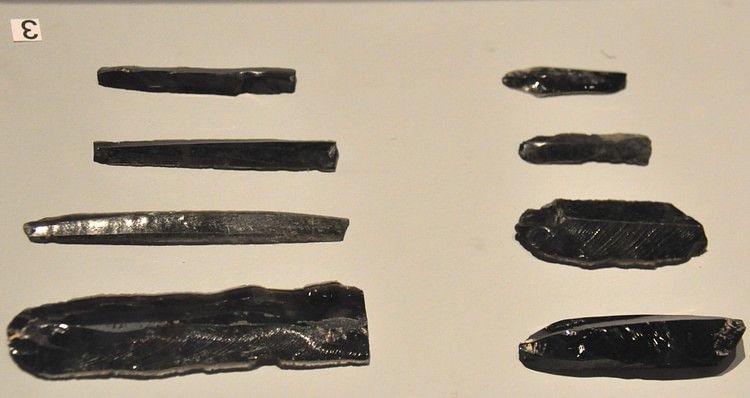 Obsidian Tools Osama Shukir Muhammed Amin (Copyright) ](https://www.worldhistory.org/image/2814/obsidian-tools/ "Obsidian Tools")Agriculture was developed independently in several regions. Since its origin, the dominant pattern in these separate regions is the spread of agricultural economies and the reduction of hunting and gathering activities, to the point that today hunting economies only persist in marginal areas where farming is not possible, such as frozen arctic regions, densely forested areas, or arid deserts.
Major changes were introduced by agriculture, affecting the way human society was organized and how it used the earth, including forest clearance, root crops, and cereal cultivation that can be stored for long periods of time, along with the development of new technologies for farming and herding such as plows, irrigation systems, etc. More intensive agriculture implies more food available for more people, more villages, and a movement towards a more complex social and political organization. As the population density of villages increase, they gradually evolve into towns and finally into [cities](https://www.worldhistory.org/city/).
### Developments During the Neolithic
By adopting a sedentary way of life, the Neolithic groups increased their awareness of territoriality. During the 9600-6900 BCE period in the Near East, there were also innovations in arrowheads, yet no important changes in the animals hunted were detected. However, human skeletons were found with arrowheads embedded in them and also some settlements such as Jericho were surrounded with a massive [wall](https://www.worldhistory.org/wall/) and ditch around this time. It seems that the evidence of this period is a testimony of inter-communal conflicts, not far from organized [warfare](https://www.worldhistory.org/warfare/). There were also additional innovations in stone tool production that became widespread and adopted by many groups in distant locations, which is evidence for the existence of important networks of exchange and cultural interaction.
[ 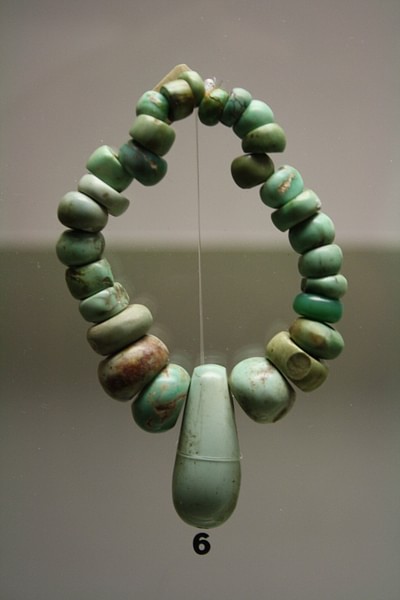 Neolithic Variscite Necklace Mark Cartwright (CC BY-NC-SA) ](https://www.worldhistory.org/image/2910/neolithic-variscite-necklace/ "Neolithic Variscite Necklace")Living in permanent settlements brought new forms of social organization. As the subsistence strategies of Neolithic communities became more efficient, the population of the different settlements increased. We know from anthropological works that the larger the group, the less egalitarian and more hierarchical a society becomes. The social importance of those in the community who were involved in the management and allocation of food resources was increased. Archaeological evidence has shown that during the early Neolithic, houses did not have individual storage facilities: storage and those activities linked to food preparation for storage were managed at village level. At the site of Jarf el Ahmar, in north [Syria](https://www.worldhistory.org/syria/), there is a large subterranean structure which was used as a communal storage facility. This construction is in a central location among the households and there is also evidence that several rituals were performed in it.
Another site in northern Syria named Tell [Abu](https://www.worldhistory.org/disambiguation/Abu/) Hureyra displays evidence for the transition from foraging to farming: it was a gradual process, which took several centuries. The first inhabitants of the site hunted gazelles, wild asses and wild cattle. Then, we see evidence of change: gazelle consumption dropped and the amount of sheep consumption rose (wild in the beginning and domesticated in the end). Sheepherding turned into the main source of meat and gazelle hunting became a minor activity. Human remains show increased tooth wear in all adults, which reflects the prominence of ground cereal in their diet. It is interesting that once pottery was introduced, tooth wear rates decreased, but the frequency of bad teeth increased, which suggests that baked food made from stone-ground flour was largely replaced by dishes such as porridge and gruel, which were boiled in pots.
### The End of the Neolithic
Towards the end of the Neolithic era, copper metallurgy is introduced, which marks a transition period to the [Bronze](https://www.worldhistory.org/disambiguation/bronze/) Age, sometimes referred to as the Chalcolithic or Eneolithic Era. Bronze is a mixture of copper and tin, which has a greater hardness than copper, better casting properties, and a lower melting point. Bronze could be used for making weapons, something that was not possible with copper, which is not hard enough to endure combat conditions. In time, bronze became the primary material for tools and weapons, and a good part of the stone technology became obsolete, signalling the end of the Neolithic and thus, of the Stone Age.
#### Editorial Review
This human-authored definition has been reviewed by our editorial team before publication to ensure accuracy, reliability and adherence to academic standards in accordance with our [editorial policy](https://www.worldhistory.org/static/editorial-policy/).
## Bibliography
- [Bahn, P. *The New Penguin Dictionary of Archaeology Paperback.* Penguin, 2005.](https://www.worldhistory.org/books/B00GSCZEXC/)
- [Cunliffe, B. *The Oxford Illustrated History of Prehistoric Europe.* Oxford University Press, 2001.](https://www.worldhistory.org/books/0192854410/)
- [Darvill, T. *Concise Oxford Dictionary of Archaeology.* Oxford University Press, 2009.](https://www.worldhistory.org/books/0199534047/)
- [Renfrew, C. *Archaeology: Theories, Methods, and Practice (Sixth Edition).* Thames & Hudson, 2012.](https://www.worldhistory.org/books/050028976X/)
- [Scarre, C. *The Human Past.* Thames & Hudson, 2013.](https://www.worldhistory.org/books/0500290636/)
## About the Author
Cristian is a public speaker and independent author with a strong passion for the human past. Inspired by the rich lessons of history, Cristian's goal is to stimulate ideas and to spark the intellectual curiosity of his audience.
- [Facebook Profile](https://www.facebook.com/cviolatti)
- [X/Twitter Profile](https://twitter.com/@CristianViolatt)
- [Linkedin Profile](https://www.linkedin.com/in/cristian-violatti-48464458/)
## Timeline
- **c. 20000 BCE**: Cave painting flourishes in Spain and France, the most famous being the Cave of [Lascaux](https://www.worldhistory.org/Lascaux_Cave/) in France.
- **c. 11700 BCE**: End of the most recent glacial episode within the current Quaternary [Ice Age](https://www.worldhistory.org/Ice_Age/).
- **10000 BCE**: Beginnings of [agriculture](https://www.worldhistory.org/disambiguation/Agriculture/) in the Middle East.
- **9000 BCE**: Cultivation of wild cereals in the [Fertile Crescent](https://www.worldhistory.org/Fertile_Crescent/).
- **9000 BCE**: Wild sheep flocks are managed in the Zagros mountains.
- **8000 BCE**: Ovens in use in the [Near East](https://www.worldhistory.org/Near_East/) are applied to [pottery](https://www.worldhistory.org/pottery/) production.
- **7700 BCE**: First domesticated wheats in the [Fertile Crescent](https://www.worldhistory.org/Fertile_Crescent/).
- **7500 BCE**: Long-distance [trade](https://www.worldhistory.org/disambiguation/trade/) in obsidian begins.
- **7000 BCE**: Domestication of goats.
- **7000 BCE - 2500 BCE**: [Neolithic](https://www.worldhistory.org/Neolithic/) and Chalcolithic periods on [Cyprus](https://www.worldhistory.org/cyprus/).
- **6700 BCE**: Domestication of sheep.
- **6500 BCE**: Domestication of pigs.
- **6500 BCE**: Textiles of flax.
- **c. 6200 BCE**: First [copper](https://www.worldhistory.org/copper/) smelting in [Anatolia](https://www.worldhistory.org/Asia_Minor/).
- **c. 6000 BCE**: First irrigation.
- **6000 BCE**: Domestication of cattle.
- **c. 6000 BCE**: First fortified settlement at [Ugarit](https://www.worldhistory.org/ugarit/).
- **5000 BCE**: Irrigation and [agriculture](https://www.worldhistory.org/disambiguation/Agriculture/) begin in earnest in [Mesopotamia](https://www.worldhistory.org/Mesopotamia/).
- **5000 BCE**: Hierarchical societies emerge in southeast [Europe](https://www.worldhistory.org/europe/).
- **5000 BCE - 4000 BCE**: Megaliths are erected at the [Neolithic](https://www.worldhistory.org/Neolithic/) site of [Locmariaquer](https://www.worldhistory.org/Locmariaquer/), north-west France.
- **5000 BCE - 3000 BCE**: [Megalithic](https://www.worldhistory.org/disambiguation/megalithic/) structures erected at [Carnac](https://www.worldhistory.org/Carnac/), north-west France.
- **c. 4800 BCE**: [Neolithic](https://www.worldhistory.org/Neolithic/) village of Banpo in [China](https://www.worldhistory.org/china/) built.
- **4500 BCE**: Invention of the plow.
- **c. 4500 BCE - c. 3750 BCE**: The [Neolithic](https://www.worldhistory.org/Neolithic/) village of Banpo is inhabited.
- **4300 BCE**: First [megalithic](https://www.worldhistory.org/disambiguation/megalithic/) tombs in [Europe](https://www.worldhistory.org/europe/).
- **4000 BCE**: Use of wool for textiles.
- **4000 BCE**: Medway Tombs of Kent, including Chesnuts, Addington and Coldrum, are constructed.
- **4000 BCE - 3500 BCE**: Clyde Tombs of Western [Scotland](https://www.worldhistory.org/disambiguation/Scotland/) and the Carlingford Tombs of Northern [Ireland](https://www.worldhistory.org/disambiguation/Ireland/) are constructed.
- **4000 BCE - 3100 BCE**: [Uruk](https://www.worldhistory.org/uruk/) period in [Mesopotamia](https://www.worldhistory.org/Mesopotamia/). First [cities](https://www.worldhistory.org/city/).
- **3807 BCE - 3806 BCE**: [The Sweet Track](https://www.worldhistory.org/The_Sweet_Track/), a [Neolithic](https://www.worldhistory.org/Neolithic/) wooden pathway, is constructed in Somerset, [Britain](https://www.worldhistory.org/disambiguation/Britain/).
- **c. 3700 BCE - c. 2800 BCE**: [Neolithic](https://www.worldhistory.org/Neolithic/) farmstead the [Knap of Howar](https://www.worldhistory.org/Knap_of_Howar/) inhabited on Papa Westray, Orkney.
- **3500 BCE**: Cotswold-Severn Group Long Barrows are constructed, which spanned from the north Wessex Downs, Cotswold Hills, South Wales coast, and the Brecon Beacons.
- **c. 3300 BCE - 2600 BCE**: [Neolithic](https://www.worldhistory.org/Neolithic/) site of [Barnhouse Settlement](https://www.worldhistory.org/Barnhouse_Settlement/) occupied.
- **c. 3300 BCE - 2600 BCE**: The [Barnhouse Settlement](https://www.worldhistory.org/Barnhouse_Settlement/) constructed and inhabited.
- **c. 3100 BCE**: [Neolithic](https://www.worldhistory.org/Neolithic/) village of [Skara Brae](https://www.worldhistory.org/Skara_Brae/) inhabited.
- **3100 BCE**: [Neolithic](https://www.worldhistory.org/Neolithic/) Village of [Skara Brae](https://www.worldhistory.org/Skara_Brae/) inhabited, stone walls built.
- **c. 3100 BCE**: [Stonehenge](https://www.worldhistory.org/stonehenge/) Phase I - earthen henge dug on the site.
- **c. 3000 BCE**: [Aegina](https://www.worldhistory.org/Aegina/) inhabited during [Neolithic period](https://www.worldhistory.org/Neolithic/).
- **c. 3000 BCE**: [Stonehenge](https://www.worldhistory.org/stonehenge/) Phase II - Digging of the Aubrey Holes, which probably contained wooden posts (or perhaps bluestones). Stonehenge functions as a cremation cemetery.
- **c. 3000 BCE - c. 2800 BCE**: The [Neolithic](https://www.worldhistory.org/Neolithic/) chambered cairn known as [Maeshowe](https://www.worldhistory.org/Maeshowe/) constructed and in use.
- **2600 BCE**: Structure Eight (so called) erected at [Barnhouse Settlement](https://www.worldhistory.org/Barnhouse_Settlement/) after village abandoned.
- **c. 2550 BCE**: Phase III at [Stonehenge](https://www.worldhistory.org/stonehenge/), the refashioning of the simple earth and timber henge into a unique stone monument.
- **c. 2500 BCE**: Village of [Skara Brae](https://www.worldhistory.org/Skara_Brae/) is abandoned for unknown reasons.
- **c. 2500 BCE - c. 2000 BCE**: The Balnuaran of Clava ([Clava Cairns](https://www.worldhistory.org/Clava_Cairns/)) is built.
- **c. 2000 BCE**: [Bronze Age](https://www.worldhistory.org/disambiguation/Bronze_Age/) begins in Northern [Europe](https://www.worldhistory.org/europe/).
- **770 CE**: Last recorded use of [Clava Cairns](https://www.worldhistory.org/Clava_Cairns/) site in antiquity.
- **1850 CE**: Storm uncovers the buried [Neolithic](https://www.worldhistory.org/Neolithic/) village of [Skara Brae](https://www.worldhistory.org/Skara_Brae/)
- **1850 CE**: Buried [Neolithic Age](https://www.worldhistory.org/Neolithic/) village of [Skara Brae](https://www.worldhistory.org/Skara_Brae/) uncovered by storm.
## External Links
- [Stonehenge and Neolithic enclosures in Europe](http://generic.wordpress.soton.ac.uk/ditchedenclosures/)
## Cite This Work
### APA
Violatti, C. (2018, April 02). Neolithic Period. *World History Encyclopedia*.
### Chicago
Violatti, Cristian. "Neolithic Period." *World History Encyclopedia*, April 02, 2018. .
### MLA
Violatti, Cristian. "Neolithic Period." *World History Encyclopedia*, 02 Apr 2018, .
## License & Copyright
Submitted by [Cristian Violatti](https://www.worldhistory.org/user/violatti/ "User Page: Cristian Violatti"), published on 02 April 2018. The copyright holder has published this content under the following license: [Creative Commons Attribution-NonCommercial-ShareAlike](https://creativecommons.org/licenses/by-nc-sa/4.0/deed.en). This license lets others remix, tweak, and build upon this content non-commercially, as long as they credit the author and license their new creations under the identical terms. When republishing on the web a hyperlink back to the original content source URL must be included. Please note that content linked from this page may have different licensing terms.