---
title: Naukratis
author: Adriana Dunn
source: https://www.worldhistory.org/Naukratis/
format: machine-readable-alternate
license: Creative Commons Attribution-NonCommercial-ShareAlike (https://creativecommons.org/licenses/by-nc-sa/4.0/)
updated: 1970-01-01
---
# Naukratis
_Authored by [Adriana Dunn](https://www.worldhistory.org/user/a.dunn92/)_
Naukratis (also spelled Naucratis, and known as Nokraji to the [ancient Egyptians](https://www.worldhistory.org/collection/162/the-ancient-egyptians/)) was a [city](https://www.worldhistory.org/city/) in Lower [Egypt](https://www.worldhistory.org/egypt/), located in the Canopic (or western) branch of the [Nile](https://www.worldhistory.org/nile/) delta, which became a powerful trading port between the Egyptians and the rest of the [Mediterranean](https://www.worldhistory.org/disambiguation/mediterranean/) world. It was the first permanent [Greek](https://www.worldhistory.org/disambiguation/greek/) settlement in Egypt, and its name translates to "naval command" from Greek.
During the [Late Period of Ancient Egypt](https://www.worldhistory.org/Late_Period_of_Ancient_Egypt/) (525-332 BCE), foreign influences, specifically from [Greece](https://www.worldhistory.org/greece/), came into the country as evidenced in the historical and archaeological record. This is predominantly seen at the ancient city of Naukratis. Today, the site exists in poor condition and covers the villages of Kom Ge'if, el-Niveria, and el-Nigrash, approximately 72 kilometers (45 miles) southeast of the city of [Alexandria](https://www.worldhistory.org/alexandria/).
### History of the Site
The site was first written about by ancient Greek historian [Herodotus](https://www.worldhistory.org/herodotus/) (c. 484 to 425/413 BCE), who had traveled to Egypt during the mid-5th century BCE. He spent his time recording the history and traditions of Egypt in one of his books known as *Histories*. According to his account, the site of Naukratis became a Greek settlement during the 6th century BCE. The [Pharaoh](https://www.worldhistory.org/pharaoh/) Apries (r. 589-570 BCE) led an army of Greek mercenaries against the former general Amasis. However, Apries was defeated by Amasis and his rebel forces, and Amasis II (also known as Ahmose II) soon became [pharaoh of Egypt](https://www.worldhistory.org/collection/25/pharaoh-of-egypt/) and reigned from 570 to 526 BCE.
Naukratis was given to the surviving Greek soldiers to be used as a trading colony by Amasis II in 570 BCE, making it a predominately Greek settlement. Herodotus stated, "Amasis was partial to the Greeks, and among other favors which he granted them, gave to such as liked to settle in Egypt the city of Naukratis for their residence" (*Histories*, II. 178). Other ancient Greeks who visited Naukratis include the Athenian statesman [Solon](https://www.worldhistory.org/solon/) (c. 640 to c. 560 BCE), geographer and historian Hekataios (also given as Hecataeus, l. 550-476 BCE), mathematician [Thales of Miletus](https://www.worldhistory.org/Thales_of_Miletus/) (l. c. 585 BCE), and allegedly [Plato](https://www.worldhistory.org/plato/) (428/427 to 348/347 BCE), the philosopher.
Naukratis became a major beacon of [trade](https://www.worldhistory.org/disambiguation/trade/) for both the Greeks and the Egyptians. The Greeks always coveted an exclusive trading opportunity in Egypt. For the ancient Egyptians, Naukratis represented a link from the Nile delta to the Mediterranean world and solidified a strong political alliance with Greece. Naukratis was the only naval port in Egypt that the Greeks were allowed to utilize until the Persian conquest of Egypt in 525 BCE. Herodotus names twelve Greek seafaring and trading [cities](https://www.worldhistory.org/city/) that were affiliated with Naukratis through trade: Ionians from [Samos](https://www.worldhistory.org/samos/), Miletus, Chios, Teos, Phokaia (Phocaea), and Klazomenai (Clazomenae); Dorians from [Rhodes](https://www.worldhistory.org/Rhodes/), Knidos (Cnidus), [Halikarnassos](https://www.worldhistory.org/halicarnassus/) ([Halicarnassus](https://www.worldhistory.org/halicarnassus/)), and Phaselis; and Aeolians from Mytilene on [Lesbos](https://www.worldhistory.org/lesbos/) and the people of Aigina ([Aegina](https://www.worldhistory.org/Aegina/)), the island close to [Athens](https://www.worldhistory.org/Athens/). Based on the archaeological record, Naukratis' influential trading power extended to [Italy](https://www.worldhistory.org/italy/), Cyrenaica, [Phoenicia](https://www.worldhistory.org/phoenicia/), [Cyprus](https://www.worldhistory.org/cyprus/), and the [Levant](https://www.worldhistory.org/levant/).
[  Map of the Trade Networks of the Ancient Mediterranean World Simeon Netchev (CC BY-NC-ND) ](https://www.worldhistory.org/image/14421/map-of-the-trade-networks-of-the-ancient-mediterra/ "Map of the Trade Networks of the Ancient Mediterranean World")Naukratis survived through the Late Period and remained a major trading station. The site has a unique history of first being inhabited by Greek mercenaries and merchants. The mercenaries served the pharaohs and Persian governors when Egypt was under Persian rule during their military campaigns. Later on, more Greeks immigrated to Egypt in the hope of becoming wealthy through trade. Many of the Greeks who came to Naukratis were sailors and merchants who stayed for only a short period of time. Others immigrated to the port city and remained there permanently. While these Greeks maintained their cultural identity, they intermarried with Egyptians and became acculturated in [Egyptian](https://www.worldhistory.org/disambiguation/Egyptian/) society. Generations of Greeks had coexisted with Carians, [Phoenicians](https://www.worldhistory.org/phoenicia/), and Egyptians at Naukratis by the time [Alexander the Great](https://www.worldhistory.org/Alexander_the_Great/) (r. 336-323 BCE) conquered Egypt in 332 BCE. The site continued to be utilized as a trading port in [Roman Egypt](https://www.worldhistory.org/Roman_Egypt/) (c. 30 BCE to 641 CE) and remained important well into the [Byzantine](https://www.worldhistory.org/disambiguation/Byzantine/) Period at least until the 7th century CE.
### Archaeological Discoveries
Naukratis was first discovered by English Egyptologist Flinders Petrie during his excavation of the site between 1884 and 1885. While Herodotus originally dated Naukratis to 570 BCE, Petrie's archaeological excavations and research suggest an earlier, mid-to-late-7th-century BCE date, better accepted by contemporary scholarship. It is estimated that approximately 15,000 people once lived at Naukratis. Excavations have yielded a massive quantity of archaeological discoveries from diverse cultures and periods: the Late Period, the [Archaic](https://www.worldhistory.org/disambiguation/Archaic/) and Classical Periods (700-323 BCE), the [Ptolemaic Period](https://www.worldhistory.org/Ptolemaic_Dynasty/) (305-30 BCE), and the [Roman](https://www.worldhistory.org/disambiguation/Roman/) and early Byzantine Periods.
Recent excavations were conducted by W. Coulson and A Leonard in 1977, who founded The Naukratis Project. They performed archaeological excavation beginning in 1977-1978 and further surveys and excavations to the south of the site from 1980 to 1982 under the sponsorship of the American Research Center in Egypt. Overall, most of the finds were vases (some whole, most fragmentary) used as votives in the temples; stone statuettes, [faience](https://www.worldhistory.org/disambiguation/Faience/) scarab seals, and amulets were also discovered. Other archaeological expeditions have shown that the Greeks bartered [silver](https://www.worldhistory.org/Silver/), timber, olive oil, and wine with the inhabitants of Naukratis.
[ 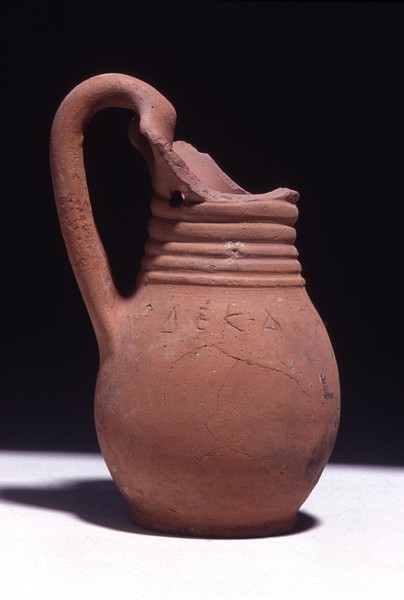 Greek-style Jug from Naukratis The Trustees of the British Museum (CC BY-NC-SA) ](https://www.worldhistory.org/image/15150/greek-style-jug-from-naukratis/ "Greek-style Jug from Naukratis")Archaeological excavation between the 19th and 20th centuries unearthed many architectural features. For example, Naukratis was once densely populated with Egyptian-style 'tower houses', which are tall, mud-brick houses commonly found in towns located along the Nile delta during and after the Saite Period. The Hellenion Sanctuary is one of the largest buildings discovered at the site and is located in the northern part of the settlement. To this day, however, very little is known about it. There are several remains of sanctuaries dedicated to the Greek gods [Hera](https://www.worldhistory.org/Hera/), [Apollo](https://www.worldhistory.org/apollo/), the [Dioscuri](https://www.worldhistory.org/Castor_and_Pollux/), and [Aphrodite](https://www.worldhistory.org/Aphrodite/) that run along the Nile River. A small factory that once crafted faience scarab seals and amulets was discovered east of the temples. A very large sanctuary dedicated to [Amun](https://www.worldhistory.org/amun/)-Ra, Nut, and Khonsu, built c. 600 BCE, occupies the southern portion of Naukratis. Lastly, a large Egyptian storehouse was uncovered in the farthest southern portion of the site.
Numerous ceramic vessels and figures were also discovered. Large quantities of terracotta figures were found in and around houses and along the Nile. These figures depict Egyptian gods, such as Harpokrates and [Bes](https://www.worldhistory.org/Bes/), and nude females associated with fertility, protection, and the flooding of the Nile River. Greek-style [pottery](https://www.worldhistory.org/pottery/) from Naukratis was primarily created for local use. Some of the most important archaeological finds are the remains found of vessels decorated with black-figure painting. These vessels emanate the diffusion of Greek elements in [Egyptian culture](https://www.worldhistory.org/Egyptian_Culture/) in Naukratis during the Late Period. They also provide early evidence of Greek [writing](https://www.worldhistory.org/writing/) found in the inscriptions on pottery discovered at the ancient site. The inscriptions featured on pottery fragments exhibit some of the earliest examples of the [Greek alphabet](https://www.worldhistory.org/Greek_Alphabet/), as well as Corinthian, Melian, Lesbian, and early Phoenician alphabets.
Lastly, Greek coins were discovered in multiple large hoards at Naukratis. The earliest findings of coins date to the late 6th century BCE and vary in their origin and value. However, most of the coins discovered at Naukratis are Athenian silver tetradrachms and date to the mid-5th century BCE. During this time, silver was a rare and highly-coveted commodity to the ancient Egyptians. The introduction of ancient [Greek coinage](https://www.worldhistory.org/Greek_Coinage/) at Naukratis is proof of the site's strong trade connection with Athens. The circulation of coinage also exhibits some of the earliest evidence of monetary distribution in ancient Egypt. Before this, Egypt did not mint its own coinage; rather, its economic infrastructure relied on a barter system.
### Trading Impact on the Mediterranean World
Naukratis played a major role in the exportation of ancient Egyptian goods to the rest of the Mediterranean world. This is evident both in the archaeological record and the literary sources. One of its major exports was natron, which is a sodium-based chemical used in [mummification in ancient Egypt](https://www.worldhistory.org/article/44/mummification-in-ancient-egypt/). Other exported goods included wool, flax, textiles, papyrus, perfumes, and amulets. Egyptian artifacts circulated through Greek trade routes and found their way into the homes and workshops of Ionian Greece and the city-states of mainland Greece through the [Aegean](https://www.worldhistory.org/aegean/) Sea.
[ 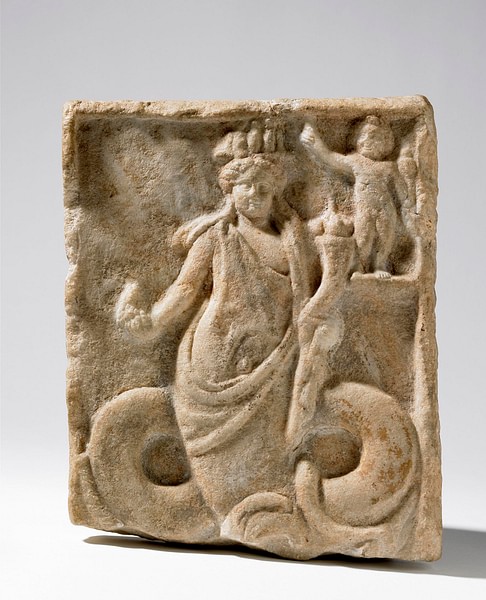 Marble Relief of Dionysos from Naukratis The Trustees of the British Museum (CC BY-NC-SA) ](https://www.worldhistory.org/image/15151/marble-relief-of-dionysos-from-naukratis/ "Marble Relief of Dionysos from Naukratis")Naukratis began as a military fort for displaced Greek mercenaries; however, it transformed into a powerful trading hub coveted for its wealth and marveled at by its Greek contemporaries such as Herodotus. The city played a major role in the [economy](https://www.worldhistory.org/disambiguation/economy/) as a trade gateway between Egypt and the Aegean, [Anatolia](https://www.worldhistory.org/Asia_Minor/), the Levant, [Persia](https://www.worldhistory.org/Persia/), [Etruria](https://www.worldhistory.org/Etruscan_Civilization/), Southern Italy, and Cyrenaica, and it represents a blending of Greek and Egyptian traditions through the existence of temples dedicated to both Greek and Egyptian deities. The abundance of both Egyptian and Greek artifacts discovered at the site suggests that Naukratis was a prosperous trading port whose economic influence over the Mediterranean was extraordinary during its time.
#### Editorial Review
This human-authored definition has been reviewed by our editorial team before publication to ensure accuracy, reliability and adherence to academic standards in accordance with our [editorial policy](https://www.worldhistory.org/static/editorial-policy/).
## Bibliography
- [Boardman, John. *The Greeks Overseas.* Thames and Hudson, 1980, 15.](https://www.worldhistory.org/books/0500250693/)
- [Colburn, Henry P. "Contact Points: Memphis, Naukratis, and the Greek East." *Beyond the Nile*, edited by Spier, Jeffrey & Potts, Timothy & Cole, Sara E. J. Paul Getty Museum, 2018, 82-86.](https://www.worldhistory.org/books/1606065513/)
- [F. Ll. Griffith, Barclay Vincent Head , Ernest Arthur Gardner , Cecil Harcourt Smith , W. M. Flinders Petrie. *Naukratis.* Isha Books, 2022.](https://www.worldhistory.org/books/9332859124/)
- [Herodotus of Halicarnassus as translated by A. D. Godley,. *Herodotus Histories Vol 2.* IDB Productions, 2022.](https://www.worldhistory.org/books/1775420574/)
- James, Peter. "Naukratis Revisited." *Hyperboreus: Studia Classica*, 9:2, 2003, p. 235.
- Leonard, Albert. ""Ancient Naukratis: Excavations at a Greek Emporium in Egypt. Part II: The Excavations at Kom Hadid"." *The Annual of the American Schools of Oriental Research*, 55, pp. 1-8.
- Villing, Alexander and Udo Schlotzhauer. *Greek Diversity in Egypt: Studies on East Greek Pottery and Exchange in the Eastern Mediterranean .* London: British Museum, 2006, 1-8.
- [Villing, Alexandra . "The Greeks in Egypt: Renewed Contacts in the Iron Age." *Beyond the Nile*, edited by Jeffrey Spier, Timothy Potts, Sara E. Cole. J. Paul Getty Museum, 2018, 77-81.](https://www.worldhistory.org/books/1606065513/)
## About the Author
Hello my name is Adriana Dunn and I am currently working as the assistant director at the Art Museum of the University of Memphis. My interests include cultural heritage, collections management, and art and archaeology of the ancient Mediterranean world.
- [Linkedin Profile](https://www.linkedin.com/in/adriana-dunn-85880a128/)
## Timeline
- **570 BCE**: [Naukratis](https://www.worldhistory.org/Naukratis/) is given to [Greek](https://www.worldhistory.org/disambiguation/greek/) soldiers to be used as a trading colony by Amasis II.
## Cite This Work
### APA
Dunn, A. (2022, January 18). Naukratis. *World History Encyclopedia*.
### Chicago
Dunn, Adriana. "Naukratis." *World History Encyclopedia*, January 18, 2022. .
### MLA
Dunn, Adriana. "Naukratis." *World History Encyclopedia*, 18 Jan 2022, .
## License & Copyright
Submitted by [Adriana Dunn](https://www.worldhistory.org/user/a.dunn92/ "User Page: Adriana Dunn"), published on 18 January 2022. The copyright holder has published this content under the following license: [Creative Commons Attribution-NonCommercial-ShareAlike](https://creativecommons.org/licenses/by-nc-sa/4.0/deed.en). This license lets others remix, tweak, and build upon this content non-commercially, as long as they credit the author and license their new creations under the identical terms. When republishing on the web a hyperlink back to the original content source URL must be included. Please note that content linked from this page may have different licensing terms.