---
title: Mystras
author: Michael Goodyear
source: https://www.worldhistory.org/Mystras/
format: machine-readable-alternate
license: Creative Commons Attribution-NonCommercial-ShareAlike (https://creativecommons.org/licenses/by-nc-sa/4.0/)
updated: 2023-09-06
---
# Mystras
_Authored by [Michael Goodyear](https://www.worldhistory.org/user/mpgoodyear/)_
The [city](https://www.worldhistory.org/city/) of Mystras (or Mistras) in southern [Greece](https://www.worldhistory.org/greece/) was the provincial capital of the [Byzantine](https://www.worldhistory.org/disambiguation/Byzantine/) [Despotate of the Morea](https://www.worldhistory.org/Despotate_of_the_Morea/) from the 13th through the 15th centuries CE. It was founded in 1249 CE by William II of Villehardouin, and it served as a center of intellectualism in the late Byzantine world. After the fall of the [Byzantine Empire](https://www.worldhistory.org/Byzantine_Empire/), the city surrendered to the Ottomans in 1460 CE and remained in Ottoman hands, with brief interruptions, until 19th century CE. The city was abandoned in 1832 CE, but its spectacular Byzantine ruins continue to attract visitors and are listed as a UNESCO World Heritage Site.
### Founding of a City
In 1249 CE, William II of Villehardouin, Prince of Achaea (r. 1246-1278 CE), built a great castle on top of one of the foothills of the Taygetus Mountains. The conical hill, c. 600 m or 2000 ft. tall, dominated the plain below and thus was an ideal vantage point for monitoring the restless Slav Milengi people of the region and the nearby city of Lacedemonia. The hill was known as Mizithra, but it later became known as Mystras.
In 1259 CE, William lost the [Battle](https://www.worldhistory.org/disambiguation/battle/) of Pelagonia against the emperor of Nicaea (soon to be the emperor of the restored Byzantine [Empire](https://www.worldhistory.org/empire/) after the capture of [Constantinople](https://www.worldhistory.org/Constantinople/) in 1261 CE), Michael VIII Palaiologos (r. 1259-1282 CE), and was captured. The terms of his release were the surrender of the castles of Monemvasia, Maina, and Mystras. In 1262 CE, the castle of Mystras became Byzantine.
When it was first occupied, Mystras was an isolated Byzantine outpost in the midst of Frankish Achaean territory. The city of Lacedemonia was still in Frankish hands, and the [Greek](https://www.worldhistory.org/disambiguation/greek/) population of Lacedomonia soon flocked to Mystras, where they could be ruled as equal citizens rather than second-class members of society. The rebellious Milengi also reached an agreement with Mystras whereby they recognized Byzantine authority. A Byzantine expedition tried to recover the surrounding area the following year but was pushed back by the [Franks](https://www.worldhistory.org/Franks/), and an Achaean army even besieged Mystras, but it was impossible to dislodge the Byzantine garrison. Meanwhile, Lacedemonia was practically deserted since the Greek population had moved to Mystras, and it was abandoned when the Franks retreated. Another city would not rise there until the 19th century CE when modern [Sparta](https://www.worldhistory.org/sparta/) (or Sparti in Greek) was built. For the next six centuries, Mystras was to be the social and political center of the region.
### A Byzantine Capital
Over the next decade, the whole of that region, the Laconian plain, came under Byzantine control. Threats and border skirmishes came from the kings of Naples and the princes of Achaea, but the Principality of Achaea gradually fell more and more into disarray until it was no longer a serious threat to the Byzantine possessions in the [Peloponnese](https://www.worldhistory.org/Peloponnese/) by the mid-14th century CE. Mystras was the center of this now-secure Byzantine dominion. Monemvasia had originally been the provincial capital, but by 1289 CE, the Byzantine provincial governor had moved to Mystras.
While Mystras served as the provincial capital from this time, it truly became a royal capital in 1349 CE, when the first despot was appointed to rule over the Morea. In 1349 CE, John VI Kantakouzenos (r. 1347-1354 CE), appointed his younger son Manuel Kantakouzenos to rule from Mystras under the title of despot. Mystras and the surrounding province were very much still under Byzantine control, but the long distance to Constantinople meant that Manuel effectively led an autonomous region and conducted his own policy and administration rather than those of his father. It is from this point that we can refer to the polity as the Despotate of the Morea, an autonomous unit in the Peloponnese that was part of the later Byzantine Empire.
[ 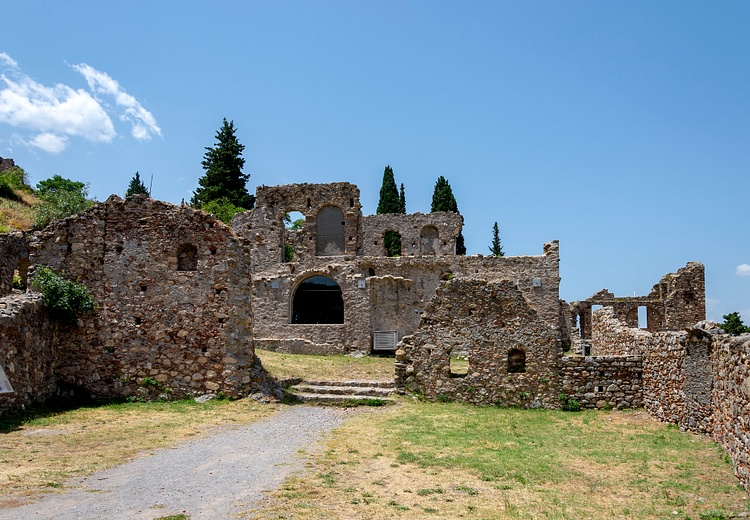 Byzantine Castle of Mystras Ava Babili (CC BY-NC-ND) ](https://www.worldhistory.org/image/12566/byzantine-castle-of-mystras/ "Byzantine Castle of Mystras")The Despotate of the Morea remained prosperous even in the face of increasing Ottoman strength in [Europe](https://www.worldhistory.org/europe/). Mystras, as the capital of the Morea, benefitted from this wealth and grew to become a significant city. After Manuel, his brother Matthew Kantakouzenos ruled as despot, followed by younger sons of the reigning Byzantine family of Palaiologos: Theodore I, Theodore II, [Constantine](https://www.worldhistory.org/disambiguation/Constantine/), and finally Thomas and Demetrios. All but Thomas would rule from Mystras.
For a time, it appeared that the Despotate of the Morea might survive as a sort of Greek fortress in an Ottoman sea. The Peloponnese is a peninsula, with the only access via land coming from the narrow Isthmus of [Corinth](https://www.worldhistory.org/corinth/). In late [Roman](https://www.worldhistory.org/disambiguation/Roman/) times, the Hexamilion [wall](https://www.worldhistory.org/wall/) had been built there to protect the Peloponnese from attacking Germanic tribes. It had long since fallen into disrepair, but it was restored by Theodore I in 1395 CE. The hope was that the Hexamilion wall would hold back the Ottoman Turks and, inside its walls, the Morea would flourish and Byzantine [culture](https://www.worldhistory.org/disambiguation/culture/) would continue under the leadership of Mystras.
This hope quickly proved to be a pipe dream. The Ottomans broke through the wall in raids in 1395 and 1396 CE. Mystras and the Laconian plain were spared, but the myth of the Morea being protected by the Hexamilion wall was shattered. Yet the Hexamilion was repaired again in 1415 and 1444 CE. Both times it was again breached by Ottoman forces. The raid in 1423 CE penetrated to Mystras itself.
In its final decades, the Despotate of the Morea was split between two or three despots. Despite this arrangement, Mystras remained preeminent in the Morea. Indeed, the final [Byzantine emperor](https://www.worldhistory.org/Byzantine_Emperor/), Constantine XI Palaiologos (r. 1449-1453 CE), the former despot of the Morea, was not crowned emperor in Constantinople, like his predecessors, but held a ceremony in Mystras. This would be a final hurrah for the mountain city, and in 1460 CE, it would surrender without a fight to the [Ottoman Empire](https://www.worldhistory.org/Ottoman_Empire/).
### The City
At its height, Mystras was a bustling town of 20,000 souls. The city itself was broken up into three areas: the upper town, middle town, and lower town. The upper town included Villehardouin's castle at the summit of the hill as well as the despots' [palace](https://www.worldhistory.org/disambiguation/palace/), protected by a triangle of walls. The middle town was below this, comprising more land inside another set of walls. Finally, the lower town lay on fatter ground and was likely unprotected by walls.
[  Mystras Lower Town Egui\_ (CC BY-NC) ](https://www.worldhistory.org/image/12570/mystras-lower-town/ "Mystras Lower Town")Under Villehardouin, only the castle had really been built, so it was under the Byzantines that most construction would take place. The one exception was a fine Frankish residence, which likely served as the residence of the Frankish castellan. This house would be added onto by Manuel Kantakouzenos and the Palaiologan despots to form it into the palace of the despots. The largest expansion, which included the addition of a throne room, was likely during one of the visits of Manuel II in 1408 or 1415 CE.
Over time, churches were built by the governors and later the despots, including St. Demetrios, which served as the cathedral for the city, and the [Hagia Sophia](https://www.worldhistory.org/Hagia_Sophia/), which was the site for ceremonies by the despots. Local magnates established houses in the city, but there was no special aristocratic quarter, with the houses of the rich and poor abutting each other, especially due to the limited space on the hill city. This limited space also meant that there were not any plazas in the city, except for the one in front of the palace of the despots, which occupied the largest area of flat land on the slopes. The [architecture](https://www.worldhistory.org/disambiguation/architecture/) of the houses, including the palace of the despots itself, borrowed heavily from Italian influences; even the palace itself looks more like contemporary Italian palazzos than the palaces of Constantinople. However, Mystras was primarily known for its churches, which, with the exception of the occasional added belfry, were still built in the Byzantine style of overlapping bricks with lines of red brick adding a telltale accent, replete with barreled ceilings and beautiful frescoes.
[  Church of Saints Theodores, Mystras Damian Entwistle (CC BY-NC) ](https://www.worldhistory.org/image/12571/church-of-saints-theodores-mystras/ "Church of Saints Theodores, Mystras")### A Center of Learning
Even as the Greek-speaking world dwindled and mostly fell under the rule of the Ottomans and Venetians, it experienced a cultural renaissance. Constantinople, [Thessalonica](https://www.worldhistory.org/Thessalonica/), and [Trebizond](https://www.worldhistory.org/Trapezus/) all boasted philosophers, mathematicians, and astronomers, but by the end of the 14th century CE, Mystras also became a center of Greek learning. The birth of intellectualism in Mystras was in part due to robust conversations between intellectuals in Constantinople and those that started to settle in Mystras, as well as the frequent visits of the former emperor John VI Kantakouzenos (r. 1347-1354 CE), who was one of the leading historians and thinkers of his age. The scholarly atmosphere also benefited from the encouragement and sponsorship of the despots.
The most famous philosopher resident of Mystras was George Gemistos Plethon, a leading philosophic thinker of his day who was extremely knowledgable about [Aristotle](https://www.worldhistory.org/aristotle/) and [Plato](https://www.worldhistory.org/plato/). Finding Constantinople too risky for the expression of Neo-Platonism due to the influence of the Orthodox Church, Plethon was encouraged to move to Mystras around 1407 CE, where he could more freely express his ideas under the patronage of the Palaiologan despots. He lived there until he died in 1452 CE. While there, Plethon served as a tutor and advisor to the young despot Theodore II (r. 1407-1443 CE).
[ 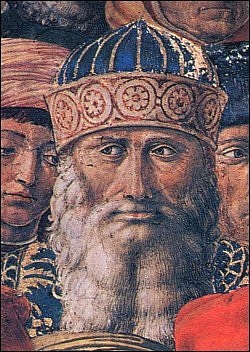 George Gemistos Plethon Benozzo Gozzoli (Public Domain) ](https://www.worldhistory.org/image/12572/george-gemistos-plethon/ "George Gemistos Plethon")Plethon also furthered Greek thinking on Hellenism. The term 'Hellene' had been derided as meaning pagan for centuries, but in the last few centuries of the Byzantine Empire, the term was reclaimed to refer to Greeks. While a Roman identity was still predominant, the idea of Hellenism gained considerable currency among Byzantine intellectuals, and Plethon encouraged this thinking, which also played into the idea of the Morea surviving as a fortress in an Ottoman sea, an island of Greek thought and culture. Other leading Greek thinkers of the day spent time at Mystras, including Isidore of Kiev, Bessarion of Trebizond, and John Eugenicus, who learned from Plethon. When a Venetian army briefly captured Mystras in 1465 CE and was forced to retreat, the commander took Plethon's body with him as the greatest treasure Mystras had to offer.
### An Ottoman Afterlife
Following the end of the Despotate of the Morea, the Ottomans created two *sanjaks*, or provinces, in the Morea. One of these had its capital at Mystras, where the Turkish pasha presided from the palace of the despots. Generally, Ottoman rule in the Peloponnese was rather successful, and Mystras was prosperous and the province peaceful for over two centuries, although the Greek population was treated differently from the Turkish rulers.
[  Palace Complex, Mystras Ava Babili (CC BY-NC-ND) ](https://www.worldhistory.org/image/12565/palace-complex-mystras/ "Palace Complex, Mystras")In 1687 CE, however, the Venetians under Francesco Morosini captured Mystras, along with other [cities](https://www.worldhistory.org/city/) in Southern Greece. The Venetians would rule in Mystras until 1715 CE, when they were ejected by the Ottomans. In 1770 CE, Mystras was taken by Russian-backed Greek rebellions during the Orlov Revolt. When the Turkish army arrived, the Russians fled to the coast. The city was mercilessly sacked and left in ruins. It partially recovered, only to be burned by the [Egyptian](https://www.worldhistory.org/disambiguation/Egyptian/)-Ottoman army of Ibrahim Pasha during the Greek [War](https://www.worldhistory.org/disambiguation/War/) of Independence in 1824 CE. The city was so devastated that rebuilding would be hopeless. Once the new Greek state was established in 1832 CE, the Greek king, Otto (r. 1832-1862 CE), decided to refound the ancient city of Sparta nearby instead in 1834 CE. Mystras would now just be the ruins of the city of despots, the former capital of the Byzantine Morea.
### Mystras Today
The ruins of Mystras still survive today. Mystras is a UNESCO World Heritage Site and features a museum and the partially restored ruins of the city. The only inhabitants today are a group of nuns who reside in the Pantanassa Monastery. Yet the ruins of the city walls and Villehardouin's fortress still rise above the surrounding plain. The majority of the most important churches are still standing, including St. Demetrios, the Hagia Sophia, St. George, and the Monastery of Peribleptos. The palace of the despots has undergone substantial restorations in the past decade, making it a significant attraction. Visitors can reach the ruins via the modern city of Sparti, which is only a few miles from Mystras. Although one of the lesser-known historical sites in Greece today, Mystras is a serene and haunting step back into the twilight of the Byzantine Empire and the brief renaissance that Mystras enjoyed.
#### Editorial Review
This human-authored definition has been reviewed by our editorial team before publication to ensure accuracy, reliability and adherence to academic standards in accordance with our [editorial policy](https://www.worldhistory.org/static/editorial-policy/).
## Bibliography
- John VI Kantakouzenos, Robert H. Trone. *The History of John Kantakouzenos.* University of Michigan, Ann Arbor, 1979
- [Nicol, Donald M. *The Last Centuries of Byzantium, 1261-1453.* Cambridge University Press, 2008.](https://www.worldhistory.org/books/0521439914/)
- [Nicol, Donald M. *The Reluctant Emperor.* Cambridge University Press, 1998.](https://www.worldhistory.org/books/0521522013/)
- [Ostrogorsky, George & Illustrated. *History of the Byzantine State.* Rutgers University Press, 1969.](https://www.worldhistory.org/books/0631110704/)
- [Runciman, Steven & Freely, John. *The Lost Capital of Byzantium.* Harvard University Press, 2009.](https://www.worldhistory.org/books/0674034058/)
- [Sphrantzes, George. *The Fall of the Byzantine Empire.* Univ of Massachusetts Pr, 1980.](https://www.worldhistory.org/books/0870232908/)
## About the Author
Michael holds degrees in History and Near Eastern Languages and Civilizations from the University of Chicago, where he prmarily studied Byzantine history. He also has a J.D. from the University of Michigan Law School.
- [Linkedin Profile](https://www.linkedin.com/https://www.linkedin.com/in/mic)
## Timeline
- **1249 CE**: William II of Villehardouin founds [Mystras](https://www.worldhistory.org/Mystras/).
- **1259 CE**: [Battle](https://www.worldhistory.org/disambiguation/battle/) of Pelagonia: Manfred of [Sicily](https://www.worldhistory.org/sicily/) and William II of Villehardouin are defeated by the [Empire of Nicaea](https://www.worldhistory.org/Empire_of_Nicaea/). William is forced to cede the castles of [Mystras](https://www.worldhistory.org/Mystras/), Maina, and Monemvasia.
- **1262 CE**: [Mystras](https://www.worldhistory.org/Mystras/) is retaken by the Byzantines.
- **c. 1289 CE**: The Byzantines move the provincial capital of the Morea from Monemvasia to [Mystras](https://www.worldhistory.org/Mystras/).
- **1349 CE - 1460 CE**: [Mystras](https://www.worldhistory.org/Mystras/) is the capital of the semi-autonomous [Byzantine](https://www.worldhistory.org/disambiguation/Byzantine/) [Despotate of the Morea](https://www.worldhistory.org/Despotate_of_the_Morea/).
- **1361 CE**: Matthew Kantakouzenos moves to [Mystras](https://www.worldhistory.org/Mystras/).
- **1380 CE - 1383 CE**: Matthew Kantakouzenos rules as despot of the Morea.
- **1383 CE - c. 1384 CE**: Rebellion of Demetrios Kantakouzenos against the Palaiologos Dynasty in the Morea.
- **1383 CE - 1407 CE**: Theodore I Palaiologos reigns as despot of the Morea.
- **1407 CE - 1443 CE**: Rule of Theodore II Palaiologos, despot of the Morea.
- **c. 1407 CE - 1452 CE**: George Gemistos Plethon lives at [Mystras](https://www.worldhistory.org/Mystras/).
- **1408 CE**: Visit of Manuel II Palaiologos, [Byzantine emperor](https://www.worldhistory.org/Byzantine_Emperor/), to [Mystras](https://www.worldhistory.org/Mystras/).
- **1415 CE**: Visit of [Byzantine emperor](https://www.worldhistory.org/Byzantine_Emperor/) Manuel II Palaiologos to [Mystras](https://www.worldhistory.org/Mystras/).
- **1449 CE**: [Constantine](https://www.worldhistory.org/disambiguation/Constantine/) XI Palaiologos is crowned as the last [Byzantine emperor](https://www.worldhistory.org/Byzantine_Emperor/) in [Mystras](https://www.worldhistory.org/Mystras/).
- **1460 CE - 1461 CE**: The Ottomans [conquer](https://www.worldhistory.org/warfare/) the [Despotate of the Morea](https://www.worldhistory.org/Despotate_of_the_Morea/).
## Cite This Work
### APA
Goodyear, M. (2020, August 13). Mystras. *World History Encyclopedia*.
### Chicago
Goodyear, Michael. "Mystras." *World History Encyclopedia*, August 13, 2020. .
### MLA
Goodyear, Michael. "Mystras." *World History Encyclopedia*, 13 Aug 2020, .
## License & Copyright
Submitted by [Michael Goodyear](https://www.worldhistory.org/user/mpgoodyear/ "User Page: Michael Goodyear"), published on 13 August 2020. The copyright holder has published this content under the following license: [Creative Commons Attribution-NonCommercial-ShareAlike](https://creativecommons.org/licenses/by-nc-sa/4.0/deed.en). This license lets others remix, tweak, and build upon this content non-commercially, as long as they credit the author and license their new creations under the identical terms. When republishing on the web a hyperlink back to the original content source URL must be included. Please note that content linked from this page may have different licensing terms.