---
title: Michelangelo
author: Mark Cartwright
source: https://www.worldhistory.org/Michelangelo/
format: machine-readable-alternate
license: Creative Commons Attribution-NonCommercial-ShareAlike (https://creativecommons.org/licenses/by-nc-sa/4.0/)
updated: 1970-01-01
---
# Michelangelo
_Authored by [Mark Cartwright](https://www.worldhistory.org/user/markzcartwright/)_
Michelangelo (1475-1564 CE) was an Italian artist, architect and poet, who is considered one of the greatest and most influential of all Renaissance figures. His most celebrated works, from a breathtaking portfolio of masterpieces, include the ceiling of the Sistine Chapel in [Rome](https://www.worldhistory.org/Rome/) and the [giant](https://www.worldhistory.org/Giants/) marble statue of David, which resides in the Galleria dell'Accademia of Florence.
Esteemed by his contemporaries as the greatest of living artists, Michelangelo was hugely influential on the artistic styles of High Renaissance, Mannerism, and Baroque. Still today, the great man's works continue to wrench from art lovers worldwide the feelings he expressly intended to produce in all of his art no matter the medium: admiration of form and motion, surprise and awe.
### Early Life
Michelangelo di Lodovico Buonarroti was born in 1475 CE in Caprese, a small town near Florence, [Italy](https://www.worldhistory.org/italy/). Unlike many other famous artists, Michelangelo was born into a prosperous family. When he reached 13 years of age, he was sent off to study in Florence under the celebrated [fresco](https://www.worldhistory.org/disambiguation/Fresco/) painter Domenico Ghirlandaio (c. 1449-1494 CE). The young artist spent two years as Ghirlandaio's apprentice but also visited many churches in the [city](https://www.worldhistory.org/city/), studying their artworks and making sketches. Michelangelo's big break came when his work was noticed by Lorenzo de Medici (1449-1492 CE), head of the great Florentine family of that name and a generous patron of the arts. It was in Lorenzo's impressive [sculpture](https://www.worldhistory.org/disambiguation/Sculpture/) garden that the young artist was able to study firsthand the works of the great sculptors of antiquity, especially [Roman](https://www.worldhistory.org/disambiguation/Roman/) sarcophagi decorated in high relief, and learn from the garden's artistic curator and noted sculptor Bertoldo di Giovanni (c. 1420-1491 CE). Michelangelo would later create Lorenzo de Medici's marble [tomb](https://www.worldhistory.org/tomb/) in the Medici family church of San Lorenzo in Florence.
The influence these Classical works had on Michelangelo is evident in the writhing figures in one of his first great masterpieces, the relief sculpture known as *The [Battle](https://www.worldhistory.org/disambiguation/battle/) of Centaurs and Lapiths* which is now on display in the Casa Buonarroti in Florence. The artist's preoccupation with antiquity in the first half of his career is amply evidenced in his work but also in his numerous deliberate attempts to pass off sculptures as actually ancient. In 1496 CE, for example, he sculpted the *Sleeping Cupid* (now lost) which he purposely aged to make it appear an authentic ancient work and which he successfully sold to Cardinal Raffaele Riario.
[  The Creation of Adam by Michelangelo Alonso de Mendoza (Public Domain) ](https://www.worldhistory.org/image/12580/the-creation-of-adam-by-michelangelo/ "The Creation of Adam by Michelangelo")Michelangelo was, then, already focussing on the technique known as *disegno* where an artist concentrated above all in trying to capture the form, musculature, and poses of the human body through sketches on paper of Classical works which were then transformed into an entirely new sculpture or painting. Michelangelo also added to this artistic heritage a passion for rendering his figures with dramatic poses and doing so on a monumental scale, which perhaps explains his own preference for sculpture over other [media](https://www.worldhistory.org/disambiguation/media/). The combination of realist execution, grandeur, and dynamism would become the hallmark of the master's works in all media as he strove to create a world more beautiful than actually existed in reality.
### The Leading Renaissance Artist
In 1496 CE Michelangelo moved on to Rome which gave him yet more opportunities to study examples of Classical art and [architecture](https://www.worldhistory.org/disambiguation/architecture/). It was in this period he created another masterpiece, the *Pietà* (see below). Returning to Florence c. 1500 CE, the artist was now well established and he was commissioned to create a figure for no less a place than the Cathedral of Florence. Michelangelo was given a massive block of highly-prized Carrara marble that nobody quite knew what to do with. The result was another masterpiece, probably the artist's most famous sculpture of all: *David* (see below). Next up was a chef-d'oeuvre using paints, demonstrating Michelangelo was by no means limited to sculpture. *The Holy Family* was painted in 1503 CE and the work is now in the Uffizi Gallery in Florence. Next came an intriguing meeting of great minds when Michelangelo and [Leonardo da Vinci](https://www.worldhistory.org/Leonardo_da_Vinci/) (1452-1519 CE) both worked on frescoes in the Council Hall of Florence. The subject of Michelangelo's work was the Battle of Cascina but, like Leonardo's effort here, it was left unfinished. It can only be speculated what each great artist might have learned from the other at this time.
Michelangelo returned to Rome to work on the tomb of Pope [Julius](https://www.worldhistory.org/disambiguation/Julius/) II (r. 1503-1513 CE), and then he was given perhaps his most challenging commission - to paint the ceiling of the Vatican City's Sistine Chapel (see below). Despite working largely alone and very often in an uncomfortable position on top of a scaffold, the ceiling was completed remarkably quickly. Finished by 1512 CE, the work may not have pleased everyone in the Church, but its central vision of [God](https://www.worldhistory.org/God/) amongst [the clouds](https://www.worldhistory.org/The_Clouds/) reaching out to touch the finger of Adam has become one of the most reproduced images of all time.
[  David by Michelangelo Joe Hunt (CC BY) ](https://www.worldhistory.org/image/7451/david-by-michelangelo/ "David by Michelangelo")Michelangelo would continue to sculpt and, much more rarely, paint for the rest of his life. He continued to write his much-admired sonnets which were frequently dedicated to the poetess Vittoria Colonna (1490-1547 CE), although many were scribbled on the backs of sketches and bills. In this example, *Sonnet 151* (c. 1538-1544 CE), the artist compares art's failure to prevent [death](https://www.worldhistory.org/disambiguation/Death/) with the search for true love:
> Not even the best of artists has any conception
> that a single marble block does not contain
> within its excess, and that is only attained
> by the hand that obeys the intellect.
> The pain I flee from and the joy I hope for
> are similarly hidden in you, lovely lady,
> lofty and divine; but, to my mortal harm,
> my art gives results the reverse of what I wish.
> Love, therefore, cannot be blamed for my pain,
> nor can your beauty, your hardness, or your scorn,
> nor fortune, nor my destiny, nor chance,
> if you hold both death and mercy in your heart
> at the same time, and my lowly wits, though burning,
> cannot draw from it anything but death.
> (Paoletti, 404)
There were, too, many important architectural projects, such as the Laurentian Library, San Lorenzo, Florence (1525 CE) with its 46-metre (150 ft.) long reading room, a triumphal combination of aesthetics and function. Other projects included the new-look Capitoline Hill in Rome (begun in 1544 CE), the soaring dome of St. Peter's Basilica in Rome (from 1547 CE but not completed until 1590 CE) for which Michelangelo refused to accept a salary, and the Medici sepulchral chapel in Florence. Fittingly, throughout the 16th century CE, the Medici chapel became a place frequently visited by aspiring artists who came to admire and learn from this master of the arts' unique and visionary combination of architecture and sculpture. Michelangelo died on 18 February 1564 CE in Rome and was buried with much ceremony in the Basilica of Santa Croce in Florence.
[  Bust of Michelangelo Sailko (CC BY-SA) ](https://www.worldhistory.org/image/12576/bust-of-michelangelo/ "Bust of Michelangelo")### Reputation & Legacy
The great artist was himself captured in several surviving works of art. One striking example is the [bronze](https://www.worldhistory.org/disambiguation/bronze/) bust by his compatriot Daniele da [Volterra](https://www.worldhistory.org/Volterra/) (1509-1566 CE), which, created c. 1564 CE, now resides in the Bargello of Florence. The sculpture is realistic and shows the bearded Michelangelo with wrinkles aplenty and with the slightly flattened nose he had carried ever since the artist Pietro Torrigiano (1472-1528 CE) had broken it when the pair were youths (Torrigiano was exiled from Florence as a consequence).
A more detailed record of Michelangelo survives in two biographies written during the artist's lifetime by Giorgio Vasari (1511-1574 CE) and Ascanio Condivi (1525-1574 CE). The Tuscan artist Vasari completed his *The Lives of the Most Excellent Italian Architects, Painters, and Sculptors* in 1550 CE but then extensively revised and expanded the work in 1568 CE. The history is a monumental record of Renaissance artists, their works and the anecdotal stories associated with them, and so Vasari is considered one of the pioneers of art history. Fellow Italian artist Condivi, meanwhile, was a pupil of Michelangelo's in Rome, and he wrote his *Life of Michelangelo* in 1553 CE, a work which was supervised by the great master himself (which perhaps explains a number of fictitious or exaggerated elements).
[  Pieta by Michelangelo Stanislav Traykov (CC BY-SA) ](https://www.worldhistory.org/image/12578/pieta-by-michelangelo/ "Pieta by Michelangelo")These two biographies helped establish Michelangelo's reputation as a living legend as fellow artists recognised his genius and contribution to the revival of art during the Renaissance. Naturally, Michelangelo's great works spoke for themselves, and those who could not see them in person could admire or study them in the many engravings made which were distributed across [Europe](https://www.worldhistory.org/europe/). His fame also went beyond Europe. The Sultan of the [Ottoman Empire](https://www.worldhistory.org/Ottoman_Empire/) Bayezid II (r. 1481-1512 CE) heard of the artist's skills and invited him, without success, to his court. Michelangelo's works were even being collected, especially in France. In short, Michelangelo was considered nothing less than divine - a term frequently used for the artist during his lifetime - and a possessor of awesome artistic power, what his contemporaries termed *terribilità*. The light the great man cast on Western art and architecture continued to shine long after his death and his work was especially influential on the development of Mannerism and the subsequent Baroque style.
### Masterpieces
**Pietà**
The *Pietà* is a depiction in marble of the [Virgin Mary](https://www.worldhistory.org/Mary,_Mother_of_Jesus/) who mourns over the body of [Jesus Christ](https://www.worldhistory.org/Jesus_Christ/) which rests across her lap. Completed between 1497 and 1500 CE, the work was commissioned by a French cardinal for his tomb in a chapel in Rome. Standing 1.74 metres (5 ft. 8 inches) tall, it now resides in St. Peter's Basilica. The work combines all aspects of the sculptor's art: a hyper-realistic depiction of the human body, complex folds of drapery, the serene and contemplative face of Mary, the languid corpse of [Jesus](https://www.worldhistory.org/Jesus_Christ/), and a composition that reminds of northern devotional statues but offers something never before seen in Italian art. That Michelangelo was highly satisfied with the result is evidenced in the anecdote that he subsequently added his signature after a rival artist had claimed to have been its creator.
[  Michelangelo's David David Michalczuk (CC BY) ](https://www.worldhistory.org/image/12577/michelangelos-david/ "Michelangelo's David")**David**
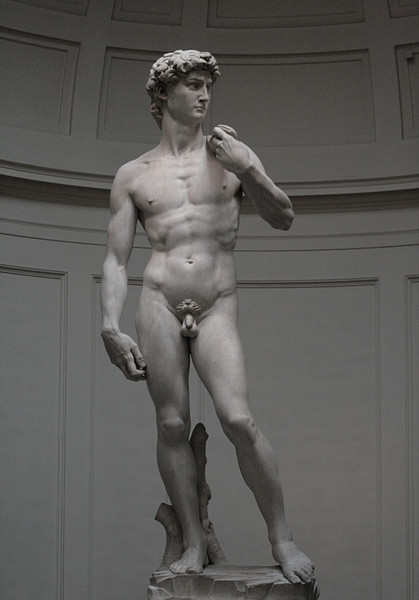
As mentioned above, Michelangelo's offering to the Cathedral of Florence was a marble sculpture of the Biblical [king David](https://www.worldhistory.org/King_David/) who, in his youth, famously killed the troublesome giant Goliath. The figure is much larger than life-size - around 5.20 metres (17 feet) tall - and so big that it could not be placed on the roof of the cathedral as intended but was stood instead in the facing square. Michelangelo received around 400 florins for a work he had started in 1501 CE and completed in 1504 CE. David now stands in the Accademia Gallery of Florence while a full-size replica stands in the open air of the Palazzo della Signoria.
The figure is all white now but originally had three gilded elements: the tree stump support, a waist belt of leaves and a garland on his head. The only identification that this is a figure of David is the sling over the figure's left shoulder. Further, the maturity of the body for what really should be a youth, together with the nudity of the figure, strongly remind of the colossal statues of antiquity, especially of [Hercules](https://www.worldhistory.org/hercules/). It cannot be coincidental that Hercules also appeared on the official seal of the city of Florence. Here, then, was a message in art that the city believed itself the equal, perhaps even the better of any city in antiquity. Michelangelo has clearly gone beyond the restraints of Classical sculpture and created a figure which is palpably tense, an effect only accentuated by David's furrowed brow and determined stare.
**The Sistine Chapel**
As noted, Michelangelo was commissioned to paint the ceiling of the Sistine Chapel, a building only just completed in 1480 CE. The ceiling had cracked badly in 1504 CE and was repaired. This, then, was an opportunity to add to the chapel's already impressive interior decoration. Michelangelo was far from keen on the project which would occupy him from 1508 to 1512 CE - and there were frequent heated quarrels with the Pope - but it is today considered one of his signature works. The frescos are painted in very bright colours and, to aid the viewer who must stand some metres below, Michelangelo used the technique of contrasting colours next to each other.
[  The Last Judgement by Michelangelo Alonso de Mendoza (Public Domain) ](https://www.worldhistory.org/image/12581/the-last-judgement-by-michelangelo/ "The Last Judgement by Michelangelo")The entire ceiling covers an area measuring 39 x 13.7 metres (128 x 45 ft.). The separate panels show a cycle of episodes from the [Bible](https://www.worldhistory.org/bible/) narrating the Creation to the time of [Noah](https://www.worldhistory.org/Noah/). Interestingly, the creation of Eve is the central panel, not the creation of Adam, although this may simply be because the scenes are chronological starting from the altar [wall](https://www.worldhistory.org/wall/). There are also seven prophets, five sibyls, and four *ignudi* which have nothing whatsoever to do with the religious narrative but which show Michelangelo's love of boldly rendered figures in dramatic poses.
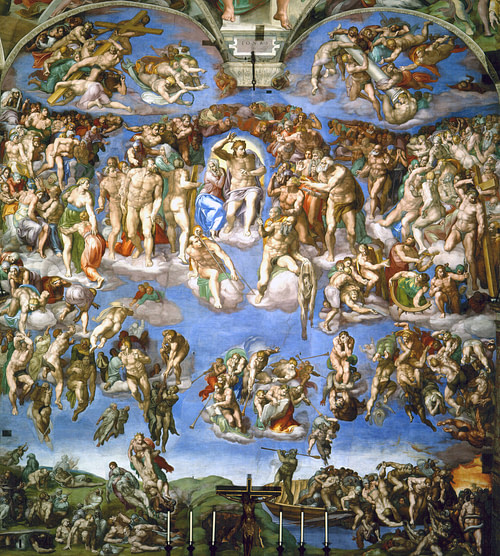
The work was an immediate success with almost everyone who saw it but there were some rumblings of discontent. The main objection was the amount of nudity and the depiction of genitalia in a handful of figures. In addition, *The Last Judgement* section of the chapel, which was added to the altar much later by Michelangelo between 1536 and 1541 CE, was also not well-received by some members of the clergy. The fact that Jesus did not have his conventional beard and looked a bit younger than usual were particular points of contention. The artist's grasp of essential theology, or perhaps his lack of concern with it for he was noted for his piety, and the appearance of yet more genitalia led to some clergy going so far as to declare the work a heresy. There were even calls to destroy it. Fortunately for posterity, the more moderate strategy was adopted of covering the offending nude elements. The task of retouching the frescoes was given to Daniele da Volterra, and this artist consequently gained the rather unfortunate nickname of *Il Braghettone* or 'the breeches-maker'.
[  Moses by Michelangelo Jörg Bittner Unna (CC BY) ](https://www.worldhistory.org/image/12579/moses-by-michelangelo/ "Moses by Michelangelo")**[Moses](https://www.worldhistory.org/Moses/)**
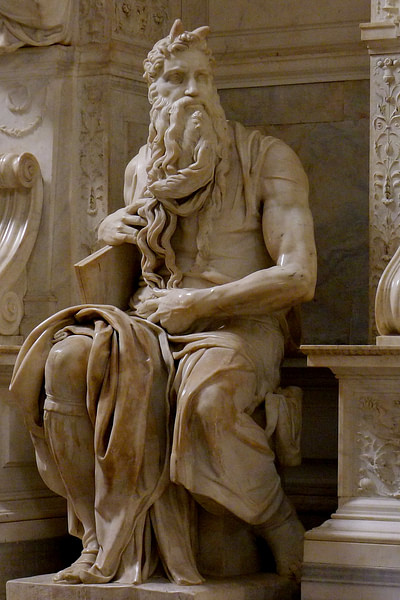
As mentioned, Michelangelo was commissioned by Julius II in 1505 CE to design an imposing tomb for the leader of the Roman Church. Starting out on paper as a grandiose monument, the tomb was finally completed in 1547 CE after many of the planned extravagances were abandoned. One survivor is the seated statue of Moses sculpted by Michelangelo which has the biblical figure holding his staff and pulling on an impressively long beard, apparently to demonstrate his awe of God. The statue was meant to be seen from below and hence Michelangelo incorporated several optical corrections. The figure, measuring 2.35 metres (7 ft. 9 inches) in height, was completed around 1520 CE and resides in the San Pietro in Vincoli church in Rome.
#### Editorial Review
This human-authored definition has been reviewed by our editorial team before publication to ensure accuracy, reliability and adherence to academic standards in accordance with our [editorial policy](https://www.worldhistory.org/static/editorial-policy/).
## Bibliography
- [Anderson, Christy. *Renaissance Architecture.* Oxford University Press, 2013.](https://www.worldhistory.org/books/0192842277/)
- [Campbell, Gordon. *The Oxford Illustrated History of the Renaissance.* Oxford University Press, 2019.](https://www.worldhistory.org/books/019871615X/)
- [Giorgio Vasari - Lives (Michelangelo)](https://www.gutenberg.org/files/32362/32362-h/32362-h.htm "Giorgio Vasari - Lives (Michelangelo)"), accessed 18 Aug 2020.
- [Hale, J.R. *The Thames & Hudson Dictionary of the Italian Renaissance by J. R. Hale.* Thames & Hudson, 2020.](https://www.worldhistory.org/books/B01K0SPLDW/)
- [Murray, Peter. *The Architecture of the Italian Renaissance.* Schocken, 1997.](https://www.worldhistory.org/books/0805210822/)
- [Paoletti, John T. & Radke, Gary M. *Art in Renaissance Italy.* Pearson, 2011.](https://www.worldhistory.org/books/0205010474/)
- [Rundle, David. *The Hutchinson Encyclopedia of the Renaissance.* Helicon, 1999.](https://www.worldhistory.org/books/1859862691/)
- [Welch, Evelyn. *Art in Renaissance Italy.* Oxford University Press, 2001.](https://www.worldhistory.org/books/019284279X/)
- [Woods, Kim W. *Making Renaissance Art.* Yale University Press, 2007.](https://www.worldhistory.org/books/030012189X/)
## About the Author
Mark is WHE’s Publishing Director and has an MA in Political Philosophy (University of York). He is a full-time researcher, writer, historian and editor. Special interests include art, architecture and discovering the ideas that all civilizations share.
## Timeline
- **1475 CE**: The Renaissance artist [Michelangelo](https://www.worldhistory.org/Michelangelo/) is born in Caprese near Florence.
- **1475 CE - 1564 CE**: Life of the Italian Renaissance artist [Michelangelo](https://www.worldhistory.org/Michelangelo/).
- **1488 CE - 1490 CE**: The Italian Renaissance artist [Michelangelo](https://www.worldhistory.org/Michelangelo/) studies as an apprentice to Domenico Ghirlandaio in Florence.
- **1497 CE - 1500 CE**: The Italian Renaissance artist [Michelangelo](https://www.worldhistory.org/Michelangelo/) works on his masterpiece the Pieta.
- **1503 CE**: The Italian Renaissance artist [Michelangelo](https://www.worldhistory.org/Michelangelo/) paints 'The Holy Family'.
- **1504 CE**: The Italian Renaissance artist [Michelangelo](https://www.worldhistory.org/Michelangelo/) completes his masterpiece the statue of David.
- **1508 CE - 1512 CE**: The Italian Renaissance artist [Michelangelo](https://www.worldhistory.org/Michelangelo/) works on his painting of the Sistine Chapel ceiling in [Rome](https://www.worldhistory.org/Rome/).
- **1512 CE**: The Laurentian Library, San Lorenzo in Florence, designed by [Michelangelo](https://www.worldhistory.org/Michelangelo/), is completed.
- **c. 1520 CE**: The Italian Renaissance artist [Michelangelo](https://www.worldhistory.org/Michelangelo/) completes his masterpiece statue of [Moses](https://www.worldhistory.org/Moses/) for the [tomb](https://www.worldhistory.org/tomb/) of Pope [Julius](https://www.worldhistory.org/disambiguation/Julius/) II.
- **1544 CE**: The Italian Renaissance artist [Michelangelo](https://www.worldhistory.org/Michelangelo/) begins his redesign of the Capitoline Hill in [Rome](https://www.worldhistory.org/Rome/).
- **1547 CE**: The Italian Renaissance artist [Michelangelo](https://www.worldhistory.org/Michelangelo/) begins working on the soaring dome of St. Peter's Basilica in [Rome](https://www.worldhistory.org/Rome/) (completed in 1590 CE).
- **1553 CE**: Ascanio Condivi completes his 'Life of [Michelangelo](https://www.worldhistory.org/Michelangelo/)'.
- **18 Feb 1564 CE**: The Italian Renaissance artist [Michelangelo](https://www.worldhistory.org/Michelangelo/) dies in [Rome](https://www.worldhistory.org/Rome/).
## External Links
- [Michelangelo Buonarroti, Royal Academy of Arts](https://www.royalacademy.org.uk/art-artists/name/michelangelo-buonarroti)
- [Michelangelo: Mind of the Master, J. Paul Getty Museum](https://www.getty.edu/art/exhibitions/michelangelo_drawings/explore.html)
- [The story of Michelangelo's David, V&A](https://www.vam.ac.uk/articles/the-story-of-michelangelos-david?srsltid=AfmBOorYZBahC2nsDb-ecLhSsws9dG-vmFlu2YqDkPqYc_C-Esoz2MEa)
- [Michelangelo, smART History](https://smarthistory.org/europe-1300-1800/italy-16th-century/michelangelo/)
## Cite This Work
### APA
Cartwright, M. (2020, August 18). Michelangelo. *World History Encyclopedia*.
### Chicago
Cartwright, Mark. "Michelangelo." *World History Encyclopedia*, August 18, 2020. .
### MLA
Cartwright, Mark. "Michelangelo." *World History Encyclopedia*, 18 Aug 2020, .
## License & Copyright
Submitted by [Mark Cartwright](https://www.worldhistory.org/user/markzcartwright/ "User Page: Mark Cartwright"), published on 18 August 2020. The copyright holder has published this content under the following license: [Creative Commons Attribution-NonCommercial-ShareAlike](https://creativecommons.org/licenses/by-nc-sa/4.0/deed.en). This license lets others remix, tweak, and build upon this content non-commercially, as long as they credit the author and license their new creations under the identical terms. When republishing on the web a hyperlink back to the original content source URL must be included. Please note that content linked from this page may have different licensing terms.