---
title: Meroë
author: Joshua J. Mark
source: https://www.worldhistory.org/Meroe/
format: machine-readable-alternate
license: Creative Commons Attribution-NonCommercial-ShareAlike (https://creativecommons.org/licenses/by-nc-sa/4.0/)
updated: 1970-01-01
---
# Meroë
_Authored by [Joshua J. Mark](https://www.worldhistory.org/user/JPryst/)_
Meroe was a wealthy metropolis of the ancient kingdom of [Kush](https://www.worldhistory.org/Kush/) in what is today the Republic of Sudan. It was the later capital of the Kingdom of Kush (c. 1069 BCE to c. 350 CE) after the earlier capital of Napata was sacked c. 590 BCE. Prior to that date, Meroe had been an important administrative centre.
The [city](https://www.worldhistory.org/city/) was located at the crossroads of major [trade](https://www.worldhistory.org/disambiguation/trade/) routes and flourished from c. 750 BCE to 350 CE. Meroe is listed by UNESCO as a World Heritage Site. As no one yet has been able to decipher the Meroitic [script](https://www.worldhistory.org/script/), very little can be said for certain on how Meroe grew to become the wondrous city written about by [Herodotus](https://www.worldhistory.org/herodotus/) circa 430 BCE, but it is known that the city was so famous for its wealth in ancient times that [Cambyses II](https://www.worldhistory.org/Cambyses_II/) of the Persian [Achaemenid Empire](https://www.worldhistory.org/Achaemenid_Empire/) mounted an expedition to capture it. The expedition faltered long before reaching the city owing to the difficult and inhospitable terrain of the desert (and, according to some claims, may never have been mounted at all). Still, the persistence of the story of Cambyses' expedition suggests the great fame of Meroe as a wealthy metropolis.
The city was also known as the Island of Meroe as the waters flowing around it made it appear so. It is referenced in the biblical [Book of Genesis](https://www.worldhistory.org/Book_of_Genesis/) (10:6) as Aethiopia, a name applied to the region south of [Egypt](https://www.worldhistory.org/egypt/) in antiquity meaning "place of the burnt-faces". Although there is evidence of overgrazing and overuse of the land, which caused considerable problems, Meroe thrived until it was sacked by an Aksumite king c. 330 CE and declined steadily afterwards.
### [Egyptian](https://www.worldhistory.org/disambiguation/Egyptian/) Influence & King [Ergamenes](https://www.worldhistory.org/Ergamenes/)
While there was a settlement at Meroe as early as 890 BCE (the oldest [tomb](https://www.worldhistory.org/tomb/) discovered there, that of 'Lord A', dates from that year), the city flourished at its height between c. 750 BCE and 350 CE. The Kingdom of Kush, founded with its capital at Napata, was ruled by Kushites (called "Nubians" by the Egyptians) who, early on, continued Egyptian practices and customs and, though they were depicted in art as distinctly Kushite, called themselves by Egyptian titles. The historian Marc Van De Mieroop writes:
> Meroitic [culture](https://www.worldhistory.org/disambiguation/culture/) shows much Egyptian influence, always mixed with local ideas. Many temples housed cults to Egyptian gods like [Amun](https://www.worldhistory.org/amun/) (called Amani) and [Isis](https://www.worldhistory.org/isis/), but indigenous deities received royal patronage as well. A very prominent Nubian [god](https://www.worldhistory.org/God/) was the lion-deity Apedemak, a god of [war](https://www.worldhistory.org/disambiguation/War/) whose popularity increased substantially in this period. Local gods were often associated with Egyptian ones: in Lower Nubia, \[the god\] Mandulis, for example, was considered to be [Horus](https://www.worldhistory.org/Horus/)'s son. Hybridity is also visible in the arts and in royal ideology. For example, kings of Meroe were represented in monumental images on temples in Egyptian fashion but with local elements, such as garments, crowns, and weapons. (338).
In time, however, these practices gave way to indigenous customs and the [Egyptian hieroglyphs](https://www.worldhistory.org/Egyptian_Hieroglyphs/) were replaced by a new system of [writing](https://www.worldhistory.org/writing/) known as Meroitic. The break from [Egyptian culture](https://www.worldhistory.org/Egyptian_Culture/) is explained by the ancient historian [Diodorus Siculus](https://www.worldhistory.org/Diodorus_Siculus/) who writes that in the time before the reign of King Ergamenes (295-275 BCE), it had been the custom for the high priests of the Egyptian god Amun at Napata to decide who became king and to set the duration of the king's reign.
As the health of the king was tied to the fertility of the land, the priests had the power to determine if the sitting king was no longer fit to rule. If they deemed him unfit, they would send a message to the king, understood to be from the god Amun himself, advising him that the time of his rule on earth was completed and that he must die. The kings had always obeyed the divine orders and had taken their own lives for the supposed good of the people. However, Diodorus continues:
> \[Ergamenes,\] who had received instruction in [Greek philosophy](https://www.worldhistory.org/Greek_Philosophy/), was the first to disdain this command. With the determination worthy of a king he came with an armed force to the forbidden place where the golden [temple](https://www.worldhistory.org/temple/) of the Aithiopians was situated and slaughtered all the priests, abolished this tradition, and instituted practices at his own discretion.
The archaeologist George A. Reisner, who excavated the [cities](https://www.worldhistory.org/city/) of Meroe and Napata, has famously questioned Diodorus' account calling it "very dubious" and claiming that the Ergamenes story was a national myth which Diodorus accepted as historical truth. Since there is no ancient evidence contradicting Diodorus, however, and since there was clearly a significant cultural break between Meroe and Egypt with Ergamenes' reign, most scholars today accept the account of Diodorus as either certain or something close to actual events.
[  Candace Amanitore of Meroe Sven-Steffen Arndt (CC BY-SA) ](https://www.worldhistory.org/image/287/candace-amanitore-of-meroe/ "Candace Amanitore of Meroe")### Candaces: The Queens of Meroe
Ergamenes (also known as Arkamani I) was the first king to institute [burial](https://www.worldhistory.org/burial/) outside of Meroe (instead of following the practice of burying the dead at Napata according to Egyptian custom) and passed the laws which would make Meroe a culture distinct from that of Egypt. Egyptian language, writing, and art disappear from the archaeological evidence after this time, roughly 285 BCE.
The [ancient Egyptian gods](https://www.worldhistory.org/collection/194/ancient-egyptian-gods/) Isis and Amon-Ra were melded into the worship of Nubian deities like Apedemak the lion god, and queens, rather than male pharaohs, shared the political power in the land with the king. The title of the queen was Kentake, commonly rendered as 'Candace' (which most likely meant 'Queen Regent'or 'Queen Mother'), and there were at least seven Candaces between c. 170 BCE and c. 314 CE.
The Candace Amanishakheto is depicted as extremely fat, a towering figure conquering her enemies who are all rendered as smaller and helpless in her grasp, and the Candace Amanitore is shown in the same way, on the Lion Temple at Naga, clearly illustrating the power and prestige [women](https://www.worldhistory.org/disambiguation/women/) rulers had in the Meroitic culture.
Easily the most famous (though fictional) event illustrating the esteem in which the Candaces were held is the legendary tale from Pseudo-Callisthenes of [Alexander the Great](https://www.worldhistory.org/Alexander_the_Great/) being deftly turned aside from his attack on the kingdom by a Candace of Meroe in 332 BCE. According to this story, the Candace arrayed her army so perfectly that [Alexander](https://www.worldhistory.org/disambiguation/Alexander/), surveying the field of [battle](https://www.worldhistory.org/disambiguation/battle/), thought it more prudent to retreat than press an attack.
The true account of [Augustus](https://www.worldhistory.org/augustus/) [Caesar](https://www.worldhistory.org/disambiguation/caesar/)'s clash with the forces of Meroe in the Meroitic War (27-22 BCE), however, is actually more compelling. The Candace Amanirenas (c. 40-10 BCE) not only led her people through the war, orchestrating a number of successful engagements, but when hostilities ended she ably negotiated a peace treaty with Augustus which favored Meroitic interests over those of [Rome](https://www.worldhistory.org/Rome/); a very rare gesture for Augustus to offer.
[ 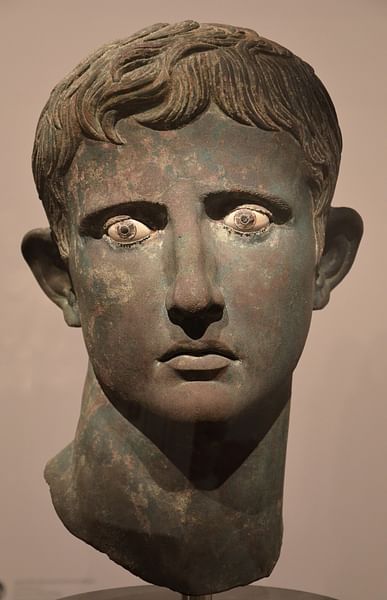 Bronze Head of Augustus Carole Raddato (CC BY-SA) ](https://www.worldhistory.org/image/2926/bronze-head-of-augustus/ "Bronze Head of Augustus")### The Rise & Fall of Meroe
The city of Meroe occupied over one square mile of fertile ground and, at its height, was a great center of iron smelting, [agriculture](https://www.worldhistory.org/disambiguation/Agriculture/), and trade. Van De Mieroop writes, "The Ptolemies \[of Egypt\] and Romans wanted African goods such as hardwoods, ivory, other exotica, and animals including elephants. Those animals had become important in [warfare](https://www.worldhistory.org/warfare/)" (340). One of the earliest documented cases of political cooperation between the Kingdom of Meroe and the [Ptolemaic Dynasty](https://www.worldhistory.org/Ptolemaic_Dynasty/) of Egypt, in fact, concerns Meroe supplying Egypt with elephants for war.
The iron industry of Meroe made the city as famous as its wealth and, of course, contributed greatly to that wealth as the ironworkers of Meroe were considered the best, and iron tools and weapons were much sought after. Situated fortuitously on the banks of the [Nile](https://www.worldhistory.org/nile/), Meroe overlooked rolling grasslands and fertile fields. Broad avenues are said to have opened the city to its people and they walked past statues of great stone rams to the Temple of Amun, located toward the city's center.
The royalty of the city lived in great palaces while the working class lived in rectangular houses of mud as well as huts (so surmised from archaeological evidence and ancient writings). The people gathered rainfall in great cisterns, the largest of which was 820 feet (250 m.) in diameter and 32 feet (10 m.) deep, decorated around the sides with figures of animals, providing enough water for a population of 300,000.
Today Meroe is the most extensive archaeological site in the Republic of Sudan, and the ruins of the [pyramids](https://www.worldhistory.org/pyramid/), palaces, and official buildings stand silent where the populous city once thrived. While some have speculated on a 'mysterious' disappearance of the people of Meroe, the victory stele on the site, erected by a Christian [Aksum](https://www.worldhistory.org/Kingdom_of_Axum/) King (thought to be King Ezana) makes it clear that the city was conquered by the Aksumites around the year 330 CE.
This date marks the [death](https://www.worldhistory.org/disambiguation/Death/) of the Meroitic written and spoken language. The Aksumite invasion, coupled with the overuse of the land leading to desertification, led to the rapid decline of Meroe. The iron industry, requiring enormous amounts of wood, led to deforestation of the surrounding lands while cattle grazing and agriculture destroyed fields and depleted the soil. Meroe was eventually abandoned and, by the 5th century CE, had been transformed into a city of mystery and legend.
#### Editorial Review
This human-authored definition has been reviewed by our editorial team before publication to ensure accuracy, reliability and adherence to academic standards in accordance with our [editorial policy](https://www.worldhistory.org/static/editorial-policy/).
## Bibliography
- [Diodorus Siculus. *Diodorus Siculus.* Loeb Classical Library, 1935.](https://www.worldhistory.org/books/0674993349/)
- [Durant, W. *Our Oriental Heritage.* Simon & Schuster, 1954.](https://www.worldhistory.org/books/B00005WJGO/)
- [Emberling, G. *Nubia.* Princeton University Press, 2011.](https://www.worldhistory.org/books/0615481027/)
- [Meroitic period](http://www.numibia.net/nubia/meroe.htm "Meroitic period"), accessed 1 Dec 2016.
- [Van De Mieroop, M. *A History of Ancient Egypt.* Wiley-Blackwell, 2010.](https://www.worldhistory.org/books/1405160713/)
- [Welsby, D.A. *The Kingdom of Kush.* Markus Wiener Pub, 1998.](https://www.worldhistory.org/books/1558761829/)
## About the Author
Joshua J. Mark is World History Encyclopedia's co-founder and Content Director. He was previously a professor at Marist College (NY) where he taught history, philosophy, literature, and writing. He has traveled extensively and lived in Greece and Germany.
- [Linkedin Profile](https://www.linkedin.com/pub/joshua-j-mark/38/614/339)
## Timeline
- **c. 890 BCE**: First [tomb](https://www.worldhistory.org/tomb/) built at [Meroe](https://www.worldhistory.org/Meroe/).
- **c. 750 BCE**: Kushite [City](https://www.worldhistory.org/city/) of [Meroe](https://www.worldhistory.org/Meroe/) is founded.
- **c. 590 BCE**: [Meroe](https://www.worldhistory.org/Meroe/) becomes capital of Kingdom of [Kush](https://www.worldhistory.org/Kush/) after the fall of Napata. .
- **295 BCE - 275 BCE**: Reign of King [Ergamenes](https://www.worldhistory.org/Ergamenes/) (Arakakamani) in [Meroe](https://www.worldhistory.org/Meroe/).
- **c. 285 BCE**: King [Ergamenes](https://www.worldhistory.org/Ergamenes/) slaughters the priests of [Amun](https://www.worldhistory.org/amun/) at Napata, breaks with [Egypt](https://www.worldhistory.org/egypt/).
- **c. 284 BCE - c. 314 CE**: Queens (Candaces) rule jointly with Kings in [Meroe](https://www.worldhistory.org/Meroe/).
- **c. 275 BCE**: [Ptolemy II](https://www.worldhistory.org/Ptolemy_II_Philadelphus/) invades the Meroitic Nubian kingdom and annexes Lower Nubia.
- **c. 205 BCE - c. 185 BCE**: Upper [Egypt](https://www.worldhistory.org/egypt/) and Lower Nubia secede from the [Ptolemaic Kingdom](https://www.worldhistory.org/Ptolemaic_Egypt/) with the support of [Meroe](https://www.worldhistory.org/Meroe/). Two Egyptians, Horwennefer and his successor Ankhwennefer are declared as [Pharaoh](https://www.worldhistory.org/pharaoh/) in the now independent territories.
- **22 BCE**: Peace Treaty favoring [Meroe](https://www.worldhistory.org/Meroe/) signed with [Rome](https://www.worldhistory.org/Rome/).
- **330 CE**: Invasion of [Meroe](https://www.worldhistory.org/Meroe/) by the Aksumites under King Ezana.
- **350 CE**: End of the Kingdom of [Kush](https://www.worldhistory.org/Kush/) and [city](https://www.worldhistory.org/city/) of [Meroe](https://www.worldhistory.org/Meroe/) in Nubia.
## External Links
- [Meroe, Sudan](http://www.flickr.com/photos/11683866@N06/2391385431/in/photostream/)
- [Archaeological Sites of the Island of Meroe](http://whc.unesco.org/en/list/1336)
- [Miniature Pyramids of Sudan](https://www.archaeology.org/issues/95-1307/features/940-sedeinga-necropolis-sudan-meroe-nubia)
- [Remains of Ancient Palace Discovered](http://www.livescience.com/15420-remains-ancient-palace-discovered-central-sudan.html)
- [Ancient Scripts: Meroïtic](http://www.ancientscripts.com/meroitic.html)
- [Pyramids of the Kingdom of Kush](https://www.heritagedaily.com/2018/02/pyramids-kingdom-kush/118369)
- [The Nubian Pyramids, The Tombs Of Sudan's 'Black Pharaohs'](https://allthatsinteresting.com/nubian-pyramids)
- [List of Rulers of Ancient Sudan | Lists of Rulers | Heilbrunn Timeline of Art History | The Metropolitan Museum of Art](https://www.metmuseum.org/toah/hd/sudan/hd_sudan.htm)
## Cite This Work
### APA
Mark, J. J. (2010, August 11). Meroë. *World History Encyclopedia*.
### Chicago
Mark, Joshua J.. "Meroë." *World History Encyclopedia*, August 11, 2010. .
### MLA
Mark, Joshua J.. "Meroë." *World History Encyclopedia*, 11 Aug 2010, .
## License & Copyright
Submitted by [Joshua J. Mark](https://www.worldhistory.org/user/JPryst/ "User Page: Joshua J. Mark"), published on 11 August 2010. The copyright holder has published this content under the following license: [Creative Commons Attribution-NonCommercial-ShareAlike](https://creativecommons.org/licenses/by-nc-sa/4.0/deed.en). This license lets others remix, tweak, and build upon this content non-commercially, as long as they credit the author and license their new creations under the identical terms. When republishing on the web a hyperlink back to the original content source URL must be included. Please note that content linked from this page may have different licensing terms.