---
title: Melqart
author: Mark Cartwright
source: https://www.worldhistory.org/Melqart/
format: machine-readable-alternate
license: Creative Commons Attribution-NonCommercial-ShareAlike (https://creativecommons.org/licenses/by-nc-sa/4.0/)
updated: 2024-08-29
---
# Melqart
_Authored by [Mark Cartwright](https://www.worldhistory.org/user/markzcartwright/)_
Melqart (also Melkarth or Melicarthus) was an important Phoenician [god](https://www.worldhistory.org/God/) and patron deity of the [city](https://www.worldhistory.org/city/) of [Tyre](https://www.worldhistory.org/Tyre/). Associated with the monarchy, sea, [colonization](https://www.worldhistory.org/disambiguation/colonization/), and commercial enterprise, both at home and abroad the god is a significant, if still somewhat mysterious, figure of the [Phoenician religion](https://www.worldhistory.org/Phoenician_Religion/). As with other Phoenician gods and their [culture](https://www.worldhistory.org/disambiguation/culture/) in general, first-hand information from the [Phoenicians](https://www.worldhistory.org/phoenicia/) themselves is scarce and details of worship and [mythology](https://www.worldhistory.org/mythology/) are sorely lacking. Historians have been obliged to piece together scraps of information from contemporary cultures and what can be discovered from [Phoenicia](https://www.worldhistory.org/phoenicia/)'s colonies. Nevertheless, Melqart's stature is attested by the reverence the god was accorded by two of the Phoenician's immediate successor cultures in the ancient [Mediterranean](https://www.worldhistory.org/disambiguation/mediterranean/): [Greece](https://www.worldhistory.org/greece/) and [Carthage](https://www.worldhistory.org/carthage/).
### Melqart's Associations
While [Baal](https://www.worldhistory.org/baal/), El, and Baalat were important deities at other Phoenician [cities](https://www.worldhistory.org/city/), Melqart was considered the head of the [pantheon](https://www.worldhistory.org/Pantheon/) at Tyre. Indeed, his very name means 'king of the city' (*melekqart*) and he was referred to as *Baal de Sor* or 'Lord of Tyre'. Melqart, in addition, assumed some of the characteristics of both [Adonis](https://www.worldhistory.org/Adonis/) and Eshmun as he was the focus of a festival of resurrection each year in the month of *Peritia* (February-March) in which a sacrifice was made by fire or a figure of the god was ritually burnt. Hence, his other name the 'fire of heaven'.
Melqart was considered by the Phoenicians to represent the monarchy, perhaps the king even represented the god, or vice-versa, so that the two became one and the same. The ruler was known by the similar term mlk-qrt, and the Hebrew prophet [Ezekiel](https://www.worldhistory.org/Ezekiel/) criticises the kings of Tyre for considering themselves god on earth. Melqart was also the patron of the sea, fertility, hunting, and colonization. Further, he was responsible for the cities commercial success as the discoverer (with the help of his consort Tyros) of the dye the Phoenicians extracted from the murex shellfish, which they used to create their famous purple cloth.
### Melqart's Temple & Worship
The god had a long-lasting temple dedicated in his name at Tyre, built during the reign of Hiram in the 10th century BCE. This seems to be the period when Melqart comes into his own as there are no references to the god prior to the 10th century BCE. Outside the god's temple, at a specially constructed altar, worship involved prayers, burning incense, the pouring of libations, and making offerings to the god of animal sacrifices, foodstuffs, and precious goods. In addition, votive columns made from wood (*aserah*) or stone (*betyl*) were placed upon sacrificial altars. These were inscribed with prayers and decorated in festivals with flowers and tree boughs. [Women](https://www.worldhistory.org/disambiguation/women/), foreigners, and pigs were not allowed in the sacred precinct of Melqart's temple, which also functioned as the city's treasury.
Melqart's temple was famously visited by Herodotus in the 5th century BCE who described its impressive entrance as having two columns, one of gold and one of emerald (Bk. 2:44). The [Greek](https://www.worldhistory.org/disambiguation/greek/) historian goes on to say that Melqart had a [tomb](https://www.worldhistory.org/tomb/) inside, supporting the theory that, involved as he was in the founding mythology of the city, perhaps Melqart was based on a historical person. Other classical authors say that Melqart's tomb was in southern Spain. [Alexander the Great](https://www.worldhistory.org/Alexander_the_Great/) wished to make a sacrifice at the temple's altar in the 4th century BCE but the priests refused this right to a foreigner, even a very powerful one.
At particular times of danger, for example [war](https://www.worldhistory.org/disambiguation/War/) or natural disaster, human sacrifices, largely children, were also made to appease Melqart at a special site, the *[tophet](https://www.worldhistory.org/Tophet/)*, a large enclosure with a sacrificial altar and tombs for the cremated remains of victims. No archaeological remains survive of a *tophet* in Phoenicia itself but references in ancient sources and their presence in several Phoenician colonies would suggest there likely was such a place at Tyre.
[ 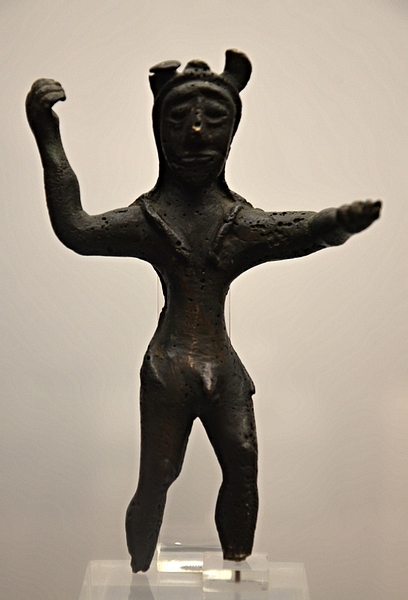 Votive Statue of Melqart Carole Raddato (CC BY-NC-SA) ](https://www.worldhistory.org/image/5032/votive-statue-of-melqart/ "Votive Statue of Melqart")Unlike in later Greek and [Roman](https://www.worldhistory.org/disambiguation/Roman/) temples, the Phoenicians seem not to have created large sculptural likenesses of their gods, the practice may even have been prohibited. Rather, at his temples Melqart was represented by an eternal fire, a symbol of regeneration. Melqart was, though, depicted on late coins from Tyre in his guise as a sea god where he is shown riding a hippocampus.
### Melqart Outside Phoenicia
As Tyre insisted every new colony build a temple to Melqart, the god was exported across the Mediterranean and so helped to create a lasting religious and political bond with the homeland. He was especially worshipped at Tharos and Kition of [Cyprus](https://www.worldhistory.org/cyprus/), the latter also minted coins showing an image of Tyre's patron. The god was very important at Carthage, where a stele indicates that a temple was dedicated to him. The Carthaginians were also obliged to send annual tribute – one tenth of their annual profits - to the temple of Melqart at Tyre for the next few centuries. In the 3rd century BCE the influential Barcid clan of Carthage were particularly keen worshippers of Melqart. [Hannibal](https://www.worldhistory.org/hannibal/) too, famously swore an oath to the god in 237 BCE when, aged 9, he stated that he would forever be the enemy of [Rome](https://www.worldhistory.org/Rome/). Hannibal, too, was not the only Carthaginian general that deified himself and took on the appearance of the god.
Closer to home, Melqart is probably confused with Baal in several passages of the [Bible](https://www.worldhistory.org/bible/), for example, when describing the sins of King Ahab in I Kings 16:31-2. Melqart appears in an inscription on a 9th-century BCE stele found near Aleppo, [Syria](https://www.worldhistory.org/syria/). It is written in Aramaic and was dedicated by Bar-Hadad, king of Aram, a Syrian-[Hittite](https://www.worldhistory.org/hittite/) kingdom.
### The Greek [Hercules](https://www.worldhistory.org/hercules/)-Melqart
From the 4th century BCE, the Greeks, ever the cultural magpies, identified Melqart with their own divine hero Hercules and he was, thus, subject of a popular cult across the Greek world. Likewise, the Greeks transformed [Astarte](https://www.worldhistory.org/astarte/) into Asteria-[Aphrodite](https://www.worldhistory.org/Aphrodite/), who was considered the mother of Melqart. Melqart may also be the origin of the Greek mythological figure Melicertes who had associations with the sea and who came to be known as Palaemon or 'the 'wrestler', one of the epithets of Hercules. The twelve labours of Hercules, which took the hero far and wide, may have been an attempt by the Greeks to account for the presence of Phoenician colonies throughout the Mediterranean. Certainly, cities such as [Gades](https://www.worldhistory.org/Gades/) (also Gadir, modern [Cadiz](https://www.worldhistory.org/Gades/)) and Carthage were thought to have been founded, in one way or another, by Hercules-Melqart, no doubt springing from the original Phoenician practice of building a temple to Melqart at new colonies.
[ 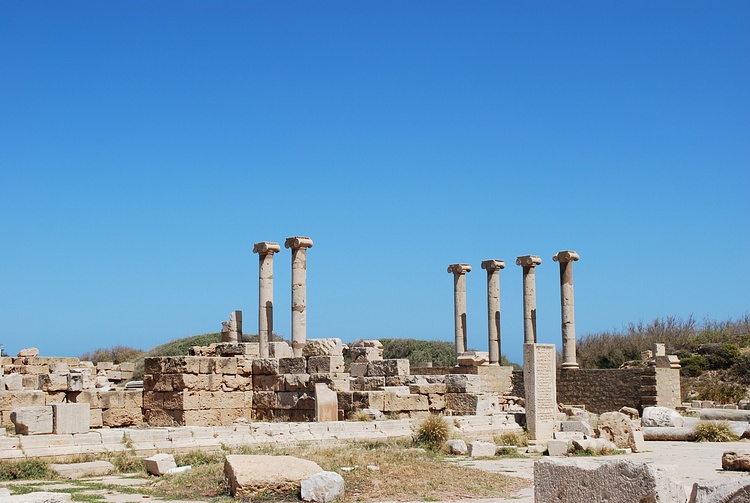 Temple of Hercules-Melqart carinemahy (Copyright) ](https://www.worldhistory.org/image/213/temple-of-hercules-melqart/ "Temple of Hercules-Melqart")The 4th-century CE [Egyptian](https://www.worldhistory.org/disambiguation/Egyptian/)-Greek historian Nonnos recounts an interesting tale in his *Dionysiacs*, which he claims to be very ancient. One day Hercules-Melqart was told by god to take possession of a group of small drifting rocks in the sea on which grew an olive tree and in whose branches sat an eagle. Hercules-Melqart complied, cut down the tree, captured the bird and so stabilized the rocks in a fixed position, thus founding the city of Tyre. This may explain Herodotus' mention of an olive tree in the Temple of Melqart at Tyre. Intriguingly, the temple of Melqart at Gades in Spain also had a sacred olive tree, said to have been made of gold and decorated with emeralds. Further, could the twin columns of the temple at Tyre and the two [bronze](https://www.worldhistory.org/disambiguation/bronze/) columns outside the Gades temple have represented the Pillars of Hercules at the western end of the Mediterranean? As so often with the Phoenicians, information is limited and speculation rife.
On Malta a temple was dedicated to Hercules-Melqart, as were two Greco-[Punic](https://www.worldhistory.org/carthage/) stelae dating to the 2nd century BCE, which still refer to the god as 'our lord Melqart, lord of Tyre'. In Spain there was a cult to Reshef-Melqart described in inscriptions, Reshef being the Phoenician god of fire and lightning.
Hercules-Melqart continued to be important in the Roman period. The temple at Gades was particularly renowned and Melqart received a boost in prestige during the reigns of [Trajan](https://www.worldhistory.org/trajan/) and [Hadrian](https://www.worldhistory.org/hadrian/), both, not coincidentally, of Spanish origin. The cult was given imperial status and coins carried his image. Finally, as [Christianity](https://www.worldhistory.org/christianity/) grew Hercules-Melqart faded into the religious background and acquired a more benign association with the sun.
#### Editorial Review
This human-authored definition has been reviewed by our editorial team before publication to ensure accuracy, reliability and adherence to academic standards in accordance with our [editorial policy](https://www.worldhistory.org/static/editorial-policy/).
## Bibliography
- [Aubet, M.E. *The Phoenicians and the West.* Cambridge University Press, 2001.](https://www.worldhistory.org/books/0521795435/)
- [Kenrick, J. *Phoenicia.* Forgotten Books, 2015.](https://www.worldhistory.org/books/1330788400/)
- [Moscati, S. *The World of the Phoenicians Paperback.* Weidenfeld & Nicolson History, 2016.](https://www.worldhistory.org/books/B011SL6MCE/)
- [Perrot, G. *History of art in Phoenicia and its dependencies Volume 1.* RareBooksClub.com, 2012.](https://www.worldhistory.org/books/113061851X/)
- [Rawlinson, G. *History of Phoenicia.* CreateSpace Independent Publishing Platform, 2014.](https://www.worldhistory.org/books/1499392885/)
- [Rawlinson, G. *\[ The Religion of the Phoenicians and Carthaginians Rawlinson, George \] { Paperback..* Kessinger Publishing 2010.](https://www.worldhistory.org/books/B00VBH74SC/)
- [Strassler, R.B. *The Landmark Herodotus.* Anchor Books, 2009.](https://www.worldhistory.org/books/1400031141/)
## About the Author
Mark is WHE’s Publishing Director and has an MA in Political Philosophy (University of York). He is a full-time researcher, writer, historian and editor. Special interests include art, architecture and discovering the ideas that all civilizations share.
## Timeline
- **c. 1000 BCE**: Height of [Tyre](https://www.worldhistory.org/Tyre/)'s power.
- **c. 850 BCE**: First mention of Melquart on a Phoenician stela found in Aleppo, erected by the son of the king of Arma "for his lord [Melqart](https://www.worldhistory.org/Melqart/), which he vowed to him and he heard his voice".
## Cite This Work
### APA
Cartwright, M. (2016, May 06). Melqart. *World History Encyclopedia*.
### Chicago
Cartwright, Mark. "Melqart." *World History Encyclopedia*, May 06, 2016. .
### MLA
Cartwright, Mark. "Melqart." *World History Encyclopedia*, 06 May 2016, .
## License & Copyright
Submitted by [Mark Cartwright](https://www.worldhistory.org/user/markzcartwright/ "User Page: Mark Cartwright"), published on 06 May 2016. The copyright holder has published this content under the following license: [Creative Commons Attribution-NonCommercial-ShareAlike](https://creativecommons.org/licenses/by-nc-sa/4.0/deed.en). This license lets others remix, tweak, and build upon this content non-commercially, as long as they credit the author and license their new creations under the identical terms. When republishing on the web a hyperlink back to the original content source URL must be included. Please note that content linked from this page may have different licensing terms.