---
title: Medea
author: Liana Miate
source: https://www.worldhistory.org/Medea/
format: machine-readable-alternate
license: Creative Commons Attribution-NonCommercial-ShareAlike (https://creativecommons.org/licenses/by-nc-sa/4.0/)
updated: 2023-01-24
---
# Medea
_Authored by [Liana Miate](https://www.worldhistory.org/user/lianamiate/)_
Medea is an enchantress and the daughter of King Aeëtes of Colchis (a [city](https://www.worldhistory.org/city/) on the coast of the Black Sea). In [Greek mythology](https://www.worldhistory.org/Greek_Mythology/), she is best known for her relationship with the [Greek](https://www.worldhistory.org/disambiguation/greek/) hero Jason, which is famously told in [Greek tragedy](https://www.worldhistory.org/Greek_Tragedy/) playwright [Euripides](https://www.worldhistory.org/Euripides/)' (c. 484-407 BCE) *Medea* and Apollonius of [Rhodes](https://www.worldhistory.org/Rhodes/)' (c. 295 BCE) epic *Argonautica*.
Throughout history, Medea is portrayed as a strong, ruthless, bloodthirsty woman who betrayed her own people and killed her brother and children. Yet, despite her life being touched by many tragedies and scandals (most caused by her own hand), she remained resilient, becoming immortal and living out her days in the paradise of the Elysian Fields.
### Birth & Family
Medea is the daughter of King Aeëtes of Colchis and Eidyia, the daughter of [Oceanus](https://www.worldhistory.org/Oceanus/) and Tethys, as well as the granddaughter of [Helios](https://www.worldhistory.org/Helios/), the [god](https://www.worldhistory.org/God/) of the sun, and the niece of [Circe](https://www.worldhistory.org/Circe/), another famous sorceress in Greek [mythology](https://www.worldhistory.org/mythology/).
> The famous daughter of Ocean, [Perseus](https://www.worldhistory.org/Perseus/),
> Bore to her mate, untiring Helios,
> Circe and King Aeëtes. He, the son
> Of Helios. Who brings light to mortal men,
> Was married to Iduia the fair-cheeked
> Daughter of Ocean, earth's last stream, by will
> Of the [immortals](https://www.worldhistory.org/disambiguation/immortals/), and subdued by love
> Through golden [Aphrodite](https://www.worldhistory.org/Aphrodite/)'s work, she bore
> To him Medea with the graceful feet.
> ([Hesiod](https://www.worldhistory.org/hesiod/), *[Theogony](https://www.worldhistory.org/Theogony/)*, 953-962)
### Medea & Jason
Jason challenged his uncle Pelias for the throne of Iolcus and accepted the mission of retrieving the [Golden Fleece](https://www.worldhistory.org/Golden_Fleece/). The goddesses on Mount Olympus took great interest in this quest, and Aphrodite persuaded her son, Eros, to strike Medea with his arrow, making her fall in love with Jason.
[Jason and the Argonauts](https://www.worldhistory.org/article/425/jason--the-argonauts/) arrived in Colchis to ask Medea's father, King Aeëtes, for the Golden Fleece. King Aeëtes agreed to give Jason the Golden Fleece, but only if he could complete a series of tasks. First, he had to yoke two fire-breathing bulls, then plough a field and sow it with serpent's teeth, which would then transform into warriors. Jason grew anxious, but Medea offered to help him by giving him a magic ointment made from the crocus flower to spread on his sword, shield, and body. This ointment would protect him from the fiery breath of the bull. Medea asked for one thing in return for her help; for Jason to marry her and take her away from Colchis.
King Aeëtes refused to hand over the Golden Fleece once Jason had successfully completed the deadly tasks. Waiting for night to fall, Medea led Jason to the fleece, which was guarded by a ferocious dragon. She put the dragon into a drug-induced sleep, and they took the fleece, stealing away into the night on the *Argo*. Aeëtes gathered his men, including Medea's brother Apsyrtus, to pursue the *Argo*. When Apsyrtus drew close, Medea killed him, chopped him into pieces and threw them into the ocean to slow down her father's pursuit, and the Argonauts were able to get away.
[  Jason and Medea John William Waterhouse (Public Domain) ](https://www.worldhistory.org/image/16885/jason-and-medea/ "Jason and Medea")They arrived in [Corcyra](https://www.worldhistory.org/corcyra/) (on the island of [Corfu](https://www.worldhistory.org/corcyra/)), the land of the Phaeacians, where a Colchian flotilla found them. The Colchians demanded that Medea be surrendered to them. King Alcinoüs of the Phaeacians agreed, but only if Jason and Medea had not yet laid together. Jason quickly arranged their wedding and led Medea into a cave to consummate their relationship.
On their way to [Crete](https://www.worldhistory.org/crete/), they were attacked by the [bronze](https://www.worldhistory.org/disambiguation/bronze/) [giant](https://www.worldhistory.org/Giants/) Talus, who threw boulders at them. Talus had a vein of ichor, the lifeblood of the gods, which was replenished through his ankle. Medea gave Talus the evil eye, causing Talus to knock his ankle against a rock and dislodge the plug that held in the ichor. Weakened, he fell off a cliff and into the sea, allowing Jason and the Argonauts to continue on their way.
[  Map of the Quest of Jason and the Argonauts Simeon Netchev (CC BY-NC-ND) ](https://www.worldhistory.org/image/16219/map-of-the-quest-of-jason-and-the-argonauts/ "Map of the Quest of Jason and the Argonauts")###
The [Death](https://www.worldhistory.org/disambiguation/Death/) of King Pelias
After a voyage of four months, Jason returned to Iolcus to present the Golden Fleece to King Pelias. He learned that Pelias had killed his parents and his infant brother in his absence and swore to take revenge. Medea volunteered to kill Pelias herself, leaving Iolcus free for the Argonauts to take.
Medea disguised herself and her handmaidens as old crones and claimed that [Artemis](https://www.worldhistory.org/artemis/) had come to Iolcus to bring it good fortune. They trampled through the streets of Iolcus, waking Pelias, who asked what Artemis required of him. Medea replied that Artemis wanted to reward his piety by making him young once again. Pelias was hesitant until Medea transformed herself back into a young woman and demonstrated how her magic could bring a dead, cut-up ram back to life as a young, feisty lamb. In reality, a young lamb was hidden in a hollow image of Artemis.
[ 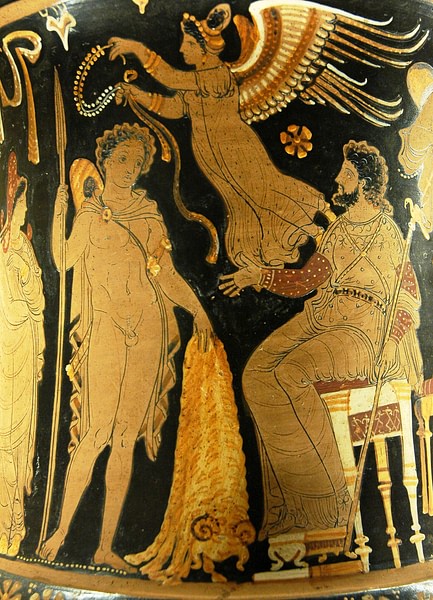 Jason Brings Pelias the Golden Fleece Marie-Lan Nguyen (CC BY-SA) ](https://www.worldhistory.org/image/780/jason-brings-pelias-the-golden-fleece/ "Jason Brings Pelias the Golden Fleece")Medea enlisted the help of Pelias' daughters, who cut him into pieces and took them to Medea. Medea placed the pieces of Pelias into her cauldron and cooked them for several [hours](https://www.worldhistory.org/Horae/) until they became a thick, gooey stew. She apologised to Pelias' daughters and admitted that she must have left out an ingredient. Jason and Medea left Iolcus for good, leaving the throne to Pelias' son Acastus.
In some versions of the myth, the murder of Pelias is carried out due to the wishes of the goddess [Hera](https://www.worldhistory.org/Hera/), who harboured a hatred for Pelias after he had failed to honour her. She decided that the beautiful but dangerous Medea would be the perfect person to bring about his end.
### Medea's Revenge
Medea and Jason travelled to [Corinth](https://www.worldhistory.org/corinth/), where they lived happily for several years, having two sons together. Over time, Jason became dissatisfied with his relationship with Medea and decided to marry Glauce, the daughter of King Creon. An enraged Medea reminded Jason of his promise to her and plotted her revenge. She sent Jason and Glauce a wedding gift – a beautiful golden crown and a white robe. As soon as Glauce put them on, unquenchable flames leapt from her and consumed the whole wedding party, except for Jason.
However, Medea's revenge did not stop there. The best-known depictions of Medea's story state that she killed her and Jason's children.
> Now hear what follows: I weep
> for what I must do; for then I'll kill
> my children. No one will give relief.
> When I've annihilated Jason's house, I'll leave
> this place, flee from the murder of my dear sons,
> that unholy act I've steeled myself for, friends.
> (Euripides, *Medea*, 791-797)
Medea fled Corinth on a [chariot](https://www.worldhistory.org/chariot/) pulled by winged [serpents](https://www.worldhistory.org/disambiguation/Serpents/) after the horrific murder of her sons.
[  Medea Kills Her Son Bibi Saint-Pol (Public Domain) ](https://www.worldhistory.org/image/3790/medea-kills-her-son/ "Medea Kills Her Son")### Medea in Exile
Medea first travelled to [Thebes](https://www.worldhistory.org/disambiguation/Thebes/), where the Greek hero Heracles ([Hercules](https://www.worldhistory.org/hercules/)) had promised to offer her refuge if Jason ever left her. She cured him of his madness after he killed his children. However, King Creon was king of the Thebans, and they resented having his murderer in their midst.
She next travelled to [Athens](https://www.worldhistory.org/Athens/) after King Aegeus promised her safety from her enemies. She married him and promised to cure his infertility. She bore Aegeus a son called Medus. [Theseus](https://www.worldhistory.org/Theseus/), Aegeus' older son, arrived in Athens, and Medea knew he would take her child's place on the throne after Aegeus had died. She made Aegeus believe that Theseus had arrived in Athens as a spy and persuaded him to invite Theseus to a feast. Aegeus offered Theseus a goblet of wine, unaware that Medea had already poisoned it with wolfsbane. As Theseus raised the goblet to his lips, Aegeus noticed the serpents that were carved on Theseus' sword and knocked the goblet from his hand before he could drink from it.
[  Medea on Her Chariot Cleveland Museum of Art (Public Domain) ](https://www.worldhistory.org/image/16884/medea-on-her-chariot/ "Medea on Her Chariot")Aegeus and Theseus reunited, and Aegeus publicly acknowledged him as his son. Theseus pursued Medea, but she hid under a magical cloud and left Athens with her son Medus. There is some debate over whether Medea persuaded Aegeus to send Theseus to face [Poseidon](https://www.worldhistory.org/poseidon/)'s [white bull](https://www.worldhistory.org/White_Bull/).
After Athens, Medea travelled to [Italy](https://www.worldhistory.org/italy/), where she taught the Marrubians (people from Central Italy) snake charming and the healing arts. She briefly stopped in [Thessaly](https://www.worldhistory.org/disambiguation/Thessaly/), where she competed in a beauty competition against the Nereid [Thetis](https://www.worldhistory.org/Thetis/). She married an Asian king whose name has been lost to time.
Learning that Aeëtes had been usurped from the throne in Colchis, Medea travelled there with her son Medus who killed her uncle Perses and helped to place Aeëtes back on the throne. Some traditions mention that she reconciled with Jason and lived with him in Corinth, but most maintain that Jason had grown old, weary, and depressed, wandering from one place to another. He sat down next to the decaying *Argo*, reminiscing when the prow suddenly fell and instantly killed him. Medea became immortal and lived in the Elysian Fields, where according to some stories, she married [Achilles](https://www.worldhistory.org/achilles/) instead of [Helen of Troy](https://www.worldhistory.org/Helen_of_Troy/).
### Medea As a Character
Over the years, there have been many studies and essays written about Medea and her place in Greek mythology. Even the ancient writers who wrote about her portrayed her in different ways. Euripides described her as a foreign woman finding her way in a strange land who had been betrayed by a cheating and cruel husband and took desperate and extreme measures to get her revenge. In [Seneca](https://www.worldhistory.org/Seneca/)'s (4 BCE to 65 CE) *Medea*, she is depicted as a ruthless sorceress who puts herself first. While Euripides has Medea kill her children off-stage, Seneca has her kill them on stage. Apollonius of Rhodes writes Medea as a vulnerable young woman who uses her magic to find her strength.
A recurring theme throughout the story of Medea is her power over life and death; she gives birth, she makes the old young again, and she kills. She embodies feminine anger at being abandoned by her lover and is a horrifying example of how far somebody will go when pushed too far.
[ 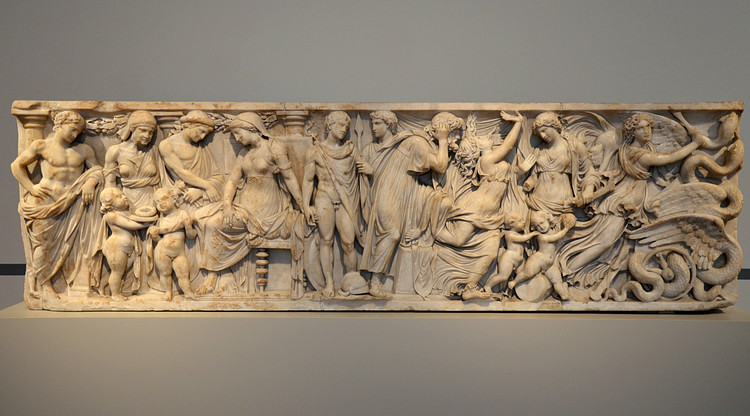 Medea Sarcophagus Carole Raddato (CC BY-NC-SA) ](https://www.worldhistory.org/image/8161/medea-sarcophagus/ "Medea Sarcophagus")### Legacy
It is no surprise that Medea's tragic, horrible story has inspired many works of art throughout history, beginning with Euripides' much-loved tragedy *Medea*, which was first performed in 431 BCE. She is featured in many books, TV shows and movies, including [Geoffrey Chaucer](https://www.worldhistory.org/Geoffrey_Chaucer/)'s (c. 1340s-1400) *The Legend of Good [Women](https://www.worldhistory.org/disambiguation/women/)*, *Jason and Medeia* by John Gardner (1933-1982), the movie *Jason and the Argonauts* (1963), and the Italian movie *Medea* (1969) with the famous Greek soprano Maria Callas in the leading role. In more recent times, she has appeared as a character in the BBC TV series *[Atlantis](https://www.worldhistory.org/atlantis/)* (2013-2015) and in Rick Riordan's *Percy Jackson and the Olympians* book series.
#### Editorial Review
This human-authored definition has been reviewed by our editorial team before publication to ensure accuracy, reliability and adherence to academic standards in accordance with our [editorial policy](https://www.worldhistory.org/static/editorial-policy/).
## Bibliography
- [Gagarin, Michael. *The Oxford Encyclopedia of Ancient Greece and Rome.* Oxford University Press, 2009.](https://www.worldhistory.org/books/0195170725/)
- [Graves, Robert. *The Greek Myths\[May 15, 2018\] Graves, Robert.* Viking, 2018.](https://www.worldhistory.org/books/0241982359/)
- [Hesiod & Theognis & Wender, Dorothea & Wender, Dorothea. *Hesiod and Theognis .* Penguin Classics, 1976.](https://www.worldhistory.org/books/0140442839/)
- [Medea - The Art and Popular Culture Encyclopedia](http://www.artandpopularculture.com/Medea "Medea - The Art and Popular Culture Encyclopedia"), accessed 13 Jan 2023.
- [Ovid & Raeburn, David & Feeney, Denis. *Metamorphoses.* Penguin Classics, 2004.](https://www.worldhistory.org/books/014044789X/)
- [Powell, Barry B. *Classical Myth.* Oxford University Press, 2020.](https://www.worldhistory.org/books/0197527981/)
- [Salisbury, Joyce E. *Encyclopedia of Women in the Ancient World.* ABC-CLIO, 2001.](https://www.worldhistory.org/books/1576070921/)
- [Sophocles & Aeschylus & Euripides & Lefkowitz, Mary & Romm, James. *The Greek Plays.* Modern Library, 2017.](https://www.worldhistory.org/books/0812983092/)
- [Woodard, Roger D. *The Cambridge Companion to Greek Mythology.* Cambridge University Press, 2008.](https://www.worldhistory.org/books/0521607264/)
## About the Author
Liana is the Social Media Editor for Ancient History Encyclopedia. She holds a Bachelor of Arts Degree with a major in ancient Greece, Rome & Late Antiquity. She is particularly passionate about Rome and Greece, and anything to do with mythology or wo
- [Linkedin Profile](https://www.linkedin.com/in/lian)
## Timeline
- **431 BCE**: The playwright [Euripides](https://www.worldhistory.org/Euripides/) publishes his [Medea](https://www.worldhistory.org/Medea/).
## Questions & Answers
### What is the main message of Medea?
The main message related to the story of Medea is that a person is capable of horrible things if they have been hurt or betrayed. Love can quickly turn to hatred and anger.
### Why is Medea a tragedy?
Medea is a tragedy because it is ultimately a story about love that turns to hatred and revenge, which results in Medea killing her own sons and ruining Jason's life.
### Why did Medea turn evil?
Medea carried out multiple evil acts. First, she killed her brother, Absyrtus, to help her lover Jason, and then she killed Jason's new wife, Glauce, and their own two sons after Jason had betrayed her.
## Cite This Work
### APA
Miate, L. (2023, January 16). Medea. *World History Encyclopedia*.
### Chicago
Miate, Liana. "Medea." *World History Encyclopedia*, January 16, 2023. .
### MLA
Miate, Liana. "Medea." *World History Encyclopedia*, 16 Jan 2023, .
## License & Copyright
Submitted by [Liana Miate](https://www.worldhistory.org/user/lianamiate/ "User Page: Liana Miate"), published on 16 January 2023. The copyright holder has published this content under the following license: [Creative Commons Attribution-NonCommercial-ShareAlike](https://creativecommons.org/licenses/by-nc-sa/4.0/deed.en). This license lets others remix, tweak, and build upon this content non-commercially, as long as they credit the author and license their new creations under the identical terms. When republishing on the web a hyperlink back to the original content source URL must be included. Please note that content linked from this page may have different licensing terms.