---
title: Marsyas
author: James Lloyd
source: https://www.worldhistory.org/Marsyas/
format: machine-readable-alternate
license: Creative Commons Attribution-NonCommercial-ShareAlike (https://creativecommons.org/licenses/by-nc-sa/4.0/)
updated: 1970-01-01
---
# Marsyas
_Authored by [James Lloyd](https://www.worldhistory.org/user/jtl203/)_
Marsyas the [satyr](https://www.worldhistory.org/satyr/), or *silen*, was seen as a mythological founder of [aulos](https://www.worldhistory.org/Aulos/) playing or a divine judge of it by the ancient Greeks. The way in which his aulos playing enraptured his audience was likened to the way in which [Socrates](https://www.worldhistory.org/socrates/) mesmerised his audience with his philosophising words, and the fact that the two were both quite ugly is also picked up on in [Plato](https://www.worldhistory.org/plato/)'s [Symposium](https://www.worldhistory.org/Symposium/). For some time, Marsyas held a prominent position within the minds of the ancient Greeks, particularly the Athenians. There are many mentions of him within the textual record, and various fine examples of Athenian artisanship represent him, such as the statue group by Myron that would have sat atop the [Acropolis](https://www.worldhistory.org/Acropolis/).
The standard myth of Marsyas involves him picking up the auloi (plural of aulos) cast down by [Athena](https://www.worldhistory.org/athena/). Athena threw down the auloi, so Melanippides relates, because she saw her reflection in a mirror as she played, and she thought that her puffed out cheeks were inelegant and unbecoming, though Telestes argued against this:
> ...somebody said that Melanippides, in his *Marsyas*, disparaging the art of playing the flute, had said very cleverly about [Minerva](https://www.worldhistory.org/Minerva/):—
> Athena cast away those instruments
> Down from her sacred hand; and said, in scorn,
> "Away, you shameful things—you stains of the body!
> Shall I now yield myself to such malpractices'"
> And some one, replying to him, said,—But Telestes of [Selinus](https://www.worldhistory.org/Selinus/), in opposition to Melanippides, says in his Argo (and it is of Athena that he too is speaking):—
> It seems to me a scarcely credible thing
> That the wise Pallas, holiest of goddesses,
> Should in the mountain groves have taken up
> That clever instrument, and then again
> Thrown it away, fearing to draw her mouth
> Into an unseemly shape, to be a glory
> To the [nymph](https://www.worldhistory.org/nymph/)-born, noisy monster Marsyas.
> For how should chaste Athena be so anxious
> About her beauty, when the [Fates](https://www.worldhistory.org/Fates/) had given her
> A childless, husbandless virginity? (Ath. 616e ff.)
The satyr Marsyas picked up Athena's auloi, however, and at some point challenged [Apollo](https://www.worldhistory.org/apollo/) to a contest (*agon* in the [Greek](https://www.worldhistory.org/disambiguation/greek/)). Apollo chose to play the [lyre](https://www.worldhistory.org/Lyre/) and, either through skill alone or a certain degree of trickery, beat Marsyas. Marsyas' punishment for thinking that he could out skill an Olympian was that he was hung up and skinned alive. The story of Marsyas has often been discussed within the context of New [Music](https://www.worldhistory.org/disambiguation/Music/) in [Athens](https://www.worldhistory.org/Athens/). A good example of this is the passages of Melanippides and Telestes preserved in Athanaeus which seemingly argue different corners in support of the aulos. However, due to Marsyas thinking himself superior to Apollo, it is a myth that is also used as an example of the dangers of hubris.
Marsyas also held appeal in [Hellenistic](https://www.worldhistory.org/Hellenic_World/) and [Roman](https://www.worldhistory.org/disambiguation/Roman/) times, but the focus becomes less on his *agon* with Apollo, or his picking up of the auloi from Athena, and more specifically on his punishment at the hands of Apollo. This can be seen clearly in a changing interest in iconographies of Marsyas, which show interest in depicting the flaying of Marsyas. We also know that a statue of Marsyas resided in the [Roman forum](https://www.worldhistory.org/Roman_Forum/) ([Horace](https://www.worldhistory.org/Horace/) S.1.6), and our surviving statues of Myron's Athenian group are in fact later Roman copies.
Various mythological genealogies were applied to Marsyas; he is often said to have been the son of an elder Olympus, sometimes of Hyagnis, or of Oeagrus. He was also said to have taught a younger Olympus (who was variably also recorded as Marsyas' son), who was famous for his music making, how to play the aulos.
[ 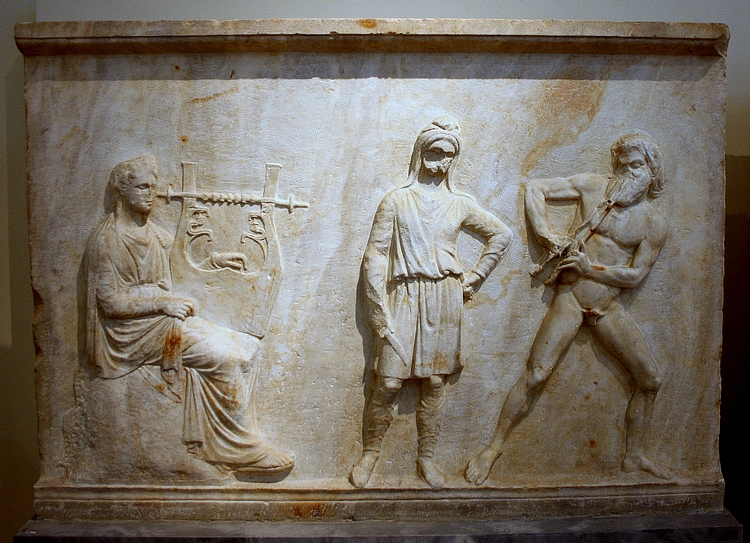 Apollo and Marsyas James Lloyd (CC BY-NC-SA) ](https://www.worldhistory.org/image/2697/apollo-and-marsyas/ "Apollo and Marsyas")Marsyas could also refer to a river in [Phrygia](https://www.worldhistory.org/phrygia/) named after the famous satyr. This part of the myth is recounted in [Herodotus](https://www.worldhistory.org/herodotus/) 7.26, [Xenophon](https://www.worldhistory.org/xenophon/) *Anabasis* 1.2, referred to at Plato *Euthyd*. 285d, and beautifully retold by [Ovid](https://www.worldhistory.org/ovid/), Metamorphoses 6.382, where the tears of Marsyas' companions collect in the river, another example of the Roman interest in the flaying of Marsyas:
> The Satyr Marsyas, when he played the flute
> in rivalry against Apollo's lyre,
> lost that audacious contest and, alas!
> His life was forfeit; for, they had agreed
> the one who lost should be the victor's prey.
> And, as Apollo punished him, he cried,
> “Ah-h-h! why are you now tearing me apart?
> A flute has not the value of my life!”
> Even as he shrieked out in his agony,
> his living skin was ripped off from his limbs,
> till his whole body was a flaming wound,
> with nerves and veins and viscera exposed.
> But all the weeping people of that land,
> and all the Fauns and Sylvan Deities,
> and all the Satyrs, and Olympus, his
> loved pupil—even then renowned in song,
> and all the Nymphs, lamented his sad fate;
> and all the shepherds, roaming on the hills,
> lamented as they tended fleecy flocks.
> And all those falling tears, on fruitful Earth,
> descended to her deepest veins, as drip
> the moistening dews,—and, gathering as a fount,
> turned upward from her secret-winding caves,
> to issue, sparkling, in the sun-kissed air,
> the clearest river in the land of Phrygia,—
> through which it swiftly flows between steep banks
> down to the sea: and, therefore, from his name,
> 'Tis called “The Marsyas” to this very day.
#### Editorial Review
This human-authored definition has been reviewed by our editorial team before publication to ensure accuracy, reliability and adherence to academic standards in accordance with our [editorial policy](https://www.worldhistory.org/static/editorial-policy/).
## Bibliography
- [Perseus Digital Library. Athenaeus, Deipnosophistai](http://www.perseus.tufts.edu/hopper/text?doc=Perseus:text:2013.01.0003:book=14:chapter=7&highlight=marsyas "Perseus Digital Library. Athenaeus, Deipnosophistai"), accessed 1 Dec 2016.
- [Perseus Digitial Library, Ovid, Metamorphoses](http://www.perseus.tufts.edu/hopper/text?doc=Ov.+Met.+6.382&fromdoc=Perseus%3Atext%3A1999.02.0028 "Perseus Digitial Library, Ovid, Metamorphoses"), accessed 1 Dec 2016.
- Barker, A. *Greek Musical Writings: I - The Musician and his Art.* Cambrigde University Press, Cambridge, 1984, 21 n.9, 92 n.19.
- [Bundrick, S. *Music and Image in Classical Athens.* Cambridge University Press, 2005, 2, 6, 11, 36-7,.](https://www.worldhistory.org/books/0521848067/)
## About the Author
James' main area of research is ancient Greek music, but he has general interests in mythology, religion, and art & archaeology. A self-confessed philhellene, James keeps at least one eye on the Roman pie.
- [Facebook Profile](https://www.facebook.com/jan.vandercrabben@ancient.eu)
## Cite This Work
### APA
Lloyd, J. (2014, June 27). Marsyas. *World History Encyclopedia*.
### Chicago
Lloyd, James. "Marsyas." *World History Encyclopedia*, June 27, 2014. .
### MLA
Lloyd, James. "Marsyas." *World History Encyclopedia*, 27 Jun 2014, .
## License & Copyright
Submitted by [James Lloyd](https://www.worldhistory.org/user/jtl203/ "User Page: James Lloyd"), published on 27 June 2014. The copyright holder has published this content under the following license: [Creative Commons Attribution-NonCommercial-ShareAlike](https://creativecommons.org/licenses/by-nc-sa/4.0/deed.en). This license lets others remix, tweak, and build upon this content non-commercially, as long as they credit the author and license their new creations under the identical terms. When republishing on the web a hyperlink back to the original content source URL must be included. Please note that content linked from this page may have different licensing terms.